US to Send More Rocket Systems to Ukraine, Moscow Signals Wider War Aims

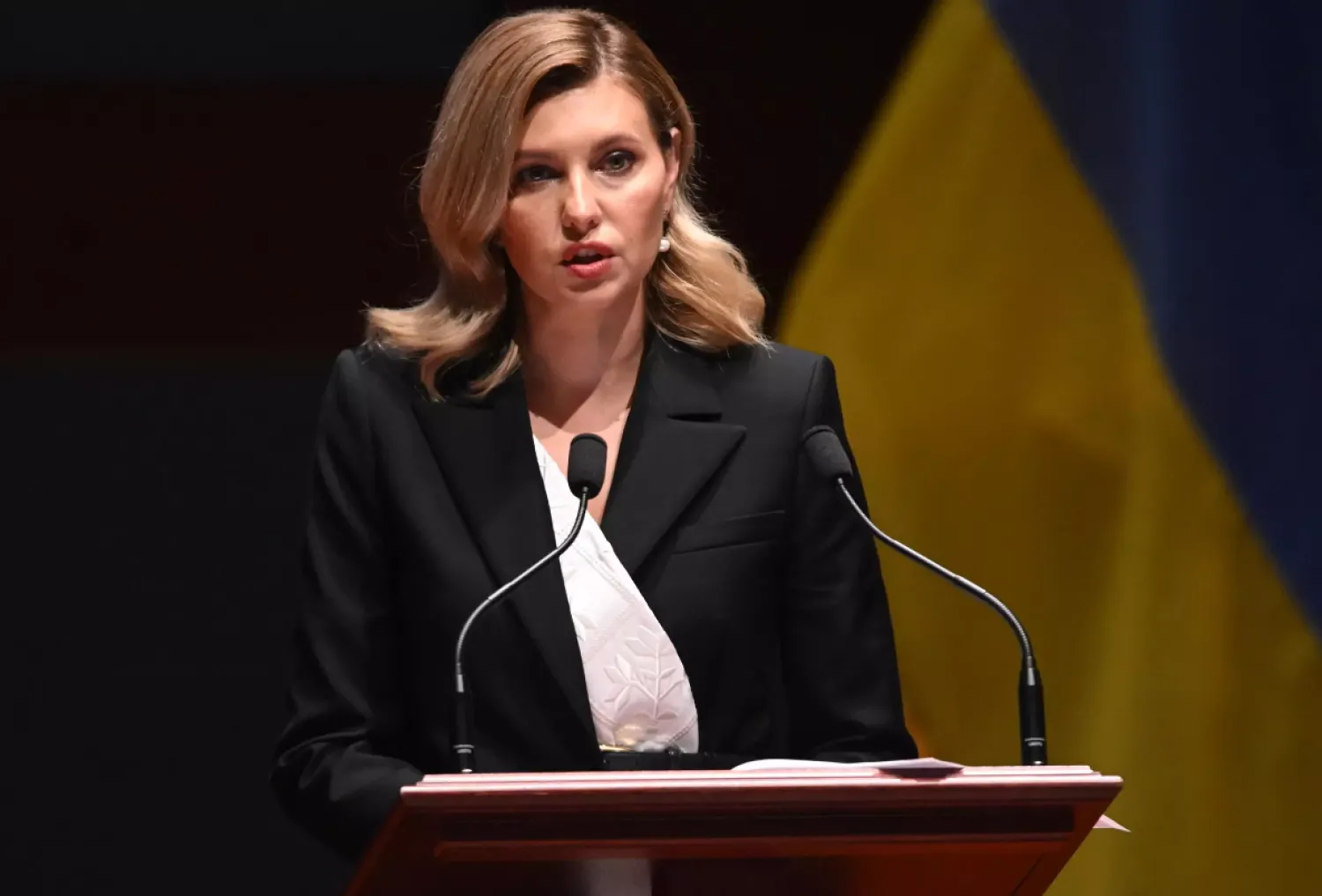
Ukrainian First Lady Olena Zelenska speaks to members of the US Congress about Russia's invasion of Ukraine SAUL LOEB POOL/AFP
TT

US to Send More Rocket Systems to Ukraine, Moscow Signals Wider War Aims

Ukrainian First Lady Olena Zelenska speaks to members of the US Congress about Russia's invasion of Ukraine SAUL LOEB POOL/AFP

The United States on Wednesday promised to send more precision rocket systems to Kyiv, soon after Moscow signaled it was aiming to seize more Ukrainian territory beyond the eastern industrial region of Donbas.

The announcement came as the European Commission called on EU members to slash demand for natural gas to relieve dependence on Russian energy and the bloc agreed an embargo on Russian gold imports, measures that Kyiv nevertheless dismissed as insufficient.

Pentagon chief Lloyd Austin said Washington would send four more M142 High Mobility Artillery Rocket System (Himars), which have notably boosted Kyiv's capabilities on the battlefield in recent weeks by allowing Ukrainian forces to hit Russian targets from long distances, AFP reported.

"Ukraine needs the firepower and the ammunition to withstand this barrage and to strike back," Austin told reporters, adding that the new shipment would bring the total of US Himars sent to Kyiv to 16.

Hours earlier, Russian Foreign Minister Sergei Lavrov said in an interview that Moscow's military was no longer only focused on wresting control of the east Ukraine regions of Lugansk and Donetsk, which have been partially controlled by pro-Moscow rebels for years.

"The geography is different now. It is not only about the DNR and LNR, but also the Kherson region, the Zaporizhzhia region and a number of other territories," he explained to state media.

On Tuesday, the United States said Russia was "beginning to roll out a version of what you could call an annexation playbook" -- citing the same areas mentioned by Lavrov.

Russian forces, since invading Ukraine on February 24, have steadily advanced into each of those regions, wreaking destruction as they captured key cities and met fierce Ukrainian resistance.

In recent weeks, they have also hit Ukrainian civilian targets in cities and towns far away from the frontline, leaving scores of civilians dead, in what Ukrainian President Volodymyr Zelensky has called a terror campaign.

In an emotional speech before the US Congress on Wednesday, Ukrainian First Lady Olena Zelenska described the suffering of millions of Ukrainian parents and children, and asked Washington for air-defense systems to fend off Russian missiles.

Zelenska, stepping into a more public role after staying sheltered in the first weeks of the war, displayed images of children who were killed or maimed by Russia, including a four-year-old killed by a strike in the city of Vinnytsia.

Photos of her blood-spattered pink stroller and footage of her final moments went viral on social media.

"Help us to stop this terror against Ukrainians," Zelenska said.

Later in the day, Zelensky expressed hope that Kyiv's pleas for anti-missile systems would be heard, saying: " I hope the answers to our requests won't be long in coming."

The steady progress of Russian troops in the east has come after Moscow's forces failed early in the invasion to capture the capital Kyiv and were pushed back from Ukraine's second city Kharkiv.

But Russian artillery has pursued an almost constant shelling campaign on Kharkiv, and strikes on Wednesday killed three people, local officials said.

"There was a 13-year-old boy among them," the regional governor Oleg Synegubov said in a statement on social media.

AFP journalists saw a man in shock kneeling over the body, which was covered by a blue sweatshirt and surrounded by shards of broken glass.

While the brunt of recent fighting in Ukraine has focused on Donbas, a Ukrainian counter-offensive in the south has slowly clawed back some Russian-held territory, thanks in large part to Western-supplied long-range artillery.

Lavrov said that Western arms deliveries to Ukraine had been a factor in Moscow's decision to focus beyond the east and said its ambitions could expand even more if the shipments continued.

"We cannot allow the part of Ukraine that Zelensky will control or whoever replaces him to have weapons that will pose a direct threat to our territory and the territory of those republics that have declared their independence," Lavrov said, referring to Donetsk and Lugansk.

Lavrov also dismissed the idea of further peace talks with Ukraine, claiming that earlier rounds showed Kyiv was unwilling to negotiate in "earnest".

"It doesn't make any sense in the current situation," he told state media.

Russian and Ukrainian delegations are nevertheless expected in Istanbul in the coming days for more talks on unblocking Ukraine's Black Sea grain exports.

Turkish President Recep Tayyip Erdogan said Wednesday he hoped an agreement could be formulated "this week".

The West has responded to Russia's invasion with several packages of damaging sanctions, which in turn has seen Russia cut natural gas supplies to the bloc, spurring a supply and cost crisis.

In its latest package of penalties Wednesday, the EU targeted gold exports and froze assets at Russia's largest bank Sberbank.

And Brussels also asked EU members to reduce demand for natural gas by 15 percent in order to limit supplies from Russia, which last year accounted for 40 percent of EU's imports.

Zelensky however criticized those measures as inadequate, saying in his address: "Russia must pay a much higher price for this war, which would force it to seek peace."


Le Pen Says France Will No Longer Aid Ukraine ‘Financially’ if Elected

Marine Le Pen (C), the far-right National Rally (RN) party's candidate for the 2027 French presidential election, visits the "Made in France" fair at the Porte de Versailles exhibition center in Paris, France, 13 November 2026. (EPA)
TT

Le Pen Says France Will No Longer Aid Ukraine ‘Financially’ if Elected

Marine Le Pen (C), the far-right National Rally (RN) party's candidate for the 2027 French presidential election, visits the "Made in France" fair at the Porte de Versailles exhibition center in Paris, France, 13 November 2026. (EPA)

Marine Le Pen on Monday said that France would provide no further financial aid to Ukraine if she is elected president next year, after a meeting with Kyiv's ambassador in Paris.

"The state of France's public finances would no longer allow the country to provide financial assistance to Ukraine in the coming months," Le Pen said in a statement, while insisting France would honor existing commitments, including toward a 90-billion-euro ($100-billion) European Union loan.

Le Pen is currently ahead in polls in the race to succeed President Emmanuel Macron next year, as the war sparked by Russia's 2022 full-scale invasion of Ukraine grinds towards its fifth anniversary.

She has faced criticism over past links to Russia, which included a 2017 meeting in the Kremlin with President Vladimir Putin and her party taking a loan from a Russian bank that it paid off in full in 2023.

But she has opposed the invasion and, at her talks in Paris with Ukrainian ambassador Vadym Omelchenko, Le Pen made clear her "unwavering support for Ukraine since the beginning of the conflict".

The statement said the talks -- the first such between Le Pen and the Ukrainian ambassador -- were "cordial".

While financial aid would be cut, Le Pen told the ambassador that "France would continue to support Ukraine through donations of equipment, humanitarian aid and much more active diplomacy".

The statement said there was a "frank discussion" on the future of the conflict, with Le Pen stressing that "the pursuit of peace -- though a difficult goal to achieve -- must remain a priority for all".

She also asked the ambassador to tell President Volodymyr Zelensky she is ready to meet in "either Paris or Brussels". However, there was no mention of the candidate making the journey to Kyiv after Zelensky invited her to visit the Ukrainian capital.

Le Pen's opponents have expressed alarm that by emphasizing the importance of ending the war swiftly, she could force Ukraine to capitulate on unfavorable terms.

"If Russia imposes its will on a European nation through brutality, all of Europe is weakened," Macron wrote on Facebook at the weekend.

Taking aim at Le Pen, he said: "Let us be clear: those who seek to limit the resources available to Ukraine are, in effect, pushing for an unjust peace -- one that would leave Ukraine permanently vulnerable, and, by extension, leave Europe vulnerable as well."


Trump Says He Might Meet with North Korea’s Kim Jong Un in China

US President Donald Trump and North Korean leader Kim Jong Un shake hands before their one-on-one chat during the second US-North Korea summit at the Metropole Hotel in Hanoi, Vietnam February 27, 2019. (Reuters)
TT

Trump Says He Might Meet with North Korea’s Kim Jong Un in China

US President Donald Trump and North Korean leader Kim Jong Un shake hands before their one-on-one chat during the second US-North Korea summit at the Metropole Hotel in Hanoi, Vietnam February 27, 2019. (Reuters)

US President Donald Trump said on Monday he might meet with North Korean leader Kim Jong Un in China this week, an announcement that could dramatically reshape his upcoming trip through East Asia if it occurs.

The president, who met the North Korean leader several times during his 2017-2021 term, including once in the Korean Demilitarized Zone, has previously expressed ‌interest in ‌another meeting during his current term. Senior ‌US ⁠officials, however, have previously ⁠said he has no immediate plans to do so.

Moreover, Trump has repeatedly previewed meetings with Kim that never took place, including during a trip to Asia last year. North Korea, whose mission to the United Nations did not immediately respond to a ⁠request for comment, has publicly indicated it ‌has no intention of ‌meeting with the US president at this time.

Trump told reporters ‌while departing the White House en route to ‌the Philippines and China that any meeting would occur in China, and that the North Korean leader's presence was ultimately up to Chinese President Xi Jinping.

"(Xi) was here a ‌month ago, and we're also going to meet with (Russian) President Putin, and we ⁠may ⁠meet with Kim Jong Un also," Trump said.

"So that'll be good. We have a chance to accomplish a lot."

Trump has indicated he will meet with Putin and Xi during his trip, but US officials and analysts have played down the possibility of a meaningful agreement emerging from any trilateral sit-down.

Among the possible topics of conversation, Trump and others have said, are Russia's invasion of Ukraine, counterproliferation and the war in Iran.


Third US Aircraft Carrier Arrives in Middle East

This US Navy handout photograph released by US Naval Forces Central Command on November 4, 2026, shows the Nimitz-class aircraft carrier USS Theodore Roosevelt (CVN 71) sails alongside Royal Australian Navy Supply-class replenishment oiler HMAS Stalwart (A304). (AFP / NAVCENT Public Affairs / US Navy)
TT

Third US Aircraft Carrier Arrives in Middle East

This US Navy handout photograph released by US Naval Forces Central Command on November 4, 2026, shows the Nimitz-class aircraft carrier USS Theodore Roosevelt (CVN 71) sails alongside Royal Australian Navy Supply-class replenishment oiler HMAS Stalwart (A304). (AFP / NAVCENT Public Affairs / US Navy)

The USS Theodore Roosevelt aircraft carrier arrived in the Middle East on Sunday, media reports said, bringing the number of American carrier strike groups in the region to three.

The deployment, which was reported by the National News and Axios journalist Barak Ravid, comes as fighting reignites in the region, with Iran claiming a drone attack on Bahrain on Sunday, ending a lull in strikes in the war.

Iran also fired drones at Bahrain on Friday -- the first strikes since September against countries in the energy-rich Gulf, which has been targeted several times in the conflict that erupted in February.

US President Donald Trump plans to discuss the war at a trilateral meeting with his Chinese and Russian counterparts Xi Jinping and Vladimir Putin this week, an official said Friday.

Months of diplomacy have failed to resolve the war, which began with US-Israeli strikes that killed Iran's supreme leader Ali Khamenei.