


Longest-living Male Giant Panda in Captivity An An Dies at 35

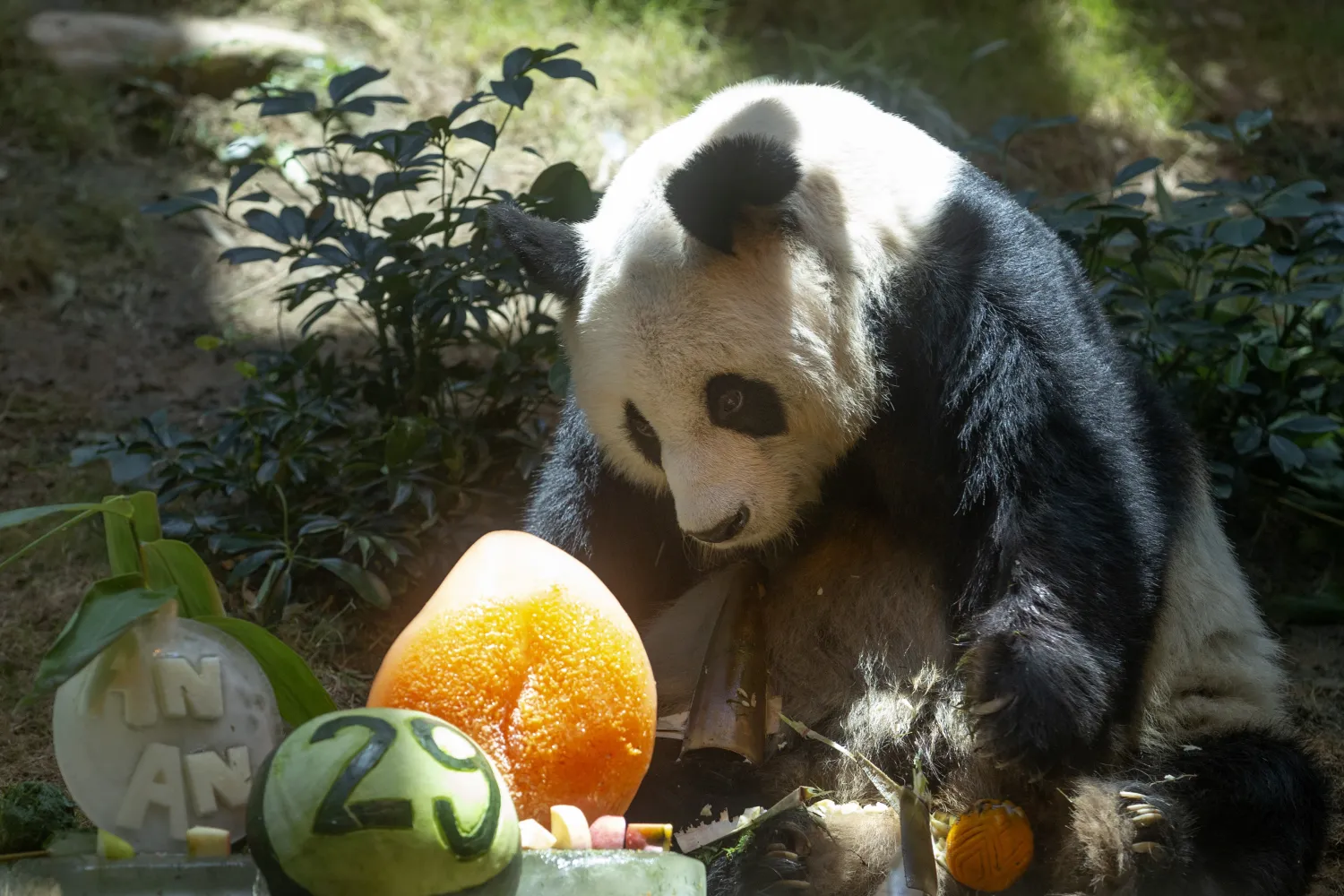
Chinese Giant panda An An celebrates his 29th birthday at Ocean Park in Hong Kong on July 28, 2015. The world’s oldest-ever male giant panda in captivity on Thursday, July 21, 2022 passed away after being euthanized in Hong Kong, following a deterioration in his health in recent weeks. (AP Photo/Kin Cheung)
TT

Longest-living Male Giant Panda in Captivity An An Dies at 35

Chinese Giant panda An An celebrates his 29th birthday at Ocean Park in Hong Kong on July 28, 2015. The world’s oldest-ever male giant panda in captivity on Thursday, July 21, 2022 passed away after being euthanized in Hong Kong, following a deterioration in his health in recent weeks. (AP Photo/Kin Cheung)

The world's longest-living male giant panda under human care, An An, has died at the age of 35, the Hong Kong zoo where he spent most of his life said Thursday.

An An's health had deteriorated in recent weeks, with a severe decrease in physical activity and appetite, and he was euthanized by veterinarians early Thursday morning, a statement from the amusement park and zoo Ocean Park said.

The park said he was equivalent to 105 in human years, and that "the difficult decision" to put him down had been made for welfare reasons in consultation with Chinese experts, AFP said.

Born in the wild of mainland China's Sichuan province, An An was one of a panda pair gifted to Hong Kong by Beijing to celebrate the second anniversary of the city's handover from Britain in 1999.

He and his mate Jia Jia spent the rest of their lives in Ocean Park.

They were a venerable pair -- Jia Jia held the Guinness World Records for the oldest living panda and oldest panda ever in captivity when she died at the age of 38 in 2016.

A panda's average life span in the wild is 14-20 years, according to the World Wildlife Fund.

After Jia Jia's death, her surviving mate led a rather solitary life -- in 2021, he celebrated his 35th birthday alone with a Haagen-Dazs fruit and bamboo ice cake, surrounded by a number of handmade birthday cards from the Park's staff.

- Political animals -
Pandas are a top choice of diplomatic gift from Beijing, and An An and Jia Jia enjoyed a fair degree of political clout for zoo-dwellers.

When they first arrived in the city, then-chief executive Tung Chee-hwa said that their names would inspire Hong Kong to be stable (An) and achieve great performance (Jia).

And when news of An An's lack of appetite was announced last week, Hong Kong's chief executive John Lee called Ocean Park to express concern.

Ocean Park has set up condolence books in the exhibition hall that An An used to live in.

Within an hour of the park announcing his death, hundreds of tributes appeared under the social media post.

"Thanks for all the happiness you have brought us over so many years," user "Tang Cc" wrote.

"I really can't accept you passing away but I also can't see you suffering. I will be missing you," user "Tuan Yuan Panda" said.

Hong Kong has another pair of pandas -- Ying Ying and Le Le -- who were gifted by Beijing in 2007.

They hit the headlines recently for beginning to show mating behavior during the pandemic after almost a decade of disinterest.

Pandas are notoriously bad at reproducing, especially in captivity.

They are categorized as "vulnerable" by WWF with a record of 1,864 living in the wild.


Does Fasting Stress You? Here’s the Role of Cortisol and How to Manage It

Deep breathing exercises, remembrance, and brief meditation before sleep may reduce stress markers (Pexels).
TT

Does Fasting Stress You? Here’s the Role of Cortisol and How to Manage It

Deep breathing exercises, remembrance, and brief meditation before sleep may reduce stress markers (Pexels).

Fasting during Ramadan is both a spiritual and a health practice that benefits the body and mind. Medical studies, however, show that fasting can sometimes raise levels of cortisol, the hormone commonly known as the stress hormone. Elevated cortisol may have noticeable effects on mood, including irritability, anxiety, and tension, making emotional regulation more challenging during long fasting hours.

Cortisol is released by the adrenal glands according to a natural daily rhythm, higher in the morning and lower in the evening. This rhythm, however, can be disrupted by poor sleep, dehydration, or physical and mental stress.

So how can cortisol levels be kept in balance during fasting? Here are key practical guidelines:

1. Prioritize sleep. It is central to hormonal balance. Sleep disruption increases stress and interferes with cortisol regulation. To minimize this effect:

Aim for a total of 7 to 8 hours of sleep, including nighttime rest and a short daytime nap if needed.

Keep sleep and wake times as consistent as possible.

Limit screen exposure for at least one hour before bedtime.

2. Break your fast in a balanced way to avoid blood sugar spikes. Research links blood sugar fluctuations to heightened stress responses. For that reason:

Start with fluids and a moderate amount of dates, followed by a meal that includes protein and fiber.

Avoid excessive simple sugars, which can cause a rapid rise and fall in blood glucose, triggering cortisol release.

3. Carbohydrates matter; do not eliminate them. While reducing refined sugars is beneficial, including moderate amounts of healthy carbohydrates - such as oats, whole-grain bread, potatoes, or fruit - at iftar and suhoor helps stabilize blood sugar gradually after fasting.

This balance helps prevent excessive cortisol release and reduces irritability, tension, and anxiety during fasting hours.

4. Maintain hydration between sunset and dawn. Dehydration places additional stress on the body. Health authorities recommend spreading fluid intake after iftar:

Drink water gradually between iftar and suhoor.

Limit caffeinated beverages, as they may interfere with sleep and increase stress.

5. Engage in moderate physical activity. Moderate movement supports healthy stress regulation:

Opt for light walking or stretching about two hours after iftar.

Avoid intense exercise during prolonged fasting hours.

6. Use relaxation techniques. Deep breathing, remembrance, and brief meditation before sleep may help lower stress markers.

US medical sources recommend daily relaxation practices lasting 5 to 10 minutes to support hormonal balance related to stress.

7. Be mindful of caffeine and sugar at night. Heavy coffee intake or frequent sweets during late Ramadan gatherings can disrupt sleep, affecting cortisol levels the following day. Keep your last cup of coffee before midnight and limit desserts to small portions.

8. Consult your doctor if you have a medical condition. If you have hormonal disorders, elevated blood sugar, or high blood pressure, medical guidance is important to adjust medications and dosing schedules during fasting.

Cortisol plays an essential role in energy regulation and the body’s stress response, but maintaining healthy levels depends on consistent sleep, balanced nutrition, adequate hydration, and moderate activity. With thoughtful planning during Ramadan, it is possible to support energy and focus throughout the month, rather than struggling with irritability, anger, and stress.


Jazan Marks Founding Day with 1,500 Banners and Regional Festivities

The region is set to host a diverse lineup of events, including national performances - SPA
TT

Jazan Marks Founding Day with 1,500 Banners and Regional Festivities

The region is set to host a diverse lineup of events, including national performances - SPA

The Jazan Municipality has finalized its preparations for Founding Day, decorating the region with over 1,500 banners and a comprehensive visual identity, SPA reported.

Streets, parks, and public squares across the city and its governorates have been transformed to reflect national pride and the joy of the local community.

In collaboration with various government departments, the region is set to host a diverse lineup of events, including national performances, folk arts, and heritage displays unique to Jazan.


Scottish Antiques Auction Selling Neck Shackles Accused of ‘Profiting from Slavery’

“I think it’s important not to upset and offend, but shock people into learning the whole truth,” the auctioneer, Marcus Salter, said. (Cheeky Auctions Tain)
TT

Scottish Antiques Auction Selling Neck Shackles Accused of ‘Profiting from Slavery’

“I think it’s important not to upset and offend, but shock people into learning the whole truth,” the auctioneer, Marcus Salter, said. (Cheeky Auctions Tain)

An antiques auction selling chains linked to the enslavement of African people in Zanzibar has been accused of “profiting from slavery,” according to The Guardian.

The shackles, dated to 1780 and valued at about £1,000, are among objects listed in the auction, called “Challenging History.”

The auctioneer Marcus Salter, of Cheeky Auctions in Tain, Ross, said he wanted to ensure history was confronted with the sale of the “sensitive artifact” and did not wish to offend.

“I think it’s important not to upset and offend, but shock people into learning the whole truth,” Salter said. “There are certain things we’re not allowed to sell at auction. We had to check with the platform we’re selling with that we could do this. They consider the slave chains to be a historical artefact, therefore we can.

But Labour MP Bell Ribeiro-Addy, who chairs the all-party parliamentary group for Afrikan reparations, said trading in such items meant people were “continuing to profit from the slave trade.”

She said, “If they were to be put in a museum I would understand, but buying and selling them like oddities is the same thing that people do when it comes to human remains– treating them as collector’s items, something to be fetishized rather than items that should be looked at in horror.”

Salter said he was selling the chains for a dealer whose father had owned them for 50 years, adding: “No matter what happens there’s going to be money made out of it from somewhere.”

He claimed if the item was donated to a museum, it could be “put into storage and never seen again”, and that slavery-linked mahogany was sold and used without controversy.

In 2024, the Antiques Roadshow expert Ronnie Archer-Morgan refused to value an ivory bangle linked to enslavement.

Caecilia Dance, an associate at London law firm Wedlake Bell, has advised on the restitution of Nazi-looted art. Dance said she could not comment on the auction, but that there was “no specific law against” trading objects linked to slavery.

She added that “public interest stewardship” – donation, sale, or long-term loan to a museum with relationships with affected communities – would be the “ideal management pathway” for an item linked to slavery.
