Japan Warns of Rising Global Tension, Russia-China Arms Ties

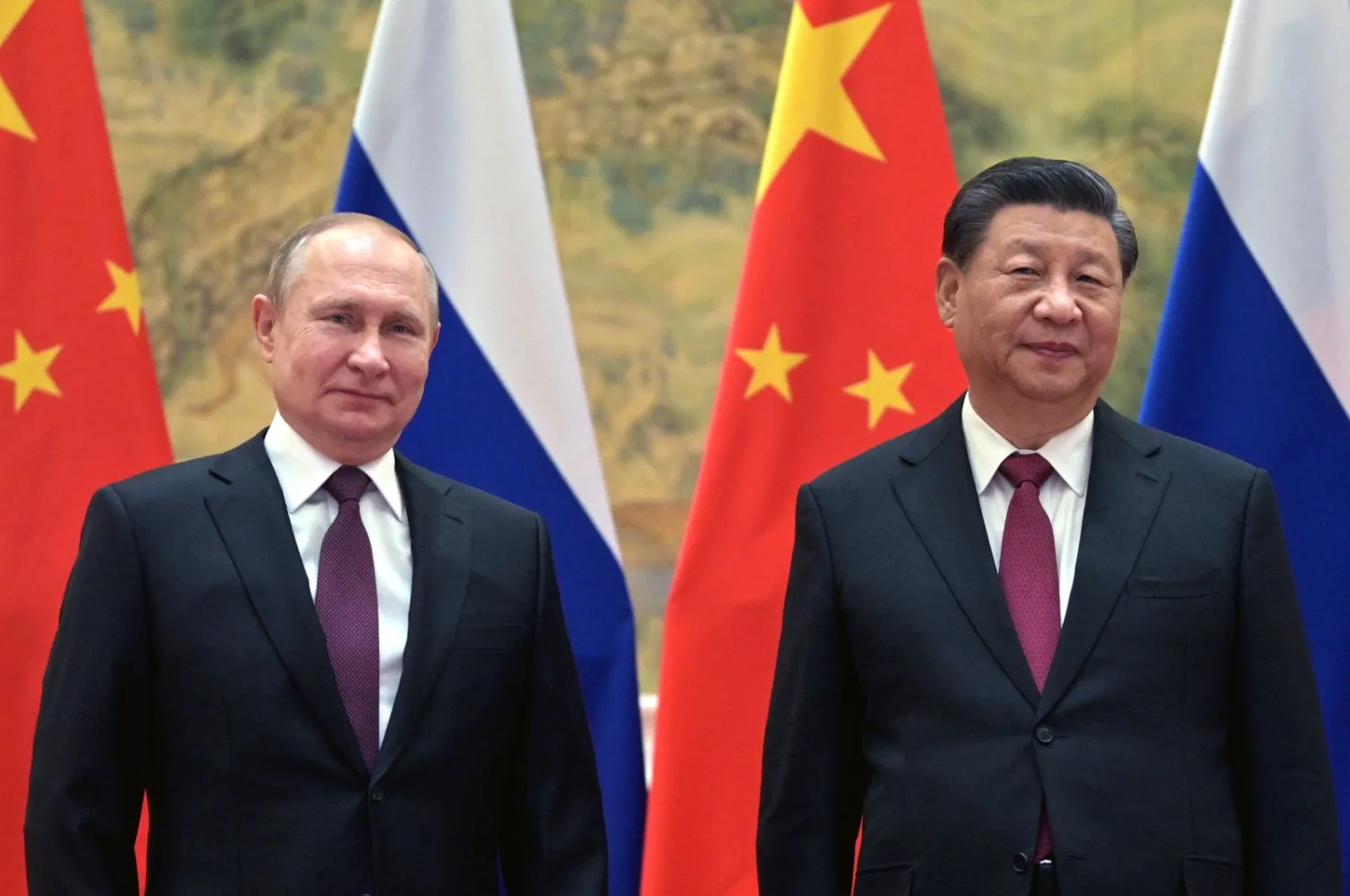
Chinese President Xi Jinping (R) and Russian President Vladimir Putin pose for a photo prior to their talks in Beijing, China, Feb. 4, 2022. (AP Photo)
TT

Japan Warns of Rising Global Tension, Russia-China Arms Ties

Chinese President Xi Jinping (R) and Russian President Vladimir Putin pose for a photo prior to their talks in Beijing, China, Feb. 4, 2022. (AP Photo)

Japan warned of escalating national security threats stemming from Russia’s war on Ukraine and China’s tensions with Taiwan in an annual defense paper issued Friday, as Japan tries to bolster its military capability and spending.

The annual defense white paper, approved by Prime Minister Fumio Kishida’s Cabinet on Friday, highlights the need for Japan’s military buildup to address security concerns and seeks to gain public support for a stronger military and increased budget, which Kishida’s governing party aims to double in coming years, The Associated
press said.

The report comes months ahead of a revision to Japan’s national security strategy that is expected to include a pre-emptive strike capability, which critics say would go beyond the limitations of Japan’s pacifist constitution.

China, Russia and North Korea top Japan’s security concerns in the 500-page report. Defense Minister Nobuo Kishi, in a statement in the report, said the Indo-Pacific region is “at the center” of international strategic competition.

The report calls Russia's war on Ukraine a “serious violation of international law” and raises "concerns that the effects of such unilateral changes to the status quo by force may extend to the Indo-Pacific region.”

Strategic competition between states has intensified amid a changing global power balance and is “further complicated by factors such as China's broad and rapid military buildup," the report said.

The paper doubled its contents on Taiwan from a previous edition last year. It raised concerns over Russia's invasion of Ukraine and its impact on Asia, possibly setting a precedent for what may happen between China and Taiwan.

The report noted growing tension between Washington and Beijing over Taiwan, as the US continues to send warships through the Taiwan Strait and sell arms to Taipei, while Chinese warplanes have increasingly entered Taiwanese airspace.

China claims self-governing Taiwan as its own territory to be annexed by force if necessary.

Tokyo is also concerned about China's “relentless” unilateral attempts to change the status quo “by coercion” near the Japanese-controlled East China Sea island it calls Senkaku, which Beijing also claims and calls the Diaoyu.

China aims to build a “world-class military” and has been ramping up the fusion of military and civilian resources, the report said.

In a new chapter devoted to Russia’s war on Ukraine, the report said that Russia's international isolation and fatigue from the war may increase the importance of Moscow's political and military cooperation with China.

The report said military cooperation between the two countries should be closely watched because it could have a “direct impact” on Japan’s security.

China and Russia are stepping up joint operations and exercises involving their warships and military aircraft around Japan, while Beijing is threatening to use force over Taiwan and escalating regional tensions, Kishi said.

The report comes as Kishida's government pledges to bolster Japan's military capability and budget under a revised national security strategy and basic defense guidelines that are planned for release later this year.

Kishida's governing Liberal Democratic Party has called for doubling Japan's military spending to 2% of its GDP, in line with the NATO standard, to about 10 trillion yen ($72.6 billion) over the next five years.

Recent media surveys showed the majority of the Japanese public support increased defense spending and deterrence, including possessing pre-emptive strike capability.


Le Pen Says France Will No Longer Aid Ukraine ‘Financially’ if Elected

Marine Le Pen (C), the far-right National Rally (RN) party's candidate for the 2027 French presidential election, visits the "Made in France" fair at the Porte de Versailles exhibition center in Paris, France, 13 November 2026. (EPA)
TT

Le Pen Says France Will No Longer Aid Ukraine ‘Financially’ if Elected

Marine Le Pen (C), the far-right National Rally (RN) party's candidate for the 2027 French presidential election, visits the "Made in France" fair at the Porte de Versailles exhibition center in Paris, France, 13 November 2026. (EPA)

Marine Le Pen on Monday said that France would provide no further financial aid to Ukraine if she is elected president next year, after a meeting with Kyiv's ambassador in Paris.

"The state of France's public finances would no longer allow the country to provide financial assistance to Ukraine in the coming months," Le Pen said in a statement, while insisting France would honor existing commitments, including toward a 90-billion-euro ($100-billion) European Union loan.

Le Pen is currently ahead in polls in the race to succeed President Emmanuel Macron next year, as the war sparked by Russia's 2022 full-scale invasion of Ukraine grinds towards its fifth anniversary.

She has faced criticism over past links to Russia, which included a 2017 meeting in the Kremlin with President Vladimir Putin and her party taking a loan from a Russian bank that it paid off in full in 2023.

But she has opposed the invasion and, at her talks in Paris with Ukrainian ambassador Vadym Omelchenko, Le Pen made clear her "unwavering support for Ukraine since the beginning of the conflict".

The statement said the talks -- the first such between Le Pen and the Ukrainian ambassador -- were "cordial".

While financial aid would be cut, Le Pen told the ambassador that "France would continue to support Ukraine through donations of equipment, humanitarian aid and much more active diplomacy".

The statement said there was a "frank discussion" on the future of the conflict, with Le Pen stressing that "the pursuit of peace -- though a difficult goal to achieve -- must remain a priority for all".

She also asked the ambassador to tell President Volodymyr Zelensky she is ready to meet in "either Paris or Brussels". However, there was no mention of the candidate making the journey to Kyiv after Zelensky invited her to visit the Ukrainian capital.

Le Pen's opponents have expressed alarm that by emphasizing the importance of ending the war swiftly, she could force Ukraine to capitulate on unfavorable terms.

"If Russia imposes its will on a European nation through brutality, all of Europe is weakened," Macron wrote on Facebook at the weekend.

Taking aim at Le Pen, he said: "Let us be clear: those who seek to limit the resources available to Ukraine are, in effect, pushing for an unjust peace -- one that would leave Ukraine permanently vulnerable, and, by extension, leave Europe vulnerable as well."


Trump Says He Might Meet with North Korea’s Kim Jong Un in China

US President Donald Trump and North Korean leader Kim Jong Un shake hands before their one-on-one chat during the second US-North Korea summit at the Metropole Hotel in Hanoi, Vietnam February 27, 2019. (Reuters)
TT

Trump Says He Might Meet with North Korea’s Kim Jong Un in China

US President Donald Trump and North Korean leader Kim Jong Un shake hands before their one-on-one chat during the second US-North Korea summit at the Metropole Hotel in Hanoi, Vietnam February 27, 2019. (Reuters)

US President Donald Trump said on Monday he might meet with North Korean leader Kim Jong Un in China this week, an announcement that could dramatically reshape his upcoming trip through East Asia if it occurs.

The president, who met the North Korean leader several times during his 2017-2021 term, including once in the Korean Demilitarized Zone, has previously expressed ‌interest in ‌another meeting during his current term. Senior ‌US ⁠officials, however, have previously ⁠said he has no immediate plans to do so.

Moreover, Trump has repeatedly previewed meetings with Kim that never took place, including during a trip to Asia last year. North Korea, whose mission to the United Nations did not immediately respond to a ⁠request for comment, has publicly indicated it ‌has no intention of ‌meeting with the US president at this time.

Trump told reporters ‌while departing the White House en route to ‌the Philippines and China that any meeting would occur in China, and that the North Korean leader's presence was ultimately up to Chinese President Xi Jinping.

"(Xi) was here a ‌month ago, and we're also going to meet with (Russian) President Putin, and we ⁠may ⁠meet with Kim Jong Un also," Trump said.

"So that'll be good. We have a chance to accomplish a lot."

Trump has indicated he will meet with Putin and Xi during his trip, but US officials and analysts have played down the possibility of a meaningful agreement emerging from any trilateral sit-down.

Among the possible topics of conversation, Trump and others have said, are Russia's invasion of Ukraine, counterproliferation and the war in Iran.


Third US Aircraft Carrier Arrives in Middle East

This US Navy handout photograph released by US Naval Forces Central Command on November 4, 2026, shows the Nimitz-class aircraft carrier USS Theodore Roosevelt (CVN 71) sails alongside Royal Australian Navy Supply-class replenishment oiler HMAS Stalwart (A304). (AFP / NAVCENT Public Affairs / US Navy)
TT

Third US Aircraft Carrier Arrives in Middle East

This US Navy handout photograph released by US Naval Forces Central Command on November 4, 2026, shows the Nimitz-class aircraft carrier USS Theodore Roosevelt (CVN 71) sails alongside Royal Australian Navy Supply-class replenishment oiler HMAS Stalwart (A304). (AFP / NAVCENT Public Affairs / US Navy)

The USS Theodore Roosevelt aircraft carrier arrived in the Middle East on Sunday, media reports said, bringing the number of American carrier strike groups in the region to three.

The deployment, which was reported by the National News and Axios journalist Barak Ravid, comes as fighting reignites in the region, with Iran claiming a drone attack on Bahrain on Sunday, ending a lull in strikes in the war.

Iran also fired drones at Bahrain on Friday -- the first strikes since September against countries in the energy-rich Gulf, which has been targeted several times in the conflict that erupted in February.

US President Donald Trump plans to discuss the war at a trilateral meeting with his Chinese and Russian counterparts Xi Jinping and Vladimir Putin this week, an official said Friday.

Months of diplomacy have failed to resolve the war, which began with US-Israeli strikes that killed Iran's supreme leader Ali Khamenei.