In Call with Biden Xi Warns against ‘Playing with Fire’ over Taiwan

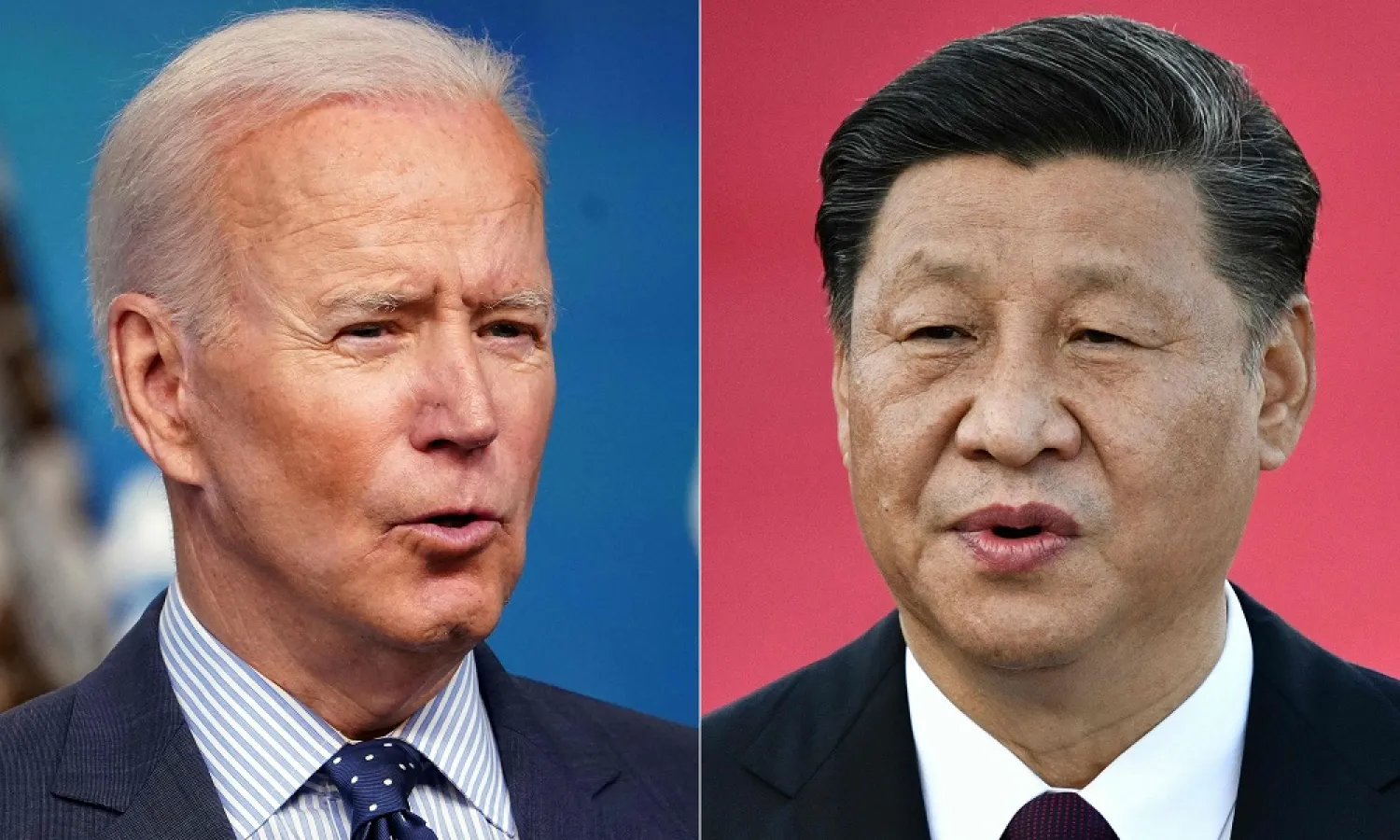
This combination of file pictures created on June 08, 2021, shows US President Joe Biden (L) speaking at the Eisenhower Executive Office Building in Washington, DC on June 2, 2021; and Chinese President Xi Jinping speaking on arrival at Macau's international airport on December 18, 2019. (AFP)
TT

In Call with Biden Xi Warns against ‘Playing with Fire’ over Taiwan

This combination of file pictures created on June 08, 2021, shows US President Joe Biden (L) speaking at the Eisenhower Executive Office Building in Washington, DC on June 2, 2021; and Chinese President Xi Jinping speaking on arrival at Macau's international airport on December 18, 2019. (AFP)

In call with Biden Xi warns against 'playing with fire' over Taiwan

US President Joe Biden and Chinese President Xi Jinping held a fifth call as leaders on Thursday, and Xi warned against "playing with fire" over Taiwan, as concerns mounted over a possible visit to Chinese-claimed island by US House Speaker Nancy Pelosi.

Chinese state media said Xi told Biden that the United States should abide by the "one-China principle" and stressed that China firmly opposed Taiwanese independence and interference of external forces.

Beijing has issued escalating warnings about repercussions should Pelosi - a Democrat like Biden - visit Taiwan, a move that would be a dramatic, though not unprecedented, show of US support for the island, which says it is facing increasing Chinese military and economic threats.

"Those who play with fire will only get burnt," Chinese state media quote Xi as telling Biden. "(We) hope the US side can see this clearly."

The White House said the call lasted over two hours. US officials had said it would have a broad agenda, including discussion of Russia's invasion of Ukraine, which China has yet to condemn.

At its core though, US officials said they saw the exchange as another chance to manage competition between the world's two largest economies, whose ties have been increasingly clouded by tensions over democratically governed Taiwan, which Xi has vowed to reunite with the mainland, by force if necessary.

Washington does not have official relations with Taiwan and follows a "one-China policy" that recognizes Beijing, not Taipei, diplomatically. But it is obliged by US law to provide the island with the means to defend itself, and pressure has been mounting in Congress for more explicit support.

"This is about keeping the lines of communication open with the president of China, one of the most consequential bilateral relationships that we have, not just in that region, but around the world, because it touches so much," White House national security spokesman John Kirby told reporters ahead of the call.

One person briefed on planning for the call said the Biden administration thinks leader-to-leader engagement is the best way to lower tensions over Taiwan.

Some analysts believe Xi also has an interest in avoiding escalation as he seeks an unprecedented third term in office at a congress of China's ruling Communist Party expected in the fall.

Biden also wanted to discuss climate and economic competition issues, the person briefed said, as well as the idea of placing a price cap on Russian oil to punish Moscow for its war in Ukraine, an issue Treasury Secretary Janet Yellen raised with Chinese counterparts earlier in July.

The Biden administration has been debating whether to lift some tariffs on Chinese goods as a way to ease soaring inflation, but US officials have said a decision was not expected ahead of the call.

When Biden last spoke to Xi in March, he warned of "consequences" if Beijing gave material support for Russia's war, and the US government believes that that red line has not been crossed in the months since.

Taiwan has complained of stepped-up Chinese military maneuvers over the past two years to try and force it to accept Beijing's sovereignty. Just ahead of Thursday's call, Taiwan's military said it fired flares to warn away a drone that "glanced by" a strategically located and heavily fortified island close to the Chinese coast that was possibly probing its defenses.

Toxic ties

The White House has reiterated that its "one-China" policy has not changed despite speculation over a possible trip by Pelosi, which the speaker has yet to confirm.

The last time a speaker of the US House visited Taiwan was in 1997, and as a co-equal branch of government, the US executive has little control over congressional travel.

China has grown more powerful militarily and economically since, and some analysts worry such a visit at a time of fraught ties, could spur a crisis across the 100-mile (160-km) wide Taiwan Strait waterway separating China and Taiwan.

Kirby said the administration has been in touch with Pelosi's office to make sure she has "all the context" she needs to make decisions about her travel.

China has given few clues to specific responses it might take if Pelosi, a longtime critic of China, particularly on human rights issues, does go to Taiwan.


Trump Says He Might Meet with North Korea’s Kim Jong Un in China

US President Donald Trump and North Korean leader Kim Jong Un shake hands before their one-on-one chat during the second US-North Korea summit at the Metropole Hotel in Hanoi, Vietnam February 27, 2019. (Reuters)
TT

Trump Says He Might Meet with North Korea’s Kim Jong Un in China

US President Donald Trump and North Korean leader Kim Jong Un shake hands before their one-on-one chat during the second US-North Korea summit at the Metropole Hotel in Hanoi, Vietnam February 27, 2019. (Reuters)

US President Donald Trump said on Monday he might meet with North Korean leader Kim Jong Un in China this week, an announcement that could dramatically reshape his upcoming trip through East Asia if it occurs.

The president, who met the North Korean leader several times during his 2017-2021 term, including once in the Korean Demilitarized Zone, has previously expressed ‌interest in ‌another meeting during his current term. Senior ‌US ⁠officials, however, have previously ⁠said he has no immediate plans to do so.

Moreover, Trump has repeatedly previewed meetings with Kim that never took place, including during a trip to Asia last year. North Korea, whose mission to the United Nations did not immediately respond to a ⁠request for comment, has publicly indicated it ‌has no intention of ‌meeting with the US president at this time.

Trump told reporters ‌while departing the White House en route to ‌the Philippines and China that any meeting would occur in China, and that the North Korean leader's presence was ultimately up to Chinese President Xi Jinping.

"(Xi) was here a ‌month ago, and we're also going to meet with (Russian) President Putin, and we ⁠may ⁠meet with Kim Jong Un also," Trump said.

"So that'll be good. We have a chance to accomplish a lot."

Trump has indicated he will meet with Putin and Xi during his trip, but US officials and analysts have played down the possibility of a meaningful agreement emerging from any trilateral sit-down.

Among the possible topics of conversation, Trump and others have said, are Russia's invasion of Ukraine, counterproliferation and the war in Iran.


Third US Aircraft Carrier Arrives in Middle East

This US Navy handout photograph released by US Naval Forces Central Command on November 4, 2026, shows the Nimitz-class aircraft carrier USS Theodore Roosevelt (CVN 71) sails alongside Royal Australian Navy Supply-class replenishment oiler HMAS Stalwart (A304). (AFP / NAVCENT Public Affairs / US Navy)
TT

Third US Aircraft Carrier Arrives in Middle East

This US Navy handout photograph released by US Naval Forces Central Command on November 4, 2026, shows the Nimitz-class aircraft carrier USS Theodore Roosevelt (CVN 71) sails alongside Royal Australian Navy Supply-class replenishment oiler HMAS Stalwart (A304). (AFP / NAVCENT Public Affairs / US Navy)

The USS Theodore Roosevelt aircraft carrier arrived in the Middle East on Sunday, media reports said, bringing the number of American carrier strike groups in the region to three.

The deployment, which was reported by the National News and Axios journalist Barak Ravid, comes as fighting reignites in the region, with Iran claiming a drone attack on Bahrain on Sunday, ending a lull in strikes in the war.

Iran also fired drones at Bahrain on Friday -- the first strikes since September against countries in the energy-rich Gulf, which has been targeted several times in the conflict that erupted in February.

US President Donald Trump plans to discuss the war at a trilateral meeting with his Chinese and Russian counterparts Xi Jinping and Vladimir Putin this week, an official said Friday.

Months of diplomacy have failed to resolve the war, which began with US-Israeli strikes that killed Iran's supreme leader Ali Khamenei.


US Airports Slowly Return to Normal After Three Days of Disruption

Passengers wait at Ronald Reagan Washington National Airport (DCA), in Arlington, Virginia, just outside Washington, DC, on November 14, 2026. (AFP)
TT

US Airports Slowly Return to Normal After Three Days of Disruption

Passengers wait at Ronald Reagan Washington National Airport (DCA), in Arlington, Virginia, just outside Washington, DC, on November 14, 2026. (AFP)

US air travel was slowly returning to normal on Monday after three days of widespread disruption following an extraordinary no-takeoff order issued by US aviation authorities.

The ground stop issued Friday afternoon was only the second time such a directive had been issued nationwide in the busy US airspace since planes were grounded following the 9/11 attacks, and was blamed by the Trump administration on a faulty upgrade to communications equipment.

On Monday morning, more than 250 US-related flights -- those traveling within, into or out of the United States -- scheduled for the same day were cancelled, according to industry tracker FlightAware.

That marked a dramatic shift from the more than 2,300 flights cancelled on Sunday.

There were delays to more than 700 US-related flights scheduled for Monday, compared to more than 10,000 the previous day.

The Trump administration sought to reassure weary flyers as questions remained over how such chaos could unfold in the world's largest economy, a country that prides itself on its technological prowess.

Throughout the weekend, stranded passengers wandered through chaotic airports and sat on floors, waiting for updates or to be rebooked.

Officials blamed Friday's colossal snafu on faulty work to upgrade air traffic control communication cables.

President Donald Trump on Sunday ended uncharacteristic days of silence on the ground stop, but only to blame his predecessor Joe Biden for the debacle.

Trump insisted he inherited a mess from the Biden administration and said Congress, which his party has controlled for two years, must approve funds to upgrade America's outdated air traffic control system.

"The Biden Administration was an FAA disaster," Trump said, referring to the Federal Aviation Administration.

"Everything they touched turned bad. Big money spent unwisely, making an old and broken system worse than when they began," Trump said.

FAA chief Bryan Bedford said Saturday that air travel for millions of Americans stranded at airports would return to normal by the close of business on Sunday.

But Transportation Secretary Sean Duffy said Sunday morning it will actually take longer to get planes, crews and travelers to where they need to be.

"We're going to see things come back to normal today, but probably fully normal tomorrow," Duffy said on ABC News.

"We had airplanes and crews out of position because of Friday, so it takes a little bit of time to do that."

- 'I'm the secretary' -

Duffy also rejected calls for his resignation over the travel chaos, insisting he inherited woefully outdated air traffic control infrastructure such as radar equipment that dates back to the 1960s.

"So when we do work and things go wrong, of course I'm the secretary. But I also have to acknowledge what was delivered to me," Duffy said in an interview on CNN.

The ground stop not only plunged US air travel into chaos, but it also raised serious concerns about the country's aging infrastructure.

Duffy has appealed for $50 billion in funds to upgrade and modernize the air traffic control system, and called for Congress, which controls the purse strings of the US government, to "meet this moment."

But Democrats quickly pounced to say Congress under Trump's Republicans could already have done this.