

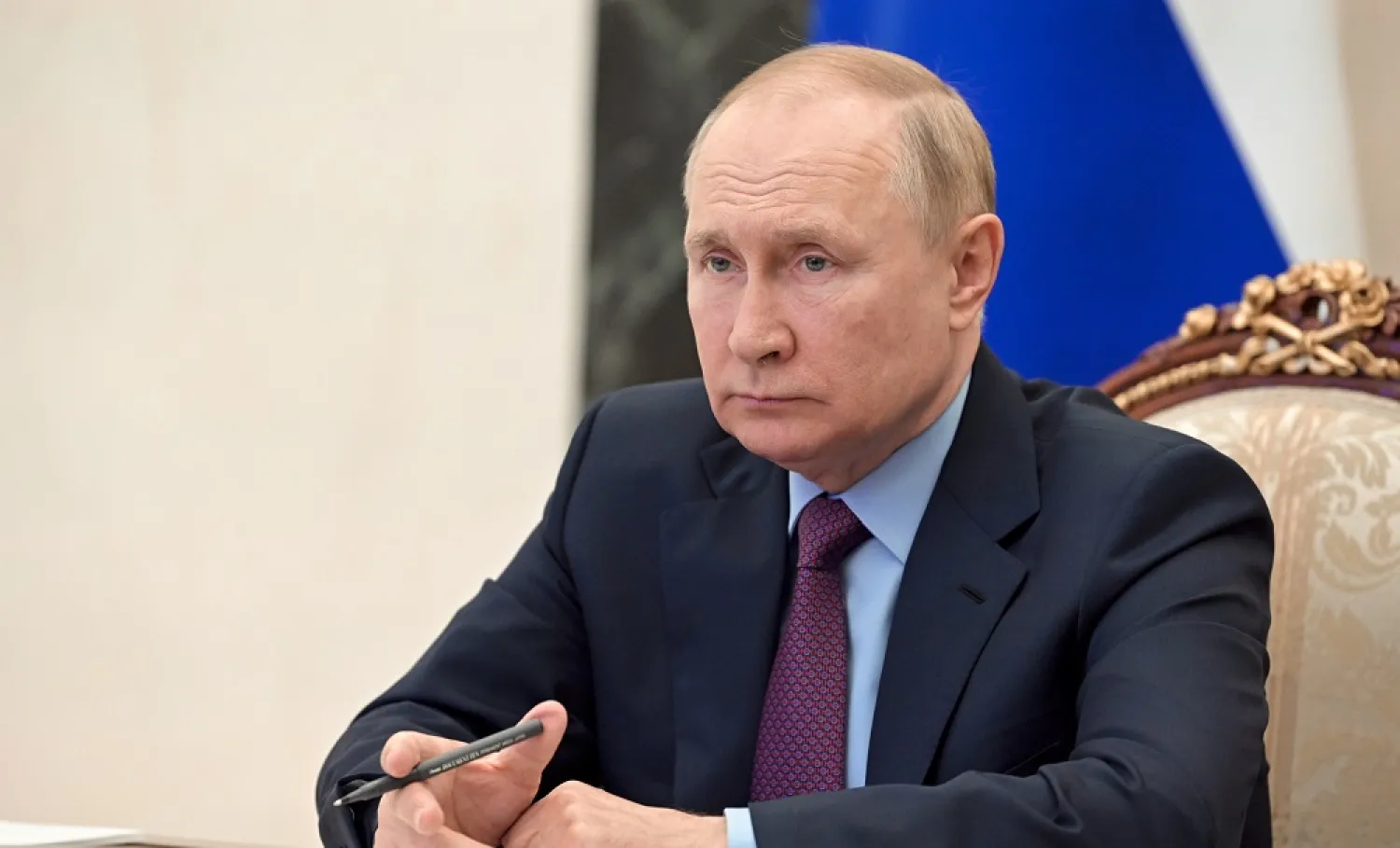

Putin Says No One Can Win a Nuclear War

Russian President Vladimir Putin chairs a meeting on metals industries via videoconference in Moscow, Russia, Monday, Aug. 1, 2022. (AP)
TT

Putin Says No One Can Win a Nuclear War

Russian President Vladimir Putin chairs a meeting on metals industries via videoconference in Moscow, Russia, Monday, Aug. 1, 2022. (AP)

Russian President Vladimir Putin said on Monday there could be no winners in a nuclear war and no such war should ever be started.

The Kremlin leader made the comment in a letter to participants of a conference on the nuclear non-proliferation treaty (NPT), more than five months into his war on Ukraine.

"We proceed from the fact that there can be no winners in a nuclear war and it should never be unleashed, and we stand for equal and indivisible security for all members of the world community," he said.

His words to the NPT forum appeared aimed at striking a reassuring note and portraying Russia as a responsible nuclear power.

They contrasted with earlier statements by Putin and other Russian politicians that have been interpreted in the West as implicit nuclear threats.

In a speech on Feb. 24, as he launched the Russian invasion of Ukraine, Putin pointedly referred to Russia's nuclear arsenal and warned outside powers that any attempt to interfere would "lead you to such consequences that you have never encountered in your history".

Days later, he ordered Russia's nuclear forces to be put on high alert.

The war has raised geopolitical tensions to levels not seen since the 1962 Cuban Missile Crisis, with politicians in both Russia and the United States speaking publicly of the risk of World War Three.

CIA director William Burns said in April that given the setbacks Russia had suffered in Ukraine, "none of us can take lightly the threat posed by a potential resort to tactical nuclear weapons or low-yield nuclear weapons."

Russia, whose military doctrine allows for the use of nuclear weapons in the event of an existential threat to the Russian state, has accused the West of waging a "proxy war" against it by arming Ukraine and imposing sanctions on Moscow.

Earlier on Monday, a Russian foreign ministry source questioned the seriousness of comments by US President Joe Biden calling for talks on a nuclear arms control framework to replace a treaty expiring in 2026.

In April, Russia conducted a first test launch of its new Sarmat intercontinental ballistic missile, capable of mounting nuclear strikes against the United States, and said it planned to deploy the weapons by autumn.



Trump Says He Might Meet with North Korea’s Kim Jong Un in China

US President Donald Trump and North Korean leader Kim Jong Un shake hands before their one-on-one chat during the second US-North Korea summit at the Metropole Hotel in Hanoi, Vietnam February 27, 2019. (Reuters)
TT

Trump Says He Might Meet with North Korea’s Kim Jong Un in China

US President Donald Trump and North Korean leader Kim Jong Un shake hands before their one-on-one chat during the second US-North Korea summit at the Metropole Hotel in Hanoi, Vietnam February 27, 2019. (Reuters)

US President Donald Trump said on Monday he might meet with North Korean leader Kim Jong Un in China this week, an announcement that could dramatically reshape his upcoming trip through East Asia if it occurs.

The president, who met the North Korean leader several times during his 2017-2021 term, including once in the Korean Demilitarized Zone, has previously expressed ‌interest in ‌another meeting during his current term. Senior ‌US ⁠officials, however, have previously ⁠said he has no immediate plans to do so.

Moreover, Trump has repeatedly previewed meetings with Kim that never took place, including during a trip to Asia last year. North Korea, whose mission to the United Nations did not immediately respond to a ⁠request for comment, has publicly indicated it ‌has no intention of ‌meeting with the US president at this time.

Trump told reporters ‌while departing the White House en route to ‌the Philippines and China that any meeting would occur in China, and that the North Korean leader's presence was ultimately up to Chinese President Xi Jinping.

"(Xi) was here a ‌month ago, and we're also going to meet with (Russian) President Putin, and we ⁠may ⁠meet with Kim Jong Un also," Trump said.

"So that'll be good. We have a chance to accomplish a lot."

Trump has indicated he will meet with Putin and Xi during his trip, but US officials and analysts have played down the possibility of a meaningful agreement emerging from any trilateral sit-down.

Among the possible topics of conversation, Trump and others have said, are Russia's invasion of Ukraine, counterproliferation and the war in Iran.


Third US Aircraft Carrier Arrives in Middle East

This US Navy handout photograph released by US Naval Forces Central Command on November 4, 2026, shows the Nimitz-class aircraft carrier USS Theodore Roosevelt (CVN 71) sails alongside Royal Australian Navy Supply-class replenishment oiler HMAS Stalwart (A304). (AFP / NAVCENT Public Affairs / US Navy)
TT

Third US Aircraft Carrier Arrives in Middle East

This US Navy handout photograph released by US Naval Forces Central Command on November 4, 2026, shows the Nimitz-class aircraft carrier USS Theodore Roosevelt (CVN 71) sails alongside Royal Australian Navy Supply-class replenishment oiler HMAS Stalwart (A304). (AFP / NAVCENT Public Affairs / US Navy)

The USS Theodore Roosevelt aircraft carrier arrived in the Middle East on Sunday, media reports said, bringing the number of American carrier strike groups in the region to three.

The deployment, which was reported by the National News and Axios journalist Barak Ravid, comes as fighting reignites in the region, with Iran claiming a drone attack on Bahrain on Sunday, ending a lull in strikes in the war.

Iran also fired drones at Bahrain on Friday -- the first strikes since September against countries in the energy-rich Gulf, which has been targeted several times in the conflict that erupted in February.

US President Donald Trump plans to discuss the war at a trilateral meeting with his Chinese and Russian counterparts Xi Jinping and Vladimir Putin this week, an official said Friday.

Months of diplomacy have failed to resolve the war, which began with US-Israeli strikes that killed Iran's supreme leader Ali Khamenei.


US Airports Slowly Return to Normal After Three Days of Disruption

Passengers wait at Ronald Reagan Washington National Airport (DCA), in Arlington, Virginia, just outside Washington, DC, on November 14, 2026. (AFP)
TT

US Airports Slowly Return to Normal After Three Days of Disruption

Passengers wait at Ronald Reagan Washington National Airport (DCA), in Arlington, Virginia, just outside Washington, DC, on November 14, 2026. (AFP)

US air travel was slowly returning to normal on Monday after three days of widespread disruption following an extraordinary no-takeoff order issued by US aviation authorities.

The ground stop issued Friday afternoon was only the second time such a directive had been issued nationwide in the busy US airspace since planes were grounded following the 9/11 attacks, and was blamed by the Trump administration on a faulty upgrade to communications equipment.

On Monday morning, more than 250 US-related flights -- those traveling within, into or out of the United States -- scheduled for the same day were cancelled, according to industry tracker FlightAware.

That marked a dramatic shift from the more than 2,300 flights cancelled on Sunday.

There were delays to more than 700 US-related flights scheduled for Monday, compared to more than 10,000 the previous day.

The Trump administration sought to reassure weary flyers as questions remained over how such chaos could unfold in the world's largest economy, a country that prides itself on its technological prowess.

Throughout the weekend, stranded passengers wandered through chaotic airports and sat on floors, waiting for updates or to be rebooked.

Officials blamed Friday's colossal snafu on faulty work to upgrade air traffic control communication cables.

President Donald Trump on Sunday ended uncharacteristic days of silence on the ground stop, but only to blame his predecessor Joe Biden for the debacle.

Trump insisted he inherited a mess from the Biden administration and said Congress, which his party has controlled for two years, must approve funds to upgrade America's outdated air traffic control system.

"The Biden Administration was an FAA disaster," Trump said, referring to the Federal Aviation Administration.

"Everything they touched turned bad. Big money spent unwisely, making an old and broken system worse than when they began," Trump said.

FAA chief Bryan Bedford said Saturday that air travel for millions of Americans stranded at airports would return to normal by the close of business on Sunday.

But Transportation Secretary Sean Duffy said Sunday morning it will actually take longer to get planes, crews and travelers to where they need to be.

"We're going to see things come back to normal today, but probably fully normal tomorrow," Duffy said on ABC News.

"We had airplanes and crews out of position because of Friday, so it takes a little bit of time to do that."

- 'I'm the secretary' -

Duffy also rejected calls for his resignation over the travel chaos, insisting he inherited woefully outdated air traffic control infrastructure such as radar equipment that dates back to the 1960s.

"So when we do work and things go wrong, of course I'm the secretary. But I also have to acknowledge what was delivered to me," Duffy said in an interview on CNN.

The ground stop not only plunged US air travel into chaos, but it also raised serious concerns about the country's aging infrastructure.

Duffy has appealed for $50 billion in funds to upgrade and modernize the air traffic control system, and called for Congress, which controls the purse strings of the US government, to "meet this moment."

But Democrats quickly pounced to say Congress under Trump's Republicans could already have done this.