


Months Into War, Ukraine Refugees Slow to Join EU Workforce

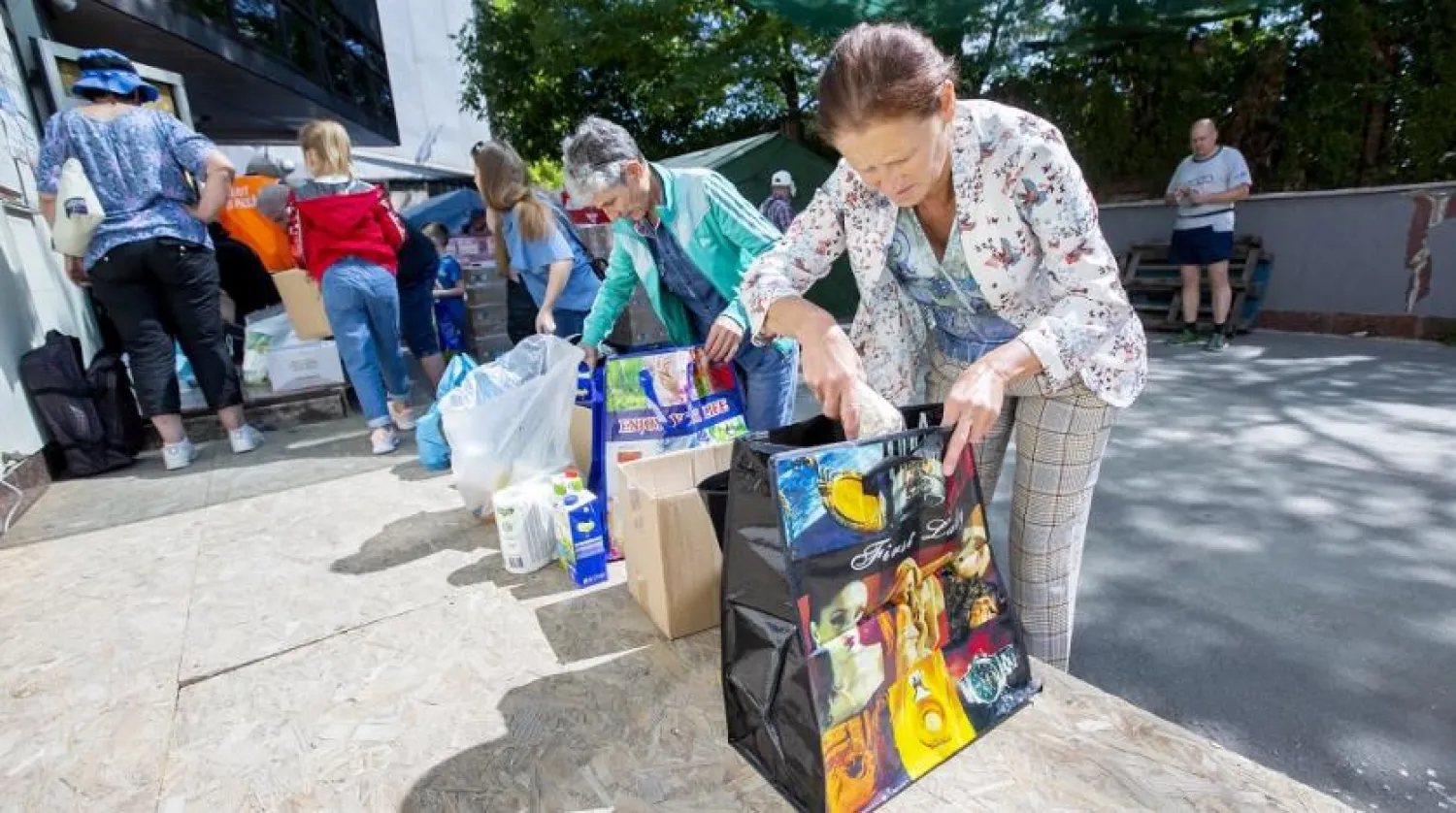
Ukrainian people receive humanitarian aid at a refugee camp set up at the Patria-Lukoil center in Chisinau, Moldova, 12 July 2022. (EPA)
TT

Months Into War, Ukraine Refugees Slow to Join EU Workforce

Ukrainian people receive humanitarian aid at a refugee camp set up at the Patria-Lukoil center in Chisinau, Moldova, 12 July 2022. (EPA)

Liudmyla Chudyjovych used to have a career as a lawyer in Ukraine and big plans for the future. That was before the Russian invasion forced the 41-year-old woman to put her daughter's safety first, and leave both her job and home behind.

Since fleeing the town of Stryj in western Ukraine in May, Chudyjovych has found a new job in the Czech Republic. But instead of practicing law, she's had to settle for work as a housekeeper at a hotel in the capital, Prague.

“It’s just a different stage of my career,” she said. “That’s simply how it is.”

One of the millions of refugees who have fled Ukraine since the Feb. 24 Russian invasion, Chudyjovych considers herself lucky to have a job at all. Not fluent enough in either Czech or English, Chudyjovych said she didn't mind the work as long as she and her daughter are safe.

Although the European Union introduced regulations early in the war to make it easier for Ukrainian refugees to live and work in its 27 member nations while they decide whether to seek asylum or return home, many are only now starting to find jobs — and many are still struggling.

Some 6.5 million Ukrainians, have entered the EU since February, according to Frontex, the EU Border and Coast Guard Agency, streaming into neighboring countries before many moved on to more prosperous nations in the West. Around half have since returned to Ukraine.

Only a relatively small number of those who stayed had entered the EU labor market by mid-June, according to the European Commission, The Associated Press reported.

A recent Organization for Economic Cooperation and Development report looking at the potential impact Ukrainian refugees will have on the EU workforce projected it will be about twice as large as the 2014-2017 inflow of refugees, which included many fleeing war in Syria.

The study estimated the Czech Republic, which has the lowest unemployment rate in Europe, would add the most Ukrainians to its workforce by the end of the year, with an increase of 2.2%, followed by Poland and Estonia. About 1.2 million workers would be added to the European workforce overall, mainly in service occupations, the report said.

Still, the influx is unlikely to drive down wages or boost unemployment in European countries, many of which face labor shortages due in part to their aging populations.

“Considering the labor needs of the main host countries, a negative impact in terms of employment or wages for the resident population ... seems very unlikely,” the report concluded.

The EU effort to help the Ukrainians has won praise from the U.N. Refugee Agency and other rights groups dealing with migration. But they also note a major difference in the treatment of people fleeing wars or poverty in the Middle East, Africa or Asia, who often have to wait years before overcoming the hurdles for acquiring residency papers or work permits.

Still, there are many challenges ahead for Ukrainian refugees looking for work.

In addition to language barriers, skilled workers from Ukraine often lack documentation to prove their professional credentials to get better-paid employment. Their diplomas may not be recognized in their host countries, meaning many have to take language and training courses before they can seek professional opportunities.

Because men between the ages of 18 and 60 are banned from leaving Ukraine, many refugees are women with children, which can be an additional obstacle for trying to find work. Many women are still weighing their options and might decide to return home for the start of the school year in September, officials say, despite the war being far from over.

In Poland, which has taken in about 1 million Ukrainian refugees, more than any other EU nation, just over a third have found work, according to the Polish minister of labor and social policy, Marlena Malag. Some have gotten jobs as nurses or Ukrainian language teachers in Polish schools, while others are working as housekeepers or waitresses.

In Portugal, some of the country’s largest companies have special job recruitment programs for Ukrainians, while the Institute for Employment and Professional Training offers free Portuguese language classes.

In Germany, about half of some 900,000 Ukrainian refugees have registered with the country’s employment agency, though no figures are available on how many have actually found jobs. The Mediendienst Integration group, which tracks migration in Germany, says about half have university degrees, but doesn’t specify how many have been able to work in their professional fields.

Natalia Borysova was chief editor of a morning TV show in the western Ukrainian city of Lviv before fleeing with her daughters, 11 and 13, in March, and settling in the German city of Cologne. She applied for low-paying jobs such as housekeeping, but ultimately decided to turn them down to focus on learning German.

“I’m an optimist and I am sure that I will find a job after learning the language,” the 41-year-old said via WhatsApp. “Perhaps on a different level than in Ukraine, but in the same field. Now it just doesn’t make sense for me to work for the minimum wage.”

Borysova, like other Ukrainian refugees, receives an allowance from the German government that helps the family pay for food and housing, but said she wants to return to work as soon as she masters German.

Chudyjovych is among some 400,000 Ukrainians in the Czech Republic who have registered for special long-term visas that grant access to jobs, health care, education and other benefits. Nearly 80,000 have already found work, the government said.

At the Background café in Prague's Old Town, 15 Ukrainian refugees work with the Czech staff as part of a project sponsored by the Mama Coffee chain. The refugees also receive free language classes and other programs.

Lisa Himich, 22, from Kyiv, likes it and says "it feels like home here.”

For Chudyjovych, working as a housekeeper is far better than living in fear and under the constant sound of air raid sirens.

“I thought I would miss Ukraine and be homesick but that hasn’t happened at all," Chudyjovych said. "It’s peaceful here and I feel like a human being.”



Nepal Flood Reconstruction Bill to be $4.78 Bn

A man carrying his belongings walks past a damaged house in the aftermath of flash floods at Trishuli in Nepal's Nuwakot district on September 11, 2026. (Photo by Prakash MATHEMA / AFP)
TT

Nepal Flood Reconstruction Bill to be $4.78 Bn

A man carrying his belongings walks past a damaged house in the aftermath of flash floods at Trishuli in Nepal's Nuwakot district on September 11, 2026. (Photo by Prakash MATHEMA / AFP)

The reconstruction bill after deadly floods sparked by a glacial mountain collapse that hit Nepal last month would amount to $4.78 billion, the foreign ministry said on Friday.

"The total estimated requirement for reconstruction is approximately $4.78 billion," foreign ministry spokesman Lok Bahadur Chhetri told reporters.

Nepali rescuers clung to hopes of finding survivors trapped in hydropower tunnels on Wednesday.

The August 26 tsunami-like surge of water, mud and debris, which began on the China-Nepal border, has killed more than 1,410 people and left 5,651 missing.

"The rescue and search work in the tunnels at Trishuli 3A, 3B and Chilime hydropower projects is ongoing," Nepal Army spokesman Raja Ram Basnet told AFP.

In Nepal, 1,367 bodies have been recovered and 5,132 people are missing, its disaster authority said on Wednesday.

In China, 43 people are dead and 519 are missing, according to state media.

Hundreds of foreigners are among the missing, as well as hundreds of hydropower workers.


China, Iran Among Countries That Have Used AI to Aid Spying, Anthropic Says

The Anthropic logo in this illustration taken June 5, 2026. (Reuters)
TT

China, Iran Among Countries That Have Used AI to Aid Spying, Anthropic Says

The Anthropic logo in this illustration taken June 5, 2026. (Reuters)

Anthropic said Thursday it shut down multiple cases of state-sponsored surveillance operations that used its artificial intelligence (AI) models, and warned that governments and state-aligned actors are increasingly using AI to spy on ethnic minorities and dissidents.

The incidents were found and disrupted between January and July, and they originated in China, Iran and west Africa, Anthropic said in a report about misuse of its models.

These surveillance campaigns "targeted the same diaspora and dissident communities these regimes have historically targeted. These include pro-democracy figures in Hong Kong, Tibetan and Falun Gong communities across Asia, and Iranian minority communities and opponents of the Iranian regime abroad," the report said.

In one case, Iranian actors developed a way to identify people through their social media accounts; in another, a contractor working for Malian national security authorities used Claude "to design the underlying software that enabled the intelligence gathering."

"AI is now being used in place of an engineering workforce," the report said.

Anthropic also disrupted efforts by users to design weapons, conduct questionable biological research, and create dating scams.

The San Francisco-based AI lab also accused Chinese developers of deceptively using Claude to produce responses to user queries while simultaneously "distilling" that data to improve their own models.

Distilling is an industry term that refers to a process where one AI model is used to train another one.

Chinese developers have previously been accused of using that technique without permission, essentially stealing resources from American labs such as Anthropic and OpenAI.

Now Anthropic alleges that China's Moonshot and DeepSeek have also secretly used Claude to generate answers given to its users.

"In one instance, over a ten-day period, Moonshot relayed almost 300,000 customer requests to Anthropic" through a "network of 5,380 fraudulent accounts, most of which appeared to be located in Singapore and Japan," the report said.

Some of that data contained sensitive user information, potentially in violation of privacy agreements.

"We do not know if Moonshot notified their customers that their requests were being rerouted to Anthropic and exposed to a third party," the report said.

DeepSeek used similar techniques.

When it comes to the research Anthropic detected and blocked that was related to biological weapons, the intent of the actors was less clear-cut and the AI lab did not identify them.

"The individuals implicated in these case studies are working scientists. We do not assert that they intended harm, and identifying them or their labs could expose them to harm," the report said.

The scientific research in those cases involved work around the mosquito-born chikungunya virus, a "highly-pathogenic" strain of the bird flu, a family of viruses that include smallpox and mpox, venoms and other toxins.


Iran is Reportedly Producing Ballistic Missiles Again in Underground Facilities

FILE PHOTO: A man walks next to a symbolic mockup of an Iranian missile and an Iranian flag at Imam Hussein Square in Tehran, Iran, July 12, 2026. Majid Asgaripour/WANA (West Asia News Agency) via REUTERS
TT

Iran is Reportedly Producing Ballistic Missiles Again in Underground Facilities

FILE PHOTO: A man walks next to a symbolic mockup of an Iranian missile and an Iranian flag at Imam Hussein Square in Tehran, Iran, July 12, 2026. Majid Asgaripour/WANA (West Asia News Agency) via REUTERS

Iran has resumed its production of ballistic missiles using stockpiled components and working in underground facilities, officials from the US and Middle East familiar with the matter said.

Despite heavy attacks on its missile sites and industrial facilities during the initial phase of the war, Iran has been busy assembling liquid-propellant missiles, which have to be fueled just before launch, as well as solid-propellant missiles, which can be stored ready to fire, some of the officials told The Wall Street Journal.

Intelligence points to activity at several underground sites, including the Khojir missile facility in southeastern Iran, those officials said. Iran is also attempting to build new underground assembly points to avoid getting struck again, the daily quoted them as saying.


A banner with a picture of US President Donald Trump next to an Iranian missile system at Azadi Square in Tehran, Iran, July 30, 2026. Majid Asgaripour/WANA (West Asia News Agency) via REUTERS

So far, Iran is mainly assembling the new missiles from existing components in more limited quantities than before the war, the US and regional officials said. The US and Israel damaged a number of industrial facilities needed to produce missile components and missiles themselves, and the naval blockade has complicated imports of parts and ingredients for solid fuel.

The renewed production underscores the difficulty of fully dismantling Tehran’s missile program, a goal of the war the US and Israel launched on Feb. 28.

“When there are no bombings of the facilities, you can replace damaged infrastructure, and you can buy new components from other countries and store them in the facilities,” said Tal Inbar, a senior analyst at the US-based Missile Defense Advocacy Alliance. “You have to be extremely naive to think that Iran is not rebuilding its missile-production capabilities.”

A White House official didn’t directly address the question of whether Tehran had resumed production of ballistic missiles but said that Iran’s nuclear facilities had been obliterated and its military forces severely degraded. “Iran is weaker now than ever before, and President Trump will never allow Iran to have a nuclear weapon,” the official said.

Sean Parnell, the Pentagon’s chief spokesman, said the US had “destroyed up to 90% of Iran’s drone, ballistic missile, and naval industrial base” and “significantly degraded” Iran’s ability to launch missiles and drones.