


Banksy Painting Sprayed in West Bank Resurfaces in Tel Aviv

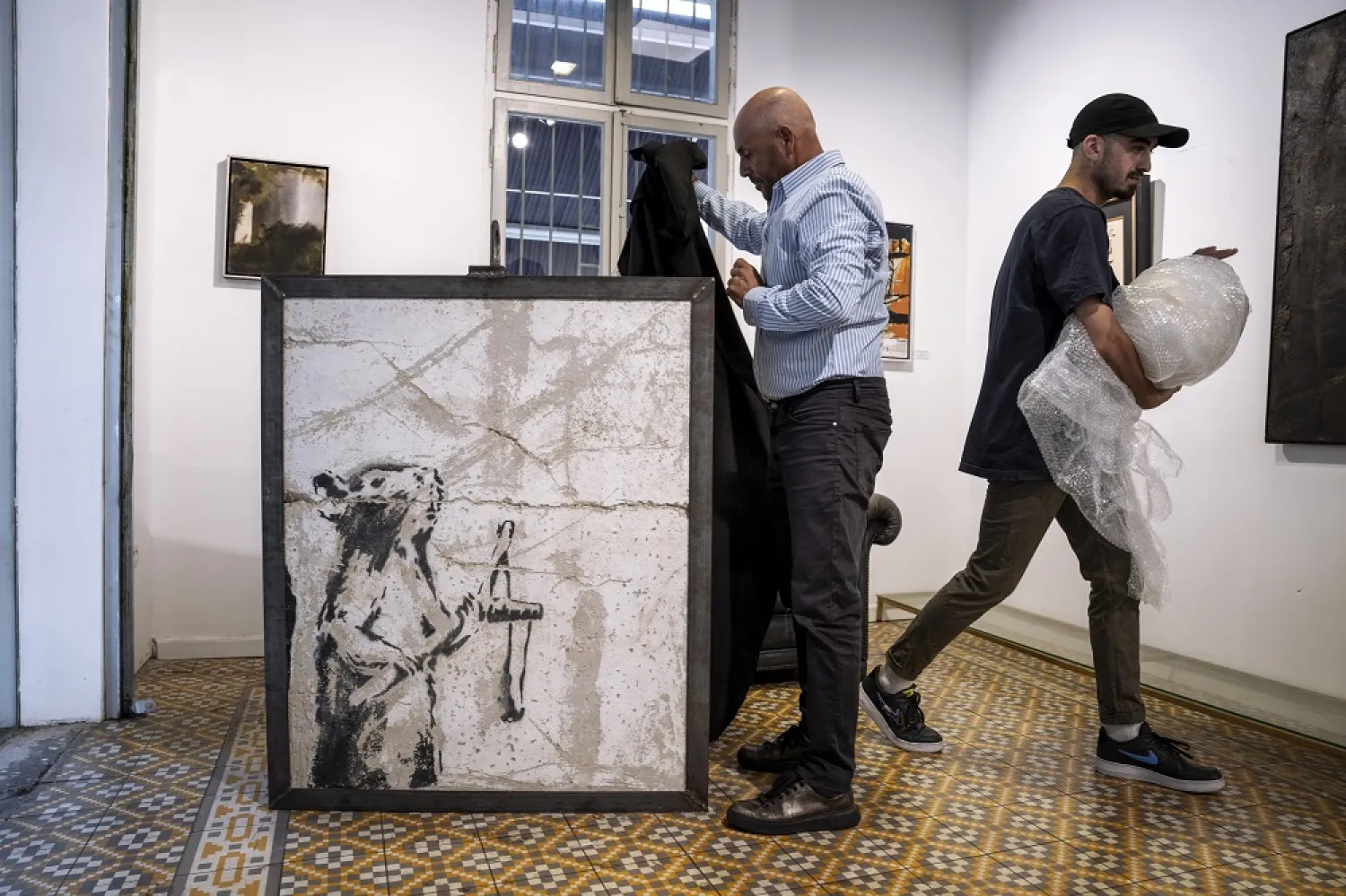
Koby Abergel, an Israeli art dealer, reveals a painting by the secretive British graffiti artist Banksy that was mysteriously transferred from the occupied West Bank to the Urban Gallery in Tel Aviv, Israel, Thursday, Aug. 4, 2022. (AP)
TT

Banksy Painting Sprayed in West Bank Resurfaces in Tel Aviv

Koby Abergel, an Israeli art dealer, reveals a painting by the secretive British graffiti artist Banksy that was mysteriously transferred from the occupied West Bank to the Urban Gallery in Tel Aviv, Israel, Thursday, Aug. 4, 2022. (AP)

A long-lost painting by the British graffiti artist Banksy has resurfaced in a swank art gallery in downtown Tel Aviv, an hour’s drive and a world away from the concrete wall in the occupied West Bank where it was initially sprayed.

The relocation of the painting — which depicts a slingshot-toting rat and was likely intended to protest the Israel occupation — raises ethical questions about the removal of artwork from occupied territory and the display of such politically-charged pieces in radically different settings from where they were created.

The painting initially appeared near Israel’s separation barrier in the occupied West Bank city of Bethlehem and was one of several works created in secret around 2007. They employed Banksy’s trademark absurdist and dystopian imagery to protest Israel’s decades-long occupation of territories the Palestinians want for a future state.

Now it resides at the Urban Gallery in the heart of Tel Aviv’s financial district, surrounded by glass and steel skyscrapers.

“This is the story of David and Goliath,” said Koby Abergel, an Israeli art dealer who purchased the painting, without elaborating on the analogy. He said the gallery was simply displaying the work, leaving its interpretation to others.

The Associated Press could not independently confirm the authenticity of the piece, but Abergel said the cracks and scrapes in the concrete serve as “a fingerprint” that proves it is the same piece that appears on the artist’s website.

The 70-kilometer (43-mile) journey it made from the West Bank to Tel Aviv is shrouded in secrecy. The 900-pound concrete slab would have had to pass through Israel’s serpentine barrier and at least one military checkpoint — daily features of Palestinian life and targets of Banksy’s biting satire.

Abergel, who is a partner with the Tel Aviv gallery, said he bought the concrete slab from a Palestinian associate in Bethlehem. He declined to disclose the sum he paid or identify the seller, but insisted on the deal's legality.

The graffiti artwork was spray-painted on a concrete block that was part of an abandoned Israeli army position in Bethlehem, next to a soaring concrete section of the separation barrier.

Some time later, the painting was itself subjected to graffiti by someone who obscured the painting and scrawled “RIP Bansky Rat” on the block. Palestinian residents cut out the painting and kept it in private residences until earlier this year, Abergel said.

He said the relocation involved delicate negotiations with his Palestinian associate and careful restoration to remove the acrylic paint sprayed over Banksy’s work. The massive block was then enclosed in a steel frame so it could be lifted onto a flatbed truck and rolled through a checkpoint, until it arrived in Tel Aviv in the middle of the night.

It was not possible to independently confirm his account of its journey.

The piece now stands on an ornately patterned tile floor, surrounded by other contemporary art. Baruch Kashkash, the gallery’s owner, said the roughly 2-square-meter (-yard) block was so heavy it had to be brought inside by a crane, and could barely be moved from the doorway.

Israel controls all access to the West Bank, and Palestinians require Israeli permits to travel in or out and to import and export goods. Even when traveling within the West Bank, they can be stopped and searched by Israeli soldiers at any time.

Israeli citizens, including Jewish settlers, can travel freely in and out of the 60% of the West Bank that is under full Israeli control. Israel prohibits its citizens from entering areas administered by the Palestinian Authority for security reasons, but there’s little enforcement of that ban.

The Palestinians have spent decades seeking an independent state in the West Bank, Gaza and east Jerusalem, territories captured by Israel in the 1967 Mideast war. The peace process ground to a halt more than 10 years ago.

Abergel said the artwork’s move was not coordinated with the Israeli military, and that his Palestinian associates, whom he declined to name, were responsible for moving it into Israel and crossing through military checkpoints. He said he has no plans to sell the piece.

According to the international treaty governing cultural property to which Israel is a signatory, occupying powers must prevent the removal of cultural property from occupied territories. It remains unclear exactly how the 1954 Hague Convention would apply in this instance.

“This is theft of the property of the Palestinian people,” said Jeries Qumsieh, a spokesperson for the Palestinian Tourism Ministry. “These were paintings by an international artist for Bethlehem, for Palestine, and for visitors to Bethlehem and Palestine. So transferring them, manipulating them and stealing them is definitely an illegal act.”

The Israeli military and COGAT, the Israeli Defense Ministry body responsible for coordinating civilian affairs with the Palestinians, said they had no knowledge of the artwork or its relocation.

Banksy has created numerous artworks in the West Bank and Gaza Strip in recent years, including one depicting a girl conducting a body search on an Israeli soldier, another showing a dove wearing a flak jacket, and a masked protester hurling a bouquet of flowers. He also designed the “Walled Off Hotel” guesthouse in Bethlehem, which is filled with his artwork.

A spokesperson for Banksy did not respond to requests for comment.

This is not the first time the street artist’s work has been lifted from the West Bank. In 2008, two other paintings — “Wet Dog” and “Stop and Search” — were removed from the walls of a bus shelter and butcher shop in Bethlehem. They were eventually bought by galleries in the United States and Britain where they were exhibited in 2011.

Abergel says it’s up to viewers to draw their own conclusions about the artwork and its implications.

“We brought it to the main street of Tel Aviv to be shown to the audience and to show his messages,” said Abergel. “He should be happy with it.”



Cuddly Olympics Mascot Facing Life or Death Struggle in the Wild

The ermine and stoat mascots of the 2026 Olympic Games are everywhere, but their real-life counterparts risk dwindling in the wild. Piero CRUCIATTI / AFP
TT

Cuddly Olympics Mascot Facing Life or Death Struggle in the Wild

The ermine and stoat mascots of the 2026 Olympic Games are everywhere, but their real-life counterparts risk dwindling in the wild. Piero CRUCIATTI / AFP

Tina and Milo, the ermine and stoat mascots of the upcoming 2026 Olympic Games in Italy, are already everywhere -– smiling on stuffed animals, posters, mugs and T-shirts.

But it's another story for their real-life counterparts –- living out of sight and under pressure in the Alps as their snow cover slowly melts away due to climate change.

Ermines and stoats are the same animal -- mustela erminea -- but with the ermine sporting its white winter coat and the stoat its brown one for summer. And while they might be the face of the Olympics, they're disappearing in Italy's Alps, according to the country's only dedicated ermine researcher.

Since 2022, University of Turin doctoral student Marco Granata has been single-handedly monitoring the sinewy, hard-to-spot mammals who inhabit the same mountain peaks where the games will take place, high in the snowy Italian Alps where their winter coats camouflage them from predators.

"The ermine is like a wild ghost. It's a small, elusive animal," Granata told AFP.

"What makes it so interesting to me is the fact that it risks disappearing from entire mountains."

Easy targets

The small mammal's ability to molt -- its brown coat turning to white in November -- is what Granata calls a "super power" that's allowed it to survive for thousands of years.

But now it's a liability.

"The ermine faces a mismatch when it finds itself completely white in a world that should be white but is no longer so," Granata said.

Snow cover in the Italian Alps has decreased by half in the last 100 years, according to a study published in December 2024 in the International Journal of Climatology.

With their snow camouflage gone, the white ermines now stand out starkly against their mountain backdrop, becoming easy targets for predators such as hawks, owls or foxes.

Another problem awaits when the energetic carnivores climb to higher altitudes in search of snow -- a lack of prey.

While the ermines are compelled to ascend, the snow voles and mice they depend upon for food have no need to do so, as they don't change color.

Ski slopes also encroach on ermine habitat because of "competition for the areas where it snows the most," Granata said.

His research predicts ermine habitat in the Italian Alps will decrease by 40 percent by 2100, with ermines forced to climb by an average of 200 meters and the voles staying put.

There is little fuss made in Italy over ermines, which were once heavily hunted for their white pelts to adorn royal ceremonial robes. Scientists have paid them scant attention in recent decades, given the difficulty of gathering data on the fast-moving creatures.

The International Union for Conservation of Nature (IUCN), the world's largest environmental network, last classified the ermine in 2015 as of "least concern" on a list of potentially threatened species.

But that influential list is out of date, argues Granata, who hopes his research will lead to their protection.

"The fact that a doctoral student is the expert on a species shows how little attention has actually been paid to this species," he said.

'Invisible world'

Every fall, Granata hikes Italy's Maritime Alps placing special camera traps -- plastic boxes with a motion-triggered camera inside -- that help him analyse the animal's seasonal patterns.

"You have to think like an ermine," he said, placing the box in areas where the curious mammal might go to find food.

When the snow melts, Granata collects the data from inside the boxes and watches a season's worth of videos and photos.

"It's like unwrapping a gift because you don't know what's inside... you actually see this invisible world," he said.

In one August video, an energetic stoat twists, sniffs and darts around in constant motion as he explores the box.

In October, after learning of the Games' choice of mascot, Granata launched an appeal to the Milano Cortina organizers, asking their sustainability team to help fund university research.

This week they sent a letter declining, which Granata considers a "huge missed opportunity".

The ermine, he said, isn't "just a cute little animal that roams our mountains, but a wild animal at risk of extinction".


Turaif Hosts Falcon Festival with Over 700 Participants

The event features over 700 participants, including professional, elite, and international falcon owners, as well as local amateurs - SPA
TT

Turaif Hosts Falcon Festival with Over 700 Participants

The event features over 700 participants, including professional, elite, and international falcon owners, as well as local amateurs - SPA

The tenth edition of Northern Borders Falcon Festival commenced today in Turaif Governorate, in collaboration with the Saudi Falcons Club.

The event features over 700 participants, including professional, elite, and international falcon owners, as well as local amateurs.

The competition consists of 18 rounds, with total financial prizes exceeding SAR1 million, according to SPA.

The five-day festival includes various activities, including entertainment, cultural, and educational programs. It also features sections for families involved in the cottage industry, poetry evenings, and musical performances, with participation from several government agencies.


Ghana Moves to Rewrite Mining Laws for Bigger Share of Gold Revenues

As the price of gold soars, Accra plans to revise its mining code to increase state revenue from the sector. Chris Stein / AFP/File
TT

Ghana Moves to Rewrite Mining Laws for Bigger Share of Gold Revenues

As the price of gold soars, Accra plans to revise its mining code to increase state revenue from the sector. Chris Stein / AFP/File

Ghana is preparing to overhaul its mining laws to increase its share of the revenues generated by the surge in the precious metal's price, sparking concern among foreign mining companies in Africa's top gold producer.

By revising its mining code, which currently offers foreign mining firms favorable tax and royalty terms, leaving the state with a limited stake, Ghana is following in the footsteps of other African countries, reported AFP.

They are looking to tighten control over natural resources as global demand for gold and critical minerals such as cobalt soars.

Among those that have recently introduced new mining laws are the Democratic Republic of Congo, Mali and Tanzania.

Gold prices have skyrocketed recently, jumping more than 65 percent in 2025, climbing to fresh records above $5,100 on Monday.

"What we have since 2014 is a policy that has not been reviewed," Isaac Andrews Tandoh, acting chief executive officer of the Minerals Commission, told AFP.

"We had to do something to bridge this gap."

In Ghana, the world's sixth-largest gold producer, gold production is largely dominated by foreign companies such as the US's Newmont, South Africa's Gold Fields and AngloGold Ashanti and Australia's Perseus Mining.

Under proposed reforms expected to be presented to parliament by March, mining royalties would jump from the current three to five percent range to between nine and 12 percent, depending on global gold prices, Tandoh said.

Ghana's mining agreements typically freeze fiscal terms for between five and 15 years in exchange for investments that can exceed $500 million to build or expand mines.

But regulators say some companies renege on their commitments.

"We have seen companies with development agreements that refuse to develop the mine and instead use revenues from Ghana to acquire assets elsewhere," Tandoh said.

The reforms would scrap development agreements entirely and review stability clauses that shield investors from future policy changes, a move authorities say reflects Ghana's growing experience in managing the sector.

'Double-edged knife'

As African governments increasingly seek a bigger share of mining revenues amid a surge in commodity prices, officials acknowledge the challenge of balancing investor confidence with national benefit.

Mining policy strategist Ing. Wisdom Gomashie said Ghana currently captures only about 10 percent of total mineral value through royalties, dividends and taxes.

"The thinking of government is right," Gomashie said. "But the approach should not be draconian."

He warned that stability agreements, while open to reform, are crucial for protecting long-term investments and securing external financing, particularly in countries perceived as politically risky.

"Scrapping them outright, while simultaneously increasing royalties, could become a double-edged knife," Gomashie said.

Industry groups have also voiced concern.

Ghana Chamber of Mines CEO Kenneth Ashigbey said miners were not opposed to the state seeking higher returns but warned that the current proposals risk undermining competitiveness.

"What we are advocating for is a sweet spot, one where government secures sustainable revenues while the industry can expand, reinvest and take advantage of high gold prices," Ashigbey told AFP.

Large-scale mining firms in Ghana already face a high tax burden, including a five percent royalty on gross revenue and a 35 percent corporate income tax, the chamber said.

Alongside fiscal reforms, Ghana has tightened gold trading rules, particularly in the small-scale sector, to curb smuggling and improve transparency.

Ghana's Gold Board spokesman, Prince Minkah said new licensing and tracking systems have helped formalize the trade and boost foreign exchange earnings.

"We now have the data to track when, where and how traders operate," Minkah told AFP.

Ghana recorded about $10.5 billion in gold export earnings last year.

The country's proposed mining reforms come as the country faces rising fiscal pressure.

It ended 2025 as Africa's fourth-largest IMF debtor, with $4.1 billion outstanding, and recently received a further $365 million under a bailout program.

Public debt stood at 684.6 billion cedis ($55.1 billion) in September, intensifying the push for domestic revenue and economic stabilization.