


Prada Navigates Tricky COVID Curbs to Hold Beijing Show

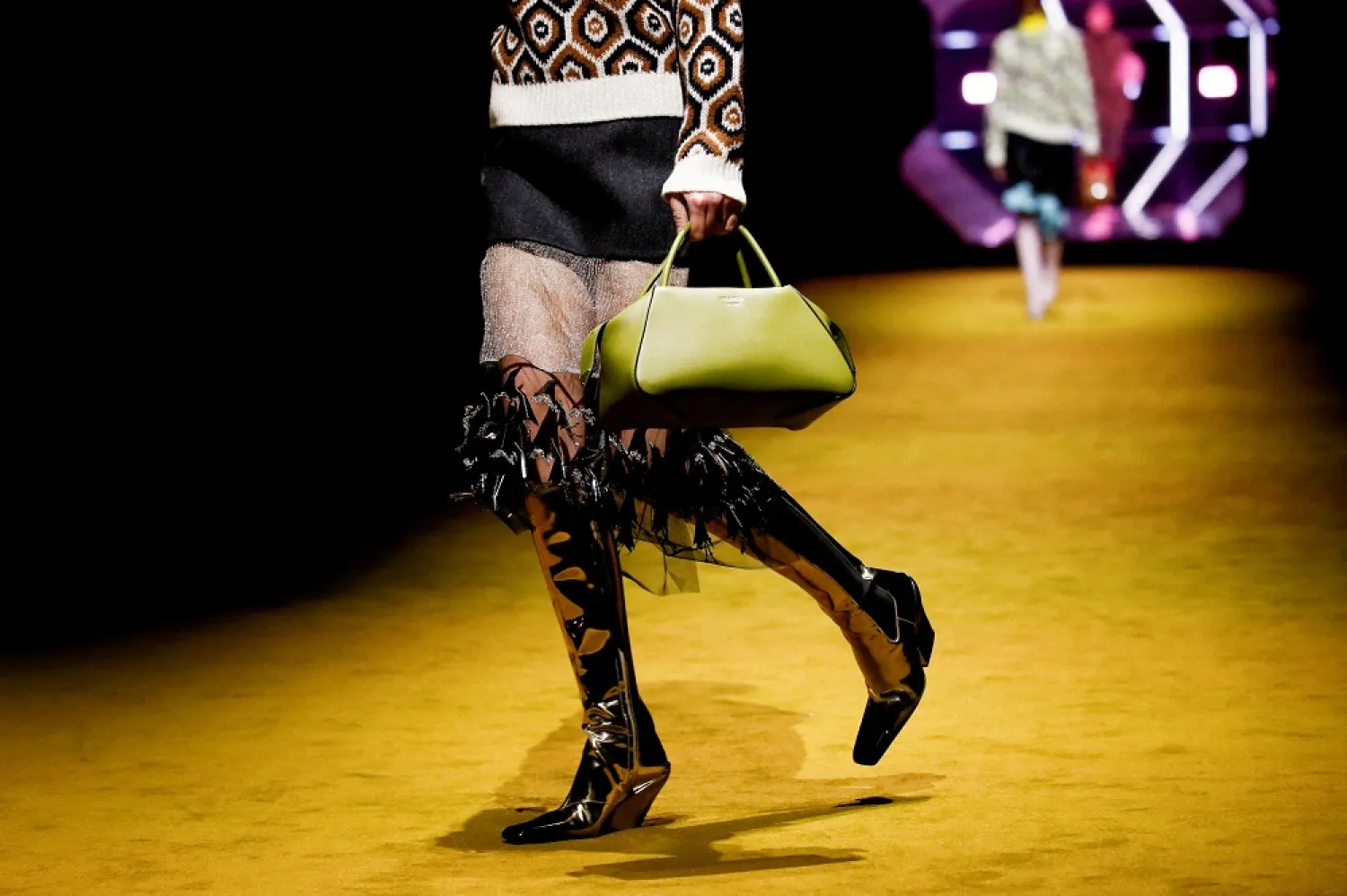
A model presents a creation from the Prada Fall-Winter 2022/2023 collection during Fashion Week in Milan, Italy, February 24, 2022. (Reuters)
TT

Prada Navigates Tricky COVID Curbs to Hold Beijing Show

A model presents a creation from the Prada Fall-Winter 2022/2023 collection during Fashion Week in Milan, Italy, February 24, 2022. (Reuters)

Prada on Friday became the first major luxury house to host a show in China this year, navigating strict COVID curbs to send models down a catwalk in a historic Beijing mansion hotel, a move aimed at underscoring its commitment to the market.

Livestreamed on multiple online platforms including Weibo, more than 400 celebrities and customers attended the event held by the Italian group in the Prince Jun’s Mansion Hotel, where it showcased its men and women's fall and winter collections.

Shows in Chinese cities by global luxury giants, from Prada to LVMH's Louis Vuitton and Christian Dior, used to be a familiar sight and continued even in 2020 and 2021 after China curbed the spread of the virus relatively quickly thanks to tough border curbs.

But much has changed in 2022 with China's continued insistence on a "dynamic zero COVID" policy that uses harsh measures to cut any virus transmission chain, even as the rest of the world opens up in the face of infectious Omicron variants.

Since the start of the year, several cities including China's commercial capital of Shanghai have undergone draconian lockdowns and much of the country's population is now required to undergo regular COVID-19 testing. These measures have bred uncertainty that has hit both the economy and consumer confidence.

In order to attend Prada's event, guests had to show proof of a negative COVID-19 test taken within 48 hours and masks were mandatory for all attendees indoors except the models stomping along the catwalk.

Those flying in from other Chinese cities also had to comply with Beijing's testing requirements for domestic travelers.

"[This event] is a key statement for the brand, especially in this moment where first mover advantage will be seen as more powerful and significant than before," said Kim Leitzes, APAC managing director of data provider Launchmetrics.

Prada declined requests to be interviewed for this story.

The brand has seen significant improvement in its China business in recent years, reducing its reliance on wholesale and driving more sales through its own stores and website, where items are more likely to be sold at full price.

It has also attracted a new generation of Chinese consumers with the appointment of superstar Cai Xukun as a celebrity ambassador in 2019.

"I'm very excited to be here tonight," said one of the Friday show attendees, Chen Zaozao, who works at an auction house in Beijing. "I used to have many opportunities to attend fashion events before but it has become rare these days."



Fashion Commission, Saudi Retail Academy to Develop National Talent 

Fashion Commission, Saudi Retail Academy to Develop National Talent 
TT

Fashion Commission, Saudi Retail Academy to Develop National Talent 

Fashion Commission, Saudi Retail Academy to Develop National Talent 

The Saudi Fashion Commission signed a memorandum of understanding (MoU) with the Saudi Retail Academy to develop national capabilities and boosting specialized skills in the fashion and retail sectors, reported the Saudi Press Agency on Monday.

The MoU aims to support local talent and the creation of sustainable employment opportunities in this vital industry. It stems from the two sides’ keenness to cooperate in the fields of training and professional development.

The agreement was signed on the sidelines of the graduation ceremony of the academy’s first cohort.

The Fashion Commission focuses on developing local talent, transferring global expertise, and advancing the fashion sector in the Kingdom, while the Saudi Retail Academy is a non-profit institute and a specialized entity in training and development in the retail field and in building professional competencies and skills related to retail and sales.

The MoU aims to establish a framework for cooperation to design and implement specialized training programs that boost the readiness of national cadres and qualify them according to the highest professional standards, with a focus on developing skills in sales, customer experience, and store management to meet labor market requirement and the needs of the growing fashion sector.

Fashion Commission chief executive Burak Cakmak said that developing human capital is a fundamental pillar for the long-term growth of the Kingdom’s fashion sector.

The partnership reflects the commitment to strengthening the capabilities that form the foundation of a competitive and sustainable industry through investment in specialized skills within retail and customer experience, enabling brands to grow and supporting the sector’s confident evolution, he added.

Saudi Retail Academy chief executive Hend Al-Dhaban stressed that the partnership embodies a shared vision to empower national talent and elevate professionalism in the retail sector.

The agreement will help channel training expertise to meet the specialized needs of the fashion sector and equip young men and women with the practical skills required to succeed in the labor market, thereby boosting service quality and supporting localization targets and economic growth, she explained.

This cooperation is part of the Fashion Commission’s ongoing efforts to develop the fashion value chain through building strategic partnerships with specialized training and education entities, expanding professional opportunities for national talent, and linking education and training outputs with labor-market needs.

Through their partnership, the commission and the academy will help in building an integrated ecosystem that connects education, vocational qualification, and employment, bolstering the competitiveness of the fashion and retail sectors and supporting the objectives of Saudi Vision 2030 in empowering national cadres, localizing jobs, and improving quality of life.


Saudi 100 Brands Debuts Landmark Fashion Presentation at Saudi Cup 2026

The experience introduced global audiences to Saudi Arabia’s dynamic and growing fashion ecosystem - SPA
TT

Saudi 100 Brands Debuts Landmark Fashion Presentation at Saudi Cup 2026

The experience introduced global audiences to Saudi Arabia’s dynamic and growing fashion ecosystem - SPA

The Fashion Commission launched its Saudi 100 Brands showcase at the Saudi Cup 2026, marking a historic milestone for the world-renowned equestrian event at King Abdulaziz Racecourse in Riyadh.
The collections celebrate Saudi heritage by blending traditional and contemporary design. Jewelry and accessory brands also exhibited throughout, providing Saudi designers with a platform to reach a broader global audience. These showcases emphasize the fusion of heritage and modern design, offering a new perspective on the Kingdom's creative identity.
The Saudi 100 Brands program, a flagship initiative of the Fashion Commission, supports emerging designers by providing tools, expertise, and platforms to grow their global presence. This collaboration with the Saudi Cup underscores the importance of celebrating cultural heritage while advancing design innovation.

Each piece in the exhibition incorporates heritage motifs, textiles, and storytelling, reimagined through innovative design to appeal to modern and international audiences.

The exhibition aims to celebrate national identity, highlight local creative talent, and present the evolving direction of Saudi fashion, SPA reported.

Visitors explored the intersection of craftsmanship and cultural expression, discovering how designers honor tradition while advancing fashion design.

The experience also introduced global audiences to Saudi Arabia’s dynamic and growing fashion ecosystem.

This participation reflects the Fashion Commission’s vision to develop a thriving fashion sector rooted in cultural heritage and global ambition. By combining cultural narratives with innovative design, the commission enables Saudi fashion to contribute to global creative industries, nurture talent, and position Saudi brands for sustained success.


L’Oreal Shares Sink as Sales Miss Forecasts 

This photo taken on February 16, 2018 shows a board with the L'Oreal logo outside of the L'Oreal plant, in Lassigny. (AFP)
TT

L’Oreal Shares Sink as Sales Miss Forecasts 

This photo taken on February 16, 2018 shows a board with the L'Oreal logo outside of the L'Oreal plant, in Lassigny. (AFP)

L'Oreal shares fell heavily on the Paris stock market on Friday after the cosmetics giant posted sales that fell short of analyst expectations, stoking fears of weakness for its luxury brands and in the key Chinese market.

While revenues rose seven percent in the fourth quarter in Europe -- still the company's biggest market -- they edged up just 0.7 percent in North America and fell five percent in North Asia, which includes China.

Overall, sales were up 1.5 percent to 11.2 billion euros ($13.3 billion) in the final quarter of 2025 -- usually when the company benefits from strong holiday-fueled buying.

This was a marked slowdown from the 4.5-percent growth seen the previous year.

On a like-for-like comparison that excludes the impact of currency fluctuations, sales rose six percent, whereas the consensus forecast was around eight percent, analysts said.

The luxury division (Luxe) in particular, which includes high-end perfumes and make-up and is L'Oreal's biggest by revenue, saw a 0.5-percent sales slide in the fourth quarter, to 4.2 billion euros.

"We think the miss, led by North Asia and Luxe, will be a concern amid a vague outlook," said David Hayes, an analyst at investment bank Jefferies.

L'Oreal's stock was down 3.2 percent in morning trading, partly recovering from a drop of more than six percent at the open.

Net profit for the full year was down 4.4 percent to 6.1 billion euros.

Chief executive Nicolas Hieronimus said when he presented the results on Thursday that L'Oreal had achieved a "solid" performance "despite a context that was at the very least volatile and unfavorable".

For 2026, he said the company had to be "cautious and humble", although he expected "the beauty market to continue its acceleration" unless there was "a new surprise".

"We're going to have to intensify our efforts in terms of innovation to energize the market and win over customers," he added.