


Ukraine Halted Oil Flows to Europe over Payment Issue, Russia’s Transneft Says

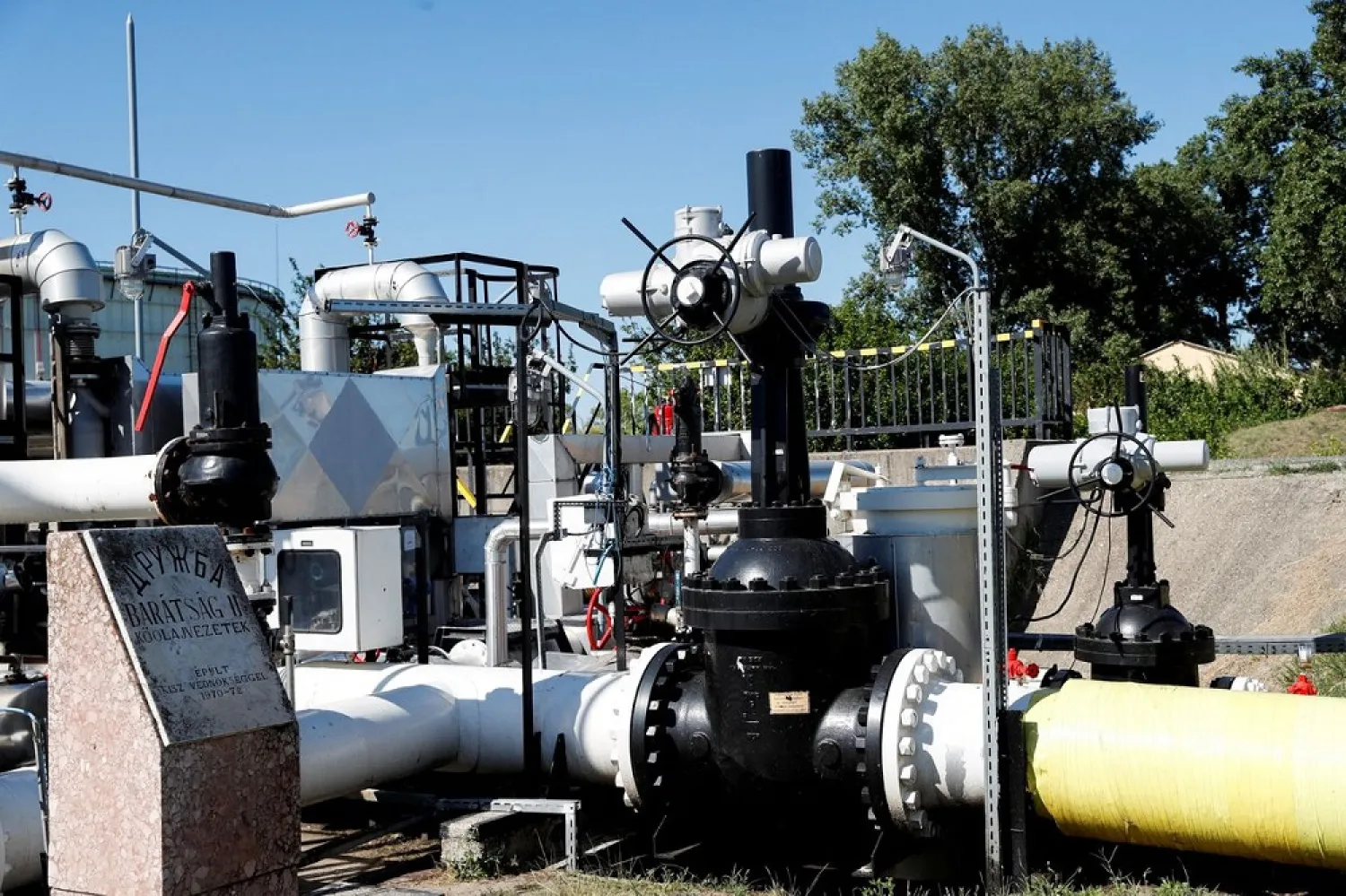
The receiver station of the Druzhba oil pipeline between Hungary and Russia is seen at the Hungarian MOL Group's Danube Refinery in Szazhalombatta, Hungary, May 18, 2022. (Reuters)
TT

Ukraine Halted Oil Flows to Europe over Payment Issue, Russia’s Transneft Says

The receiver station of the Druzhba oil pipeline between Hungary and Russia is seen at the Hungarian MOL Group's Danube Refinery in Szazhalombatta, Hungary, May 18, 2022. (Reuters)

Ukraine has suspended Russian oil pipeline flows to parts of central Europe since early this month because Western sanctions prevented it from accepting transit fees from Moscow, Russian pipeline monopoly Transneft said on Tuesday.

International benchmark Brent crude jumped by $2 per barrel to trade near $98 as the news added to energy supply concerns, but turned negative later in the day.

Europe is heavily reliant on Russian crude, diesel, natural gas and coal. Energy prices have rallied this year on short supply as Europe scrambles to replace Russian energy with alternative sources.

Flows along the southern route of the Druzhba pipeline have been affected while the northern route serving Poland and Germany remains uninterrupted.

The suspension of pipeline flows on Tuesday will hit countries such as Slovakia, Hungary and the Czech Republic, which all rely heavily on Russian crude and have limited ability to import alternative supply by sea.

The fact that refiners have to import seaborne oil on such short notice will make the job to secure alternative supply even more difficult in an already tight oil market, traders said.

Hungarian energy firm MOL and Slovak pipeline operator Transpetrol confirmed flows have been halted for a few days over the payment of transit fees.

MOL said it had reserves for several weeks and was working on a solution. MOL's oil refiner Slovnaft said that it initiated discussions with Ukraine and Russian partners on possible payment of the transit fee by Slovnaft or MOL.

Hungary is one of the most reliant countries on Russia oil and its government has been lobbying hard to get exemption from wider EU sanctions on Moscow.

Hungary can import oil via Adria pipeline that connects the Omisalj oil terminal in Croatia to its Duna refinery in Hungary, but the capacity of the route is limited and shipments are much more expensive than via Druzhba.

Slovakia's options for alternative oil imports are even more limited as it has to import oil via Hungary.

Poland's PKN Orlen, which controls refiner Unipetrol in the Czech Republic, may secure alternative supplies from Trieste in Italy via the Transalpine (TAL) pipeline, though the route is operating close to its limited capacity and might not be enough to fulfil feedstock needs, traders said.

The Czech Republic's pipeline company MERO has operative oil stocks that can last at least until the second half of August, and the government is not currently planning to tap its near 90-day strategic reserve, Industry Minister Jozef Sikela said on Tuesday.

MERO said it expected Russian oil supplies through the Druzhba pipeline to the Czech Republic to restart within several days.

Russia's Transneft said it made payments for August oil transit to Ukrainian pipeline operator UkrTransNafta on July 22, but the money was returned on July 28 as the payment did not go through.

It said the shipments were halted from Aug. 4.

Transneft said in a statement that Gazprombank, which handled the payment, told it the money was returned because of European Union restrictions.

Sanction rules

Under the new sanctions, European banks have to receive approval from a relevant government authority instead of deciding by themselves whether to allow a transaction, Transneft said.

It said European regulators had yet to decide on algorithms for all the banks, which complicates the dealings.

Transneft is considering alternative payment systems, but had sent a request for the transaction to be allowed, the pipeline monopoly said.

MOL and Unipetrol are the main buyers of oil via the Druzhba route, also known as the Friendship pipeline, while Russia's Lukoil, Rosneft and Tatneft are the main suppliers of oil.

UkrTransNafta did not respond to a request for comment.

Since March, Hungary, Slovakia and the Czech Republic have relied extensively on supplies of Russian Urals crude via the Druzhba pipeline and reduced purchases of maritime crude.

A decline in European demand for Russian oil since Russia invaded Ukraine at the end of February has pushed the value of seaborne Urals, used to price Druzhba deliveries, to the widest discount in history against the dated Brent benchmark.

Moscow refers to the invasion as a "special military operation".

Russia normally supplies about 250,000 barrels per day (bpd) via the southern leg of the Druzhba pipeline. If the supplies remain suspended Russian oil exporters will have to divert volumes to sea ports, traders said.

Russian oil loadings from its western ports of Primorsk, Ust-Luga and Novorossiisk were set at 8.74 million tons in August.

Russia, the world's second biggest oil exporter and leading gas exporter, has already reduced gas pipeline flows to many EU members, citing problems with turbine maintenance on the Nord Stream 1 pipeline as well as sanctions against some buyers Moscow describes as "unfriendly".



US Stocks Fall as Iran Angst Lifts Oil Prices

A screen displays a stock chart at a work station on the floor of the New York Stock Exchange (NYSE) in New York City, US, April 6, 2022. REUTERS/Brendan McDermid
TT

US Stocks Fall as Iran Angst Lifts Oil Prices

A screen displays a stock chart at a work station on the floor of the New York Stock Exchange (NYSE) in New York City, US, April 6, 2022. REUTERS/Brendan McDermid

Wall Street stocks retreated early Thursday as worries over US-Iran tensions lifted oil prices while markets digested mixed results from Walmart.

US oil futures rose to a six-month high as Iran's atomic energy chief Mohammad Eslami said no country can deprive the Islamic republic of its right to nuclear enrichment, after US President Donald Trump again hinted at military action following talks in Geneva.

"We'd call this an undercurrent of concern that is bubbling up in oil prices," Briefing.com analyst Patrick O'Hare said of the "geopolitical angst."

About 10 minutes into trading, the Dow Jones Industrial Average was down 0.6 percent at 49,379.46, AFP reported.

The broad-based S&P 500 fell 0.5 percent to 6,849.35, while the tech-rich Nasdaq Composite Index declined 0.6 percent to 22,621.38.

Among individual companies, Walmart rose 1.7 percent after reporting solid results but offering forecasts that missed analyst expectations.

Shares of the retail giant initially fell, but pushed higher after Walmart executives talked up artificial intelligence investments on a conference call with analysts.

The US trade deficit in goods expanded to a new record in 2025, government data showed, despite sweeping tariffs that Trump imposed during his first year back in the White House.


Gold Advances on US–Iran Tensions as Markets Weigh Fed Policy Path

UK gold bars and gold Sovereign coins are displayed at Baird & Co in Hatton Garden in London, Britain, October 8, 2025. REUTERS/Hiba Kola/File Photo
TT

Gold Advances on US–Iran Tensions as Markets Weigh Fed Policy Path

UK gold bars and gold Sovereign coins are displayed at Baird & Co in Hatton Garden in London, Britain, October 8, 2025. REUTERS/Hiba Kola/File Photo

Gold prices extended gains on Thursday after rising more than 2% in the previous session, as lingering tensions between the United States and Iran prompted a flight to safety, while investors evaluated the Federal Reserve's monetary policy path.

Spot gold rose 0.2% to $4,989.09 per ounce by 1227 GMT. US gold futures for April delivery held steady at $5,008.60.

"Geopolitical concerns are front and centre with reports that, if the US were to take military action against Iran, it could go on for several weeks," said Jamie Dutta, market analyst at Nemo.money, Reuters reported.

Some progress was made during Iran talks this week in Geneva but distance remained on some issues, the White House said on Wednesday.

FED LARGELY UNITED

Top US national security advisers met in the White House Situation Room on Wednesday to discuss Iran and were told all US military forces deployed to the region should be in place by mid-March.

Meanwhile, the Fed's January minutes showed it largely united on holding interest rates steady, but divided over what comes next, with "several" open to rate hikes if inflation remains elevated, while others were inclined to support further cuts if inflation recedes.

The weekly jobless claims data, due later in the day, and Friday's Personal Consumption Expenditures report, the Fed’s preferred inflation gauge, will provide further clues on the central bank's policy trajectory.

Markets currently expect this year's first interest rate cut to be in June, according to CME's FedWatch Tool.

Non-yielding bullion tends to do well in low-interest-rate environments.

Spot silver rose 0.9% to $77.87 per ounce after climbing more than 5% on Wednesday.

Silver is "supported by tight supply and low COMEX stock levels ahead of the delivery period of the March contract. However, given the extent of the historic correction earlier this month, silver is not back on safer ground until it trades back above $86," said Ole Hansen, head of commodity strategy at Saxo Bank.

Spot platinum fell 0.6% to $2,059.55 per ounce, while palladium lost 1.7% to $1,686.47.


Oil Prices Extend Gains on Concerns of Potential US-Iran Conflict

FILE PHOTO: The Phillips 66 Lake Charles Refinery is pictured in West Lake, Louisiana, US, June 12, 2018. REUTERS/Jonathan Bachman/File Photo
TT

Oil Prices Extend Gains on Concerns of Potential US-Iran Conflict

FILE PHOTO: The Phillips 66 Lake Charles Refinery is pictured in West Lake, Louisiana, US, June 12, 2018. REUTERS/Jonathan Bachman/File Photo

Oil prices rose on Thursday as the US and Iran attempted to ease a standoff in talks over Tehran's nuclear program while both sides heightened military activity in the key oil-producing region.

Brent futures climbed 23 cents, or 0.3% to $70.58 a barrel by 0735 GMT, while US West Texas Intermediate (WTI) crude gained 25 cents, or 0.4%, to trade at $65.44 a barrel.

Both benchmarks settled more than 4% higher on Wednesday, posting their highest settlements since January 30, as traders priced in the risk of supply disruptions in the event of ‌a conflict.

"Oil prices are ‌rallying as the market becomes increasingly concerned over the potential ‌for ⁠imminent US action ⁠against Iran," said ING analysts in a Thursday note.

Iranian state media reported the country had shut down the Strait of Hormuz for a few hours on Tuesday, without making clear whether the waterway had fully reopened. About 20% ⁠of the world's oil supply passes through the waterway.

"Tensions between Washington ‌and Tehran remain high, but the prevailing view ‌is that full-scale armed conflict is unlikely, prompting a wait-and-see approach," said Hiroyuki Kikukawa, chief strategist of ‌Nissan Securities Investment, a unit of Nissan Securities.

"US President Donald Trump does not ‌want a sharp rise in crude prices, and even if military action occurs, it would likely be limited to short-term air strikes," Kikukawa added.

A degree of progress was made during Iran talks in Geneva this week but distance remained on some issues, the White House said on Wednesday, ‌adding that it expected Tehran to come back with more details in a couple of weeks.

Iran issued a notice to ⁠airmen (NOTAM) that ⁠it plans rocket launches in areas across its south on Thursday from 0330 GMT to 1330 GMT, according to the US Federal Aviation Administration website.

At the same time, the US has deployed warships near Iran, with US Vice President JD Vance saying Washington was weighing whether to continue diplomatic engagement with Tehran or pursue "another option".

Meanwhile, two days of peace talks in Geneva between Ukraine and Russia ended on Wednesday without a breakthrough, with Ukrainian President Volodymyr Zelenskiy accusing Moscow of stalling US-mediated efforts to end the four-year-old war.

US crude and gasoline and distillate inventories fell last week, market sources said, citing American Petroleum Institute figures on Wednesday, contrary to expectations in a Reuters poll that crude stocks would rise by 2.1 million barrels in the week to February 13.

Official US oil inventory reports from the Energy Information Administration are due on Thursday.