

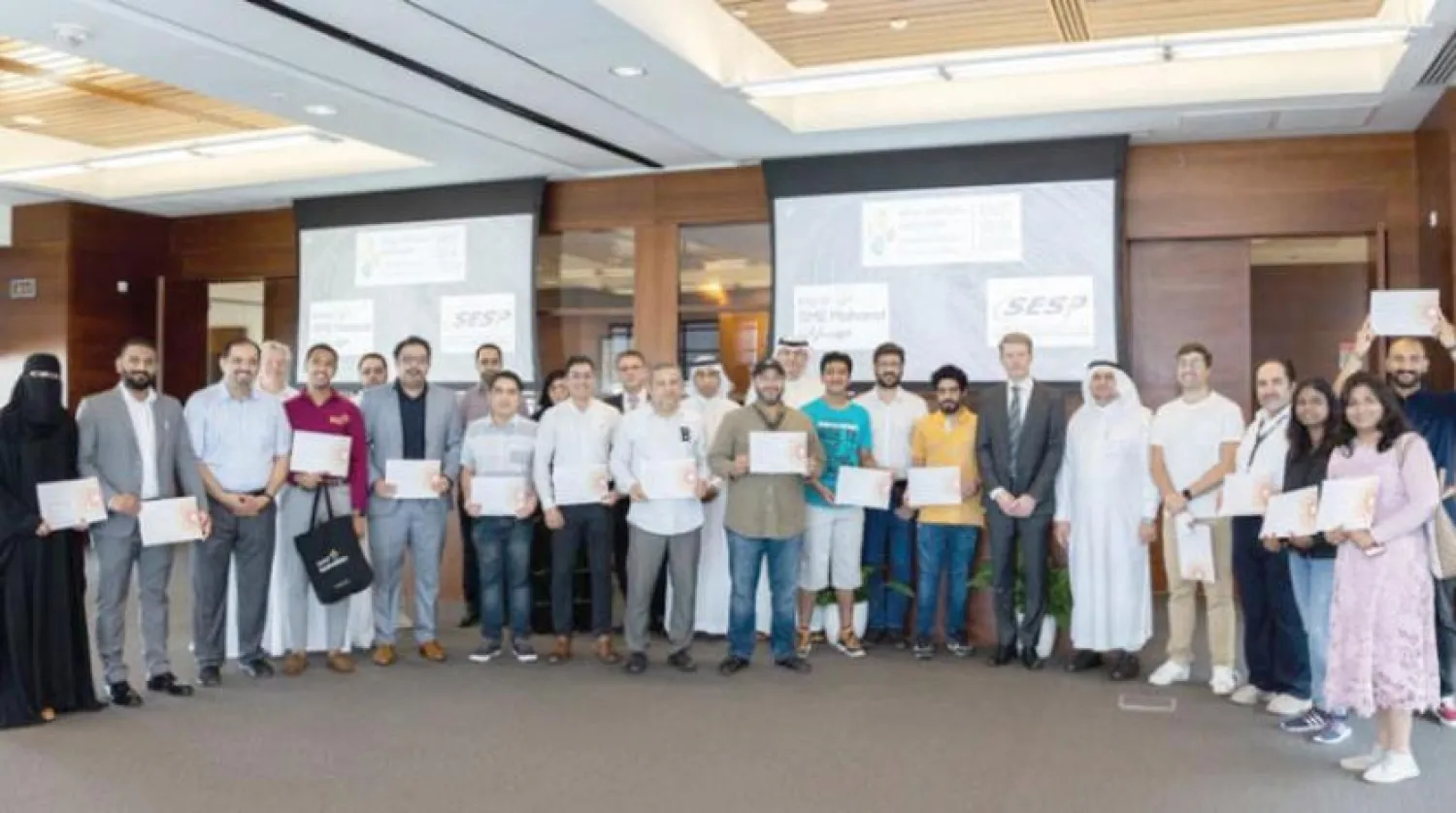

KAUST, SESP Sign MoU to Train Qualified Cadres in Solar Power Industry

The King Abdullah University of Science and Technology (KAUST) has signed a memorandum of understanding (MoU) with the Saudi Electric Services Polytechnic (SESP)
TT

KAUST, SESP Sign MoU to Train Qualified Cadres in Solar Power Industry

The King Abdullah University of Science and Technology (KAUST) has signed a memorandum of understanding (MoU) with the Saudi Electric Services Polytechnic (SESP)

The King Abdullah University of Science and Technology (KAUST) has signed a memorandum of understanding (MoU) with the Saudi Electric Services Polytechnic (SESP), a leading center of vocational training in the field of energy.

The MoU supports the renewable energy goals stated in the Saudi Vision 2030. Both KAUST and SESP look forward to achieving joint, strategic goals, and implementing projects and initiatives that enhance solar power skills in the Kingdom.

Saudi Arabia is characterized with a geographic location and climate suitable for solar energy, which is set to become a key power source in the country. One of the Saudi Vision 2030 goals is to generate half of its power needs using renewables including solar power.

The MoU crowns KAUST and SESP’s unified efforts to train skilled and qualified national cadres to design and install solar panels, to help achieve one of the country’s strategic priorities -the conversion to clean energy- and prepare over 100 skilled workers by 2023.

This partnership consists of two programs that focus on designing photovoltaic power and installing photovoltaic power. At the end of the programs, trainees will have the chance to apply for official tests at the Saudi Electricity Company (SEC) to become certified designers and technicians in the solar power industry.

This is not the first cooperation between KAUST and SESP. They formerly joined efforts in providing training courses in partnership with KAUST’s Solar Center, which contributed to making qualified Saudi engineers who designed photovoltaic and solar power plants in the country. Supported by KAUST’s innovation department responsible for translating research and building abilities, SESP and KAUST’s Solar Center also launched the first vocational training program for solar power techniques.

Dr. Kevin Cullen, KAUST vice president for innovation, said: “Building technical abilities and skilled workforce in the Kingdom is among KAUST’s top innovation goals. We look forward to supporting SESP and the Solar Center in KAUST by establishing the first program aimed at filling the gap in the specialized workforce, and basic infrastructure in the Saudi solar power market.”

“The institute was capable of producing qualified, productive graduates while also recognizing the need of renewable energy companies for qualified junior technicians,” said SESP Director-General Dr. Khaled Al-Somali.

“There is no doubt that the ongoing improvements in our institute, programs, financial status, and culture based on safety, respect, good manner, and constant education, have contributed to perfectly achieve our visions and goals.”

As part of the MoU, a coordination team including two senior executives from KAUST and SESP will be formed to oversee the exchange of knowledge and expertise, with focus on graduating skilled leaders.

By signing this MoU, both parties have emphasized their joint will to establish a special connection that serves their strategic interests in line with the Kingdom’s goals including addressing the national, regional, and global challenges topped by economic diversification, providing skilled workforce, and building a more sustainable future.



Snowstorm Paralyzes Vienna Airport

People wait at a tram stop after heavy snowfalls in Vienna, Austria, February 20, 2026. REUTERS/Elisabeth Mandl
TT

Snowstorm Paralyzes Vienna Airport

People wait at a tram stop after heavy snowfalls in Vienna, Austria, February 20, 2026. REUTERS/Elisabeth Mandl

Massive snowstorms caused power outages and transport chaos in Austria on Friday, forcing the Vienna airport to temporarily halt all flights.

Flights departing from the capital, a major European hub, were cancelled or delayed, and more than 230 arrivals were similarly disrupted or rerouted.

"Passengers whose flights have been delayed are asked not to come to the airport," the facility said in a statement.

The area received 20 centimeters (nearly eight inches) of snow, national news agency APA reported.

The main highway south of Vienna was closed for several hours, and other sections of highway were temporarily inaccessible because of snowdrift, stranded lorries or poor visibility, said the national automobile association, OAMTC.

According to AFP, electric companies reported power outages in several regions in the south and east, including Styria, where 30,000 homes lost electricity.

The weather was forecast to improve from around midday, but the risk of avalanches remained high.


NASA Delivers Harsh Assessment of Botched Boeing Starliner Test Flight

NASA duo Butch Wilmore and Suni Williams were stuck on the ISS for nine months. Handout / NASA TV/AFP/File
TT

NASA Delivers Harsh Assessment of Botched Boeing Starliner Test Flight

NASA duo Butch Wilmore and Suni Williams were stuck on the ISS for nine months. Handout / NASA TV/AFP/File

NASA on Thursday blamed what it called engineering vulnerabilities in Boeing's Starliner spacecraft along with internal agency mistakes in a sharply critical report assessing a botched mission that left two astronauts stranded in space.

The US space agency labeled the 2024 test flight of the Starliner capsule a "Type A" mishap -- the same classification as the deadly Challenger and Columbia shuttle disasters -- a category that reflects the "potential for a significant mishap," it said.

The failures left a pair of NASA astronauts stranded aboard the International Space Station for nine months in a mission that captured global attention and became a political flashpoint.

"Starliner has design and engineering deficiencies that must be corrected, but the most troubling failure revealed by this investigation is not hardware. It's decision-making and leadership," said NASA administrator Jared Isaacman in a briefing.

"If left unchecked," he said, this mismanagement "could create a culture incompatible with human spaceflight."

The top space official said the investigation found that a concern for the reputation of Boeing's Starliner clouded an earlier internal probe into the incident.

"Programmatic advocacy exceeded reasonable bounds and place the mission, the crew and America's space program at risk in ways that were not fully understood at the time," Isaacman said.

He said Starliner currently "is less reliable for crew survival than other crewed vehicles" and that "NASA will not fly another crew on Starliner until technical causes are understood and corrected" and a problematic propulsion system is fixed.

But the administrator insisted that "NASA will continue to work with Boeing, as we do all of our partners that are undertaking test flights."

In a statement, Boeing said it has "made substantial progress on corrective actions for technical challenges we encountered and driven significant cultural changes across the team that directly align with the findings in the report."

- 'We failed them' -

Isaacman also had harsh words for internal conduct at NASA.

"We managed the contract. We accepted the vehicle, we launched the crew to space. We made decisions from docking through post-mission actions," he told journalists.

"A considerable portion of the responsibility and accountability rests here."

In June 2024 Butch Wilmore and Suni Williams embarked on what was meant to be an eight-to-14-day mission. But this turned into nine months after propulsion problems emerged in orbit and the Starliner spacecraft was deemed unfit to fly them back.

The ex-Navy pilots were reassigned to the NASA-SpaceX Crew-9 mission. A Dragon spacecraft flew to the ISS that September with a team of two, rather than the usual four, to make room for the stranded pair.

The duo, both now retired, were finally able to arrive home safely in March 2025.

"They have so much grace, and they're so competent, the two of them, and we failed them," NASA associate administrator Amit Kshatriya told Thursday's briefing.

"The agency failed them."

Kshatriya said the details of the report were "hard to hear" but that "transparency" was the only path forward.

"This is not about pointing fingers," he said. "It's about making sure that we are holding each other accountable."

Both Boeing and SpaceX were commissioned to handle missions to the ISS more than a decade ago.


Abandoned Baby Monkey Finds Comfort in Stuffed Orangutan

A baby Japanese macaque named Punch sits next to a stuffed orangutan at Ichikawa City Zoo, in Ichikawa, Chiba Prefecture, Japan, February 19, 2026. REUTERS/Kim Kyung-Hoon
TT

Abandoned Baby Monkey Finds Comfort in Stuffed Orangutan

A baby Japanese macaque named Punch sits next to a stuffed orangutan at Ichikawa City Zoo, in Ichikawa, Chiba Prefecture, Japan, February 19, 2026. REUTERS/Kim Kyung-Hoon

At a zoo outside Tokyo, the monkey enclosure has become a must-see attraction thanks to an inseparable pair: Punch, a baby Japanese macaque, and his stuffed orangutan companion.

Punch's mother abandoned the macaque when he was born seven months ago at the Ichikawa City Zoo and when an onlooker noticed and alerted zookeepers, they swung into action.

Japanese baby macaques typically cling to their mothers to build muscle strength and for a ‌sense of security, ‌so Punch needed a swift intervention, zookeeper ‌Kosuke ⁠Shikano said. The keepers ⁠experimented with substitutes including rolled-up towels and other stuffed animals before settling on the orange, bug-eyed orangutan, sold by Swedish furniture brand IKEA.

“This stuffed animal has relatively long hair and several easy places to hold," Shikano said. "We thought that its resemblance to a monkey might help ⁠Punch integrate back into the troop later ‌on, and that’s why ‌we chose it."

Punch has rarely been seen without it since, ‌dragging the cuddly toy everywhere even though it is ‌bigger than him, and delighting fans who have flocked to the zoo since videos of the two went viral, Reuters reported.

“Seeing Punch on social media, abandoned by his parents but still trying ‌so hard, really moved me," said 26-year-old nurse Miyu Igarashi. "So when I got the ⁠chance to ⁠meet up with a friend today, I suggested we go see Punch together.”

Shikano thinks Punch's mother abandoned him because of the extreme heat in July when she gave birth.

Punch has had some differences with the other monkeys as he has tried to communicate with them, but zookeepers say that is part of the learning process and he is steadily integrating with the troop.

"I think there will come a day when he no longer needs his stuffed toy," Shikano said.