

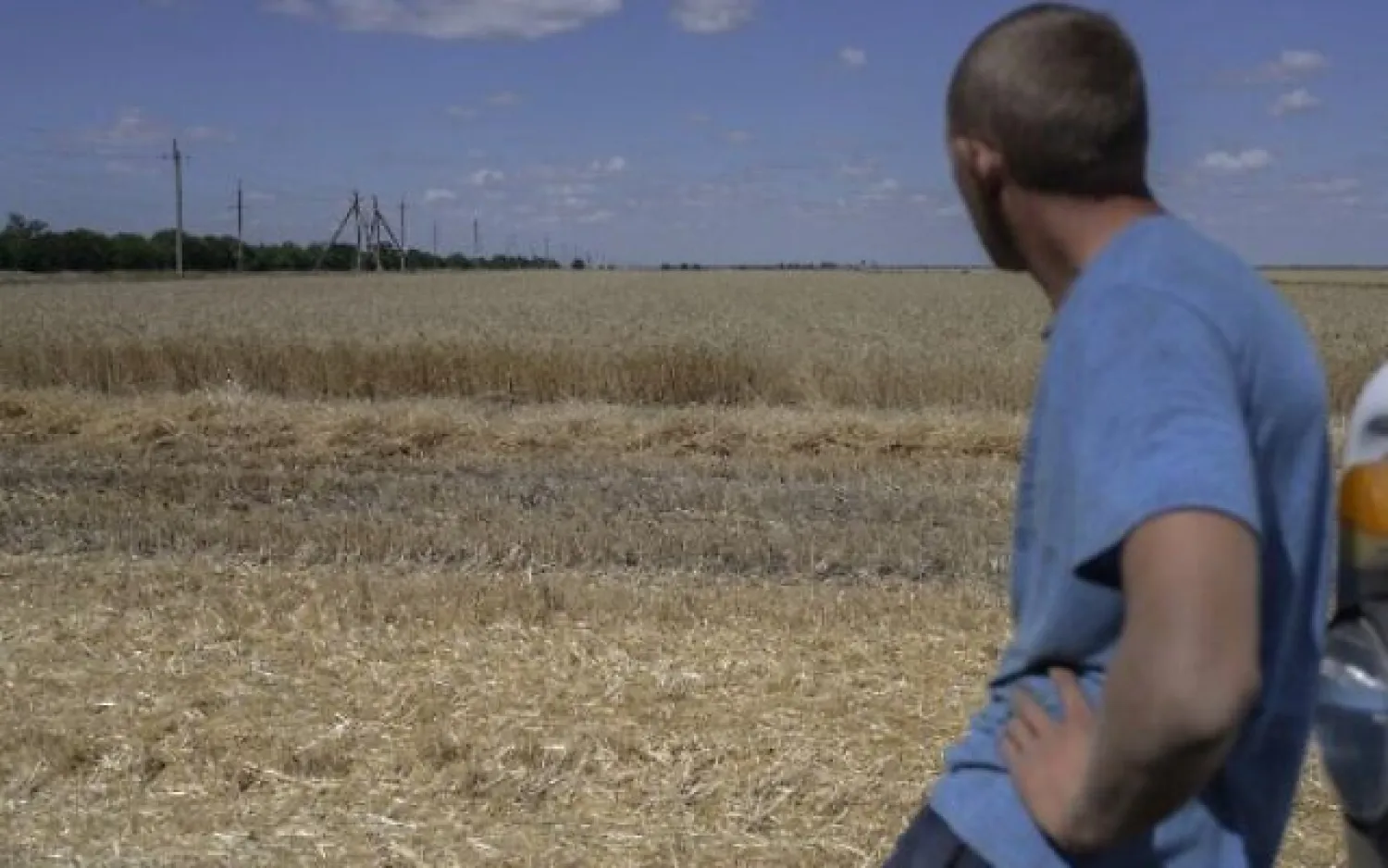

Farming Under Fire on the Frontlines in Eastern Ukraine

A farmer stands next to wheat field near Mykolaiv, Ukraine, July 21, 2022. (Bulent Kilic/AFP)
TT

Farming Under Fire on the Frontlines in Eastern Ukraine

A farmer stands next to wheat field near Mykolaiv, Ukraine, July 21, 2022. (Bulent Kilic/AFP)

The combine harvester lies crippled in a field of eastern Ukraine, surrounded by a blackened patch of cropland.

The machine was lumbering through a pasture outside the village of Maidan -- around 20 kilometers (12 miles) from the frontline with Russian forces -- when it struck a mine, according to farmer Pavlo Kudimov.

One front wheel was wrenched off and the giant rotating reel prized aside, as the cabin was scorched by flames, AFP said.

The next morning the driver remained in hospital suffering serious burns as the wreck still smoldered, a reminder of the risks of tending land in a breadbasket that has become a brutal war zone.

"Farming has always been hard, but it's even harder now," Kudimov told AFP.

At the start of August, the first shipment of grain left Ukraine since Russia launched its large-scale invasion and blockaded Kyiv's ports on the southern Black Sea.

Ukraine accounts for 10 percent of the world wheat market and the boat left under a deal brokered by Turkey and the United Nations, eager to assuage a global food price crisis hammering poor nations.

Inside Ukraine, the embargo on grain exports has created a crisis for farmers.

With no access to international markets, silos are full, prices have dived and the supply chain logjam has yet to ease up.

- 'Risking our lives' -
Farmers in Donbas -- the eastern region where the war with Russia shifted after the Kremlin gambit to capture Kyiv failed -- are facing threats on two fronts.

Comprising the regions of Donetsk and Lugansk, Donbas is the industrial and farming heartland of Ukraine.

But every day the air raid sirens sound. Rockets rain down, military jets attack ground targets and cluster bombs speckle fields.

Endless sunflower pastures are now gouged with defensive trenches.

Last year, farmer Sergey Lubarskyi was paid up to 8 hryvnia ($0.22) for each kilo of wheat.

Since the blockade, he can now fetch just 3 hryvnia -- if he can transport it to the regional hub of Kramatorsk.

In the frontline village of Rai-Aleksandrovka, he can only fetch 1.80 hyrvnia.

"Drivers are afraid to come here," he says.

Eduard Stukalo, 46, farms 150 hectares on the outskirts of the city of Sloviansk.

Some 30 hectares of wheat have "completely burned down" -- he suspects from artillery fire.

It is a struggle to convince workers to collect the crop that remains near the frontlines.

"Farmers like us will go bankrupt this year," he says. "No one wants to go there to harvest, because everyone is afraid of incoming missiles."

"We were risking our lives also when we sowed the fields in April and May this year," he added.

"Cluster bombs hit our fields. Bombs exploded 100 to 200 meters from us."

But some are driven by wartime austerity to work the land, despite the risks.

"We go to work in the fields, because there is no other employment here," said 57-year-old Svitlana Gaponova, plucking aubergines in a field outside the besieged settlement of Soledar.

"It's scary, but it's distracting," she said as the sound of munition blasts rolled across the horizon.

- 'Nothing left' -
In this impoverished portion of Ukraine, there is also a strong tradition of subsistence farming.

At the Sunday market, stallholders sell the meagre produce they can nurture in their personal plots.

"People plant their gardens and they work there constantly," said Volodymyr Rybalkin, military administration head of the frontline Sviatohirsk district, discussing residents' reluctance to leave.

"We constantly explain to people what is happening around, and try to motivate them to evacuate to safer cities."

Though these plots do not weigh on the scales of global trade and politics, they are not exempt from the perils of wartime.

In the early hours last Monday morning, incoming fire cratered the space behind 57-year-old Lyubov Kanisheva's modest cottage on the outskirts of Kramatorsk.

Next door more than a dozen beehives were shattered and upended. Now the swarming hum of bees merges with the hounding air raid siren.

In Kanisheva's plot, grape vines have been caked in dust and tomatoes smashed into the earth.

"The garden was just for our needs, but we managed to grow a lot," she said.

"There is nothing of it left."


'Call of Duty' Co-creator Vince Zampella Killed in Car Crash

Vince Zampella died while driving his Ferrari north of Los Angeles. Frederick M. Brown / GETTY IMAGES NORTH AMERICA/AFP
TT

'Call of Duty' Co-creator Vince Zampella Killed in Car Crash

Vince Zampella died while driving his Ferrari north of Los Angeles. Frederick M. Brown / GETTY IMAGES NORTH AMERICA/AFP

Vince Zampella, the acclaimed co-creator of video gaming juggernaut "Call of Duty," has died in a car crash, gaming giant Electronic Arts confirmed on Monday. He was 55.

The developer and executive died on Sunday while driving his Ferrari on a scenic road north of Los Angeles, according to local broadcaster NBC4.

"For unknown reasons, the vehicle veered off the roadway, struck a concrete barrier, and became fully engulfed," the California Highway Patrol said in a statement, without identifying the two victims in the crash.

The CHP added that both the driver and a passenger who was ejected from the vehicle succumbed to their injuries, reported AFP.

Witnesses posted video of the mangled cherry-red Ferarri, engulfed in flames, on the mountain road. The cause of the crash remains under investigation.

His studios created some of the world's best-selling video games, and Zampella was considered an innovator in first-person military shooter style games.

This year, when his "Battlefield 6" video game set a new sales record for the franchise, Zampella expressed gratitude, saying "we never take moments like this for granted" -- despite a long career of success in gaming.

The mass-combat game has won over 100 million players in the past two decades, in its various iterations.

And yet, that number isn't a first. To this day, "Call of Duty" boasts more than 100 milion active players, monthly.

"You have that dream of the game being popular, but I don't think you're ever ready for that level of success," Zampella told gaming site IGN in a 2016 interview.

Profound, far-reaching

Zampella was best known for co-creating the "Call of Duty" franchise and founding Respawn Entertainment, the studio behind "Titanfall,Apex Legends," and the "Star Wars Jedi" games.

After starting out in the 1990s as a designer on shooter games, he co-founded Infinity Ward in 2002 and helped launch "Call of Duty" in 2003. Activision later acquired his studio.

He left Activision under contentious circumstances and established Respawn in 2010, which Electronic Arts acquired in 2017.

At EA, he eventually took charge of revitalizing the "Battlefield" franchise, cementing his reputation as one of the most influential figures in modern first-person shooter games.

"This is an unimaginable loss, and our hearts are with Vince's family, his loved ones, and all those touched by his work," Electronic Arts said in a statement.

"Vince's influence on the video game industry was profound and far-reaching," the company said, adding that "his work helped shape modern interactive entertainment."

A statement by Respawn, posted on the "Battlefield" X account, praised Zampella "for how he showed up every day, trusting his teams, encouraging bold ideas, and believing in Battlefield and the people building it."

Zampella "championed what he believed was right for the people behind those studios and our players because it mattered."

"It was a bold, transgressive method of storytelling, of a moment in time that was political, that was violent and that was impactful," Washington Post video game reporter Gene Park told NBC4.

"He really knew how to create stories and create experiences, that really hit at the heart of human experience -- whether it was terror, dread, heroism. I think he was really able to kindof encapsulate that through the designs of the video games that he made," Park said.


GEA Chairman Named 2025 ‘Promoter of the Year’ by Boxing News

Turki Alalshikh, Chairman of the General Entertainment Authority (GEA) and Saudi Boxing Federation President, was named “Promoter of the Year” for 2025 by the Britain-based Boxing News magazine. (SPA)
TT

GEA Chairman Named 2025 ‘Promoter of the Year’ by Boxing News

Turki Alalshikh, Chairman of the General Entertainment Authority (GEA) and Saudi Boxing Federation President, was named “Promoter of the Year” for 2025 by the Britain-based Boxing News magazine. (SPA)

Turki Alalshikh, Chairman of the General Entertainment Authority (GEA) and Saudi Boxing Federation President, was named “Promoter of the Year” for 2025 by the Britain-based Boxing News magazine, the Saudi Press Agency reported on Tuesday.

The recognition reflects Alalshikh influential contributions and growing role in advancing the global boxing industry, built on a series of initiatives led by him in recent years.

It celebrates his efforts in elevating the stature of major fight cards, raising organizational standards, and enhancing both the sporting and media experience of boxing events, with a vision and strong international partnerships that have been instrumental in attracting the sport’s biggest global names.


Al-Qatif Street Food Festival Celebrates Saudi Culinary Arts

The event features six pavilions that allow visitors to explore a wide variety of foods and beverages made from local ingredients, reflecting the Kingdom’s diverse environments and regional flavors - SPA
TT

Al-Qatif Street Food Festival Celebrates Saudi Culinary Arts

The event features six pavilions that allow visitors to explore a wide variety of foods and beverages made from local ingredients, reflecting the Kingdom’s diverse environments and regional flavors - SPA

The Culinary Arts Commission launched Al-Qatif Street Food Festival, which runs until December 30, 2025, offering visitors a rich cultural experience that highlights Saudi culinary arts in a setting that reflects the authenticity and diversity of the Kingdom’s national cuisine, while reinforcing the presence of heritage within the contemporary cultural landscape.

The festival showcases Saudi food culture as a vital component of national identity through live cooking stations where traditional dishes are prepared and presented by culinary experts, SPA reported.

The event features six pavilions that allow visitors to explore a wide variety of foods and beverages made from local ingredients, reflecting the Kingdom’s diverse environments and regional flavors.

In addition to the culinary offerings, the festival presents a range of accompanying cultural experiences designed to enrich the visitor journey and encourage engagement with food as both an artistic and knowledge-based experience.

These include a dedicated children’s pavilion, interactive tasting spaces for dishes, and innovative beverage experiences inspired by Saudi agricultural products.
