



Saudi Arabia Announces Qualified Bidders for 2nd Exploration Licensing Round at Umm Ad Damar

A general view of Riyadh, Saudi Arabia. (SPA)
TT

Saudi Arabia Announces Qualified Bidders for 2nd Exploration Licensing Round at Umm Ad Damar

A general view of Riyadh, Saudi Arabia. (SPA)

Saudi Ministry of Industry and Mineral Resources announced on Wednesday that 13 bidders have qualified for the second stage of the Umm Ad Damar exploration site licensing round, the second of its kind in the Kingdom.

The move is in with Saudi Vision 2030, which seeks to transform the mining sector into the third pillar of the national industries.

Umm Ad Damar is an early exploration site that is part of the mineral-rich Arabian Shield, and covers more than 40 square km. The Umm Ad Damar deposit, which includes copper, zinc, gold, and silver, lies 300km northeast of Jeddah and 25km northwest of Mahd Adh Dhahab town, on the Jeddah geological terrane in the Jabal Saiyd mineralized belt within the Mahad formation.

On July 17, a diverse pool of highly experienced and competent candidates, both local and international, submitted qualification questionnaires with the aim of proceeding to the second stage of the licensing round.

The Ministry has qualified 13 bidders from this pool to the proposal stage: Abdul Rahman Saad AlRashid & Sons Co. (ARTAR), African Rainbow Minerals, Al Masane Al Kobra Mining Company (AMAK), Alara Saudi Ventures PTY LTD, Barrick Gold T 7 Limited, Consortium between Moxico Resources PLC and Ajlan & bros mining company, ERG Arabia LLC, Norin Mining Ltd, Saudi Arabian Mining Company (Ma’aden), UDS Golden Group, Vedanta Limited, Yancoal Australia Ltd. and Yilmaden Holding.

Qualified bidders will receive an Information Memorandum, which sets out the requirements to follow when submitting their proposals for the site exploration license. Qualified bidders are given until the beginning of October 2022 to complete and submit their proposals.

Proposal submissions will be assessed based on a number of criteria, including technical, financial, environmental, and social management plans. Qualified bidders can now access the data room, which includes an Independent Technical Report and additional data such as the 3D model.

The qualified bidders will also be invited to a workshop which will be organized by the Ministry in August to learn more about the next stages of the licensing round process and visit the site in person. This will be followed by a multi-round auction to select the preferred bidder.

Considering the emphasis Saudi Arabia is placing on environmental, social and governance (ESG) as it seeks to lead and transform the region’s mining sector, bidders will need to demonstrate how they will uphold these principles in terms of providing a social plan that demonstrates the bidders’ positive contribution and commitment to the surrounding communities.

The current Umm Ad Damar licensing round is a key milestone for the Ministry of Industry and Mineral Resources and supports its objectives of enabling the growth of the mining industry in Saudi Arabia and diversifying the economy towards a sustainable future. The Kingdom’s second mineral tender for Umm Ad Damar is a continuation of a successful and new chapter in the journey towards a robust Saudi Mining sector.

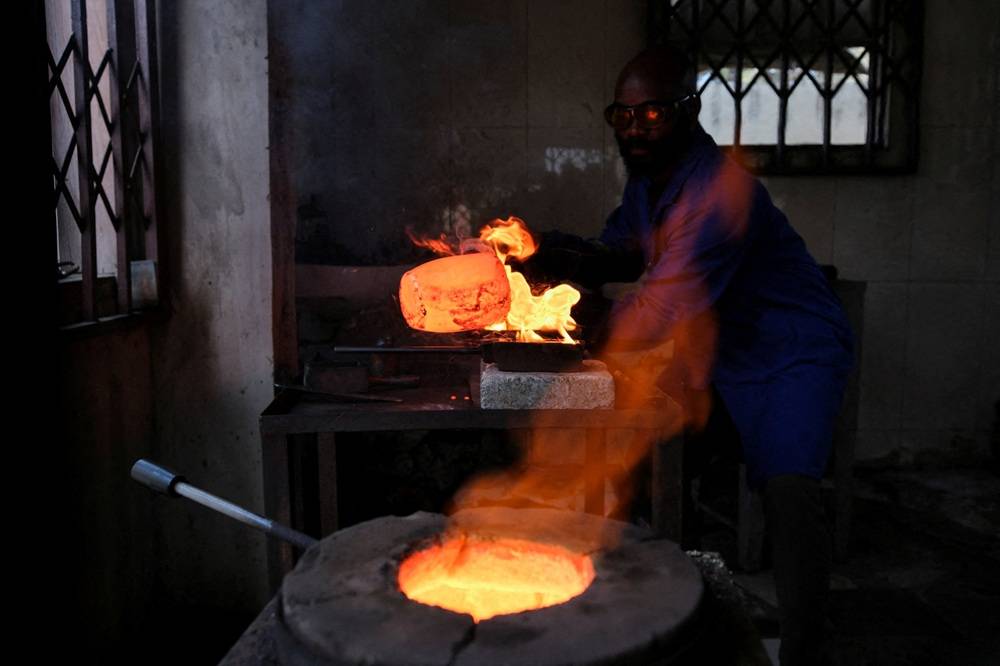
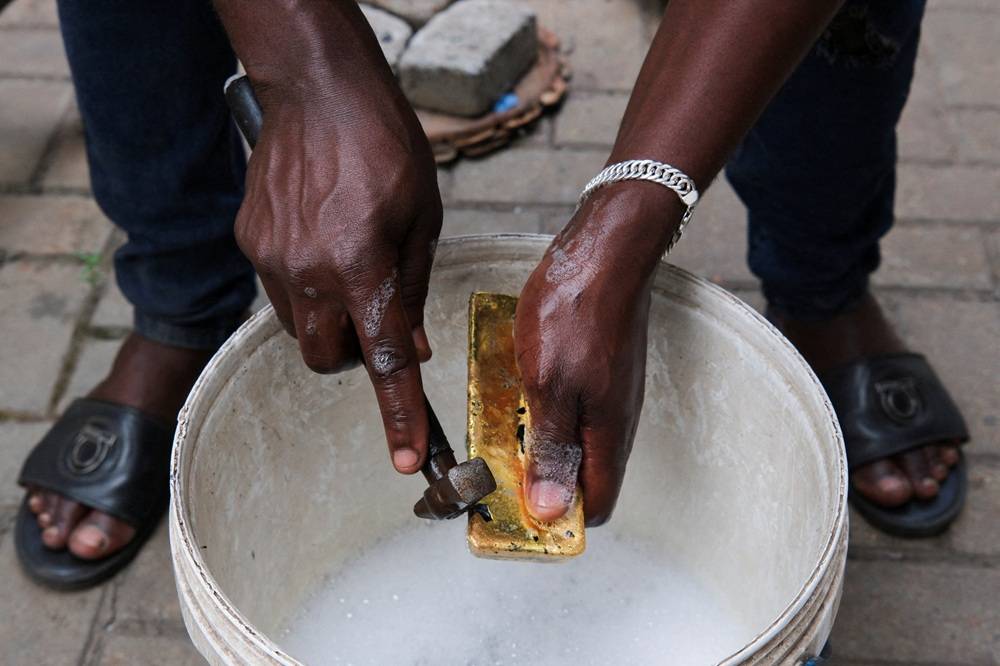
West Africa’s Rush to Refine Its Own Gold Unleashes Flood of Capacity

A worker washes off excess impurities during a gold smelting process at a facility in Accra, Ghana August 22, 2024. (Reuters)
TT

West Africa’s Rush to Refine Its Own Gold Unleashes Flood of Capacity

A worker washes off excess impurities during a gold smelting process at a facility in Accra, Ghana August 22, 2024. (Reuters)

West African governments are racing to refine gold at home to capture more mining revenue from soaring prices and reduce reliance on foreign hubs.

But miners and investors warn the region may be building more refining capacity than it has gold to process, raising the risk of idle plants and weaker returns for investors and governments. Producers could face lower prices if local refineries lack access to major bullion markets.

Since 2024, Ghana, Guinea, Mali and Burkina Faso have launched or announced projects with combined annual capacity that is nearly double West Africa's gold output.

Unlike bauxite or ‌iron ore, where ‌processing can significantly increase value, gold's worth is largely realized before refining. ‌Four ⁠mining executives said ⁠that leaves refiners competing in a low-margin business where commercial success depends more on scale, accreditation and access to global markets.

A worker smelts gold at a facility in Accra, Ghana August 22, 2024. (Reuters)

MORE REFINERIES THAN GOLD

"There is already overcapacity in terms of gold refining across Africa and globally," Rand Refinery chief executive Dean Subramanian told Reuters.

"The risk is additional processing capacity competing for the same accessible, responsibly sourced feedstock."

Since 2024, West African governments have launched or commissioned at least four major gold refineries with combined annual capacity of more than 1,000 metric tons, compared with estimated regional output of about 585 ⁠tons.

Despite operating several underutilized refineries, Ghana, Africa's largest gold producer, plans a ‌new 600-ton-per-year refinery in 2027.

The CEO of the Ghana Chamber ‌of Bullion Traders, Dan Krampah, said there is no "economically compelling case for another refinery."

THERE'S MORE TO DOMESTIC REFINING ‌THAN MARGINS

Governments argue that refining projects should be judged on broader economic and strategic objectives rather ‌than refining margins alone.

Supporters of local refining argue it could help formalize artisanal mining, gold mining carried out by individual miners or small groups, and give central banks greater access to domestic gold supplies.

Ghana has expanded domestic gold purchases as part of efforts to strengthen foreign-exchange reserves, an approach other African governments are studying.

Yet investors caution ‌that localization does not guarantee commercial viability.

"Governments are increasingly pushing for local processing and refining, which is a noble goal, but many countries still lack ⁠the power, infrastructure, skills ⁠and capital required to support it at scale," said Appian Capital Advisory CEO Michael Scherb.

A worker washes off excess impurities during a gold smelting process at a facility in Accra, Ghana August 22, 2024. (Reuters)

CERTIFICATION HEADACHES

Another issue facing some of the new refiners is their lack of certification under the London Bullion Market Association (LBMA), complicating access to key markets.

LBMA Good Delivery accreditation allows refiners to access the world's largest bullion-trading networks and is often a prerequisite for selling to major banks, traders and central banks.

In Guinea, miners are already stockpiling gold as they adapt to new local refining requirements.

Three executives said refining fees, settlement terms and marketing arrangements remain unclear, raising fears locally refined gold could trade at a discount.

Guinea's Mines Minister Bouna Sylla remains bullish, saying the country is aiming to build a broader domestic gold ecosystem centered on traceability and central-bank reserves, in order to compete with the region's dominant gold market, Dubai.

"We need to make Guinea competitive and create a transparent system that can attract business," he said.


Gold Edges Lower as Markets Await US Inflation Data

A 5-gram and a 10-gram, 24-karat gold bar featuring Disney characters and marked with the logo of BTC (Bullion Trading Center) are displayed at a gold retailer in Cairo, Egypt, November 23, 2026. (Reuters)
TT

Gold Edges Lower as Markets Await US Inflation Data

A 5-gram and a 10-gram, 24-karat gold bar featuring Disney characters and marked with the logo of BTC (Bullion Trading Center) are displayed at a gold retailer in Cairo, Egypt, November 23, 2026. (Reuters)

Gold prices inched lower on Tuesday as investor focus shifted to US inflation data for fresh clues to the Federal Reserve’s rate outlook.

Spot gold fell 0.3% to $3,619.95 per ounce by 0635 GMT after touching its lowest level since September 2025 on Friday. US gold futures ‌dropped 0.9% ‌to $3,619.00.

"Last week, hawkish signals from the ‌Federal ⁠Reserve coincided with a ⁠rout in AI stocks, and investors sold bullion to cover losses and raise cash. Some of that pressure has faded, although the metal could remain under pressure amid monetary policy tightening expectations," said Bas Kooijman, CEO and asset manager of DHF Capital S.A.

Although gold is seen ⁠as an inflation hedge, higher interest rates reduce ‌its appeal by increasing ‌the opportunity cost of holding the non-yielding asset.

Markets currently see ‌a 93.5% chance of a 25-basis-point rate increase at ‌the Fed's policy meeting in December, while a larger 50-bp hike is priced in at 6.5%, according to CME's FedWatch tool. The US central bank last raised rates in September.

New York ‌Fed President John Williams said on Monday that persistently high inflation continues to point ⁠the US ⁠central bank towards tighter monetary policy, while stressing that the pace of future rate hikes will depend on incoming economic data.

The US Personal Consumption Expenditures (PCE) Index, a key gauge closely watched by the central bank as it targets a 2% inflation rate, is due on Wednesday.

Data showed US business activity growth slowed further in November as high prices held back new orders and capacity constraints restrained output, but overall activity remained resilient.

Among other metals, spot silver fell 1.9% to $42.23 per ounce, platinum slid 2.7% to $1,288.75 and palladium dropped 1.2% to $882.35.


US Blacklists Megaspeed Cloud Company Linked to Nvidia Scandal

The logo of data center company Megaspeed International is pictured at its office in the Ocean Financial Centre in Singapore on November 10, 2026. (AFP)
TT

US Blacklists Megaspeed Cloud Company Linked to Nvidia Scandal

The logo of data center company Megaspeed International is pictured at its office in the Ocean Financial Centre in Singapore on November 10, 2026. (AFP)

The US Commerce Department on Monday added Singapore-based Megaspeed, the cloud company at the center of the Nvidia scandal, to its trade blacklist, following criticism from lawmakers and administration officials.

Megaspeed, an Nvidia partner which has been under investigation by US authorities since 2024 over whether it diverted AI chips to China, will now need approval from the US Commerce Department to obtain US exports, which is likely to be denied.

"The Department of Commerce still needs to explain to Commerce why this took so long," Senator Pete ‌Ricketts, a Nebraska ‌Republican, said in a posting on X.

Megaspeed gained the spotlight about ‌two ⁠weeks ago after news ⁠broke that Nvidia CEO Jensen Huang had an affair with former Megaspeed executive Alice Huang, whom US authorities suspect of being a Chinese spy. China has said the spy accusations are "groundless."

After the news broke, Treasury Secretary Scott Bessent publicly complained that the Commerce Department had not yet placed the company on its Entity List.

He also called out Nvidia. "The real story here should be: Did Nvidia know their client and was there a robust effort at Nvidia to make sure that there was no leakage ⁠and that they were selling to what were obviously pass-through shell companies?" Bessent ‌told CNBC's "Squawk Box" program.

Nvidia has said it recently formed ‌an export control committee to oversee trade compliance and national security risks.

Megaspeed did not immediately return a request ‌for comment. A week ago, the company issued a statement saying it conducts legitimate and lawful ‌business, including complying with US export controls.

It also said Alice Huang officially left Megaspeed in August 2025.

The US Justice Department and Commerce Department issued a joint statement last week saying they would "bring the full extent of the law against Megaspeed for any criminal conduct that may have occurred."

Democrats in the House of Representatives last week ‌opened a probe into what influence Nvidia was able to wield over the Commerce Department's investigation.

Senator Maria Cantwell, a Democrat from Washington, on Monday ⁠called for a broader ⁠investigation of how the department dropped the ball on export controls.

The Megaspeed blacklisting "does not absolve Commerce from answering to Congress," Cantwell said.

Besides Megaspeed International Pte in Singapore, the Commerce Department on Monday added six other companies from Singapore, Malaysia and Thailand to the Entity List. All had some link to Megaspeed, a Commerce official said.

The blacklisting coincided with Jensen Huang's reinstatement as CEO of Nvidia after his resignation two weeks ago. The last time the Commerce Department placed any new entities on the list was October 2025.

Singaporean Prime Minister Lawrence Wong said on Tuesday his country would continue its investigation into Megaspeed. US and Singapore law enforcement conducted an onsite visit in 2025 and interviewed Alice Huang.

As Reuters exclusively reported in June, the US has held off adding China’s AI startup DeepSeek, memory chipmaker CXMT and more than 100 other companies flagged as national security risks to the trade blacklist, as the Trump administration tried to avoid escalating tensions with Beijing.
