


Canada Minister: Not Safe Yet for Syrian Refugees to Go Home

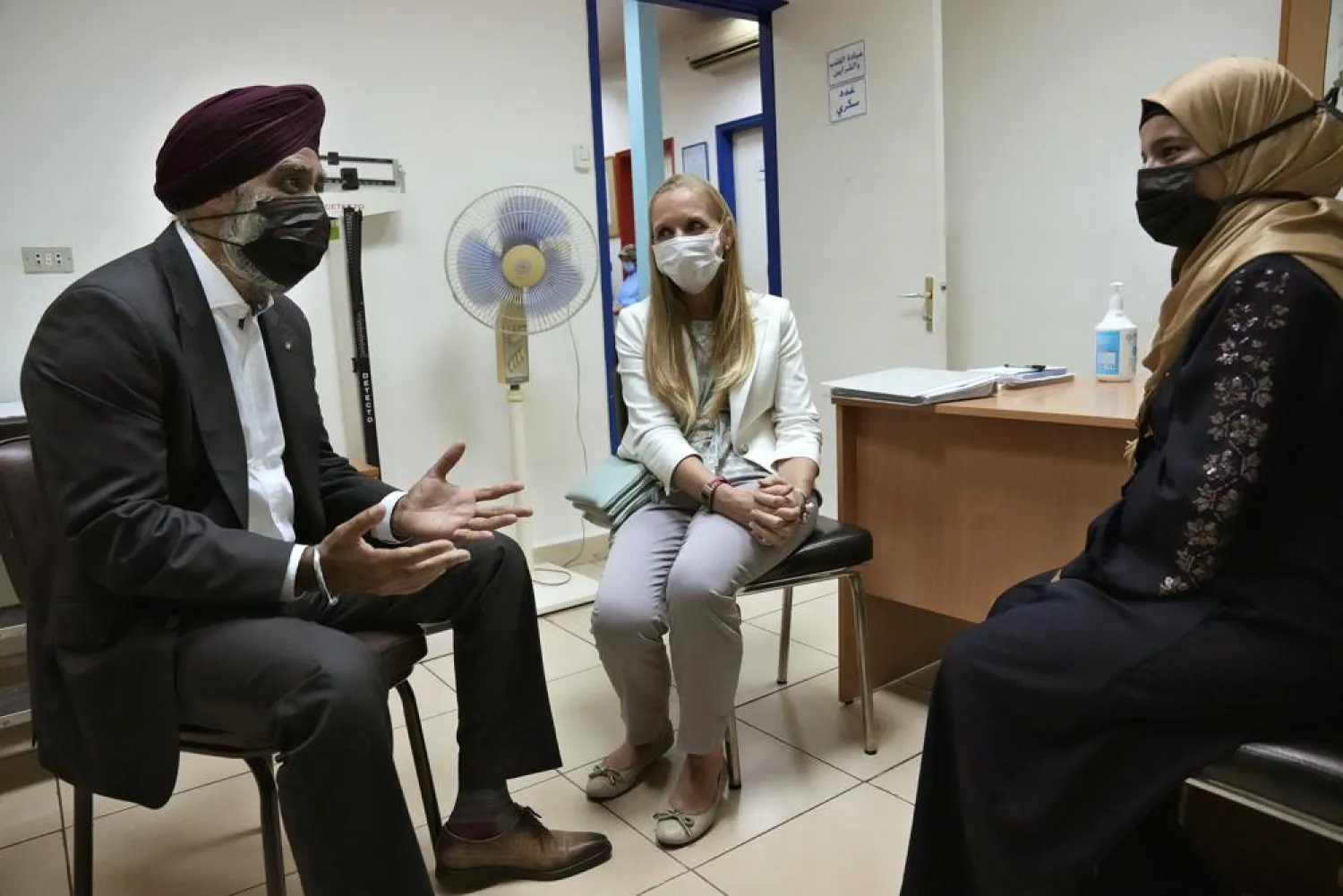
Canadian Minister of International Development Harjit Sajjan, left, speaks with a Syrian refugee woman during his visit with the Canadian Ambassador to Lebanon Chantal Chastenay, center, to Makassed primary health care center, in Beirut, Lebanon, Wednesday, Aug. 17, 2022. (AP Photo/Hussein Malla)
TT

Canada Minister: Not Safe Yet for Syrian Refugees to Go Home

Canadian Minister of International Development Harjit Sajjan, left, speaks with a Syrian refugee woman during his visit with the Canadian Ambassador to Lebanon Chantal Chastenay, center, to Makassed primary health care center, in Beirut, Lebanon, Wednesday, Aug. 17, 2022. (AP Photo/Hussein Malla)

Syria is not safe yet for millions of refugees to start going back home, a Canadian minister cautioned during a visit to Lebanon on Wednesday. He spoke days after Lebanese officials announced a plan to start returning 15,000 Syrian refugees to their war-shattered country every month.

The remarks by Harjit Sajjan, Canada’s minister of international development, followed his tour of the region that also took him to Jordan, where he visited Syrian refugees living in tent settlements.

More than 5 million Syrians fled their country when the conflict began 11 years ago, with most of them now living in neighboring countries Turkey, Lebanon and Jordan. Lebanon, which has taken in 1 million Syrians, is facing an economic meltdown and unprecedented financial crisis — and is eager to see the refugees return.

On Monday, Syria’s Minister of Local Administration Hussein Makhlouf said Syrian refugees in Lebanon can start returning home, pledging they will get all the help they need from authorities, The Associated Press reported.

However, the UN refugee agency and rights groups oppose involuntary repatriation to Syria, saying the practice risks endangering the returning refugees. Human rights groups have said that some Syrian refugees who returned home were detained.

Sajjan echoed those concerns Wednesday.

“It is very, very important to make sure that there is an absolute safe environment where they can return to,” Sajjan said in an interview with The AP. “Clearly, right now, based on our assessments Syria is not a safe place for people to return.”

“These are very proud people, who want to go back home. They don’t want to live in these conditions,” Sajjan said, adding that any return will have to be a “voluntary situation.”

Over the past few years, Canada has resettled tens of thousands of Syrian refugees, some of them from Lebanon and Jordan. Sajjan, a former defense minister and ex-member of the military who served in Afghanistan said he saw first-hand the effects and “horrors of war, which pushes people out.”

“No one wants to leave their homes, but they have to,” he added.

He said Canada will continue to look at ways, with multinational partners, to provide the appropriate direct support for the Lebanese people and “the vulnerable Syrian refugees as well.”

The calls for the return of Syrian refugees have increased in Lebanon since its economic downturn began in late 2019, leaving three-quarters of Lebanese living in poverty. For Syrians, living conditions have become much worse.

Sajjan said that during his talks with Lebanese leaders, he urged them “to move as quickly as possible” to reach an agreement with the International Monetary Fund on a bailout program.

He stress that IMF’s demands on Lebanon are “all legitimate things that are being asked for, given how the economic crisis has unfolded.”

Ahead of any deal with IMF, Lebanon still has to draft legislation on combatting money laundering and a law on capital controls.

Lebanon’s crisis was further exacerbated by the massive August 2020 explosion in Beirut’s port that killed more than 200 people, injured thousands and caused billions of dollars in damages.

Sajjan expressed hopes that the investigation into the explosion would resume soon. The domestic investigation has been stalled since December, due to legal challenges raised by some politicians against the judge leading the probe after he had filed charges against them.

“I think the impact of the explosion ... has shocked the world,” Sajjan said. “We are hopeful that the current investigation can move forward in a transparent way.”



Israeli Settlers Forcibly Enter Palestinian Home and Kill Sheep in Latest West Bank Attack

 This picture shows sheep grazing on a field in Kafr al-Labad with the Israeli settlement of Avnei Hefetz seen in the background, near the city of Tulkarem in the occupied West Bank on December 18, 2025. (AFP)
This picture shows sheep grazing on a field in Kafr al-Labad with the Israeli settlement of Avnei Hefetz seen in the background, near the city of Tulkarem in the occupied West Bank on December 18, 2025. (AFP)
TT

Israeli Settlers Forcibly Enter Palestinian Home and Kill Sheep in Latest West Bank Attack

 This picture shows sheep grazing on a field in Kafr al-Labad with the Israeli settlement of Avnei Hefetz seen in the background, near the city of Tulkarem in the occupied West Bank on December 18, 2025. (AFP)
This picture shows sheep grazing on a field in Kafr al-Labad with the Israeli settlement of Avnei Hefetz seen in the background, near the city of Tulkarem in the occupied West Bank on December 18, 2025. (AFP)

Israeli settlers attacked a Palestinian home in the south of the Israeli-occupied West Bank overnight, breaking in and killing sheep, a Palestinian official said Tuesday. It was the latest in a surge of attacks by settlers against Palestinians in the territory in recent months.

Israeli police said they arrested five settlers.

The settlers killed three sheep and injured four more, smashed a door and a window of the home, and fired tear gas inside, sending three Palestinian children under the age of 4 to the hospital, said Amir Dawood, who directs an office documenting such attacks within a Palestinian governmental body called the Wall and Settlement Resistance Commission.

Police said they arrested the five settlers on suspicion of trespassing onto Palestinian land, damaging property and dispensing pepper spray, not tear gas. They said they are investigating.

CCTV video from the attack in the town of As Samu’, shared by the commission, showed five masked settlers in dark clothing, some with batons, approaching the home and appearing to enter. Sounds of smashing are heard, as well as animal noises. Another video from inside shows masked figures appearing to strike sheep in the stable.

Photos of the aftermath, also shared by the commission, show smashed car windows and a shattered front door. Bloodied sheep lie dead as others stand with blood staining their wool. Inside the home, photos show broken glass and the furniture ransacked.

Dawood said it was the second settler attack on the family in less than two months. He called it “part of a systematic and ongoing pattern of settler violence targeting Palestinian civilians, their property and their means of livelihood, carried out with impunity under the protection of the Israeli occupation.”

During October’s olive harvest, settlers across the territory launched an average of eight attacks daily, the most since the United Nations humanitarian office began collecting data in 2006. The attacks continued in November, with the UN recording at least 136 by Nov. 24.

Israel captured the West Bank, east Jerusalem and Gaza — areas claimed by the Palestinians for a future state — in the 1967 war. It has settled over 500,000 Jews in the West Bank, in addition to over 200,000 in contested east Jerusalem.

Israel’s government is dominated by far-right proponents of the settler movement, including Finance Minister Bezalel Smotrich and Cabinet Minister Itamar Ben-Gvir, who oversees the nation’s police force. Earlier this week, Smotrich said the Israeli cabinet had approved a proposal for 19 new Jewish settlements, another blow to the possibility of a Palestinian state.


Palestinian Authority Says Israel Tightening Control Over West Bank with New Settlements

Israeli bulldozers level land at the evacuated Israeli settlement of Sanur, near the West Bank city of Jenin, 23 December 2025. (EPA)
TT

Palestinian Authority Says Israel Tightening Control Over West Bank with New Settlements

Israeli bulldozers level land at the evacuated Israeli settlement of Sanur, near the West Bank city of Jenin, 23 December 2025. (EPA)

The Palestinian Authority condemned on Tuesday Israel's recent approval of 19 settlements in the occupied West Bank, accusing it of tightening its control over Palestinian land.

On Sunday, Israel's far-right Finance Minister Bezalel Smotrich announced the authorities had greenlit the settlements, saying the move was aimed at preventing the establishment of a Palestinian state.

The Ramallah-based Palestinian foreign ministry decried the approval as a "dangerous step aimed at tightening colonial control over the entirety of Palestinian land", calling it a continuation of "apartheid, settlement, and annexation policies that undermine the inalienable rights of the Palestinian people".

"The decision provides political cover for accelerating the plunder of Palestinian lands, expanding settlement infrastructure... alongside an escalating pace of settler terrorism against members of our people and their properties," it said in a statement.

The latest move brings the total number of settlements approved over the past three years to 69, Smotrich's office said.

Excluding east Jerusalem, which was occupied and annexed by Israel in 1967, more than 500,000 Israelis live in the West Bank, along with about three million Palestinian residents.

Smotrich's office said the 19 newly approved settlements were located in what it described as "highly strategic" areas, adding that two of them -- Ganim and Kadim in the northern West Bank -- would be re-established after being dismantled two decades ago.

Five of the 19 settlements already existed but had not previously been granted legal status under Israeli law, the statement said.

Israel's decision came days after the United Nations said the expansion of Israeli settlements in the West Bank -- all of which are illegal under international law -- had reached its highest level since at least 2017.

US President Donald Trump recently warned that Israel "would lose all of its support from the United States" if it annexed the West Bank.

Israel has occupied the territory since 1967, and violence there has surged following the outbreak of the Gaza war in October 2023 with Hamas's attack on Israel.

Israeli troops or settlers have killed at least 1,028 Palestinians in the West Bank -- both fighters and civilians -- since the start of the fighting in Gaza, according to an AFP tally based on Palestinian health ministry figures.

At least 44 Israelis have been killed in the West Bank in Palestinian attacks or Israeli military operations during the same period, according to Israeli data.


Germany Deports Man to Syria for First Time Since 2011

People attend a protest against reelection of Syria's president Bashar al-Assad, near Syria's embassy, Berlin, Germany May 26, 2021. (Reuters)
TT

Germany Deports Man to Syria for First Time Since 2011

People attend a protest against reelection of Syria's president Bashar al-Assad, near Syria's embassy, Berlin, Germany May 26, 2021. (Reuters)

Germany deported a man to Syria for the first time since the civil war began in that country in 2011, the interior ministry in Berlin announced on Tuesday.

A Syrian immigrant previously convicted of criminal offences in Germany was flown to Damascus and handed over to Syrian authorities on Tuesday morning, the ministry said.