


Heavy Gunfire Rocks Iraq’s Green Zone amid Violent Protests

A supporter of Iraqi Shiite cleric Moqtada al-Sadr carries the Iraqi flag as he walks down a road blocked by burning tires during a demonstration in Iraq's southern city of Basra on August 29, 2022. (AFP)
TT

Heavy Gunfire Rocks Iraq’s Green Zone amid Violent Protests

A supporter of Iraqi Shiite cleric Moqtada al-Sadr carries the Iraqi flag as he walks down a road blocked by burning tires during a demonstration in Iraq's southern city of Basra on August 29, 2022. (AFP)

Supporters of an influential Iraqi Shiite cleric fired rocket-propelled grenades and machine guns into Iraq's Green Zone and security forces returned fire Tuesday, a serious escalation of a monthslong political crisis gripping the nation.

The death toll rose to at least 30 people after two days of unrest, officials said.

After cleric Moqtada al-Sadr announced Monday he would resign from politics, his supporters stormed the Green Zone, once the stronghold of the US military that's now home to Iraqi government offices and foreign embassies. At least one country evacuated its embassy amid the chaos.

Iraq’s government has been deadlocked since Sadr’s party won the largest share of seats in October parliamentary elections but not enough to secure a majority government — unleashing months of infighting between different Shiite factions. Sadr refused to negotiate with his Iran-backed Shiite rivals, and his withdrawal Monday catapulted Iraq into political uncertainty and volatility with no clear path out.

Iran closed its borders to Iraq on Tuesday — a sign of Tehran’s concern that the chaos could spread, though streets beyond the capital's government quarter largely remained calm. The country's vital oil continued to flow, with global benchmark Brent crude trading slightly down at $103 a barrel.

A day after they stormed the Green Zone, supporters of Sadr could be seen on live television firing both heavy machine guns and rocket-propelled grenades into the heavily area through a section of pulled-down concrete walls. Security forces armed with machine guns inside the zone sporadically returned fire.

Some bystanders filmed the gunfight with their mobile phones, though most hid behind still-standing segments of wall, wincing when rounds cracked nearby. As Sadr's forces fired, a line of armored tanks stood on the other side of the barriers that surround the Green Zone, though they did not use their heavy guns.

At least one wounded man from Sadr's forces was taken away in a three-wheel rickshaw, the Iraqi Foreign Ministry visible in the background. Heavy black smoke at one point rose over the area, visible from kilometers (miles) away.

At least 30 people have been killed and over 400 wounded, two Iraqi medical officials said. The toll included both Sadr loyalists killed in protests the day before and clashes overnight. Those figures are expected to rise, said the officials, who spoke on condition of anonymity because they weren’t authorized to release the information to journalists.

Shiites are fighting among themselves after the Americans largely withdrew from the nation, with Iranian-backed Shiites and Iraqi-nationalist Shiites jockeying for power, influence and state resources.

It’s an explosive rivalry in a country where many remain way of the Iranian government’s influence even though trade and ties remain strong between its peoples. Iraq and Iran fought a bloody war in the 1980s that saw a million people killed.

Sadr’s nationalist rhetoric and reform agenda resonates powerfully with his supporters, who largely hail from Iraq’s poorest sectors of society.

Sadr's announcement that he is leaving politics has implicitly given his supporters the freedom to act as they see fit.

Iranian state television cited unrest and a military-imposed curfew in Iraqi cities for the reason for the border closures. It urged Iranians avoid any travel to the neighboring country. The decision came as millions were preparing to visit Iraq for an annual pilgrimage to Shiite sites, and Tehran encouraged any Iranian pilgrims already in Iraq to avoid further travel between cities.

The Netherlands evacuated its embassy in the Green Zone, Foreign Affairs Minister Wopke Hoekstra tweeted early Tuesday.

“There are firefights around the embassy in Baghdad. Our staff are now working at the German embassy elsewhere in the city,” Hoekstra wrote.

On Monday, protesters loyal to Sadr pulled down the cement barriers outside the government palace with ropes and breached the palace gates. Many rushed into the lavish salons and marbled halls of the palace, a key meeting place for Iraqi heads of state and foreign dignitaries.

Iraq’s military announced a nationwide curfew, and the caretaker premier suspended Cabinet sessions in response to the violence.



Board of Peace Proposes $2.45 Billion Blueprint to Begin Gaza Reconstruction

Palestinian firefighters extinguish a fire on a vehicle hit by an Israeli airstrike in Khan Younis, in the southern Gaza Strip, September 23, 2026. REUTERS/Ramadan Abed
TT

Board of Peace Proposes $2.45 Billion Blueprint to Begin Gaza Reconstruction

Palestinian firefighters extinguish a fire on a vehicle hit by an Israeli airstrike in Khan Younis, in the southern Gaza Strip, September 23, 2026. REUTERS/Ramadan Abed

The US-backed Board of Peace is proposing a six-month, $2.45 billion plan to begin reconstruction and governance in Gaza as President Donald Trump’s ceasefire plan struggles to stay afloat.

At a meeting of the group’s board in New York on the sidelines of the UN General Assembly on Wednesday, the governors unveiled a 66-project blueprint to get things started while acknowledging enormous hurdles that must still be overcome.

The projects include ambitious infrastructure, education and health initiatives that are designed to support Trump’s 20-point plan to end the Israel-Hamas war, The Associated Press reported.

“The need is immense,” the board said, noting that full reconstruction from the physical damage across Gaza will cost roughly $35.2 billion over the medium term and another $71.4 billion in the next 10 years.

The proposal is largely aimed at potential donors who will be asked to foot the bill for reconstruction of the war-devastated territory.

The ceasefire, which took effect on Oct. 10, was meant to clear the way for a broader process to rebuild Gaza under the guidance of the Board of Peace.

The plan included additional Israeli military withdrawals from Gaza, the disarmament of Hamas, the arrival of an international peacekeeping force and a new apolitical Palestinian government to administer the territory’s day-to-day affairs. It also envisioned an ambitious program for rebuilding war-ravaged Gaza.

But the US-backed plan has largely stalled. While the ceasefire halted the heaviest fighting and humanitarian conditions have improved, the Israeli military has expanded its control of Gaza and now occupies some 60% of the territory.

Hamas has not given up its weapons. The international military force and new government still have not entered Gaza, and reconstruction has not begun.

The vast majority of Palestinians continue to live in tent camps or ruins of their former homes.

The board’s high representative, Nikolay Mladenov, has said progress hinges largely on Hamas disarming — a step the group has refused to take. But he also has pressed Israel to scale back its military operation.

“I want to be very clear that we are not bound by a calendar,” he said. “We want to make sure that this works.”

Key questions that the board faces are not only laying out plans for reconstruction but also a timeline for the deployment of the international force meant to provide security in the territory and a new government, plans to disarm Hamas, and bringing in badly needed building materials.

US Gen. Jasper Jeffers, commander of the international stabilization force planned for Gaza, outlined a five-step approach to dealing with the thorny issue of demilitarizing Hamas. It begins with the first wave of the multinational unit being deployed with troops from Kosovo and Morocco, to be followed by additional personnel from Albania and Kazakhstan.

Their task will be to demilitarize the territory and decommission all of Hamas’ military infrastructure.

The goal, he said, is to gradually turn security control over to the interim government, after which Israel will be expected to withdraw its forces.


Gaza’s Damaged Buildings Face Growing Risk of Collapse as Winter Approaches

Palestinian Umm Iyad Azzam sits with her two grandchildren who survived the collapse of the Al-Saada building in Gaza (Asharq Al-Awsat) 
TT

Gaza’s Damaged Buildings Face Growing Risk of Collapse as Winter Approaches

Palestinian Umm Iyad Azzam sits with her two grandchildren who survived the collapse of the Al-Saada building in Gaza (Asharq Al-Awsat) 

When 69-year-old Umm Iyad Azzam heard that the Al-Saada building in the Al-Sinaa area of southwest Gaza City had collapsed, she rushed from the tent where she was staying, about 400 meters away, searching for her daughter-in-law and grandchildren.

There, she learned that her daughter-in-law, Islam, and grandson Rizq had been killed. Residents and Civil Defense crews managed to rescue two other grandchildren, along with dozens of people trapped beneath the rubble.

Reeling from her loss, Azzam then hurried to Al-Shifa Medical Complex, itself heavily damaged by the Israeli war, to bid farewell to those who had died and check on those who survived.

Her relatives were among dozens of casualties in the collapse of the six-story Al-Saada building about a week ago. The building had been damaged during the Israeli war after being struck in earlier raids and a series of heavy bombardments at the start of the conflict in October 2023.

Gaza officials estimate that around 2,000 inhabited buildings across the territory are at risk of collapse.

Recalling the first moments after the disaster, Azzam told Asharq Al-Awsat that her eldest son, Iyad, was away from his family when he received a call about the collapse. He immediately headed there without alarming her. A short time later, another daughter-in-law told Azzam that the building housing Iyad’s family had fallen on its occupants.

“There is no safety in Gaza. No one can feel secure about their life,” Azzam said. “Danger threatens everyone, wherever they are, in a tent, a house or a building at risk of collapse.”

“Every home is in mourning, and if it isn’t today, it will be tomorrow,” she added. “We’ve had enough suffering and massacres. We want a solution.”

Twenty-one Palestinians were killed in the Al-Saada building collapse, while 45 others were injured and rescued. About 35 escaped after leaving the building before it fell.

Dozens of tents housing displaced people surround the site, alongside another damaged residential building at risk of collapse, fueling fears that the disaster could be repeated.

Mahmoud Basal, spokesman for Gaza’s Civil Defense, warned that structurally unsafe buildings posed a major threat across the territory. More than 2,000 were at risk of collapse and all were inhabited by civilians, he told Asharq Al-Awsat. Even the least crowded building houses around 10 people, while some accommodate more than 100.

Nowhere else to go

Aref Fura, 57, a displaced resident of the same area who himself lives in a damaged building, explained that those sheltering in Al-Saada had lost their homes, property, savings and livelihoods during the war.

With nowhere else to go, they remained there until the last moment despite signs that the building might collapse.

Their response, Fura recalled, was always the same: “Where will we go? Where can we go? There is nowhere else.”

More than two million Palestinians were now crowded into around 70 square kilometers after Israel occupied about 70 percent of the Gaza Strip, Fura said, arguing that this had pushed residents into thousands of buildings at risk of collapse.

Displaced from Gaza City’s Shujaiya neighborhood, he witnessed the first moments of the Al-Saada disaster.

“We held our breath after the building buried its residents beneath the rubble, without being able to do anything,” he recalled.

Now the approaching winter is deepening fears among those living in Gaza’s damaged buildings, with rainfall expected to heighten the risk of further collapses.

“People have no real options for dealing with the current reality, especially with winter approaching and the genuine threat it poses to those in buildings at risk of collapse and even those living in tents,” Fura warned.

“I personally live in a dangerous building. All of Gaza is living under a similar threat, and even those in tents are living beside buildings at risk of collapse, so their lives are in danger too.”

He appealed to the world to find solutions for Gaza’s residents, who he said faced a genuine threat. “All they want is to live safely, nothing more.”

‘We are forced to sleep on chairs’

For Bassam Naseer, 48, displaced from Beit Hanoun, danger is part of daily life.

Naseer described living in humiliating and difficult conditions, fearing that the roof sheltering his family could collapse. He shares a small room and an empty, damaged storefront near the site of the Al-Saada rubble with his family of eight. His son-in-law and his six-member family live with them.

The structure could collapse at any moment, Naseer told Asharq Al-Awsat, but the only alternatives were a tent or the street.

“No one knows who will live and who will die, because every winter this place floods, and we are forced to sleep on chairs,” he said.

He noted that several airstrikes, as well as the collapse of Al-Saada about 150 meters away, had worsened cracks and structural damage in the roof of the storefront.

“We can’t live like this. There are no solutions or options, and no one tells us we can live with dignity, because dignity is gone,” Naseer said. “Things are extremely difficult for us. There are no tarpaulins, tents or caravans. We cover ourselves with scraps of worn fabric.”

For Naseer and hundreds of thousands of other displaced people, the hardship extends beyond winter and unsafe shelter.

Rodents force him to stay awake at night to keep them away from his children, while mosquitoes and other insects leave him and his wife struggling to sleep as they try to protect their family.

“This is not a life,” he said. “Let the officials come and see how we live.”

Winter brings greater danger

Gaza’s Civil Defense has warned of the risk of further collapses.

In the 24 hours from Saturday afternoon to Sunday afternoon following the Al-Saada disaster, crews responded to several incidents involving homes previously hit by Israeli strikes and classified as uninhabitable but occupied by displaced residents because no alternative housing was available.

Several families were rescued after partial collapses in buildings and homes across Gaza City, including in the Zeitoun and Sheikh Radwan neighborhoods.

Civil Defense prevention and safety teams also inspected several cracked homes and told residents of four to evacuate and move to safer accommodation.

Basal explained that Civil Defense repeatedly urges residents to leave unstable buildings, only to receive the same response: “What is the alternative?”

He argued that addressing the problem was the responsibility of the international community, calling for intervention to evacuate residents and provide safe alternatives.

“Tents are not fit to live in, either in summer or winter,” Basal warned. “We are already living through difficult conditions, and now winter is approaching. It has become the nightmare and the great danger facing Gaza’s residents — those living in buildings at risk of collapse, those in tents and those living anywhere in Gaza.”

“The lives of all Gaza’s residents are threatened by the coming winter,” he added, urging the international community and international organizations to intervene immediately to protect civilians and provide a safe environment.

Such intervention, he continued, would allow residents to move from dangerous areas to safer ones and “provide them with a dignified life instead of the danger that accompanies them all the time.”


Aoun Rejects Any Settlement at Lebanon’s Expense as Salam Rallies Int’l Support

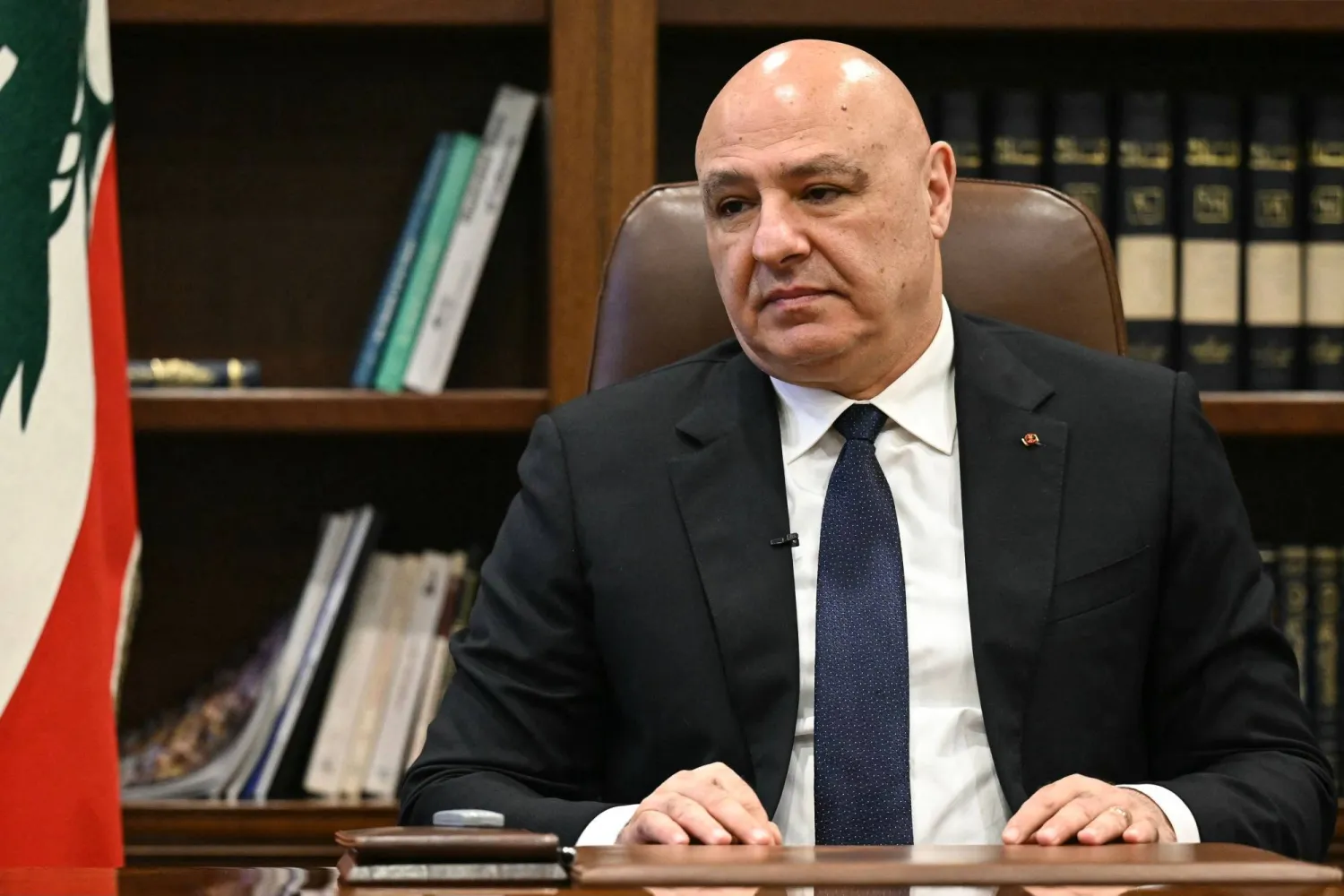
Lebanese President Joseph Aoun speaks during an interview with AFP at the Presidential Palace in Baabda on September 15, 2026. (Photo by JOSEPH EID / AFP)
TT

Aoun Rejects Any Settlement at Lebanon’s Expense as Salam Rallies Int’l Support

Lebanese President Joseph Aoun speaks during an interview with AFP at the Presidential Palace in Baabda on September 15, 2026. (Photo by JOSEPH EID / AFP)

Lebanese President Joseph Aoun has stressed the need to strengthen national unity in the face of the challenges confronting Lebanon, saying any political settlement must not come at the expense of the country and its national interests.

Aoun warned on Tuesday against “seeking support from abroad against one another at home in ways that serve Lebanon’s enemies.”

“Let us instead draw strength from one another in dealing with the outside world,” he said.

Aoun stressed that Lebanon cannot be built by a single group, sect, or political party, calling for efforts to overcome divisions and enhance dialogue and communication among Lebanese citizens as the gateway to building trust and ensuring stability.

He said Lebanon can recover whenever its people place the national interest above all other considerations, urging greater engagement between generations and a move away from grudges and divisions.

Salam Mobilizes Support in New York

In New York, Prime Minister Nawaf Salam held a series of meetings on the sidelines of the United Nations General Assembly, stressing Lebanon’s priorities in discussions with UN Secretary-General Antonio Guterres, Jordan’s King Abdullah II, Turkish President Recep Tayyip Erdogan, Finnish President Alexander Stubb, Qatari Prime Minister and Foreign Minister Sheikh Mohammed bin Abdulrahman Al Thani, Iraqi Prime Minister Ali al-Zaidi, Bahraini Foreign Minister Abdullatif bin Rashid Al-Zayani, and US Senator Jeanne Shaheen.

During these meetings, Salam stressed the need for Israel to fully withdraw from Lebanese territory and cease its attacks, strengthen the capabilities of the Lebanese Army, and ensure a continued international presence in southern Lebanon following the end of UNIFIL’s mandate.
He also emphasized extending state authority across the country and ensuring that weapons remain solely under state control.

Salam sought support for Lebanon’s recovery, reconstruction, and rehabilitation efforts, as well as for the continuation of government reforms and the expansion of cooperation and investment, particularly in energy, transportation, and regional connectivity.

Meeting with the UN Secretary-General

In his meeting with Guterres, Salam stressed the importance of maintaining a UN-backed international presence in southern Lebanon after the conclusion of UNIFIL’s mission, arguing that such a presence would support stability and help extend state authority.

He also discussed the humanitarian situation, noting that approximately 329,000 people remain displaced, and highlighted the need to shift from emergency response measures toward supporting returns, recovery efforts, and the restoration of essential services.

Regional Consultations

With King Abdullah II of Jordan, discussions focused on supporting Lebanon and its institutions, particularly the Lebanese Army, continuing coordination to reduce tensions, and mobilizing international support for arrangements that would prevent a security vacuum in the south.

In talks with Erdogan, Salam discussed strengthening Lebanese-Turkish relations and expanding cooperation in trade, investment, energy, and infrastructure, in addition to electricity and railway connectivity projects and support for recovery and reconstruction in southern Lebanon.

Salam to the Lebanese Diaspora: Difficult Decisions and Reforms

Addressing members of the Lebanese community in New York, Salam said that despite the difficult circumstances, the government had not abandoned its course. Instead, it had taken “difficult decisions” and launched a serious reform agenda aimed at changing the country's trajectory and building a state in which Lebanese citizens can regain confidence.

On the issue of weapons, Salam stressed that the government remains committed to implementing its decisions so that the state alone exercises authority across Lebanon, holds exclusive control over decisions of war and peace, and entrusts responsibility for citizens’ security to the Lebanese Army and legitimate security institutions.

He linked these efforts to achieving an Israeli withdrawal, securing the return of residents to southern Lebanon, and launching a broader recovery and reconstruction process, emphasizing that stability is an essential prerequisite for economic revival and investment.