


Iran Closes Border to Iraq, Flights Stop amid Violent Unrest

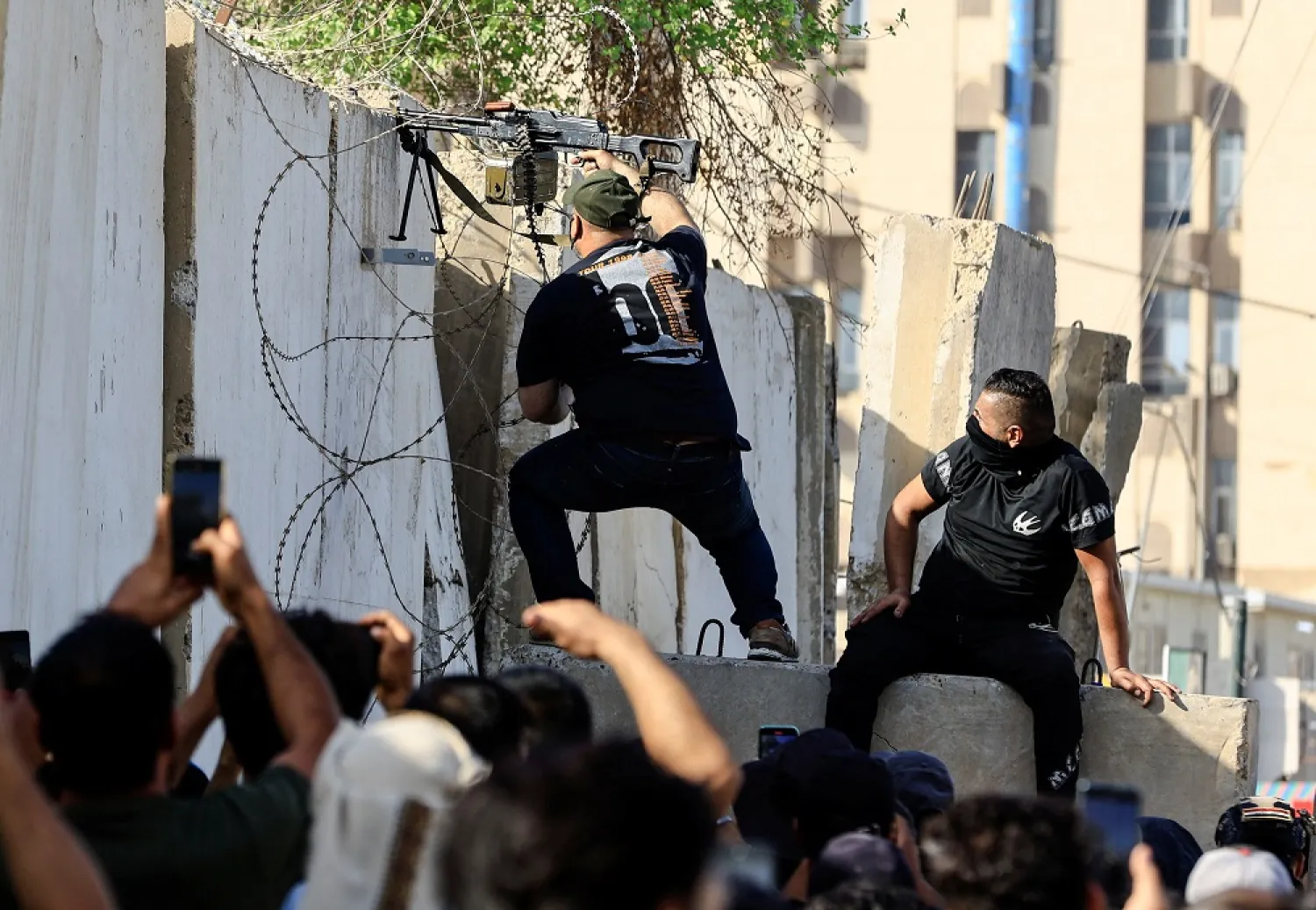
A member of Sadr's Saraya al-Salam fighters fires his weapon during clashes with the Iraqi security forces near the Green Zone, in Baghdad, Iraq August 30, 2022. (Reuters)
TT

Iran Closes Border to Iraq, Flights Stop amid Violent Unrest

A member of Sadr's Saraya al-Salam fighters fires his weapon during clashes with the Iraqi security forces near the Green Zone, in Baghdad, Iraq August 30, 2022. (Reuters)

Iran closed its land borders to Iraq as flights to the country halted Tuesday amid violence in Baghdad following influential Shiite cleric Moqtada al-Sadr's announcement he would resign from politics.

The death toll rose to 22 Iraqis on Tuesday after the unrest erupted the previous day, according to two medical officials.

Iraq's military said four rockets were launched into the heavily fortified Green Zone, the seat of Iraq's government where armed clashes raged overnight between a militia royal to Sadr and Iraqi security forces.

Sadr's sudden resignation has catapulted Iraq into violence and chaos with no clear path out. The cleric derives power from his ability to mobilize and control his large grassroots following, but with his stated exit from politics, he has implicitly given them the freedom to act as they see fit.

To avenge the killing of unarmed loyalists, Sadr's militia Saraya Salam clashed with Iraqi security forces in the Green Zone using an array of weapons, including mortars and rocket-propelled grenades, two security officials said. The militia also took over some headquarters belonging to rival Iran-backed militia groups in the southern provinces overnight.

Iranian state television cited “unrests” and “curfew” in Iraqi cities for the reason for the border closures. It urged Iranians avoid any travel to Iraq while urging Iran's Shiite pilgrims in Iraq to avoid further travel between cities.

Iraq’s government has been deadlocked since Sadr’s party won the largest share of seats in October parliamentary elections but not enough to secure a majority government. His refusal to negotiate with his Iran-backed Shiite rivals in the Coordination Framework and subsequent exit from the talks has catapulted the country into political uncertainty and volatility amid intensifying intra-Shiite wrangling.

To further his political interests, Sadr has wrapped his rhetoric with a nationalist and reform agenda that resonates powerfully among his broad grassroots base of supporters. They are calling for the dissolution of parliament and early elections without the participation of Iran-backed Shiite groups, which they see as responsible for the status quo.

The Netherlands has evacuated its embassy in the Green Zone, Foreign Affairs Minister Wopke Hoekstra tweeted early Tuesday.

“There are firefights around the embassy in Baghdad. Our staff are now working at the German embassy elsewhere in the city,” Hoekstra wrote.

Protesters loyal to Sadr pulled down the cement barriers outside the government palace with ropes and breached the palace gates. Many rushed into the lavish salons and marbled halls of the palace, a key meeting place for Iraqi heads of state and foreign dignitaries.

Iraq’s military announced a nationwide curfew, and the caretaker premier suspended Cabinet sessions in response to the violence. Medical officials said dozens of protesters were wounded by gunfire and tear gas and physical altercations with riot police.



Trump Says His Ballroom Will House a Drone Port. The Secret Service Already Has One Next Door

NEW YORK, NEW YORK - SEPTEMBER 22: US President Donald Trump speaks during the 81st session of the United Nations (UN) General Assembly at UN Headquarters on September 22, 2026 in New York City. Michael M. Santiago/Getty Images/AFP
TT

Trump Says His Ballroom Will House a Drone Port. The Secret Service Already Has One Next Door

NEW YORK, NEW YORK - SEPTEMBER 22: US President Donald Trump speaks during the 81st session of the United Nations (UN) General Assembly at UN Headquarters on September 22, 2026 in New York City. Michael M. Santiago/Getty Images/AFP

President Donald Trump's AI-fueled vision for a drone port he intends to install atop the new White House ballroom includes missile-bearing unmanned aerial vehicles and gun-toting troops, ostensibly to protect the 18-acre complex and the nation’s capital.

A few hundred feet away, a drone port, run by the US Secret Service and not the military, is already quietly operational. Equipped with cameras and sensors to scope out potential threats from a bird’s-eye view, the small UAVs stand on alert in four gray weatherproof boxes until deployed at officers' commands, The Associated Press.

The agency is using a model known as “drone as first responder,” deploying speedy unarmed drones from outdoor stations to serve as flying cameras. That model has been adopted by hundreds of police agencies across the US, often powered by AI software to help dodge obstacles or track targets.

The existence of the surveillance drones on a Treasury Department building adjacent to the White House complex has not been previously reported, and could undercut Trump's legal claims that the ballroom construction is necessary “to protect the White House and surrounding region from aerial attacks.” The need for the drone port underpinned Trump's national security defense for the construction project — a justification he is now citing for the construction of a massive arch outside the gates of Arlington National Cemetery.

The installation is thus far markedly less imposing than the vision outlined by Trump, with its rows of futuristic attack drones, apparently modeled after those used in US military strikes, that drone experts describe as outlandish.

“To be honest, if a drone was so close to the White House that it needed interdiction, it’s already gotten too far,” said Matt Sloane, co-founder of SkyfireAI, which makes software for drones used by public safety agencies.

It would be more realistic for the White House to build something akin to what the Secret Service is using next door, Sloane said: “The drone takes off and does some type of perimeter sweep or whatever, and then puts itself back in the box.”

The White House did not comment for the story. The Secret Service declined to comment on the specifics of its drone operations but said the new docks are separate from Trump's ballroom drone port.

The details of Trump’s ballroom drone port remain murky

Security of the president and the White House complex is generally the domain of the Secret Service, which works in close concert with the White House Military Office and other military elements when needed.

Trump has said the drone port came at the request of US military officials. Speaking to reporters in May, he said the building’s plans were expanded to meet the request: “They wanted more drone capacity,” he said. On social media, he boasted that the drone port might end up being the “most sophisticated” in the world.

What Trump is ultimately aiming to build, and how far it goes beyond what has already been installed, remains unclear. Beyond Trump’s AI images, some of which he filed in his appeal to the US Supreme Court to lift lower courts' blocks on the construction, the White House has not disclosed what kinds of drones will be used or for what tactical purpose.

The Secret Service is using smaller surveillance drones that are a fraction of the size of the attack drones depicted in Trump’s AI images. The US Air Force bought similar drones from Skydio in April to protect bases across the Middle East. The company also supplied drones to help protect World Cup matches this year.

The Secret Service has been building out its drone- and counter-drone programs for years. But work has accelerated since the 2024 attempted assassination of Trump at a campaign rally in Butler, Pennsylvania, when the agency failed both to take action against a drone used by the shooter to scout out the attack and to fly one of its own to provide overwatch of the event.

In the weeks that followed, tethered and untethered surveillance drones became commonplace at campaign rallies and large events at the White House complex.

In an online video released by the agency highlighting their deployment, the Secret Service said the Skydio drones are used to provide “real-time situational awareness” and “aerial overwatch."

“It allows you to see the threat before it becomes an issue, and to task assets accordingly,” Dustin Talbott, of the Secret Service’s Aviation and Airspace Security Division, said in the video. “We no longer wait for the threat to reveal itself. We find it first.”

Skydio did not provide comment for this story.

Trump's drone port vision would face logistical hurdles

Trump has made it a priority to build a stronger drone presence around the White House, responding to an increase in political violence and the evolution of drone warfare.

Paul Eckloff, a former supervisor of the Secret Service’s presidential protection division, said the Russia-Ukraine war has highlighted the risks posed by drones, even off-the-shelf models that can cause massive damage. Drones now represent one of the largest emerging threats the White House must defend against, he said.

During Trump’s first term, conversations about drones often centered on their use in places like Iraq and Syria, said Javed Ali, who served on the National Security Council during that time and now teaches national security at the University of Michigan. Since then, it has become a matter of domestic security, he said.

Yet there would be major logistical hurdles involved in putting a busy drone port on top of the White House, he said. “There’s a whole host of questions, like who is responsible for overseeing it, and how would there be any de-confliction with commercial airspace?” he said.

Complexities around federal oversight were laid bare this year when the US military used a laser to shoot down a drone near El Paso, Texas, only to find it belonged to Customs and Border Protection. The mishap briefly led the FAA to close nearby airspace.

A drone hub at the White House would navigate crowded and complex airspace around Washington, not far from Reagan Washington National Airport and flight paths shared by other military aircraft.

Opponents say the White House is becoming a fortress

Trump started talking about the drone port in May, weeks after a federal judge halted ballroom construction but allowed work on security components to continue. Trump later went on to refer to the ballroom as a “military complex,” leaning on that security role as a legal justification.

The Supreme Court in August cleared Trump to continue construction as the legal challenge moves ahead.

Opponents say the president is going too far in his hardening of the White House, turning it into something closer to a fortress. Edward Lengel, a former chief historian for the White House Historical Association, said Trump has militarized the White House at a scale that’s at odds with its legacy as “the people’s house.”

“It turns it into a big giant porcupine that has its spines pointing out against the people and against the world,” Lengel said.

Trump has argued that the White House was in “very bad condition” when he returned to office, saying it had become vulnerable to modern threats.

At times, he has expressed concerns about his own safety and the risks posed by drones and other air threats. Speaking at a Rose Garden dinner for law enforcement officials in May, Trump quickly glanced up from the lectern as a low bird flew overhead.

“I thought that was a drone,” Trump said, bringing laughs from the crowd. “They make them in all different sizes nowadays — they can be very destructive, as you’ve probably heard."


French ISIS Extremist Gets 30 Years for Syria Crimes

French police gather outside a local police station in Paris, France, October 11, 2016. REUTERS/Charles Platiau 
TT

French ISIS Extremist Gets 30 Years for Syria Crimes

French police gather outside a local police station in Paris, France, October 11, 2016. REUTERS/Charles Platiau 

A French court on Tuesday, September 22, sentenced a former ISIS member in Syria, Othman Garrido, to 30 years' imprisonment for murders committed as part of an organized group.

Garrido, a 32-year-old French citizen, was convicted by a special court in Paris at the end of a week-long trial.

He was convicted over a September 2015 public execution in Syria of two Iranians, but was acquitted on another charge of being their executioner. His sentence came with a 20-year non-parole period.

ISIS had attempted in 2014 to create what it called a “caliphate” in Syria, but it ended up being defeated in 2019 by a US-led international coalition.

Garrido, during his trial, had portrayed himself as forced to follow ISIS or risk death himself.

Some 1,500 French nationals had transited through Iraq and Syria to join ISIS in the 2010s.


Guterres Calls on China, US to Establish AI Dialogue

United Nations Secretary-General Antonio Guterres during the 81st session of the United Nations General Assembly at United Nations headquarters, Tuesday, Sept. 22, 2026. (AP Photo/Heather Khalifa)  
TT

Guterres Calls on China, US to Establish AI Dialogue

United Nations Secretary-General Antonio Guterres during the 81st session of the United Nations General Assembly at United Nations headquarters, Tuesday, Sept. 22, 2026. (AP Photo/Heather Khalifa)  

UN chief Antonio Guterres called Tuesday for AI superpowers, the United States and China, to start a dialogue on the fast-moving technology's future, as calls grow to rein in the sector’s rapid development amid concerns about its potential impact on humanity.

“Governments with the greatest AI capabilities have the greatest responsibilities to humanity, to establish channels for dialogue, transparency, trust and cooperation,” Guterres said at the General Debate of the 81st Session of the UN General Assembly in New York.

“At a pivotal moment during the Cold War, strategic rivals came to recognize the need to manage shared existential risks,” he noted.

China and the US are currently discussing creating a communication channel for AI concerns in anticipation of a Washington summit meeting between US President Donald Trump and Chinese President Xi Jinping on Thursday.

The talks come as both powers confront rising fears that increasingly capable artificial intelligence systems could wipe out humanity, offering a rare incentive for cooperation despite an intensifying race for technological supremacy.

Power Has Polarized the World

In his final address to the annual high-level gathering at the UN General Assembly, Guterres urged leaders to avoid what he called “the great fracture – the division of the world into two rival blocs with separate economic, technological and security systems.”

He rebuked might-makes-right thinking, telling superpowers to recognize “that their power isn’t so super” — that “military power alone cannot secure peace” and that “no power can solve today’s challenges alone,” according to AP.

The future will be shaped by how the world addresses “four great tests of power” – power over war and peace, power fueling climate chaos, power unleashed by artificial intelligence and “power that concentrates wealth and drives inequality,” he said

The UN Chief said geopolitical divides have deepened, inequalities have intensified and trust has frayed.

“The climate crisis went from distant warning to daily reality. And artificial intelligence (AI) moved at a speed that has blindsided even those who created it,” he noted.

He said that on January 1, when he is no longer Secretary-General, he will keep championing the conviction that peace is possible and that human dignity is universal.

Guterres’ speech opened the main portion of the world's biggest diplomatic meeting of the year. Leaders from the UN's 193 member countries address each other and the international community and air their hopes, plans and grievances.

AI is a major theme at this year's UN General Assembly. Ahead of the week of meetings and speeches in New York, leaders of more than 20 countries urged binding safety measures for advanced artificial intelligence, warning that the technology's development could outpace the ability to control it.

China and the United States were not signatories.

Trump has come out strongly against AI safety measures, vowing on Saturday not to allow the “destruction” of the AI industry over what he calls unjustified fears.

China's President Xi Jinping in July said AI should not be dominated by a single country and urged international cooperation on its development.