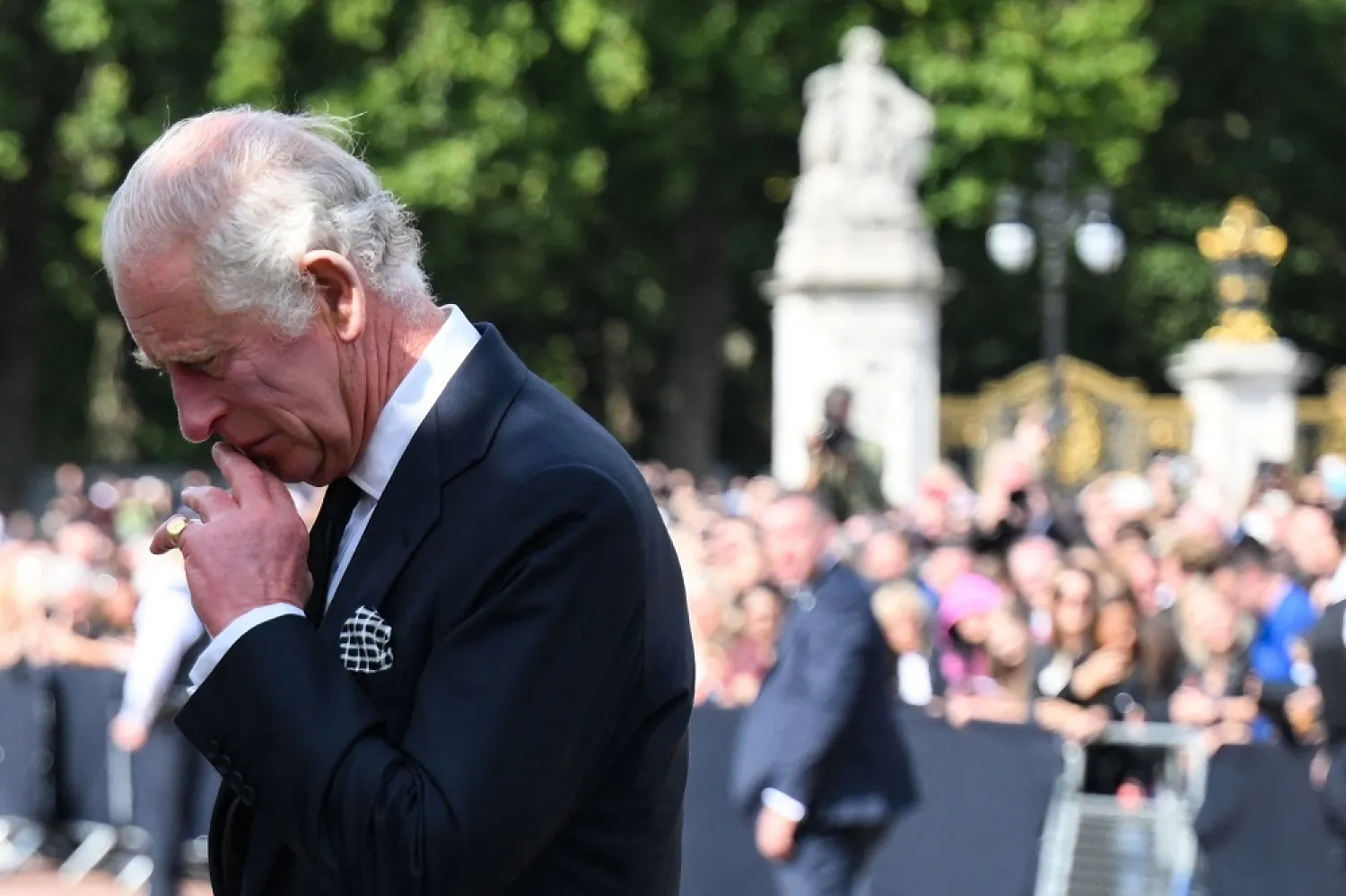
King Charles III, in First Address, Vows ‘Lifelong Service’

Britain's King Charles III looks at floral tributes left outside of Buckingham Palace in London, on September 9, 2022, a day after Queen Elizabeth II died at the age of 96. (AFP)
TT

King Charles III, in First Address, Vows ‘Lifelong Service’

Britain's King Charles III looks at floral tributes left outside of Buckingham Palace in London, on September 9, 2022, a day after Queen Elizabeth II died at the age of 96. (AFP)

King Charles III vowed in his first speech to the nation as monarch Friday to carry on Queen Elizabeth II's "lifelong service," as Britain entered a new age under a new sovereign. Around the world, the queen's exceptional reign was commemorated, celebrated and debated.

Charles, who spent much of his 73 years preparing for the role of king, addressed a nation grieving the only British monarch most people alive today had ever known. He takes the throne in an era of uncertainty for both his country and the monarchy itself.

He spoke of his "profound sorrow" over the death of his mother, calling her an inspiration.

"That promise of lifelong service I renew to all today," he said in the recorded, 9 1/2-minute address, delivered with a framed photo of the queen on a desk in front of him.

"As the queen herself did with such unswerving devotion, I, too, now solemnly pledge myself, throughout the remaining time God grants me, to uphold the constitutional principles at the heart of our nation," he said.

Charles bestowed the titles of Prince and Princess of Wales on his eldest son William and daughter-in-law Kate, passing on the titles that he and his late wife Diana previously held.

"With Catherine (Kate) beside him, our new Prince and Princess of Wales will, I know, continue to inspire and lead our national conversations, helping to bring the marginal to the center ground where vital help can be given," Charles said.

The king's speech was broadcast on television and streamed at St. Paul’s Cathedral, where some 2,000 people attended a service of remembrance for the queen. Mourners at the service included Prime Minister Liz Truss and members of her government.

As the country began a 10-day mourning period, people around the globe gathered at British embassies to pay homage to the queen, who died Thursday at Balmoral Castle in Scotland.

In London and at military sites across the United Kingdom, cannons fired 96 shots in an elaborate, 16-minute salute marking each year of the queen’s life.

In Britain and across its former colonies, the widespread admiration for Elizabeth herself was occasionally mixed with scorn for the institution and the imperial history she symbolized.

On the king's first full day of duties, Charles left Balmoral and flew to London for a meeting with Truss, appointed by the queen just two days before her death.

He arrived at Buckingham Palace, the monarch's London home, for the first time as sovereign, emerging from the official state Bentley limousine alongside Camilla, the queen consort, to shouts from the crowd of "Well done, Charlie!" and the singing of the national anthem, now called "God Save the King." One woman gave him a kiss on the cheek.

Under intense scrutiny and pressure to show he can be both caring and regal, Charles walked slowly past flowers heaped at the palace gates for his mother. The mood was both grieving and celebratory.

The seismic change of monarch comes at a time when many Britons are facing an energy crisis, the soaring cost of living, the war in Ukraine and the fallout from Brexit.

As the second Elizabethan Age came to a close, hundreds of people arrived through the night to grieve together outside the gates of Buckingham Palace and other royal residences, as well as British embassies worldwide. Some came simply to pause and reflect.

Finance worker Giles Cudmore said the queen had "just been a constant through everything, everything good and bad."

At Holyrood Palace in Edinburgh, mourner April Hamilton stood with her young daughter, struggling to hold back tears.

"It’s just such a momentous change that is going to happen," she said. "I’m trying to hold it together today."

Everyday politics was put on hold, with lawmakers paying tribute to the monarch in Parliament over two days, beginning with a special session where Truss called the queen "the nation’s greatest diplomat."

Senior lawmakers will also take an oath to King Charles III.

Meanwhile, many sporting and cultural events were canceled as a mark of respect, and some businesses — including Selfridges department store and the Legoland amusement park — shut their doors. The Bank of England postponed its meeting by a week.

But while Elizabeth’s death portends a monumental shift for some, day-to-day life in Britain went on in other respects, with children in school and adults at work, facing concerns about inflation.

Charles, who became the monarch immediately upon his mother's death, will be formally proclaimed king at a special ceremony Saturday. The new king is expected to tour the United Kingdom in the coming days.

The queen's coffin will be brought to London, where she is expected to lie in state before a funeral at Westminster Abbey, expected around Sept. 19.

Elizabeth was Britain’s longest-reigning monarch and a symbol of constancy in a turbulent era that saw the decline of the British empire and disarray in her scandal-plagued family.

The impact of Elizabeth's loss will be unpredictable. The public’s abiding affection for the queen had helped sustain support for the monarchy during the family scandals, including the divorce of Prince Charles and Princess Diana, but Charles does not command that kind of popularity.

"Charles can never replace her, you know," said 31-year-old Londoner Mariam Sherwani.

Like many, she referred to Elizabeth as a grandmother figure. Others compared her to their mothers, or great-grandmothers.

But around the world, her passing revealed conflicting emotions about the nation and institutions she represented.

In Ireland, some football fans cheered.

In India, once the "jewel in the crown" of the British empire, entrepreneur Dhiren Singh described his own personal sadness at her death, but added, "I do not think we have any place for kings and queens in today’s world."

For some, Elizabeth was a queen whose coronation glittered with shards of a stunning 3,106-carat diamond pulled from grim southern African mines, a monarch who inherited an empire they resented.

In the years after she became queen, tens of thousands of ethnic Kikuyu in Kenya were rounded up in camps by British colonizers under threat from the local Mau Mau rebellion. Across the continent, nations rejected British rule and chose independence in her first decade on the throne.

She led a power that at times was criticized as lecturing African nations on democracy but denying many of their citizens the visas to visit Britain and experience it firsthand.

While the global fascination with the British queen is puzzling to some, others felt a personal connection to a woman who seemed ubiquitous, from banknotes used on multiple continents to TV shows like "The Crown" — which is pausing production to honor her.

Adi Trivedi, a 33-year-old British lawyer living in Paris, called Elizabeth "a model of humility, a model of duty, taking the ego out of an office of state." He hopes to join the mourners at Buckingham Palace soon, so that "we can really celebrate the life of Queen Elizabeth II together."


Third US Aircraft Carrier Arrives in Middle East

This US Navy handout photograph released by US Naval Forces Central Command on November 4, 2026, shows the Nimitz-class aircraft carrier USS Theodore Roosevelt (CVN 71) sails alongside Royal Australian Navy Supply-class replenishment oiler HMAS Stalwart (A304). (AFP / NAVCENT Public Affairs / US Navy)
TT

Third US Aircraft Carrier Arrives in Middle East

This US Navy handout photograph released by US Naval Forces Central Command on November 4, 2026, shows the Nimitz-class aircraft carrier USS Theodore Roosevelt (CVN 71) sails alongside Royal Australian Navy Supply-class replenishment oiler HMAS Stalwart (A304). (AFP / NAVCENT Public Affairs / US Navy)

The USS Theodore Roosevelt aircraft carrier arrived in the Middle East on Sunday, media reports said, bringing the number of American carrier strike groups in the region to three.

The deployment, which was reported by the National News and Axios journalist Barak Ravid, comes as fighting reignites in the region, with Iran claiming a drone attack on Bahrain on Sunday, ending a lull in strikes in the war.

Iran also fired drones at Bahrain on Friday -- the first strikes since September against countries in the energy-rich Gulf, which has been targeted several times in the conflict that erupted in February.

US President Donald Trump plans to discuss the war at a trilateral meeting with his Chinese and Russian counterparts Xi Jinping and Vladimir Putin this week, an official said Friday.

Months of diplomacy have failed to resolve the war, which began with US-Israeli strikes that killed Iran's supreme leader Ali Khamenei.


US Airports Slowly Return to Normal After Three Days of Disruption

Passengers wait at Ronald Reagan Washington National Airport (DCA), in Arlington, Virginia, just outside Washington, DC, on November 14, 2026. (AFP)
TT

US Airports Slowly Return to Normal After Three Days of Disruption

Passengers wait at Ronald Reagan Washington National Airport (DCA), in Arlington, Virginia, just outside Washington, DC, on November 14, 2026. (AFP)

US air travel was slowly returning to normal on Monday after three days of widespread disruption following an extraordinary no-takeoff order issued by US aviation authorities.

The ground stop issued Friday afternoon was only the second time such a directive had been issued nationwide in the busy US airspace since planes were grounded following the 9/11 attacks, and was blamed by the Trump administration on a faulty upgrade to communications equipment.

On Monday morning, more than 250 US-related flights -- those traveling within, into or out of the United States -- scheduled for the same day were cancelled, according to industry tracker FlightAware.

That marked a dramatic shift from the more than 2,300 flights cancelled on Sunday.

There were delays to more than 700 US-related flights scheduled for Monday, compared to more than 10,000 the previous day.

The Trump administration sought to reassure weary flyers as questions remained over how such chaos could unfold in the world's largest economy, a country that prides itself on its technological prowess.

Throughout the weekend, stranded passengers wandered through chaotic airports and sat on floors, waiting for updates or to be rebooked.

Officials blamed Friday's colossal snafu on faulty work to upgrade air traffic control communication cables.

President Donald Trump on Sunday ended uncharacteristic days of silence on the ground stop, but only to blame his predecessor Joe Biden for the debacle.

Trump insisted he inherited a mess from the Biden administration and said Congress, which his party has controlled for two years, must approve funds to upgrade America's outdated air traffic control system.

"The Biden Administration was an FAA disaster," Trump said, referring to the Federal Aviation Administration.

"Everything they touched turned bad. Big money spent unwisely, making an old and broken system worse than when they began," Trump said.

FAA chief Bryan Bedford said Saturday that air travel for millions of Americans stranded at airports would return to normal by the close of business on Sunday.

But Transportation Secretary Sean Duffy said Sunday morning it will actually take longer to get planes, crews and travelers to where they need to be.

"We're going to see things come back to normal today, but probably fully normal tomorrow," Duffy said on ABC News.

"We had airplanes and crews out of position because of Friday, so it takes a little bit of time to do that."

- 'I'm the secretary' -

Duffy also rejected calls for his resignation over the travel chaos, insisting he inherited woefully outdated air traffic control infrastructure such as radar equipment that dates back to the 1960s.

"So when we do work and things go wrong, of course I'm the secretary. But I also have to acknowledge what was delivered to me," Duffy said in an interview on CNN.

The ground stop not only plunged US air travel into chaos, but it also raised serious concerns about the country's aging infrastructure.

Duffy has appealed for $50 billion in funds to upgrade and modernize the air traffic control system, and called for Congress, which controls the purse strings of the US government, to "meet this moment."

But Democrats quickly pounced to say Congress under Trump's Republicans could already have done this.


Republican 2028 Field Takes Shape After Midterm Drubbing

 US Vice President JD Vance delivers remarks during a Veterans Day ceremony at Arlington National Cemetery in Arlington, Virginia, on November 11, 2026. (AFP)
US Vice President JD Vance delivers remarks during a Veterans Day ceremony at Arlington National Cemetery in Arlington, Virginia, on November 11, 2026. (AFP)
TT

Republican 2028 Field Takes Shape After Midterm Drubbing

 US Vice President JD Vance delivers remarks during a Veterans Day ceremony at Arlington National Cemetery in Arlington, Virginia, on November 11, 2026. (AFP)
US Vice President JD Vance delivers remarks during a Veterans Day ceremony at Arlington National Cemetery in Arlington, Virginia, on November 11, 2026. (AFP)

The Republican Party's midterm drubbing has opened the door to a crowded battle to succeed President Donald Trump, with a wide field of potential 2028 contenders gearing up for presidential bids, according to interviews with more than a dozen people involved in prospective campaigns.

Allies and operatives around Vice President JD Vance, US Senator Ted Cruz of Texas, Florida Governor Ron DeSantis and former Virginia Governor Glenn Youngkin have begun making early preparations or assessing potential campaigns, the people said.

They are "at least trying to get their ducks in order to run," said one Republican operative familiar with the activity.

More Republicans are expected to join them, according to Republican donors, strategists and influential conservative leaders, some of whom spoke on the condition of anonymity to describe private conversations.

Some potential candidates are also considering sitting out 2028 and waiting until 2032, calculating that Trump's unpopularity and the party's midterm losses could make the next presidential election an especially difficult one for the Republican nominee.

After those losses, many Republicans no longer view Vance as Trump's inevitable successor. While potential rivals explore bids, donors are holding back their money and some Republicans are taking a fresh look at governors who can claim distance from Washington and the Trump administration.

"What happened (in the midterms) was a major reset and changed everything as it relates to presidential politics," said Bob Vander Plaats, an Iowa evangelical leader and chief executive of The Family Leader, a conservative Christian advocacy organization.

Had Republicans fared better, "JD Vance would have been a lock in terms of the heir apparent," Vander Plaats said. Now, "he’ll probably have competition and a lot of competition."

VANCE STILL THE MAN TO BEAT

Vance appears likely to ‌run, according to four ‌people familiar with his thinking, but has not yet formally decided as he weighs the souring political environment for Republicans and the effect of a ‌campaign on ⁠his young family.

A ⁠Vance ally, speaking on the condition of anonymity, said Vance and his political operation expected Republican figures opposed to the vice president's brand of conservatism would emerge after the midterms to promote rival presidential candidates.

The person said Vance favored a competitive primary instead of an early Trump endorsement because it would prove his mettle for a general election.

Vance would enter the race with formidable advantages as the sitting vice president with a national profile. One Republican operative who worked on a competitive House race described the nomination as Vance's to lose.

"I think if he wants the nomination, he probably wins it in an ugly fashion," the operative said, predicting a potentially nasty contest.

But running from the vice presidency could complicate his path. After largely avoiding public disagreement with Trump, Vance blamed the Iran war for Republicans’ midterm defeat. A week later, Trump directed him to focus on domestic issues instead of efforts to secure a peace deal with Iran.

The fallout from the conflict will likely prove a challenge for the broader Republican field, as candidates navigate how much to distance themselves from a war that Trump continues to defend.

The Vance ally said the vice president considered the midterm ⁠result a rejection of the Iran war rather than voters' verdict on the Trump presidency. When the war ends, the person said, Vance and populist ‌Republicans will be able to rebuild Trump's coalition of voters.

CRUZ, OTHER RIVALS SEE AN OPENING

Cruz has spoken openly with associates about another White House ‌run, after his failed attempt for the nomination in 2016, and has begun early preparations, according to two people familiar with the activity. Representatives for Cruz did not respond to a request for comment.

Over a steak dinner with conservative ‌economist Stephen Moore before the midterms, Cruz said he planned to launch a bid, Moore told Reuters. On Texas Lieutenant Governor Dan Patrick's podcast in August, Cruz was similarly direct: “It's no secret that I want ‌to be president."

Cruz has spent months positioning himself as a conservative who would return Republicans to a market-first domestic policy and a more traditional approach to international relations, emphasizing that any military action must be in US national interests and not aimed at nation-building.

"He says he's the mantle to the Reagan Republican wing of the party," Moore said.

One Republican donor said calls from potential candidates to major funders are likely to pick up soon, followed by donor retreats and trips to primary states early next year.

Hovering over the emerging field is Trump. He has said the Republican Party has a deep bench but suggested after the midterms that he may not endorse anyone in the primary.

Several strategists said Trump's backing could ‌reshape the Republican nominating race.

"Unless the president swoops in with an endorsement early, there’s plenty of time," said Kellyanne Conway, Trump's 2016 campaign manager and first-term senior counselor. "His endorsement is still the biggest get in all of politics."

DISTANCE FROM TRUMP MAY BENEFIT GOVERNORS

Some Republicans see a lane for conservative ⁠governors who could tout their executive experience and distance ⁠themselves from Washington and Trump's sagging popularity.

DeSantis is keeping his options open for 2028 and considering waiting until 2032, believing Trump’s low approval rating could make it difficult for any Republican to win in the upcoming election cycle, according to a party operative familiar with his thinking. Florida was one of the few Republican strongholds to withstand the Democratic wave in the midterms.

Youngkin is also considering a run, according to Moore and another person familiar with his thinking. He has remained active in national Republican politics since winning the Virginia governorship in 2021 despite the state's leftward turn in recent decades. In August, he began a nationwide education advocacy group widely seen in party circles as a possible launching pad for a presidential bid.

Youngkin, whose term ended in January, supports Trump but is not seen as close to him, which could potentially help him if the party is looking for a reset.

"I know Glenn Youngkin very well and if he can find an avenue, he’s likely to get in the race," Moore said.

Another potential contender is Secretary of State Marco Rubio, who three Republican donors said they hoped would enter the race.

But several people familiar with Rubio's thinking said a 2028 bid appears unlikely for now, with some close to him expecting him to spend time in the private sector. A former aide pointed instead to a possible 2032 run.

The latest Reuters/Ipsos poll showed some 45% of Republican voters said they believed Rubio would be an "excellent" presidential candidate, with 43% saying the same of Vance.

Representatives for DeSantis, Youngkin and Rubio did not respond to requests for comment.

The early jockeying comes as some Republicans have grown pessimistic about their party's 2028 prospects.

Robert Bigelow, a major conservative donor who gave around $14 million to the main pro-Trump super PAC in the 2024 election, blamed Trump for the midterm defeats and said he expected Democrats to win the White House in 2028.

Still, Bigelow said he likes both Vance and Rubio and had suggested them as a potential ticket when Trump asked him in February who should succeed him.

Despite thinking the Democrats’ election "tsunami” could last a decade, Bigelow said Vance should run.

“You can run again," he said. "But not to run at all is a mistake.”