


How Did Queen Elizabeth Embody British Spirit in Classic, Whimsical Way?

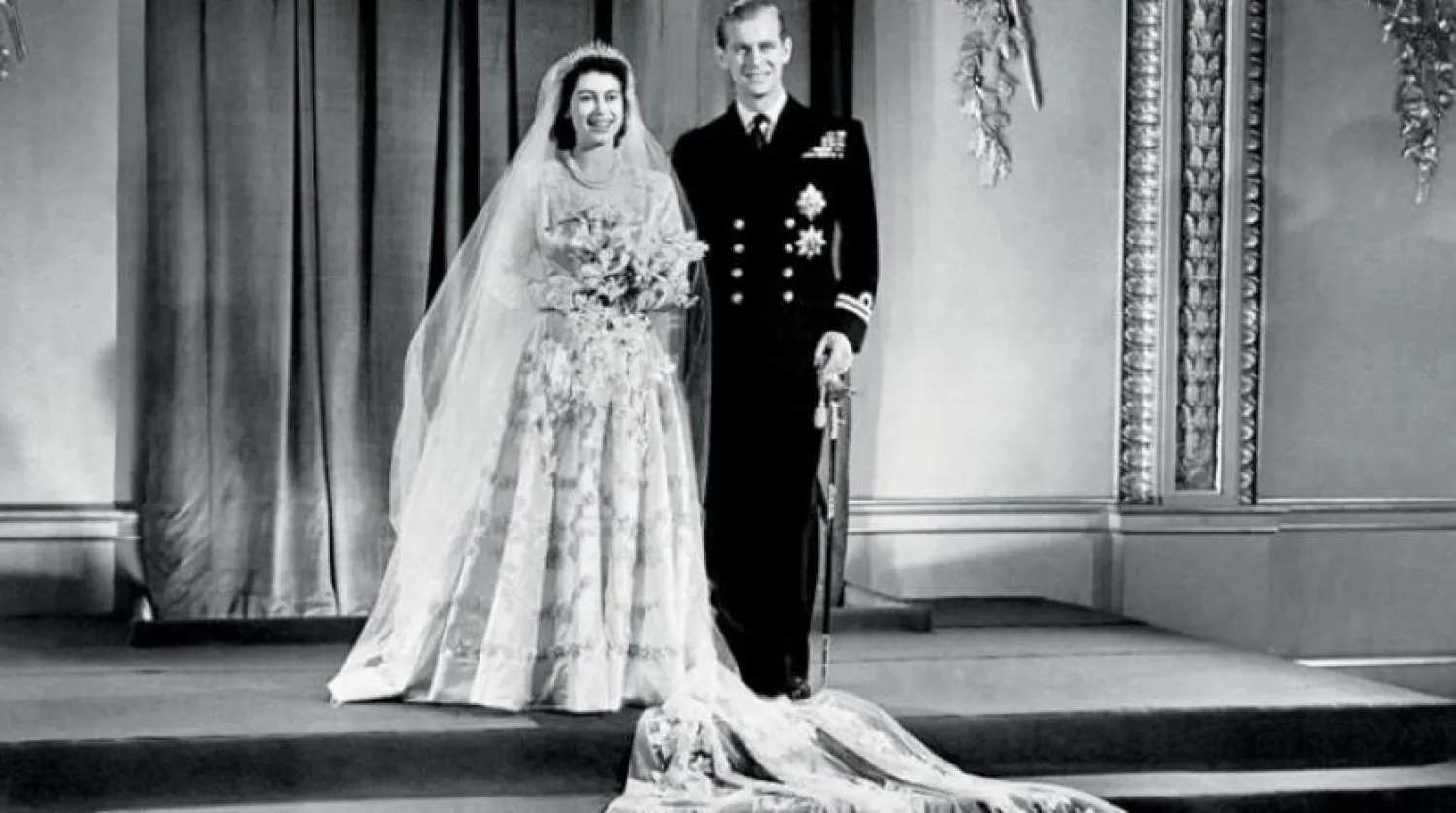
The official wedding picture of Princess Elizabeth and her new husband the Duke of Edinburgh, after their return to Buckingham Palace in November, 1947. dpa
TT

How Did Queen Elizabeth Embody British Spirit in Classic, Whimsical Way?

The official wedding picture of Princess Elizabeth and her new husband the Duke of Edinburgh, after their return to Buckingham Palace in November, 1947. dpa

When Liz Truss, the newly appointed Prime Minister of the United Kingdom, addressed her speech following the announcement of the death of Queen Elizabeth II, on Thursday, she said “the queen was the rock on which modern Britain was built…She has been a personal inspiration to me and to many Britons.”

Her last sentence reminded us that the queen is also the tree from which bourgeoned the foundations of the modern British fashion, and a source of inspiration for many designers. Her effect was huge since she was crowned as the Queen of Britain, she was the best to reflect a boldness mixed with a conservative, classic sense, and a whimsicality that makes a key element of fashion and British culture in general. The pictures posted in newspapers, magazines, and social media platforms these days prove that the queen’s sobriety and respect for traditions hid an audacity reflected by the bright colors and hats that can only be spotted at the Royal Ascot.

However, the queen had always worn them like if she was saying loyalty to one style and sustainability are indivisible.

The queen never presented herself as a fashion influencer or passionate like her sister Marguerite and Jacqueline Kennedy, but she was always aware that she’s under the microscope, and pictures are way more significant than words when it comes to a queen that cannot explicitly express her political inclinations and personal thoughts. With time, she managed to create a special position for herself, one that goes beyond the image of the beautiful woman to a queen that had never waived her charm.

Shortly after becoming the queen, she attended a movie premiere in London wearing a black and white dress designed by the palace’s couturier Norman Hartnell, and matched it with white gloves, and a simple tiara to look like an elegant star that stole lights. In the next day, the dress she wore was the request of every British woman. The Barbour country coats and jackets, headscarves, and tartan skirts she wore in non-official appearances have also become a style for members of the high social class and aristocrats, and a source of inspiration for many designers.

Ahead of his 2016 show in Westminster Abby, London, Alessandro Michele, creative director of Gucci, described her as “one of the weirdest people on earth” but in a positive way. He was inspired by her like many other designers including the rebellious Vivienne Westwood, Miuccia Prada, and late Karl Lagerfeld, who said in 2014 that despite all this whimsicality and exaggerated classic sense, “She is never ridiculous; she is flawless.”

Burberry's creative director Riccardo Tisci said it’s impossible to ignore the monarch’s style because it’s an integral part of Burberry’s style in Britain. “She’s one of the world’s most elegant and decent women, and this is what makes Britain an amazing place that combines class and sophistication with the desire of rebellious self-expression.” Designers don’t usually like this appreciation of her style, which doesn’t change or follow fashion seasonal trends, because they often rely on change and controversy to attract customers and make profits. Therefore, some of them went to use her style with some modern, trendy twists. In his Spring/Summer 2011 collection, Designer Christopher Kane presented designs inspired by Norman Hartnell but in flashy neon colors; and in 2018, Erdem Moralıoğl inspired his spring/summer collection from a photo of the queen she took with Duke Ellington in 1958.

Designer Richard Quinn owed his fame to the queen, who attended his fashion show in 2018, and awarded him the Queen Elizabeth Award. This was the first fashion show she attends in person since she became a queen, as a message to support young designers and the London Fashion Week. Her wedding dress was made of Damascene Damask in which craftsman Qassim Ayoubi used gold threads to create the “Elizabeth carving,” later known as the “lover and beloved”.

The queen valued and appreciated the beauty of the dress she received as a gift from the Syrian government in 1947, or maybe she wanted to send a certain message through it, as she had always used her garments and accessories to deliver diplomatic messages, especially during her official meetings with kings and statemen, or in her visits abroad.

Her passion for fashion was nurtured in her early years by her father King George V, who used her in his early rule to gain acceptance and popularity after his brother Edward waived his crown because of a woman, the elegant Alice Simpson. At the time, King George recruited couturier Norman Hartnell to design creative, yet conservative and respectful outfits for his wife and two daughters, Elizabeth and Marguerite. After her father’s death in 1952, Elizabeth requested Hartnell to design a dress for her crowning ceremony. She wanted a dress that reflects the grandness of the occasion, and at the same time, promises the government and the people that she is eligible for her new responsibility.

Her attention to details and the reflection of her outfits had persisted until her last day, not only because she knew she’s a woman in a world dominated by men, so she has to be elegant and unattainable, but also because she never tolerated mistakes in this field. In an interview with The Times newspaper in 2021, couturier Stewart Parvin, who worked with the queen since the 2000s, revealed that the monarch archives her dresses based on dates and occasions, so she doesn’t wear the same outfit twice with the same person. “Some said she doesn’t wear the same dress twice, but that wasn’t true. It’s just that she was very careful in her choices. If she wants to meet President Obama for instance, she can’t wear the same dress she wore when she met him the last time,” he explained.

The queen has died, but her style will always be inspirational for the unique, classic British spirit, and it would be so hard to replace what she had calmly rooted over decades.



Coffee Regions Hit by Extra Days of Extreme Heat, Say Scientists 

17 April 2012, North Rhine-Westphalia, Vluyn: A general view of Arabica Coffee beans. (dpa)
TT

Coffee Regions Hit by Extra Days of Extreme Heat, Say Scientists 

17 April 2012, North Rhine-Westphalia, Vluyn: A general view of Arabica Coffee beans. (dpa)

The world's main coffee-growing regions are roasting under additional days of climate change-driven heat every year, threatening harvests and contributing to higher prices, researchers said Wednesday.

An analysis found that there were 47 extra days of harmful heat per year on average in 25 countries representing nearly all global coffee production between 2021 and 2025, according to independent research group Climate Central.

Brazil, Vietnam, Colombia, Ethiopia and Indonesia -- which supply 75 percent of the world's coffee -- experienced on average 57 additional days of temperatures exceeding the threshold of 30C.

"Climate change is coming for our coffee. Nearly every major coffee-producing country is now experiencing more days of extreme heat that can harm coffee plants, reduce yields, and affect quality," said Kristina Dahl, Climate Central's vice president for science.

"In time, these impacts may ripple outward from farms to consumers, right into the quality and cost of your daily brew," Dahl said in a statement.

US tariffs on imports from Brazil, which supplies a third of coffee consumed in the United States, contributed to higher prices this past year, Climate Central said.

But extreme weather in the world's coffee-growing regions is "at least partly to blame" for the recent surge in prices, it added.

Coffee cultivation needs optimal temperatures and rainfall to thrive.

Temperatures above 30C are "extremely harmful" to arabica coffee plants and "suboptimal" for the robusta variety, Climate Central said. Those two plant species produce the majority of the global coffee supply.

For its analysis, Climate Central estimated how many days each year would have stayed below 30C in a world without carbon pollution but instead exceeded that level in reality -- revealing the number of hot days added by climate change.

The last three years have been the hottest on record, according to climate monitors.


Dog Gives Olympics Organizers Paws for Thought

A dog wanders on the ski trail during the women's team cross country free sprint qualification event of the Milano Cortina 2026 Winter Olympic Games at Tesero Cross-Country Skiing Stadium in Lago di Tesero (Val di Fiemme), on February 18, 2026. (Photo by Anne-Christine POUJOULAT / AFP)
TT

Dog Gives Olympics Organizers Paws for Thought

A dog wanders on the ski trail during the women's team cross country free sprint qualification event of the Milano Cortina 2026 Winter Olympic Games at Tesero Cross-Country Skiing Stadium in Lago di Tesero (Val di Fiemme), on February 18, 2026. (Photo by Anne-Christine POUJOULAT / AFP)

A dog decided he would bid for an unlikely Olympic medal on Wednesday as he joined the women's cross country team free sprint in the Milan-Cortina Games.

The dog ran onto the piste in Tesero in northern Italy and gamely, even without skis, ran behind two of the competitors, Greece's Konstantina Charalampidou and Tena Hadzic of Croatia.

He crossed the finishing line, his moment of glory curtailed as he was collared by the organizers and led away -- his owner no doubt will have a bone to pick with him when they are reunited.


Olives, Opera and a Climate-Neutral Goal: How a Mural in Greece Won ‘Best in the World’ 

A building with the mural entitled “Kalamata” depicting opera legend Maria Callas by artist Kleomenis Kostopoulos is seen in Kalamata town, about 240 kilometers (150 miles) southwest of Athens, Monday, Feb. 9, 2026. (AP) 
TT

Olives, Opera and a Climate-Neutral Goal: How a Mural in Greece Won ‘Best in the World’ 

A building with the mural entitled “Kalamata” depicting opera legend Maria Callas by artist Kleomenis Kostopoulos is seen in Kalamata town, about 240 kilometers (150 miles) southwest of Athens, Monday, Feb. 9, 2026. (AP) 

Long known for its olives and seaside charm, the southern Greek city of Kalamata has found itself in the spotlight thanks to a towering mural that reimagines legendary soprano Maria Callas as an allegory for the city itself.

The massive artwork on the side of a prominent building in the city center has been named 2025’s “Best Mural of the World” by Street Art Cities, a global platform celebrating street art.

Residents of Kalamata, approximately 240 kilometers (150 miles) southwest of Athens, cultivate the world-renowned olives, figs and grapes that feature prominently on the mural.

That was precisely the point.

Vassilis Papaefstathiou, deputy mayor of strategic planning and climate neutrality, explained Kalamata is one of the few Greek cities with the ambitious goal of becoming climate-neutral by 2030. He and other city leaders wanted a way to make abstract concepts, including sustainable development, agri-food initiatives, and local economic growth, more tangible for the city’s nearly 73,000 residents.

That’s how the idea of a massive mural in a public space was born.

“We wanted it to reflect a very clear and distinct message of what sustainable development means for a regional city such as Kalamata,” Papaefstathiou said. “We wanted to create an image that combines the humble products of the land, such as olives and olive oil — which, let’s be honest, are famous all over the world and have put Kalamata on the map — with the high-level art.”

“By bringing together what is very elevated with ... the humbleness of the land, our aim was to empower the people and, in doing so, strengthen their identity. We want them to be proud to be Kalamatians.”

Southern Greece has faced heatwaves, droughts and wildfires in recent years, all of which affect the olive groves on which the region’s economy is hugely dependent.

The image chosen to represent the city was Maria Callas, widely hailed as one of the greatest opera singers of the 20th century and revered in Greece as a national cultural symbol. She may have been born in New York to Greek immigrant parents, but her father came from a village south of Kalamata. For locals, she is one of their own.

This connection is also reflected in practice: the alumni association at Kalamata’s music school is named for Callas, and the cultural center houses an exhibition dedicated to her, which includes letters from her personal archive.

Artist Kleomenis Kostopoulos, 52, said the mural “is not actually called ‘Maria Callas,’ but ‘Kalamata’ and my attempt was to paint Kalamata (the city) allegorically.”

Rather than portraying a stylized image of the diva, Kostopoulos said he aimed for a more grounded and human depiction. He incorporated elements that connect the people to their land: tree branches — which he considers the above-ground extension of roots — birds native to the area, and the well-known agricultural products.

“The dress I create on Maria Callas in ‘Kalamata’ is essentially all of this, all of this bloom, all of this fruition,” he said. “The blessed land that Kalamata itself has ... is where all of these elements of nature come from.”

Creating the mural was no small feat. Kostopoulos said it took around two weeks of actual work spread over a month due to bad weather. He primarily used brushes but also incorporated spray paint and a cherry-picker to reach all edges of the massive wall.

Papaefstathiou, the deputy mayor, said the mural has become a focal point.

“We believe this mural has helped us significantly in many ways, including in strengthening the city’s promotion as a tourist destination,” he said.

Beyond tourism, the mural has sparked conversations about art in public spaces. More building owners in Kalamata have already expressed interest in hosting murals.

“All of us — residents, and I personally — feel immense pride,” said tourism educator Dimitra Kourmouli.

Kostopoulos said he hopes the award will have a wider impact on the art community and make public art more visible in Greece.

“We see that such modern interventions in public space bring tremendous cultural, social, educational and economic benefits to a place,” he said. “These are good springboards to start nice conversations that I hope someday will happen in our country, as well.”