


Queen Elizabeth II Lies in State after Solemn Procession

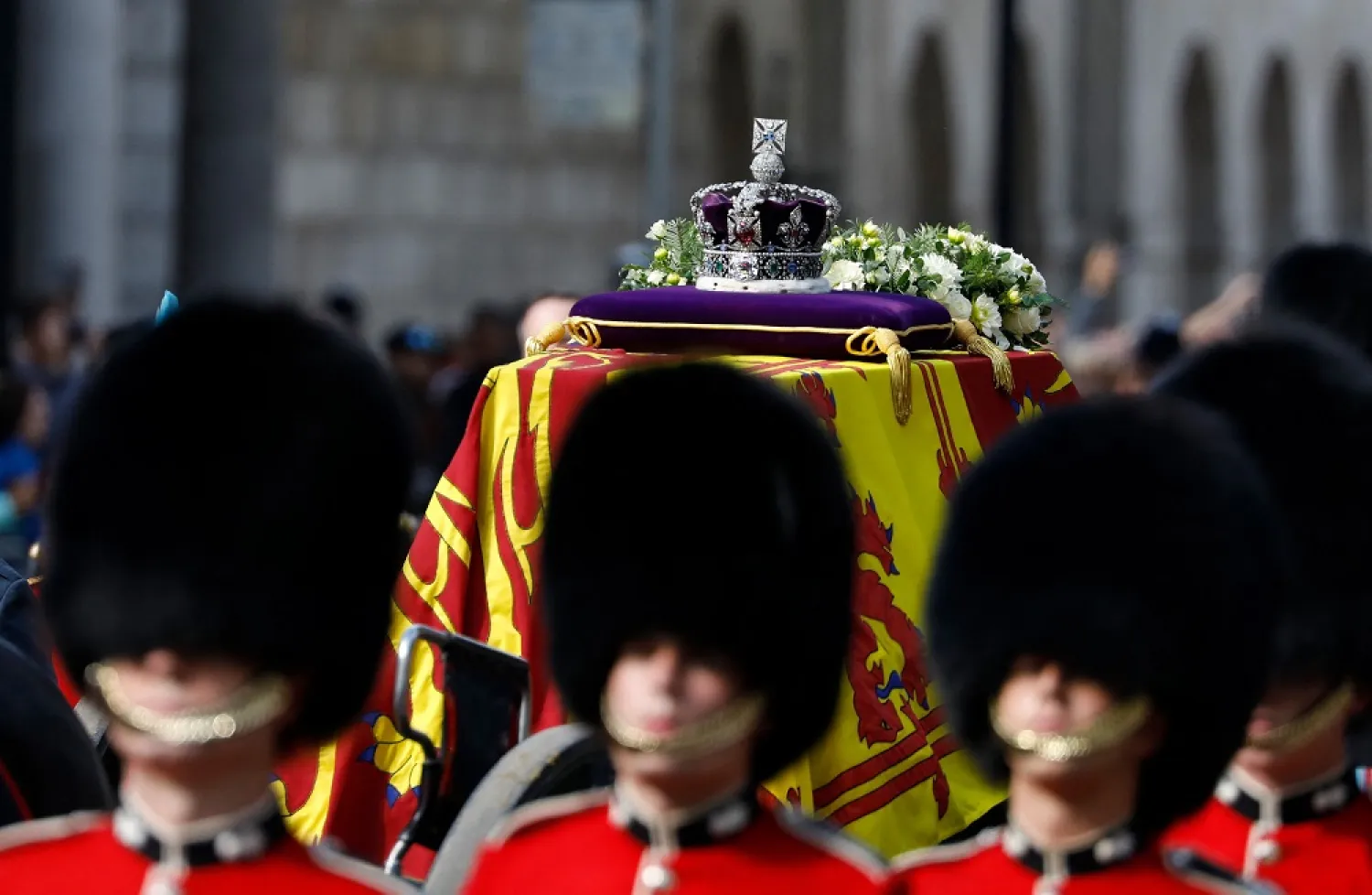
The Imperial State Crown is seen on the coffin of Queen Elizabeth II, adorned with a Royal Standard and the Imperial State Crown and pulled by a Gun Carriage of The King's Troop Royal Horse Artillery, during a procession from Buckingham Palace to the Palace of Westminster, in London on September 14, 2022. (AFP)
TT

Queen Elizabeth II Lies in State after Solemn Procession

The Imperial State Crown is seen on the coffin of Queen Elizabeth II, adorned with a Royal Standard and the Imperial State Crown and pulled by a Gun Carriage of The King's Troop Royal Horse Artillery, during a procession from Buckingham Palace to the Palace of Westminster, in London on September 14, 2022. (AFP)

The coffin of Queen Elizabeth II left Buckingham Palace for the last time Wednesday, borne on a horse-drawn carriage and saluted by cannons and the tolling of Big Ben, in a solemn procession through the flag-draped, crowd-lined streets of London to Westminster Hall. There, Britain’s longest-serving monarch will lie in state for the world to mourn.

Her son, King Charles III, and his siblings and sons marched behind the coffin, which was topped by a wreath of white roses and her crown resting on a purple velvet pillow.

The queen will lie in state for four days until her funeral Monday, with hundreds of thousands of people expected to file past. Eight pall bearers carried the oak and lead-lined coffin into Westminster Hall, placing it on a raised platform known as a catafalque.

Shortly after 5 p.m., the first members of the public were allowed to file past the coffin. They moved in two lines, one on either side of the coffin.

One woman looked close to tears as she paused, faced the coffin and bowed her head.

The military procession from Buckingham Palace was designed to underscore the queen’s seven decades as head of state as the national mourning process shifted to the grand boulevards and historic landmarks of the UK capital.

Thousands who had waited for hours along The Mall outside the palace and other locations along the route held up phones and cameras, and some wiped away tears, as the procession passed. Applause broke out as the coffin passed through Horse Guards Parade. Thousands more sat in nearby Hyde Park watching on large screens.

The coffin was draped in the Royal Standard and topped with the Imperial State Crown — encrusted with almost 3,000 diamonds — and a bouquet of flowers and plants, including pine from the Balmoral Estate, where Elizabeth died on Sept. 8 at the age of 96.

Two officers and 32 troops from the 1st Battalion Grenadier Guards in red uniforms and bearskin hats walked on either side of the gun carriage. The 38-minute procession ended at Westminster Hall, where Archbishop of Canterbury Justin Welby led a service attended by Charles and other royals.

"Let not your heart be troubled: ye believe in God, believe also in me. In my Father’s house are many mansions: if it were not so, I would have told you," Welby read from the Book of John.

After a short service, the captain of The Queen’s Company 1st Battalion Grenadier Guards, assisted by a senior sergeant, laid the royal standard of the regiment on the steps of the catafalque.

Four officers from the Household Cavalry – two from the Life Guards and two from the Blues Royals – began the first vigil around the coffin, taking their places at the corner and bowing their heads.

Thousands had queued up along the banks of the River Thames, waiting their turn to enter the hall and pay their respects.

The crowds are the latest manifestation of the nationwide outpouring of grief and respect for the only monarch most Britons have ever known after her 70 years on the throne.

Judith Nix, left her home in Leicestershire, central England, at 4:30 a.m. to stake out a place with a good view of the procession.

"We weren’t sure what to expect because we’ve seen clapping, we’ve seen ‘God save the King,’ we’ve seen ‘God save the Queen,’ so we didn’t know. But the silence was just unbelievable," she said.

Maj. Gen. Christopher Ghika, of the Household division, who organized the ceremonial aspects of the queen’s funeral, said it was "our last opportunity to do our duty for the queen, and it’s our first opportunity to do it for the king, and that makes us all very proud."

Troops involved in the procession had been preparing since the queen died. So had the horses of the King’s Troop Royal Horse Artillery.

Sgt. Tom Jenks, from the King’s Troop Royal Horse Artillery, said the horses were specially trained, including how to handle weeping mourners, as well as flowers and flags being tossed in front of the procession.

Heathrow Airport temporarily halted flights, saying it would "ensure silence over central London as the ceremonial procession moves from Buckingham Palace to Westminster Hall."

President Joe Biden spoke Wednesday with Charles to offer his condolences, the White House said.

Biden recalled "the Queen’s kindness and hospitality" she hosted them and the first lady at Windsor Castle in June, the statement said. "He also conveyed the great admiration of the American people for the Queen, whose dignity and constancy deepened the enduring friendship and special relationship between the United States and the United Kingdom."

Crowds have lined the route of the queen’s coffin whenever it has been moved in its long journey from Scotland to London.

On Tuesday night, thousands braved a typical London drizzle as the hearse, with interior lights illuminating the casket, drove slowly from an air base to Buckingham Palace.

Earlier, in Edinburgh, some 33,000 people filed in silent respect past her coffin as it lay for 24 hours at St. Giles’ Cathedral.

Hundreds of thousands are expected to visit the 900-year-old Westminster Hall, the oldest building in Parliament, for four days before her state funeral on Monday. By Wednesday afternoon, the line snaking along the banks of the River Thames was 2 1/2 miles long, according to a government tracker.

The hall is where Guy Fawkes and Charles I were tried, where kings and queens hosted magnificent medieval banquets, and where ceremonial addresses were presented to Queen Elizabeth II during her silver, golden and diamond jubilees.

Chris Bond, from Truro in southwest England, was among those waiting to see the queen's coffin. He also attended the lying in state of the queen’s mother in 2002.

"Obviously, it’s quite difficult queuing all day long, but when you walk through those doors into Westminster Hall, that marvelous, historic building, there was a great sense of hush and one was told you take as much time as you like, and it’s just amazing," he said.

"We know the queen was a good age and she served the country a long time, but we hoped this day would never come," he added.

Chris Imafidon, secured the sixth place in the queue.

"I have 1,001 emotions when I see her," he said. "I want to say, God, she was an angel, because she touched many good people and did so many good things."



Migrants Missing after Mediterranean Capsize: NGOs

Hellenic coast guard performs SAR operation, following migrant's boat collision with coast guard off the Aegean island of Chios, near Mersinidi, Greece, February 4, 2026. REUTERS
TT

Migrants Missing after Mediterranean Capsize: NGOs

Hellenic coast guard performs SAR operation, following migrant's boat collision with coast guard off the Aegean island of Chios, near Mersinidi, Greece, February 4, 2026. REUTERS

Dozens of people are missing after a migrant boat capsized in the central Mediterranean, the NGOs Mediterranea Saving Humans and Sea-Watch said Sunday on social media.

Two people died and 32 were rescued from the boat, which had left Libya on Saturday afternoon with around 105 people on board, according to Mediterranea Saving Humans, AFP reported.

"Tragic Easter shipwreck. 32 survivors, two bodies recovered and more than 70 people missing," the NGO wrote on X, adding that the boat capsized in a search-and-rescue zone handled by Libyan authorities.

Sea-Watch said two commercial ships saved the survivors and took them to the Italian island of Lampedusa.

An aerial video it posted showed two men clinging to the hull of the capsized vessel, and the approach of one of the commercial ships.

Mediterranea Saving Humans said the accident was "the consequence of policies by European governments that refuse to open safe and legal pathways" for migrants.

Lampedusa is a key entry point for migrants crossing the Mediterranean from North Africa to Europe.

Since the start of 2026, at least 683 migrants have lost their lives or gone missing on attempts to cross the sea, according to the UN's migration agency IOM.

According to the Italian government, 6,175 migrants arrived on Italian territory over the same period.


Trump Vows Strikes on Iran’s Power Plants, Bridges if Strait of Hormuz isn't Reopened

ABD Başkanı Donald Trump (Reuters)
TT

Trump Vows Strikes on Iran’s Power Plants, Bridges if Strait of Hormuz isn't Reopened

ABD Başkanı Donald Trump (Reuters)

US President Donald Trump has promised strikes on Iran’s power plants and bridges on Tuesday, restating his threat to attack civilian infrastructure if the Strait of Hormuz isn’t reopened.

In an expletive-laden post Sunday morning, Trump promised the “crazy bastards” would be “living in Hell” if the waterway isn’t opened to marine traffic, The AP news reported.

Trump had previously threatened strikes two weeks ago, but extended the deadline for Iran to reopen the waterway twice, claiming there were positive signs in negotiations with the Iranians. But there have been few public signs of progress in a diplomatic off-ramp to the war.


Pope Leo Marks First Easter as Pontiff with Call for Hope Amid Global Conflicts

 Pope Leo XIV presides over Easter Mass in St. Peter's Square at the Vatican, Sunday, April 5, 2026 (AP)
Pope Leo XIV presides over Easter Mass in St. Peter's Square at the Vatican, Sunday, April 5, 2026 (AP)
TT

Pope Leo Marks First Easter as Pontiff with Call for Hope Amid Global Conflicts

 Pope Leo XIV presides over Easter Mass in St. Peter's Square at the Vatican, Sunday, April 5, 2026 (AP)
Pope Leo XIV presides over Easter Mass in St. Peter's Square at the Vatican, Sunday, April 5, 2026 (AP)

Pope Leo celebrated his first Easter Mass as pontiff with a call Sunday to exercise hope against “the violence of war that kills and destroys,” saying “we need this song of hope today” as conflicts spread around the world.

With the US-Israeli war on Iran in its second month and Russia’s ongoing campaign in Ukraine, Leo has repeatedly called for a halt in hostilities. In his Easter homily, the pope singled out those who wage war, abuse the weak and prioritize profits.

Leo, the first US-born pope, addressed the faithful from an open-air altar in St. Peter’s Square flanked with white roses, while the steps leading down to the piazza where the faithful gathered were filled with spring perennials, symbolically resonating with the pope’s message of hope.

The pontiff implored the faithful to keep their hope in the face of death, which lurks “in injustices, in partisan selfishness, in the oppression of the poor, in the lack of attention given to the most vulnerable.

“We see it in violence, in the wounds of the world, in the cry of pain that rises from every corner because of the abuses that crush the weakest among us, because of the idolatry of profit that plunders the earth’s resources, because of the violence of war that kills and destroys,” he said.

He quoted his predecessor Pope Francis in warning against falling into indifference in the face of “persistent injustice, evil, indifference and cruelty,” because “it is also true that in the midst of darkness, something new always springs to life and sooner or later produces fruit.”

He will later deliver the traditional “Urbi et Orbi” message — Latin for “to the city and the world.”

Christians in the Holy Land were marking a subdued Easter Traditional ceremonies at the Church of the Holy Sepulchre, revered by Christians as the traditional site of Jesus’ crucifixion and resurrection, were scaled back under an agreement with Israeli police. Authorities have put limits on the sizes of public gatherings due to ongoing missile attacks.

The restrictions also dampened the recent Muslim holy month of Ramadan and Eid al-Fitr holiday, as well as the current weeklong Jewish festival of Passover. On Sunday, the Jewish priestly blessing at the Western Wall — normally attended by tens of thousands — was limited to just 50 people.

The restrictions have strained relations between Israeli authorities and Christian leaders. Police last week prevented two of the church’s top religious leaders, including Latin Patriarch Pierbattista Pizzaballa, from celebrating Palm Sunday at the Church of the Holy Sepulchre.

On Tuesday, the pope had expressed hope that the war could be finished before Easter.