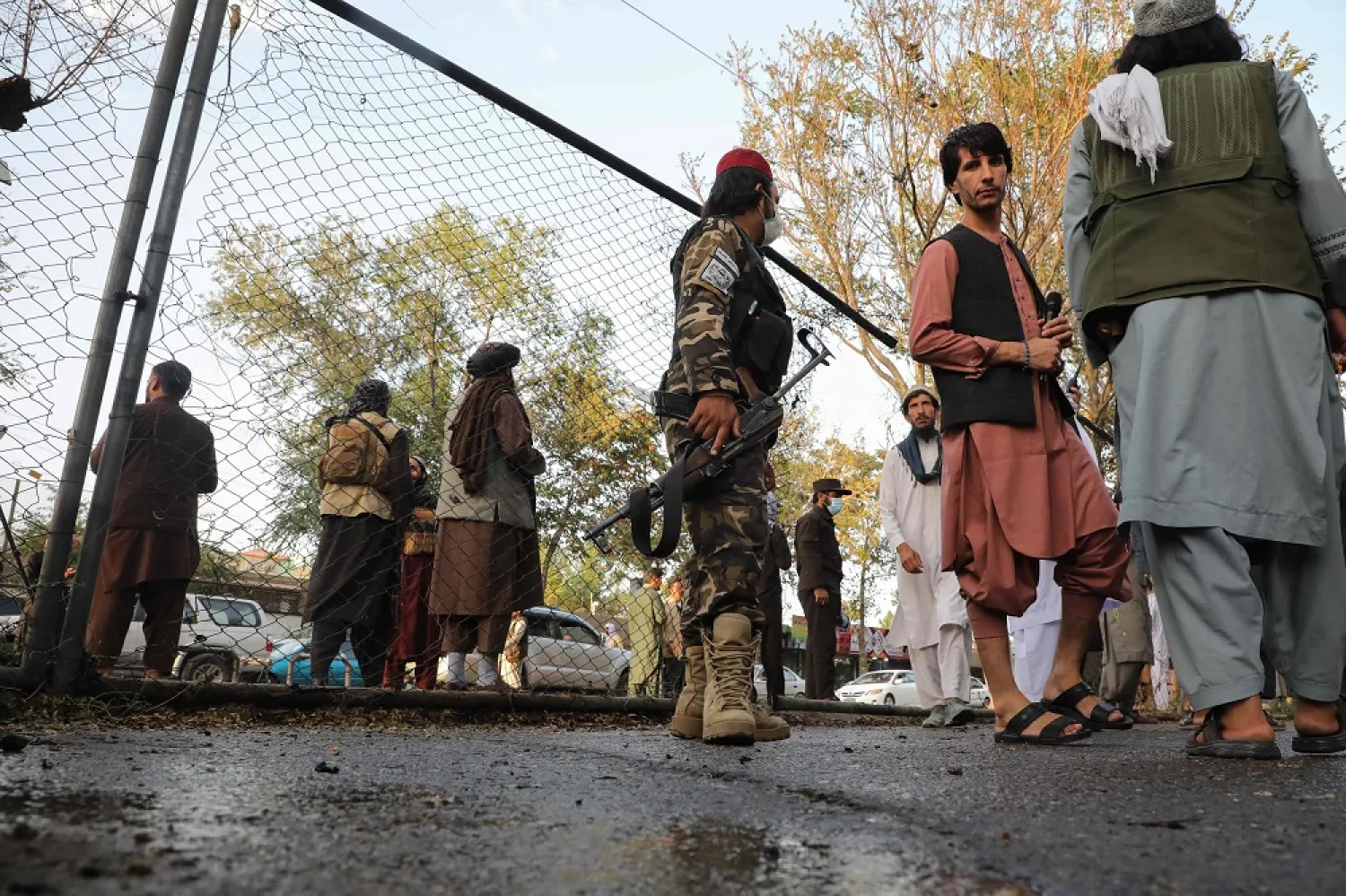
Taliban: Car Bomb Near Kabul Mosque Kills 7, Wounds 41

Taliban fighters investigate at a site after a blast near the Wazir Akbar Khan Mosque that reportedly happened as people were leaving the mosque after Friday prayers at Wazir Akbar Khan in Kabul on September 23, 2022. (AFP)
TT

Taliban: Car Bomb Near Kabul Mosque Kills 7, Wounds 41

Taliban fighters investigate at a site after a blast near the Wazir Akbar Khan Mosque that reportedly happened as people were leaving the mosque after Friday prayers at Wazir Akbar Khan in Kabul on September 23, 2022. (AFP)

A car bomb went off Friday as worshippers were leaving a Kabul mosque, killing at least seven people and wounding 41, including several children, a Taliban official said.

No one immediately claimed responsibility for the bombing, the latest in a steady stream of attacks since the Taliban seized power in Afghanistan just over a year ago.

A column of black smoke rose into the sky and shots rang out several minutes after the explosion near the mosque, located in a high-profile diplomatic neighborhood of the Afghan capital.

A Taliban-appointed Interior Ministry spokesman, Abdul Nafi Takor, said the vehicle with explosives was parked by the roadside near the mosque and detonated as worshippers were coming out after Friday prayers. He added that an investigation was underway, with police at the site.

"Many people were martyred or wounded," said Mohammad Basir, an eyewitness. "I don’t know if there were explosives placed on the roadside or if it was a car bomb, but there was an explosion, and all the people were in a bad situation."

Another eyewitness said the blast was very strong.

"I came out and had crossed the street when an explosion happened," he said. "Right after the explosion, people nervously started evacuating wounded victims to hospital."

The Italian Emergency Hospital, one of Kabul's clinics that treated the victims, said it received 14 casualties from the site, with four dead on arrival.

Khalid Zadran, a spokesman for the Kabul police chief, said worshippers were intentionally targeted as they were leaving the Wazir Akbar Khan Mosque.

"Targeting mosques and worshippers is an unforgivable crime, the nation should cooperate with the regime in eliminating criminals," said Taliban government spokesman Zabihullah Mujahid.

The ISIS group — a top rival of the Taliban since their takeover in Afghanistan just over a year ago — has previously targeted mosques and worshippers, and especially members of Afghanistan’s minority Shiites in attacks.

The United Nations mission in Kabul tweeted that the bombing was another "bitter reminder of ongoing insecurity and terrorist activity in Afghanistan."

"Our thoughts are with the families of those killed, wishing speedy recovery to the injured," added the mission, known as UNAMA.


Iran Executes Three Men over Armed Unrest during January Protests

Iranians protest to stop death penalty executions (Archive - Reuters)
TT

Iran Executes Three Men over Armed Unrest during January Protests

Iranians protest to stop death penalty executions (Archive - Reuters)

Iran executed three men on Sunday after they were convicted of carrying out operations for Israel and the US and taking part in armed unrest during anti-government protests in January, state media reported.
The executions are the latest in a ‌series Iran has ‌carried out in recent ‌months ⁠over the January ⁠protests, including of people accused of links to Israel and the US, Reuters reported.
Hassan Dioband, Hamid Kazemi and Reza Zanganeh were accused of using firearms, grenades and Molotov ⁠cocktails, setting fire to public facilities ‌and ‌damaging an electricity substation in the city of ‌Karaj, causing power outages ‌in some areas, according to the judiciary.
The judiciary said Dioband was arrested on January 11 after investigations identified him ‌as a suspect in attacks on public property and incitement ⁠to ⁠violence.
Ten others accused of participating in the unrest under his supervision were subsequently arrested.
The three were sentenced to death and ordered to have their assets confiscated. Their executions were carried out after the Supreme Court upheld their sentences, while the other defendants received prison terms of 5 to 10 years.


Drone, Missile Attacks Wound 9 as Ukraine Prepares for Talks with Russia and the US

The site of the Russian missile strike near a kindergarten in Kyiv, Ukraine, 07 November 2026, amid the Russian invasion. EPA/SERHII DILIN
TT

Drone, Missile Attacks Wound 9 as Ukraine Prepares for Talks with Russia and the US

The site of the Russian missile strike near a kindergarten in Kyiv, Ukraine, 07 November 2026, amid the Russian invasion. EPA/SERHII DILIN

Drone and missile attacks struck across Ukraine on Saturday, wounding at least nine people, as Kyiv and Moscow prepared for new talks next week with the United States.

Negotiators from Russia, Ukraine and the US are to meet on Tuesday in Abu Dhabi, the capital of the United Arab Emirates, for talks aimed at ending the war. The new round of negotiations would be the fourth brokered by the Trump administration, the most recent having been in Geneva in February.

Western governments backing the peace initiative are seeking a new formula to break the impasse while acknowledging that territorial and security questions remain unresolved.

The Russian missiles that hit overnight across the Ukrainian capital, Kyiv, damaged homes and commercial properties, triggering new power and water outages, national and city authorities said.

Kateryna Korniichuk, 64, was at home with her granddaughter when an attack hit.

“The first blast wave threw us against that wall and then against the other wall, because we were in the corridor. It’s very hard. No sleep, no peace — nothing. The children aren’t sleeping, and neither are we," she told The Associated Press. “I’m old, I can handle it, but what have the children done wrong?”

Strikes also prompted officials to close Kyiv's 816-meter-long (892-yard-long) Northern Bridge, a major route connecting the city with large residential areas on the east bank of the Dnipro River.

Kyiv Mayor Vitali Klitschko said that work was already underway to repair the city's Northern Bridge and that water pressure in Kyiv had been stabilized.

Earlier Saturday, he had described the city's energy situation as "extremely difficult, affecting the city’s heating and water supply systems.”

In a statement Saturday, Ukrainian President Volodymyr Zelenskyy said Russia was preparing for trilateral talks by “launching ballistic missiles at Ukraine’s critical infrastructure.”

Later, he said that Moscow was stepping up strikes to build pressure on Ukraine ahead of the Abu Dhabi talks. “Russia perceives diplomacy in its own peculiar way – as a form of aggression,” he wrote in an online post.

The Ukrainian leader said that Russia fired 36 ballistic missiles at Kyiv and the surrounding region overnight, of which only four were shot down due to a lack of Patriot interceptors.

Zelenskyy also said that Russia had used North Korean-made ballistic missiles to strike energy facilities, citing preliminary findings from investigations at impact sites.

The barrage involved 172 drones over Kyiv and 12 other regions, wounding nine people, including a child, he said.

“When Russia tries to plunge Kyiv — a city of millions — and the entire country into a blackout, Ukraine must not be left to face this alone,” Zelenskyy said. He urged greater US support and attention from Congress, calling for bipartisan backing for Ukraine and stronger sanctions on Russia.

Ukraine’s Energy Ministry said Saturday’s missile attacks damaged networks that carry electricity from nuclear power plants to Kyiv and central regions, as well as multiple other power facilities. It said outages were most widespread in the Kyiv and central Zhytomyr regions, as well as in the eastern regions of Kharkiv, Donetsk and Dnipropetrovsk.

The outages were separate from scheduled rolling blackouts imposed to protect the grid, which remain in effect across much of Ukraine.

Russia’s Ministry of Defense confirmed Saturday that it had targeted the Northern Bridge, saying that it facilitated the transport of weaponry, military hardware and specialist equipment for Ukraine’s armed forces.

It also said that it had targeted an industrial facility in the capital producing Flamingo missiles, as well as a power station, an electrical substation, and a plant producing ammunition, explosives and gunpowder in the wider Kyiv region. It also confirmed striking an electrical substation in the Zhytomyr region.

Meanwhile, in southern Ukraine, a recovery operation continued into its sixth day in the village of Komyshuvakha, devastated on Monday when multiple Russian guided bombs slammed into a former school and nearby shelter as residents waited for humanitarian aid.

Emergency services said they had recovered nine more bodies in the previous 24 hours, bringing the death toll early Saturday morning to 55. Dozens of people remain missing.

Village resident Mykola Krasnov, 72, said he was still looking for his wife but had heard no word from rescuers.

“She went to get humanitarian aid, and a three-ton bomb was dropped there. Where is she?” he said. “She didn’t come home, and they didn’t find her body there. She isn’t in the morgue, and she isn’t here alive.”

The village of Komyshuvakha is located near the front line in the Zaporizhzhia region.

A Ukrainian attack killed one person in Russia’s Belgorod region when a drone hit a private home in the town of Grayvoron, local officials said Saturday.

Russia’s Ministry of Defense said its forces shot down 411 Ukrainian drones overnight over 10 Russian regions, including Belgorod. Drones were also destroyed over the annexed Ukrainian peninsula of Crimea and the Black and Azov Seas, it said.

The head of Russia’s southwestern Saratov region, Gov. Roman Busargin, wrote on social media that a drone attack damaged “civilian infrastructure” and several residential buildings in the area. Russian media outlets later reported that the Saratov Oil Refinery had been hit and shared images of plumes of smoke over the city.

The head of Russia’s Oryol region, Gov. Andrey Klychkov, also said Saturday that a Ukrainian attack had damaged commercial warehouse and production sites in the regional capital, as cited by state media.

Russian media outlets reported that a Ukrainian attack sparked a blaze at Oryol’s Proton-Electrotex plant, which produces components for military equipment.



Iran Says it Has Lifted its Self-imposed Limit on Missile Ranges

A banner depicting US President Donald Trump, Israeli Prime Minister Benjamin Netanyahu, US Vice President JD Vance and US Special Envoy Steve Witkoff is displayed on a street in Tehran, Iran, November 4, 2026. Majid Asgaripour/WANA (West Asia News Agency) via REUTERS
TT

Iran Says it Has Lifted its Self-imposed Limit on Missile Ranges

A banner depicting US President Donald Trump, Israeli Prime Minister Benjamin Netanyahu, US Vice President JD Vance and US Special Envoy Steve Witkoff is displayed on a street in Tehran, Iran, November 4, 2026. Majid Asgaripour/WANA (West Asia News Agency) via REUTERS

Iran’s Revolutionary Guard said Saturday it has lifted a self-imposed limit of 2,000 kilometers on the range of its ballistic missiles, suggesting the country may seek to develop missiles capable of reaching more distant targets as fears of renewed all-out war rise.

The comments by the spokesman of the Revolutionary Guard came days after the country’s supreme leader, Mojtaba Khomeini, warned that “any kind and level of threat” from the US or Israel would face a response without geographic limits.

Asked at a Tehran news conference about the limit on missile ranges, Gen. Hossein Mohebbi said: “That restriction has been lifted for us.”

He did not say whether Tehran had missiles capable of exceeding the limit, saying only Iran would “demonstrate these capabilities in practice” rather than make statements.

Iran is not known to have missiles that can go beyond the 2,000-kilometer limit. However, US officials have said technology from Iran’s space program can be repurposed to build intercontinental ballistic missiles.

The Iranian military, meanwhile, said a tanker east of the Strait of Hormuz had hit a mine and caught fire. It did not identify the tanker's flag or destination. It said the vessel had turned off its navigational beacon and was sailing in a “prohibited area.”