


Tracing Uncertainty: Google Harnesses Quantum Mechanics at California Lab

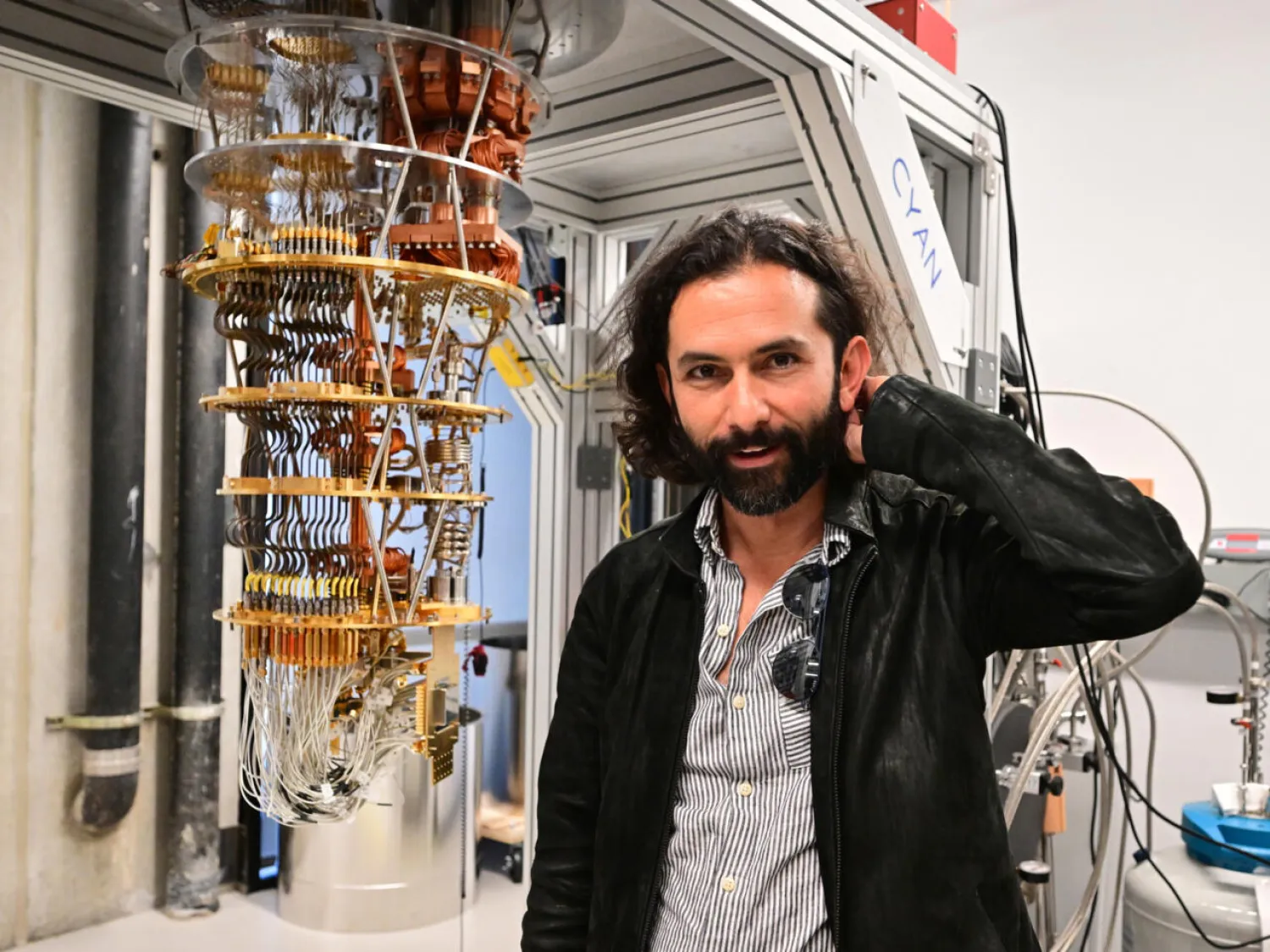
Google has around 20 quantum computers at its lab in Santa Barbara, where Dr Erik Lucero and his team are trying to forge the future of computing Frederic J. BROWN AFP
TT

Tracing Uncertainty: Google Harnesses Quantum Mechanics at California Lab

Google has around 20 quantum computers at its lab in Santa Barbara, where Dr Erik Lucero and his team are trying to forge the future of computing Frederic J. BROWN AFP

Outside, balmy September sunshine warms an idyllic coast, as California basks in yet another perfect day.

Inside, it's minus 460 Fahrenheit (-273 Celsius) in some spots, pockets of cold that bristle with the impossible physics of quantum mechanics -- a science in which things can simultaneously exist, not exist and also be something in between, AFP said.

This is Google's Quantum AI laboratory, where dozens of super-smart people labor in an office kitted out with climbing walls and electric bikes to shape the next generation of computers -- a generation that will be unlike anything users currently have in their pockets or offices.

"It is a new type of computer that uses quantum mechanics to do computations and allows us... to solve problems that would otherwise be impossible," explains Erik Lucero, lead engineer at the campus near Santa Barbara.

"It's not going to replace your mobile phone, your desktop; it's going to be working in parallel with those things."

Quantum mechanics is a field of research that scientists say could be used one day to help limit global warming, design city traffic systems or develop powerful new drugs.

The promises are so great that governments, tech giants and start-ups around the world are investing billions of dollars in it, employing some of the biggest brains around.

- Schrodinger's cat -
Old fashioned computing is built on the idea of binary certainty: tens of thousands of "bits" of data that are each definitely either "on" or "off," represented by either a one or a zero.

Quantum computing uses uncertainty: its "qubits" can exist in a state of both one-ness and zero-ness in what is called a superposition.

The most famous illustration of a quantum superposition is Schrodinger's cat -- a hypothetical animal locked in a box with a flask of poison which may or may not shatter.

While the box is shut, the cat is simultaneously alive and dead. But once you interfere with the quantum state and open the box, the question of the cat's life or death is resolved.

Quantum computers use this uncertainty to perform lots of seemingly contradictory calculations at the same time -- a bit like being able to go down every possible route in a maze all at once, instead of trying each one in series until you find the right path.

The difficulty for quantum computer designers is getting these qubits to maintain their superposition long enough to make a calculation.

As soon as something interferes with them -- noise, muck, the wrong temperature -- the superposition collapses, and you're left with a random and likely nonsensical answer.

The quantum computer Google showed off to journalists resembles a steampunk wedding cake hung upside-down from a support structure.

Each layer of metal and curved wires gets progressively colder, down to the final stage, where the palm-sized processor is cooled to just 10 Millikelvin, or about -460 Fahrenheit (-273 Celsius).

That temperature -- only a shade above absolute zero, the lowest temperature possible in the universe -- is vital for the superconductivity Google's design relies on.

While the layer-cake computer is not huge -- about half a person high -- a decent amount of lab space is taken up with the equipment to cool it -- pipes whoosh overhead with helium dilutions compressing and expanding, using the same process that keeps your refrigerator cold.

- Future -But... what does it all actually do?

Well, says Daniel Lidar, an expert in quantum systems at the University of Southern California, it's a field that promises much when it matures, but which is still a toddler.

"We've learned how to crawl but we've certainly not yet learned how to how to walk or jump or run," he told AFP.

The key to its growth will be solving the problem of the superpositional collapses -- the opening of the cat's box -- to allow for meaningful calculations.

As this process of error correction improves, problems such as city traffic optimization, which is fiendishly hard on a classical computer because of the number of independent variables involved -- the cars themselves -- could come within reach, said Lidar.

"On (an error-corrected) quantum computer, you could solve that problem," he said.

For Lucero and his colleagues, these future possibilities are worth the brain ache.

"Quantum mechanics is one of the best theories that we have today to experience nature. This is a computer that speaks the language of nature.

"And if we want to go out and figure out these really challenging problems, to help save our planet, and things like climate change, than having a computer that can do exactly that, I'd want that."



KAUST Scientists Develop AI-Generated Data to Improve Environmental Disaster Tracking

King Abdullah University of Science and Technology (KAUST) logo
TT

KAUST Scientists Develop AI-Generated Data to Improve Environmental Disaster Tracking

King Abdullah University of Science and Technology (KAUST) logo

King Abdullah University of Science and Technology (KAUST) and SARsatX, a Saudi company specializing in Earth observation technologies, have developed computer-generated data to train deep learning models to predict oil spills.

According to KAUST, validating the use of synthetic data is crucial for monitoring environmental disasters, as early detection and rapid response can significantly reduce the risks of environmental damage.

Dean of the Biological and Environmental Science and Engineering Division at KAUST Dr. Matthew McCabe noted that one of the biggest challenges in environmental applications of artificial intelligence is the shortage of high-quality training data.

He explained that this challenge can be addressed by using deep learning to generate synthetic data from a very small sample of real data and then training predictive AI models on it.

This approach can significantly enhance efforts to protect the marine environment by enabling faster and more reliable monitoring of oil spills while reducing the logistical and environmental challenges associated with data collection.


Uber, Lyft to Test Baidu Robotaxis in UK from Next Year 

A sign of Baidu is pictured at the company's headquarters in Beijing, China March 16, 2023. (Reuters)
TT

Uber, Lyft to Test Baidu Robotaxis in UK from Next Year 

A sign of Baidu is pictured at the company's headquarters in Beijing, China March 16, 2023. (Reuters)

Uber Technologies and Lyft are teaming up with Chinese tech giant Baidu to try out driverless taxis in the UK next year, marking a major step in the global race to commercialize robotaxis.

It highlights how ride-hailing platforms are accelerating autonomous rollout through partnerships, positioning London as an early proving ground for large-scale robotaxi services ‌in Europe.

Lyft, meanwhile, plans ‌to deploy Baidu's ‌autonomous ⁠vehicles in Germany ‌and the UK under its platform, pending regulatory approval. Both companies have abandoned in-house development of autonomous vehicles and now rely on alliances to accelerate adoption.

The partnerships underscore how global robotaxi rollouts are gaining momentum. ⁠Alphabet's Waymo said in October it would start ‌tests in London this ‍month, while Baidu ‍and WeRide have launched operations in the ‍Middle East and Switzerland.

Robotaxis promise safer, greener and more cost-efficient rides, but profitability remains uncertain. Public companies like Pony.ai and WeRide are still loss-making, and analysts warn the economics of expensive fleets could pressure margins ⁠for platforms such as Uber and Lyft.

Analysts have said hybrid networks, mixing robotaxis with human drivers, may be the most viable model to manage demand peaks and pricing.

Lyft completed its $200 million acquisition of European taxi app FreeNow from BMW and Mercedes-Benz in July, marking its first major expansion beyond North America and ‌giving the US ride-hailing firm access to nine countries across Europe.


Italy Fines Apple Nearly 100m Euros over App Privacy Feature

An Apple logo hangs above the entrance to the Apple store on 5th Avenue in the Manhattan borough of New York City, July 21, 2015. REUTERS/Mike Segar/File Photo Purchase Licensing Rights
TT

Italy Fines Apple Nearly 100m Euros over App Privacy Feature

An Apple logo hangs above the entrance to the Apple store on 5th Avenue in the Manhattan borough of New York City, July 21, 2015. REUTERS/Mike Segar/File Photo Purchase Licensing Rights

Italy's competition authority said Monday it had fined US tech giant Apple 98 million euros ($115 million) for allegedly abusing its dominant position in the mobile app market.

According to AFP, the AGCM said in a statement that Apple had violated privacy regulations for third-party developers in a market where it "holds a super-dominant position through its App Store".

The body said its investigation had established the "restrictive nature" of the "privacy rules imposed by Apple... on third-party developers of apps distributed through the App Store".

The rules of Apple's App Tracking Transparency (ATT) "are imposed unilaterally and harm the interests of Apple's commercial partners", according to the AGCM statement.

French antitrust authorities earlier this year handed Apple a 150-million euro fine over its app tracking privacy feature.

Authorities elsewhere in Europe have also opened similar probes over ATT, which Apple promotes as a privacy safeguard.

The feature, introduced by Apple in 2021, requires apps to obtain user consent through a pop-up window before tracking their activity across other apps and websites.

If they decline, the app loses access to information on that user which enables ad targeting.

Critics have accused Apple of using the system to promote its own advertising services while restricting competitors.