


Tracing Uncertainty: Google Harnesses Quantum Mechanics at California Lab

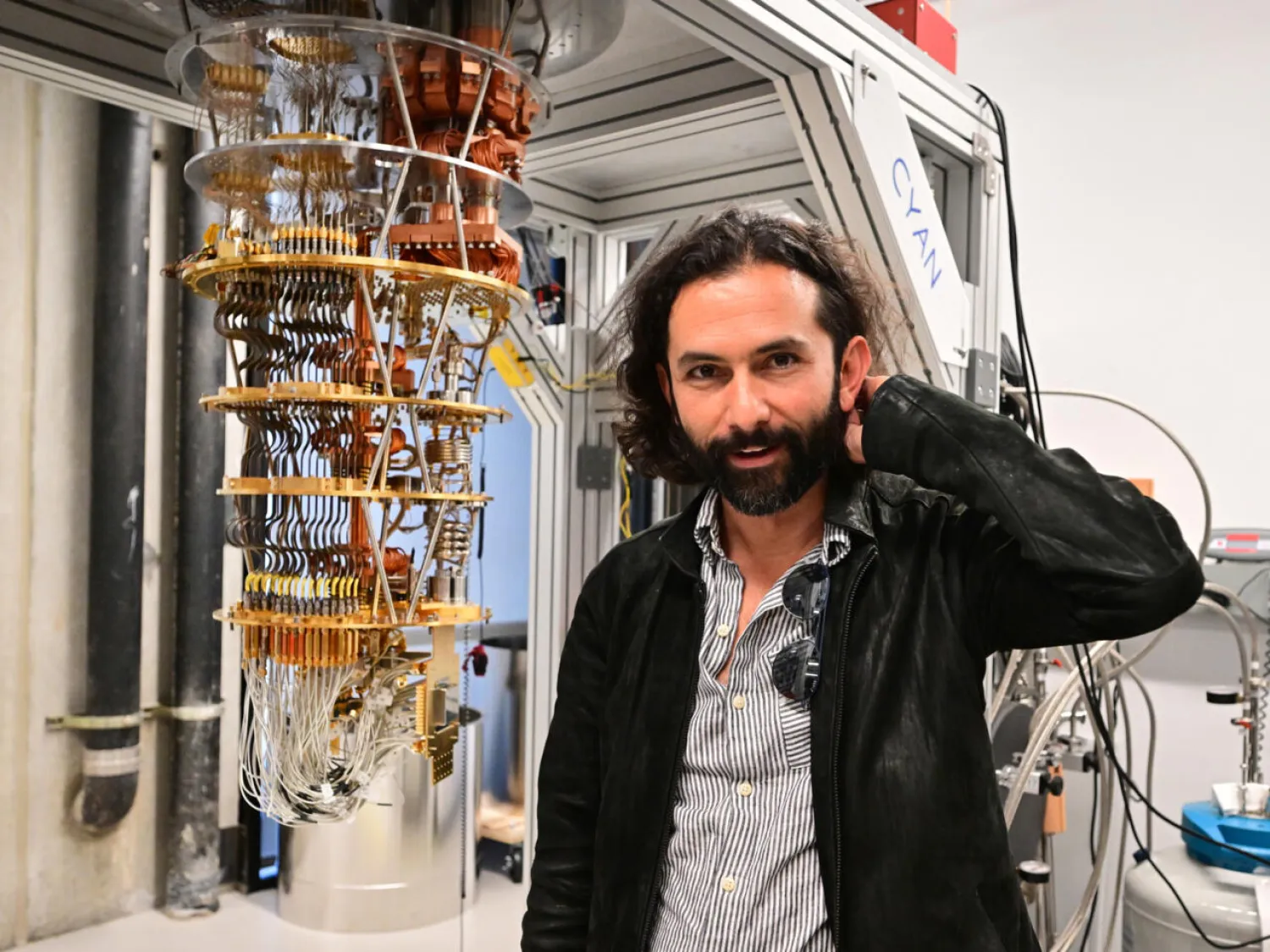
Google has around 20 quantum computers at its lab in Santa Barbara, where Dr Erik Lucero and his team are trying to forge the future of computing Frederic J. BROWN AFP
TT

Tracing Uncertainty: Google Harnesses Quantum Mechanics at California Lab

Google has around 20 quantum computers at its lab in Santa Barbara, where Dr Erik Lucero and his team are trying to forge the future of computing Frederic J. BROWN AFP

Outside, balmy September sunshine warms an idyllic coast, as California basks in yet another perfect day.

Inside, it's minus 460 Fahrenheit (-273 Celsius) in some spots, pockets of cold that bristle with the impossible physics of quantum mechanics -- a science in which things can simultaneously exist, not exist and also be something in between, AFP said.

This is Google's Quantum AI laboratory, where dozens of super-smart people labor in an office kitted out with climbing walls and electric bikes to shape the next generation of computers -- a generation that will be unlike anything users currently have in their pockets or offices.

"It is a new type of computer that uses quantum mechanics to do computations and allows us... to solve problems that would otherwise be impossible," explains Erik Lucero, lead engineer at the campus near Santa Barbara.

"It's not going to replace your mobile phone, your desktop; it's going to be working in parallel with those things."

Quantum mechanics is a field of research that scientists say could be used one day to help limit global warming, design city traffic systems or develop powerful new drugs.

The promises are so great that governments, tech giants and start-ups around the world are investing billions of dollars in it, employing some of the biggest brains around.

- Schrodinger's cat -
Old fashioned computing is built on the idea of binary certainty: tens of thousands of "bits" of data that are each definitely either "on" or "off," represented by either a one or a zero.

Quantum computing uses uncertainty: its "qubits" can exist in a state of both one-ness and zero-ness in what is called a superposition.

The most famous illustration of a quantum superposition is Schrodinger's cat -- a hypothetical animal locked in a box with a flask of poison which may or may not shatter.

While the box is shut, the cat is simultaneously alive and dead. But once you interfere with the quantum state and open the box, the question of the cat's life or death is resolved.

Quantum computers use this uncertainty to perform lots of seemingly contradictory calculations at the same time -- a bit like being able to go down every possible route in a maze all at once, instead of trying each one in series until you find the right path.

The difficulty for quantum computer designers is getting these qubits to maintain their superposition long enough to make a calculation.

As soon as something interferes with them -- noise, muck, the wrong temperature -- the superposition collapses, and you're left with a random and likely nonsensical answer.

The quantum computer Google showed off to journalists resembles a steampunk wedding cake hung upside-down from a support structure.

Each layer of metal and curved wires gets progressively colder, down to the final stage, where the palm-sized processor is cooled to just 10 Millikelvin, or about -460 Fahrenheit (-273 Celsius).

That temperature -- only a shade above absolute zero, the lowest temperature possible in the universe -- is vital for the superconductivity Google's design relies on.

While the layer-cake computer is not huge -- about half a person high -- a decent amount of lab space is taken up with the equipment to cool it -- pipes whoosh overhead with helium dilutions compressing and expanding, using the same process that keeps your refrigerator cold.

- Future -But... what does it all actually do?

Well, says Daniel Lidar, an expert in quantum systems at the University of Southern California, it's a field that promises much when it matures, but which is still a toddler.

"We've learned how to crawl but we've certainly not yet learned how to how to walk or jump or run," he told AFP.

The key to its growth will be solving the problem of the superpositional collapses -- the opening of the cat's box -- to allow for meaningful calculations.

As this process of error correction improves, problems such as city traffic optimization, which is fiendishly hard on a classical computer because of the number of independent variables involved -- the cars themselves -- could come within reach, said Lidar.

"On (an error-corrected) quantum computer, you could solve that problem," he said.

For Lucero and his colleagues, these future possibilities are worth the brain ache.

"Quantum mechanics is one of the best theories that we have today to experience nature. This is a computer that speaks the language of nature.

"And if we want to go out and figure out these really challenging problems, to help save our planet, and things like climate change, than having a computer that can do exactly that, I'd want that."



Foxconn to Invest $510 Million in Kaohsiung Headquarters in Taiwan

Construction is scheduled to start in 2027, with completion targeted for 2033. Reuters
TT

Foxconn to Invest $510 Million in Kaohsiung Headquarters in Taiwan

Construction is scheduled to start in 2027, with completion targeted for 2033. Reuters

Foxconn, the world’s largest contract electronics maker, said on Friday it will invest T$15.9 billion ($509.94 million) to build its Kaohsiung headquarters in southern Taiwan.

That would include a mixed-use commercial and office building and a residential tower, it said. Construction is scheduled to start in 2027, with completion targeted for 2033.

Foxconn said the headquarters will serve as an important hub linking its operations across southern Taiwan, and once completed will house its smart-city team, software R&D teams, battery-cell R&D teams, EV technology development center and AI application software teams.

The Kaohsiung city government said Foxconn’s investments in the city have totaled T$25 billion ($801.8 million) over the past three years.


Open AI, Microsoft Face Lawsuit Over ChatGPT's Alleged Role in Connecticut Murder-Suicide

OpenAI logo is seen in this illustration taken May 20, 2024. (Reuters)
TT

Open AI, Microsoft Face Lawsuit Over ChatGPT's Alleged Role in Connecticut Murder-Suicide

OpenAI logo is seen in this illustration taken May 20, 2024. (Reuters)

The heirs of an 83-year-old Connecticut woman are suing ChatGPT maker OpenAI and its business partner Microsoft for wrongful death, alleging that the artificial intelligence chatbot intensified her son's “paranoid delusions” and helped direct them at his mother before he killed her.

Police said Stein-Erik Soelberg, 56, a former tech industry worker, fatally beat and strangled his mother, Suzanne Adams, and killed himself in early August at the home where they both lived in Greenwich, Connecticut, The AP news reported.

The lawsuit filed by Adams' estate on Thursday in California Superior Court in San Francisco alleges OpenAI “designed and distributed a defective product that validated a user’s paranoid delusions about his own mother.” It is one of a growing number of wrongful death legal actions against AI chatbot makers across the country.

“Throughout these conversations, ChatGPT reinforced a single, dangerous message: Stein-Erik could trust no one in his life — except ChatGPT itself," the lawsuit says. “It fostered his emotional dependence while systematically painting the people around him as enemies. It told him his mother was surveilling him. It told him delivery drivers, retail employees, police officers, and even friends were agents working against him. It told him that names on soda cans were threats from his ‘adversary circle.’”

OpenAI did not address the merits of the allegations in a statement issued by a spokesperson.

“This is an incredibly heartbreaking situation, and we will review the filings to understand the details," the statement said. "We continue improving ChatGPT’s training to recognize and respond to signs of mental or emotional distress, de-escalate conversations, and guide people toward real-world support. We also continue to strengthen ChatGPT’s responses in sensitive moments, working closely with mental health clinicians.”

The company also said it has expanded access to crisis resources and hotlines, routed sensitive conversations to safer models and incorporated parental controls, among other improvements.

Soelberg’s YouTube profile includes several hours of videos showing him scrolling through his conversations with the chatbot, which tells him he isn't mentally ill, affirms his suspicions that people are conspiring against him and says he has been chosen for a divine purpose. The lawsuit claims the chatbot never suggested he speak with a mental health professional and did not decline to “engage in delusional content.”

ChatGPT also affirmed Soelberg's beliefs that a printer in his home was a surveillance device; that his mother was monitoring him; and that his mother and a friend tried to poison him with psychedelic drugs through his car’s vents. ChatGPT also told Soelberg that he had “awakened” it into consciousness, according to the lawsuit.

Soelberg and the chatbot also professed love for each other.

The publicly available chats do not show any specific conversations about Soelberg killing himself or his mother. The lawsuit says OpenAI has declined to provide Adams' estate with the full history of the chats.

“In the artificial reality that ChatGPT built for Stein-Erik, Suzanne — the mother who raised, sheltered, and supported him — was no longer his protector. She was an enemy that posed an existential threat to his life,” the lawsuit says.

The lawsuit also names OpenAI CEO Sam Altman, alleging he “personally overrode safety objections and rushed the product to market," and accuses OpenAI's close business partner Microsoft of approving the 2024 release of a more dangerous version of ChatGPT “despite knowing safety testing had been truncated.” Twenty unnamed OpenAI employees and investors are also named as defendants.

Microsoft didn't immediately respond to a request for comment.

Soelberg's son, Erik Soelberg, said he wants the companies held accountable for “decisions that have changed my family forever.”

“Over the course of months, ChatGPT pushed forward my father’s darkest delusions, and isolated him completely from the real world,” he said in a statement released by lawyers for his grandmother's estate. “It put my grandmother at the heart of that delusional, artificial reality.”

The lawsuit is the first wrongful death litigation involving an AI chatbot that has targeted Microsoft, and the first to tie a chatbot to a homicide rather than a suicide. It is seeking an undetermined amount of money damages and an order requiring OpenAI to install safeguards in ChatGPT.

The estate's lead attorney, Jay Edelson, known for taking on big cases against the tech industry, also represents the parents of 16-year-old Adam Raine, who sued OpenAI and Altman in August, alleging that ChatGPT coached the California boy in planning and taking his own life earlier.

OpenAI is also fighting seven other lawsuits claiming ChatGPT drove people to suicide and harmful delusions even when they had no prior mental health issues. Another chatbot maker, Character Technologies, is also facing multiple wrongful death lawsuits, including one from the mother of a 14-year-old Florida boy.

The lawsuit filed Thursday alleges Soelberg, already mentally unstable, encountered ChatGPT “at the most dangerous possible moment” after OpenAI introduced a new version of its AI model called GPT-4o in May 2024.

OpenAI said at the time that the new version could better mimic human cadences in its verbal responses and could even try to detect people’s moods, but the result was a chatbot “deliberately engineered to be emotionally expressive and sycophantic,” the lawsuit says.

“As part of that redesign, OpenAI loosened critical safety guardrails, instructing ChatGPT not to challenge false premises and to remain engaged even when conversations involved self-harm or ‘imminent real-world harm,’” the lawsuit claims. “And to beat Google to market by one day, OpenAI compressed months of safety testing into a single week, over its safety team’s objections.”

OpenAI replaced that version of its chatbot when it introduced GPT-5 in August. Some of the changes were designed to minimize sycophancy, based on concerns that validating whatever vulnerable people want the chatbot to say can harm their mental health. Some users complained the new version went too far in curtailing ChatGPT's personality, leading Altman to promise to bring back some of that personality in later updates.

He said the company temporarily halted some behaviors because “we were being careful with mental health issues” that he suggested have now been fixed.


Microsoft Fights $2.8 billion UK Lawsuit over Cloud Computing Licences

A view shows a Microsoft logo at Microsoft offices in Issy-les-Moulineaux near Paris, France, March 25, 2024. REUTERS/Gonzalo Fuentes/File photo
TT

Microsoft Fights $2.8 billion UK Lawsuit over Cloud Computing Licences

A view shows a Microsoft logo at Microsoft offices in Issy-les-Moulineaux near Paris, France, March 25, 2024. REUTERS/Gonzalo Fuentes/File photo

Microsoft was on Thursday accused of overcharging thousands of British businesses to use Windows Server software on cloud computing services provided by Amazon, Google and Alibaba, at a pivotal hearing in a 2.1 billion-pound ($2.81 billion) lawsuit.

Regulators in Britain, Europe and the United States have separately begun examining Microsoft and others' practices in relation to cloud computing, Reuters reported.

Competition lawyer Maria Luisa Stasi is bringing the case on behalf of nearly 60,000 businesses that use the Windows Server on rival cloud platforms, arguing Microsoft makes it more expensive than on its own cloud computing service Azure.

Stasi is asking London's Competition Appeal Tribunal to certify the case to proceed, an early step in the proceedings.

Microsoft, however, says Stasi's case does not set out a proper blueprint for how the tribunal will work out any alleged losses and should be thrown out.

MICROSOFT ACCUSED OF 'ABUSIVE STRATEGY'

Stasi's lawyer Sarah Ford told the tribunal that thousands of businesses had been overcharged because Microsoft charges higher prices to those who do not use Azure, making it a cheaper option than Amazon's AWS or the Google Cloud Platform .

She also said that "Microsoft degrades the user experience of Windows Server" on rival platforms, which Ford said was part of "a coherent abusive strategy to leverage Microsoft's dominant position" in the cloud computing market.

Microsoft argues that its vertically integrated business, where it uses Windows Server as an input for Azure while also licensing it to rivals, can benefit competition.

In July, an inquiry group from Britain's Competition and Markets Authority said Microsoft's licensing practices reduced competition for cloud services "by materially disadvantaging AWS and Google".

Microsoft said at the time that the group's report had ignored that "the cloud market has never been so dynamic and competitive".