

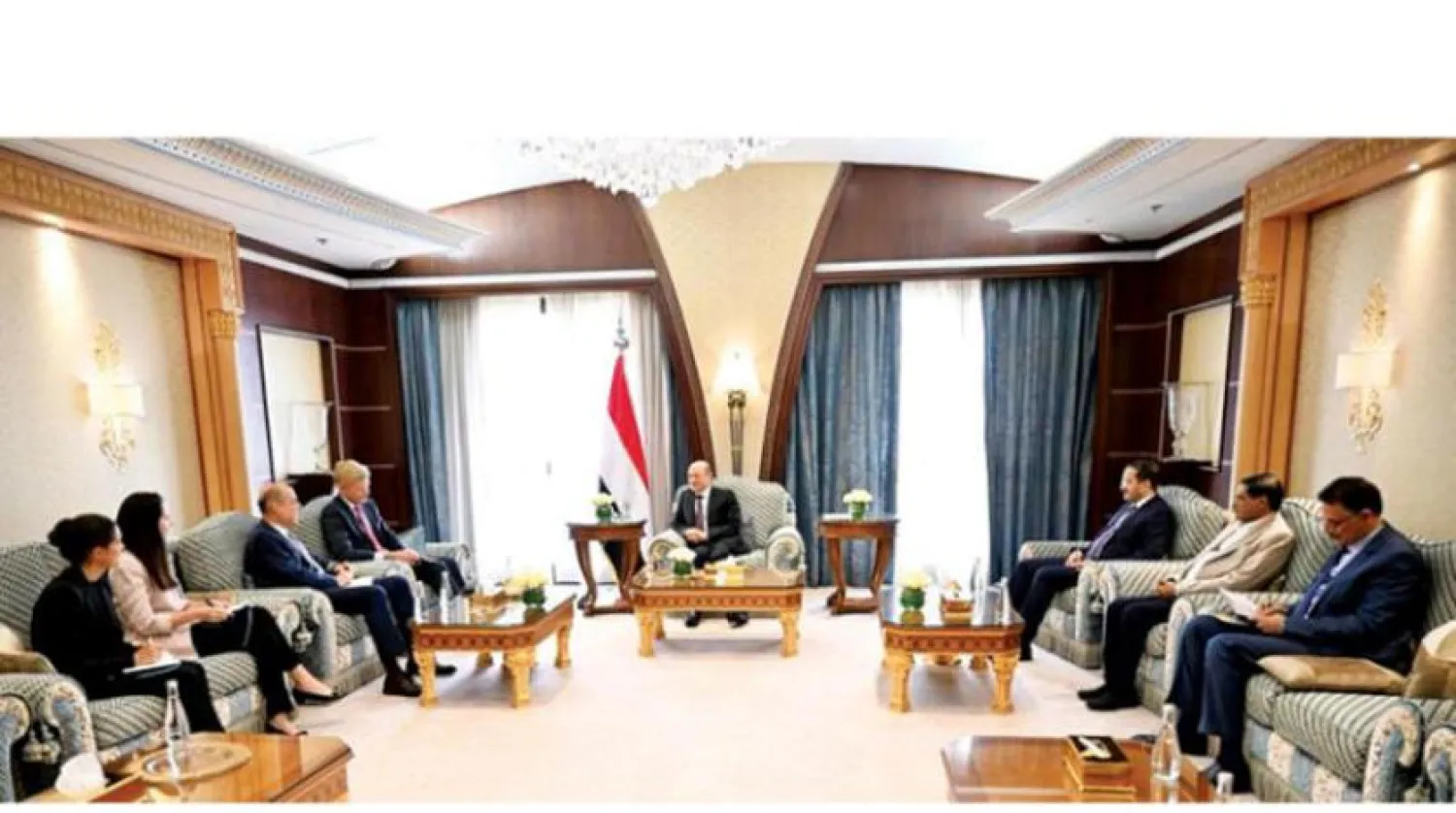

UN Envoy Visits Sanaa to Pressure Houthis to Extend Yemen Truce

UN Envoy Hans Grundberg with the President of Yemen's Presidential Leadership Council (PLC), Rashad al-Alimi (Saba)
TT

UN Envoy Visits Sanaa to Pressure Houthis to Extend Yemen Truce

UN Envoy Hans Grundberg with the President of Yemen's Presidential Leadership Council (PLC), Rashad al-Alimi (Saba)

The UN Envoy, Hans Grundberg, arrived in Sanaa Wednesday as part of his efforts to persuade the Houthi militias to extend Yemen’s truce according to his proposed plan.

The international community is optimistic that Grundberg will agree with the Yemeni government and the Houthi militias to extend the truce for a period longer than two months.

Observers are afraid clashes will return on a larger scale, especially with the militias' intransigence and refusal to lift the siege on Taiz and put it forward as a condition for obtaining new political and economic gains.

In a statement, Grundberg announced he met with the President of Yemen's Presidential Leadership Council (PLC), Rashad al-Alimi, in Riyadh to discuss ongoing efforts to implement and extend the truce.

During his visit to Riyadh, the Special Envoy also met with senior Saudi officials who expressed Saudi Arabia's strong support for the UN's efforts to extend the Yemen truce to reach a comprehensive ceasefire and a durable political settlement.

The envoy indicated that he traveled to Muscat, Oman, where he met with the Minister of Foreign Affairs of the Sultanate, Badr Albusaidi, and other senior Omani officials. He praised Oman's critical role in supporting UN efforts.

In Muscat, Grundberg met with the Houthis' chief negotiator and spokesman, Mohammed Abdulsalam. They discussed the UN proposal to extend and expand the agreement beyond Oct. 2.

Grundberg indicated that he discussed with Abdulsalam extending the truce, which could allow Yemenis to progress in a broader basket of priorities and provide the space to prepare for movement toward inclusive political negotiations, including a nationwide ceasefire.

Grundberg warned of the return of war, saying: "We are at a crossroads where the risk of a return to war is real, and I am urging the parties to choose an alternative that prioritizes the needs of the Yemeni people."

Meanwhile, a member of the government negotiating delegation, Nabil Jamel, said on Twitter that the team received a new proposal from the UN envoy, adding that opening the main roads in Taiz and the rest of the provinces and paying the employees' salaries is a top priority.

Jamel hoped Houthis would realize the importance of responding to international efforts to alleviate the suffering of Yemenis.

Official Yemeni sources reported Alimi, accompanied by PLC members, met with the Grundberg. Alimi affirmed to the envoy the commitment of the Council and the government to the comprehensive peace approach based on the references of the Gulf initiative, the national dialogue, and the relevant international resolutions, especially Resolution 2216.

Saba news agency reported that the meeting touched on the coordinated UN efforts with the region and the international community to renew the truce and extend it, aiming to alleviate the human suffering of the Yemeni people.

They also addressed the international efforts required to pressure the Houthi militias to fulfill their obligations under the UN Declaration and the Stockholm Agreement.

In addition to the international efforts led by Grundberg, the international community, the EU, and the US are pressing for the extension of the Yemeni truce, but the Houthis' failure to end the siege on Taiz is still an obstacle to moving forward with other issues.

In his latest statements, the Houthi spokesman hinted that the militia would impede the implementation of the UN envoy's proposals, as the group requires the opening of Sanaa airport commercially and the abolition of control over imports to Hodeidah port away from the mechanisms approved by the Yemeni government.

Abdulsalam said that Houthis also want the legitimate government to pay salaries without using the money the militias earn in its control areas.

The Yemeni government says that during the past six months, the Houthi militias obtained about YR200 billion from levies on fuel imports to Hodeidah port.

Furthermore, its senior leaders recently threatened to target oil facilities under the legitimate government and export ports in the Arabian Gulf if they did not receive a share of the revenues.

Yemeni political sources believe the UN envoy will at least be able to gain the approval of the two parties to extend the truce with its current terms if he is unable to convince them to include a mechanism for paying employees' salaries, making other destinations available to and from Sanaa airport, and ensuring the flow of increased fuel quantities to Hodeidah port.



Sanaa's GPC Wing Deepens Submission to Houthis

A view of previous meetings of the General People’s Congress wing in Sanaa (local media)
TT

Sanaa's GPC Wing Deepens Submission to Houthis

A view of previous meetings of the General People’s Congress wing in Sanaa (local media)

A wing of Yemen’s General People’s Congress (GPC) operating in areas under Houthi control has moved to consolidate its alignment with the Iran-backed group, dismissing the party’s secretary general, Ghazi Ali al-Ahwal, and replacing Ahmed Ali Saleh, son of the late Yemeni president, with a figure closely associated with the Houthis in the post of deputy party leader.

The party’s General Committee, its political bureau, held a meeting in Sanaa on Thursday, chaired by Sadiq Amin Abu Ras, head of the party wing in Houthi-controlled areas.

The meeting ended with the selection of Abdulaziz bin Habtoor, the former head of the unrecognized Houthi government, as deputy party leader.

The move was widely seen as a direct response to public Houthi demands to remove the former president’s son, coupled with repeated threats to shut down the party and ban its activities.

The decision to sideline Ahmed Ali Saleh came after weeks of mounting pressure by the Houthis on the wing’s leadership.

Measures included tight security restrictions on Abu Ras’s movements and threats to dissolve the party and seize what remained of its political and organizational activity, citing the group’s full control over party headquarters and finances in Sanaa and other areas under its influence.

According to party sources, the Houthis did not stop at imposing the removal, but also demanded the appointment of a loyal figure as deputy leader in an effort to tighten their grip on what remains of the party’s decision-making structures and to prevent any potential communication with party leaders abroad or with rival political forces.

The most controversial decision was the final expulsion of al-Ahwal from party membership, around four months after his arrest by the Houthis on charges of communicating with party leaders outside the country, foremost among them Ahmed Ali Saleh.

At an earlier meeting, the wing had approved the appointment of Yahya al-Raai as secretary general to replace al-Ahwal, in addition to his role as deputy party leader alongside Abu Ras.

The party’s Organizational Oversight Authority submitted a report to the General Committee accusing al-Ahwal of harming party unity and national unity, violating internal regulations, the constitution and national principles.

The leadership used the report to justify the expulsion decision, which it said was taken unanimously, despite criticism that the secretary general remains detained under unlawful conditions without even minimal guarantees of defense or trial.

Houthi grip

Political sources in Sanaa said the appointment of bin Habtoor as deputy party leader was an attempt by the wing’s leadership to ease pressure and avoid a scenario in which the Houthis imposed a more hardline and openly loyal figure, such as Hussein Hazeb, whom the group had been pushing to appoint as first deputy leader or secretary general.

However, the same sources said the move did not prevent the Houthis from pressing ahead with their demand to permanently expel al-Ahwal, underscoring how limited the leadership’s room for maneuver has become and how key decisions are effectively made outside the party’s organizational framework.

In an apparent attempt to justify the moves, the General Committee said the General People’s Congress “has always been and will remain keen to resolve disputes within the framework of national unity,” speaking of visions related to decentralized governance and reducing centralization.

By contrast, senior party figure Jamal al-Humairi, who is based abroad, said the recent decisions were “an extension of a clear trajectory of Houthi pressure,” stressing that they were issued in a “kidnapped political and security reality” where intimidation and blackmail are used to subjugate a long-established party and strip it of its historic leadership.

He said organizational legitimacy “is derived from the grassroots, not from decisions imposed by force,” adding that the decisions “do not represent the party or its base.”

Internal anger

Inside Sanaa, party sources said there was widespread anger and rejection among party cadres over the decision to expel al-Ahwal, as well as criticism of the General Committee meeting for failing to address his detention or demand his release. They also cited frustration over the failure to address the siege imposed on the home of the wing’s leader and other senior figures.

Observers say the treatment of the Sanaa-based wing reflects a broader picture of political life being stifled in Houthi-controlled areas, where a single ideological vision is imposed on parties and only a narrow margin of activity is allowed for organizations that orbit the group.

Since the killing of former president Ali Abdullah Saleh at the end of 2017, the General People’s Congress has been deeply divided. Most of its historic leadership left Houthi-controlled areas without agreeing on a unified leadership abroad, while the Sanaa wing opted to adapt to the reality of Houthi dominance.

Meanwhile, Tareq Saleh formed a political bureau for the National Resistance Forces on the Red Sea coast, which has attracted party figures and members of parliament.

Analysts agree that the latest decisions mark a new stage in the dismantling of the party in Sanaa, turning it into a body stripped of independent will and operating under Houthi conditions, further entrenching the erosion of political pluralism in Yemen.


Lebanon: Return of Residents Dominates Naqoura Ceasefire Mechanism Meeting

Lebanese President Joseph Aoun met with Simon Karam at Baabda Palace. Photo: Lebanese presidency
TT

Lebanon: Return of Residents Dominates Naqoura Ceasefire Mechanism Meeting

Lebanese President Joseph Aoun met with Simon Karam at Baabda Palace. Photo: Lebanese presidency

The committee overseeing the ceasefire between Israel and Lebanon, known as the “mechanism,” convened its 15th meeting in Naqoura, the second to include civilian representatives, with renewed focus on the return of residents to their homes on both sides of the border.

The statement issued after the meeting highlighted the importance of the return of residents on both sides of the border to their homes, and said Lebanese and Israeli representatives reaffirmed their commitment to continue efforts to support stability and work toward a permanent halt to hostilities, according to the US Embassy in Beirut.

Earlier this month, two civilian representatives, one Lebanese and one Israeli, joined the committee’s meetings in the first direct talks between the two countries in decades. The committee is led by the United States and includes representatives from France and the United Nations Interim Force in Lebanon (UNIFIL).

Aoun: Return of residents is the entry point for further talks

Lebanese President Joseph Aoun met with the head of the Lebanese delegation, Simon Karam, after he took part in the meeting in Naqoura.

Aoun stressed that “the priority is the return of residents of the border villages to their towns, homes and land as an entry point to discussing all other details.”

He added that the meeting included a detailed presentation of what the Lebanese army has achieved, supported by documentation. It was agreed that Jan. 7, 2026, would be the date of the next meeting.

Netanyahu’s office: Discussion on boosting economic projects

While the US Embassy said participants focused on strengthening military cooperation between the two sides, the office of Israeli Prime Minister Benjamin Netanyahu said the deputy head of the National Security Council represented Israel at the Naqoura meeting to discuss the disarmament of Hezbollah.

It added that talks also covered ways to boost economic projects to demonstrate the shared interest in removing the Hezbollah threat and ensuring lasting security for residents on both sides of the border.

US Embassy: Political and economic progress is essential

In its statement, the US Embassy in Beirut said military participants in the mechanism meeting “offered operational updates and remained focused on deepening the cooperation” between the two sides “by finding ways to increase coordination.”

“All agreed a strengthened Lebanese Armed Force, the guarantors of security in the South Litani Sector, is critical to success.”

“Civilian participants, in parallel, focused on setting conditions for residents to return safely to their homes, advancing reconstruction, and addressing economic priorities. They underscored that durable political and economic progress is essential to reinforcing security gains and sustaining lasting peace,” the statement added.

The embassy also said “participants reaffirmed that progress on security and political tracks remain mutually reinforcing and essential to ensuring long-term stability and prosperity for both parties. They look forward to the next round of regularly scheduled meetings in 2026.”

Lebanese authorities had approved earlier this month the appointment of former ambassador Simon Karam as a civilian representative to the committee’s meetings, in a move aimed at “warding off the specter of a second war” on Lebanon amid Israeli threats and continued airstrikes that Israel says target Hezbollah positions.

The authorities stressed the technical nature of the talks with Israel, aimed at halting its attacks and securing the withdrawal of its forces from areas they advanced into during the latest war.

Hezbollah described the appointment of a civilian delegate at the time as a “misstep” added to what it called the government’s “sin” of deciding to disarm the group under the ceasefire agreement.

Lebanon is facing mounting pressure from the United States and Israel to accelerate the disarmament of Hezbollah under a plan approved by the government as part of implementing the ceasefire agreement.

The Lebanese army is expected to complete the first phase of the plan in the border area south of the Litani River by the end of the year.


Israel Turns Gaza ‘Yellow Line’ into Deadly Boundary

Palestinians carry the body of a person killed in an Israeli military strike as they arrive at Shifa Hospital in Gaza City, Friday, Dec. 19, 2025. (AP Photo/Yousef Al Zanoun)
TT

Israel Turns Gaza ‘Yellow Line’ into Deadly Boundary

Palestinians carry the body of a person killed in an Israeli military strike as they arrive at Shifa Hospital in Gaza City, Friday, Dec. 19, 2025. (AP Photo/Yousef Al Zanoun)

Israel has effectively turned the “yellow line” marked on the Gaza withdrawal map, part of a phased pullback agreed under the October ceasefire, into a de facto firing line, where approaching civilians are routinely shot, according to Palestinian officials, underscoring a widening pattern of Israeli violations of the truce.

Gaza’s health ministry and other local authorities report almost daily at least one fatal shooting near the line, whether in the north or south of the enclave, with fewer incidents in central Gaza. The highest number of cases has been recorded in the south.

Over the past 24 hours, from Thursday afternoon to Friday, four Palestinians, including a woman, were killed in the town of Bani Suheila, east of Khan Younis in southern Gaza, after repeated attacks on people trying to reach their homes. Most of the town lies at least 200 meters from the yellow line defined under the ceasefire.

Medical teams, civil defense crews and even international organizations were unable to retrieve the bodies, which remained on the ground, similar to cases reported previously.

Field sources told Asharq Al-Awsat that Israeli forces first shot and killed a woman. When a young man tried to recover her body, he was also killed. Two others were then shot dead while attempting to reach the bodies.

The sources said the number of casualties is rising due to ongoing violations around the yellow line, which Israeli forces have deliberately advanced further into Gaza.

This has caused confusion among residents trying to access what remains of their homes, areas they had previously reached safely before the line was moved deeper into the enclave.

Israel has effectively turned the yellow line into a “death trap,” the sources said, adding that most of those killed there were shot from a distance of at least 200 meters.

Nearly 400 Palestinians have been killed since the ceasefire came into force on Oct. 10 as a result of Israeli violations.

At least 220 were killed in airstrikes carried out during several major military escalations that included targeted killings of armed Palestinian faction members in homes, vehicles or gatherings.

Israel said those attacks were in response to Palestinian violations of the ceasefire, including shooting incidents in Rafah and elsewhere.

Most of the remaining deaths, about 150, resulted from gunfire and drone strikes or artillery shelling targeting Palestinians who approached the yellow line. Others were killed by unexploded ordnance or from complications related to earlier injuries.

Israel continues daily violations of the ceasefire through airstrikes, demolitions and live fire on both sides of the yellow line.

An Israeli security official told the Hebrew-language newspaper Israel Hayom on Thursday that the yellow line is now considered the new border and that Israel will not withdraw from it unless Hamas is disarmed.

The official said Israeli forces are preparing to remain there for an open period, allowing them to control roughly half of Gaza’s territory and impose new security arrangements. He added that any withdrawal would depend on political decisions determining the next phase.

A meeting is due to be held on Friday in Miami between the US president’s Middle East envoy, Steve Witkoff, and officials from Egypt, Qatar and Türkiye to discuss Gaza, including ceasefire violations and the second phase of the truce.

Hamas hopes the talks will lead to an end to the violations. Senior Hamas official Bassem Naim told AFP that Palestinians expect the participants to agree on stopping what he described as ongoing Israeli rampages, halting all violations and obliging Israel to adhere to the Sharm el-Sheikh agreement.

Hamas sources in Gaza told Asharq Al-Awsat that the movement and other Palestinian factions are counting on mediators to persuade the United States to pressure Israel to halt violations, allow the entry of aid including tents and prefabricated housing, begin genuine reconstruction and fully comply with humanitarian commitments under the agreement.

The sources said restraining Israel must be more effective on the part of Washington and the guarantor mediators to allow progress toward the second phase of the deal, warning that continued Israeli backtracking on the first phase could derail the next stage.

Humanitarian conditions

On the humanitarian front, the World Health Organization said more than 1,000 patients in Gaza have died while waiting for evacuation since July 2024.

WHO Director-General Tedros Adhanom Ghebreyesus said on X that 1,092 patients died while awaiting medical evacuation between July 2024 and November 2025, adding that the actual number was likely higher.

Doctors Without Borders (MSF) reported high rates of respiratory infections among Gaza’s population due to harsh winter conditions and worsening living standards, as the humanitarian crisis continues.

The organization said hundreds of thousands of Palestinians remain in makeshift, deteriorating tents flooded by rainwater, heightening health risks, particularly for children and the elderly.

It urged Israeli authorities to immediately allow a significant increase in humanitarian aid deliveries to Gaza, warning of further deterioration in health and humanitarian conditions if restrictions on essential supplies persist.