


North Korea Fires Ballistic Missiles, Fourth Time this Week

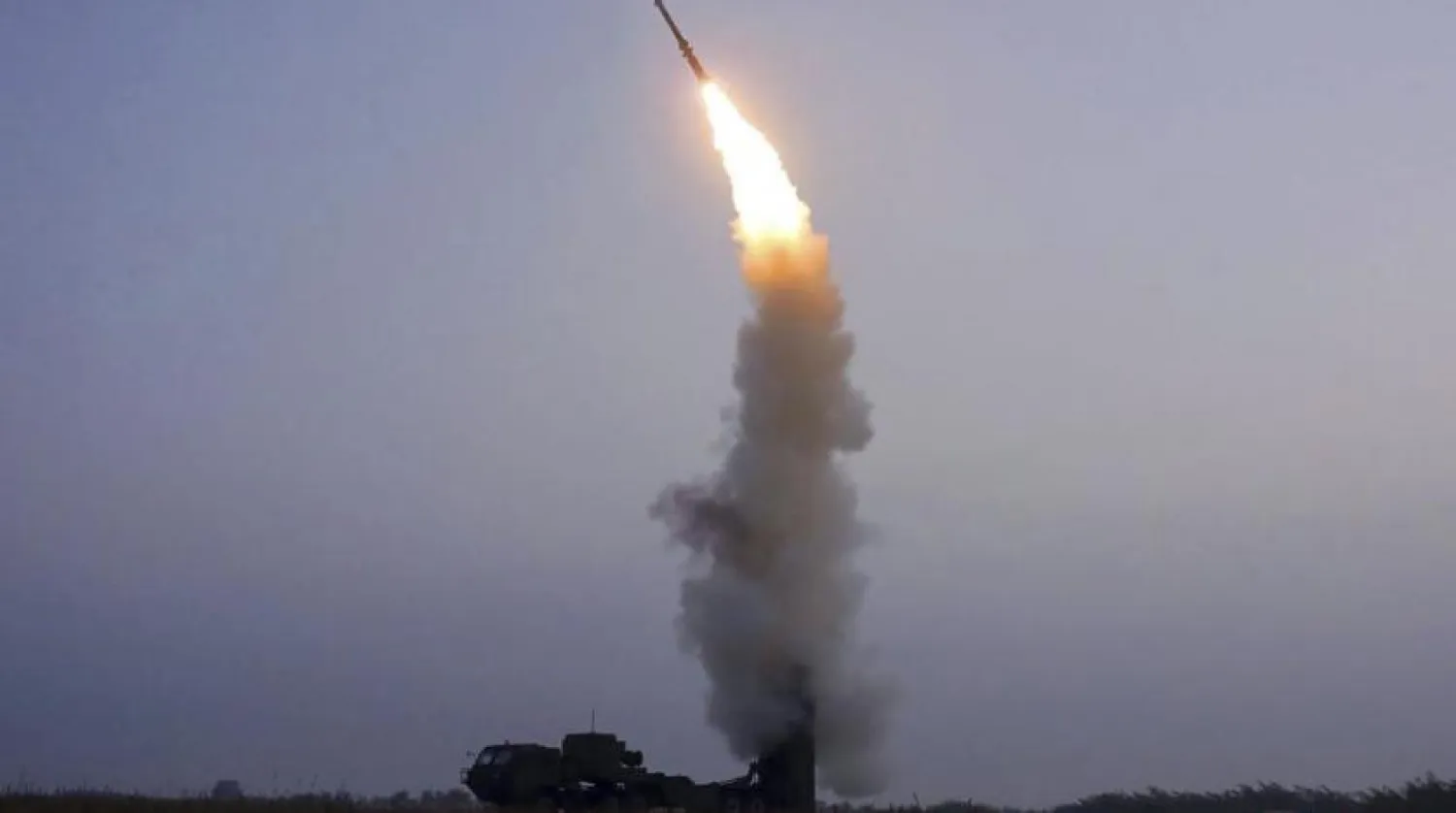
This photo provided on Oct. 1, 2021, by the North Korean government shows what North Korea claims to be the test firing of a newly developed anti-aircraft missile in North Korea, Thursday, Sept. 30, 2021. (Korean Central News Agency/Korea News Service via AP)
TT

North Korea Fires Ballistic Missiles, Fourth Time this Week

This photo provided on Oct. 1, 2021, by the North Korean government shows what North Korea claims to be the test firing of a newly developed anti-aircraft missile in North Korea, Thursday, Sept. 30, 2021. (Korean Central News Agency/Korea News Service via AP)

North Korea fired two ballistic missiles early on Saturday, South Korea's military said, the nuclear-armed country's fourth launch this week as Seoul, Tokyo and Washington ramp up joint military drills to counter Pyongyang.

South Korea, Japan and the US staged anti-submarine drills Friday -- the first in five years -- just days after Washington and Seoul's navies conducted large-scale exercises in waters off the peninsula, AFP said.

US Vice President Kamala Harris was in Seoul Thursday and toured the heavily fortified Demilitarized Zone that divides the peninsula, on a trip that aimed to underscore her country's "ironclad" commitment to South Korea's defense against the North.

With talks long stalled, Pyongyang has doubled down on its banned weapons programs, conducting a record-breaking blitz of tests this year and revising its laws to declare itself an "irreversible" nuclear power.

South Korea's military said it had "detected two short-range missiles between 0645 and 0703 fired from the Sunan area in Pyongyang into the East Sea", referring to the body of water also known as the Sea of Japan.

The missiles "flew approximately 350 km (217 miles) at an altitude of 30 km at speed of Mach 6", Seoul's Joint Chiefs of Staff said in a statement, calling the launches "a serious provocation".

Tokyo also confirmed the launch, saying the missiles had landed outside Japan's exclusive economic zones.

Toshiro Ino, Japan's vice defense minister, said the missiles "appear to have flown in irregular trajectories".

Experts say the irregular trajectories indicate the missiles are capable of maneuverings in flight, making them harder to track and intercept.

The US Indo-Pacific Command said in a statement that the latest launch "highlights the destabilizing impact of the DPRK's unlawful WMD and ballistic missile programs", using the official abbreviation for North Korea.

- Harris trip -
North Korea marked Harris's trip to Seoul with a flurry of missile launches -- firing off short-range ballistic missiles on Sunday, Wednesday and Thursday, including a test just hours after the vice president flew out of South Korea.

Washington has about 28,500 troops stationed in South Korea to help protect it from the North.

Under South Korea's President Yoon Suk-yeol, who took office in May, the two countries have boosted joint exercises, which they insist are purely defensive.

Just before Harris arrived in Seoul, Washington sent the nuclear-powered USS Ronald Reagan aircraft carrier to South Korea to conduct a large-scale joint naval exercise in a show of force against Pyongyang.

Such drills infuriate North Korea, which sees them as rehearsals for an invasion.

"North Korea's short-range ballistic tests are less important than a nuclear test but still violate UN Security Council resolutions," said Leif-Eric Easley, a professor at Ewha University in Seoul, adding that the timing was "provocative".

North Korea is "rapidly modernizing weapons and taking advantage of a world divided by US-China rivalry and Russia's annexation of more Ukrainian territory", he said.

"Pyongyang's actions again make clear the need for Washington and Seoul to reinforce military deterrence, tighten economic sanctions, and increase policy coordination with Tokyo," he added.

- Nuclear test next? -
South Korean and US officials have been warning for months that North Korean leader Kim Jong Un is preparing to conduct another nuclear test.

On Wednesday, the South's spy agency said North Korea's next nuclear test could happen in the window between China's upcoming party congress on October 16 and the US midterm elections on November 7.

North Korea, which is under multiple UN sanctions for its weapons programs, typically seeks to maximize the geopolitical impact of its tests with careful timing.

The isolated regime has tested nuclear weapons six times since 2006, most recently in 2017.

President Yoon on Saturday warned of dire consequences if Pyongyang uses nuclear weapons against its southern neighbor.

"If North Korea attempts to use nuclear weapons it will face a resolute and overwhelming response from our military and Korea-US alliance," he said in a speech marking Armed Forces Day.



Russian Strikes kill 11, Including 3 Children

Local residents stand amid the rubble of a five-story residential building following a Russian attack that killed seven people, including three children, in Zaporizhzhia on October 10, 2026. (Photo by Daria Nazarova / AFP)
TT

Russian Strikes kill 11, Including 3 Children

Local residents stand amid the rubble of a five-story residential building following a Russian attack that killed seven people, including three children, in Zaporizhzhia on October 10, 2026. (Photo by Daria Nazarova / AFP)

Russian strikes on Ukraine's southeastern city of Zaporizhzhia on Saturday killed at least 11 people, including three children, according to regional authorities.

Ukrainian national police said Russia had targeted residential neighborhoods in the city with "five guided aerial bombs" early Saturday morning, hitting two residential buildings.

The strikes came a day after Ukrainian and European officials met in Miami in a renewed diplomatic push to end Russia's war in Ukraine.

"The toll from the air strikes on Zaporizhzhia continues to rise. At present, 11 civilians have been killed. Among them are three children," said Mykhailo Semikin, head of Zaporizhzhia Regional Military Administration.

He said rescuers were continuing their search for people under the rubble.

An AFP correspondent at the scene saw people being pulled from the rubble by Ukrainian emergency services.

"We saw people under the rubble -- a woman, her husband and a child," one volunteer rescuer, Daniil Pishkin, told AFP.

He added that he saw two people rescued from the wreckage but "unfortunately there was a little girl who died.”

A resident of one of the buildings that was hit, who identified herself as Iryna, 69, said she just had time to seek refuge in the toilets after receiving an air raid warning.

She said her two neighbors were killed.

"They were 75 years old. They were simply thrown out there, onto the street. They didn't make it to the hospital," she told AFP.

The Zaporizhzhia region, located just a few dozen kilometers from the front line, and its capital by the same name have been the target of frequent strikes.

Russia has intensified its strikes on Ukrainian territory in recent months, causing a growing number of civilian casualties.

Diplomatic efforts mediated by the United States to end the war more than four years since Russia's invasion of Ukraine have so far yielded no results.


OpenAI Disrupts 2 Influence Operations Linked to Russia and Iran

A keyboard is placed in front of a displayed OpenAI logo in this illustration taken February 21, 2023. REUTERS/Dado Ruvic/Illustration//File Photo
TT

OpenAI Disrupts 2 Influence Operations Linked to Russia and Iran

A keyboard is placed in front of a displayed OpenAI logo in this illustration taken February 21, 2023. REUTERS/Dado Ruvic/Illustration//File Photo

OpenAI on Thursday said it shut down two influence operations -- from Russia and Iran -- that used ChatGPT to push fake journalist personas and run a “think-tank” to covertly peddle anti-Ukraine propaganda.

The American AI giant said it banned a cluster of ChatGPT accounts that originated in Russia and Iran and were used to support “false front” entities for geopolitical and conflict-related messaging, according to AFP.

The Iranian operation involved seven “journalist” profiles, each purporting to be from Western countries including the United States, that were used to plant long-form articles in media outlets around the world.

“We identified almost 100 articles published or syndicated under the operation's bylines across roughly a dozen online outlets around the world,” OpenAI said.

“These were small to medium outlets, generally focused on international affairs, geopolitics, and events in the Middle East.”

The earliest article identified by OpenAI was published in July 2025, and the latest in October 2026, with the frequency of reports increasing after the US-Iran war broke out earlier this year.
The operation also generated social media comments on topics related to the US-Iran war, it added.

One of the personas named Ervin B Hoskins, whose bio claimed to be “an American freelance writer,” had social media accounts across tech platforms including Elon Musk's X and Meta-owned Instagram.

X's transparency information showed the account was connected via a “West Asia android app” and Instagram's transparency information showed the account was based in Iran, according to screenshots provided by OpenAI.

Both accounts appeared to be suspended.

The Russian operation co-opted “unwitting people” in Latin America to run a “think-tank” -- called the Social Research Center (SRC) -- used for covert activities aimed at undermining Ukraine's reputation in the region and to influence local politics, the company said.

“The available evidence indicates that the SRC's employees in Latin America were not aware that they were working for a Russian group,” OpenAI said.

The SRC appears to have produced a majority of original content via its co-opted staff. “This stands out as the most complex attempt to run a front identity that we've disrupted over the past two and a half years,” it added.


Iran Guards Say Struck Tanker Transiting Strait of Hormuz

An aerial view shows ships anchored off the coast of Khasab in Oman's Musandam Governorate, near the Strait of Hormuz, on October 2, 2026. (Photo by AFP)
TT

Iran Guards Say Struck Tanker Transiting Strait of Hormuz

An aerial view shows ships anchored off the coast of Khasab in Oman's Musandam Governorate, near the Strait of Hormuz, on October 2, 2026. (Photo by AFP)

Iran's Revolutionary Guards said that they had struck a tanker attempting to take an “illegal route” through the Strait of Hormuz, which Tehran has sought to blockade since the outset of the Middle East war.

Maritime trackers also reported on Friday that an unknown projectile sparked a fire aboard a ship off the UAE coast, but named a different vessel.

In a statement carried by official media, the Guards said its naval forces were acting in accordance with “the orders of the commander-in-chief of the armed forces and the Iranian people’s desire to exercise sovereignty over the Strait of Hormuz.”

“In carrying out this mission, a few hours ago, a giant LPG carrier named NV Sunshine, owned by NatWit, which was attempting to transit via the illegal route south of the Strait of Hormuz, was struck,” they added, according to AFP.

Iran has attempted to impose its control over the Hormuz over the course of the war, insisting that vessels seek its permission to cross via its preferred routes.

However, ships have increasingly been willing to risk transiting via an alternative route hugging the strait's southern coast.

Britain's UKMTO maritime agency said on Friday that a ship 13 nautical miles (24 kilometers) off the UAE's Al Jazeera Al Hamra, southwest of the strait, was struck by a projectile, which caused a fire on board.

“Status of the crew, damage assessment and environmental impact are unknown at present. Authorities are investigating,” UKMTO said in a statement.

British security firm Vanguard also reported the incident, and identified the vessel as the Panama-flagged crude tanker GEM NO2.

The incident comes days after a tanker was hit off Qatar, around 500 kilometers west of the vital strait.

Ships in the Gulf and those attempting to transit the strait -- the only maritime route in or out of the oil-rich region -- have come under repeated attack since the US and Israel sparked the Middle East war on February 28.

Iran has blockaded the strait ever since, though some vessels do manage to cross, and US media has reported on American military efforts to protect ships on the southern route.

The United States has set up its own counter-blockade of Iranian ports and occasionally fires on vessels linked to Tehran.

Hormuz is vital to the world economy, with around a fifth of the planet's oil and liquefied natural gas passing through the strait before the war began.