


Russia Presses Ahead with Annexation Plan despite Military Retreats

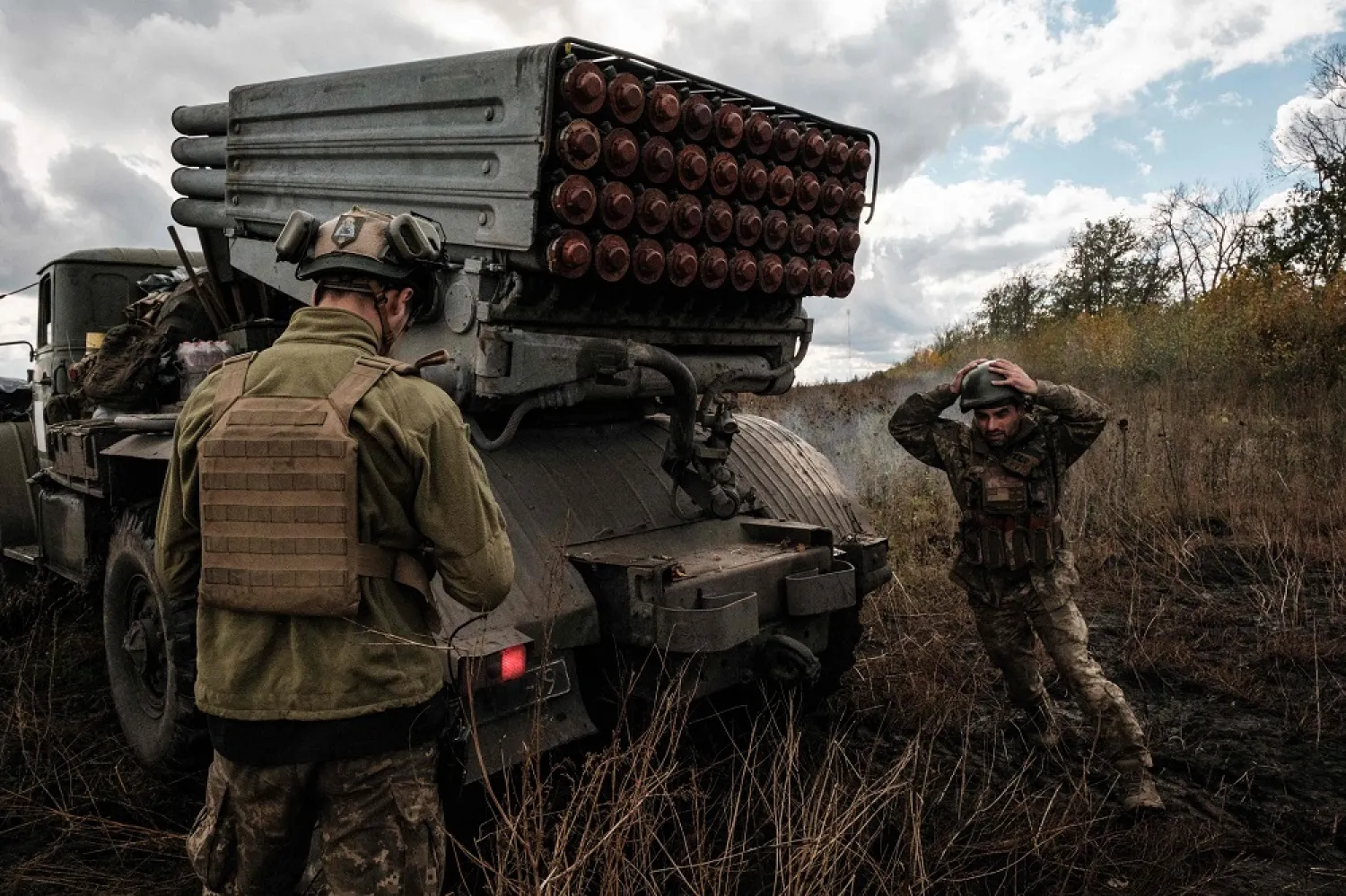
Ukrainian soldiers prepare to fire a BM-21 Grad multiple rocket launcher towards Russian positions in Kharkiv region on October 4, 2022. (AFP)
TT

Russia Presses Ahead with Annexation Plan despite Military Retreats

Ukrainian soldiers prepare to fire a BM-21 Grad multiple rocket launcher towards Russian positions in Kharkiv region on October 4, 2022. (AFP)

Russian troops abandoned a key Ukrainian city so rapidly that they left the bodies of their comrades in the streets, offering more evidence Tuesday of Moscow's latest military defeat as it struggles to hang on to four regions of Ukraine that it illegally annexed last week.

Meanwhile, Russia’s upper house of parliament rubber-stamped the annexations following "referendums" that Ukraine and its Western allies dismissed as fraudulent.

Responding to the move, Ukrainian President Volodymyr Zelenskyy formally ruled out talks with Russia, declaring that negotiations with Russian President Vladimir Putin are impossible after his decision to take over the regions.

The Kremlin replied by saying that it will wait for Ukraine to agree to sit down for talks, noting that it may not happen until a new Ukrainian president takes office.

"We will wait for the incumbent president to change his position or wait for a future Ukrainian president who would revise his stand in the interests of the Ukrainian people," Kremlin spokesman Dmitry Peskov said.

Despite the Kremlin's apparent political bravado, the picture on the ground underscored the disarray Putin faces in his response to Ukrainian advances and attempts to establish new Russian borders.

Over the weekend, Russian troops pulled back from Lyman, a strategic eastern city that the Russians had used as a logistics and transport hub, to avoid being encircled by Ukrainian forces. The city's liberation gave Ukraine a key vantage point for pressing its offensive deeper into Russian-held territories.

Two days later, an Associated Press team reporting from the town saw at least 18 bodies of Russian soldiers still on the ground. The Ukrainian military appeared to have collected the bodies of their comrades after fierce battles for control of Lyman, but they did not immediately remove those of the Russians.

"We fight for our land, for our children, so that our people can live better, but all this comes at a very high price," said a Ukrainian soldier who goes by the nom de guerre Rud.

Lyman residents emerged from basements where they had hidden during the battle and built bonfires for cooking. The city has had no water, electricity or gas since May. Residential buildings were burned. A few residents emerged on bicycles.

An 85-year-old woman, who identified herself by her name and patronymic, Valentyna Kuzmivna, recalled a recent explosion nearby.

"I was standing in the hall, about five meters away, when it boomed," she said. "God forbid, now I can’t hear well."

The Russian forces launched more missile strikes at Ukrainian cities Tuesday as Kyiv's forces pressed their counteroffensives in the east and the south.

Several missiles hit Ukraine’s second-largest city of Kharkiv, damaging its infrastructure and causing power cuts. Kharkiv Gov. Oleh Syniehubov said one person was killed and at least two others, including a 9-year-old girl, were wounded.

In the south, four civilians were wounded when Russian missiles struck the city of Nikopol.

After reclaiming control of Lyman in the Donetsk region, Ukrainian forces pushed further east and may have gone as far as the border of the neighboring Luhansk region as they advance toward Kreminna, the Washington-based Institute for the Study of War said in its latest analysis of the combat situation.

On Monday, Ukrainian forces also scored significant gains in the south, raising flags over the villages of Arkhanhelske, Myroliubivka, Khreshchenivka, Mykhalivka and Novovorontsovka.

Despite the latest military gains, Ukrainian Deputy Foreign Minister Yevhen Perebyinis called for the deployment of more weapons to Ukraine following the partial mobilization announcement by Russia last month.

In a video address to a conference in the Turkish capital, Ankara, on Russia’s war against Ukraine on Tuesday, Perebyinis said the additional weapons wouldn't lead to an escalation but instead would help to end the war sooner.

"We need additional long-range artillery and ammunition, combat aircraft and armed vehicles to continue the liberation of the occupied territories," the deputy minister said. "We need anti-aircraft and anti-missile defense systems to secure our civilians and critical infrastructure from the terrorist attacks on the Russian forces."

Russian Defense Minister Sergei Shoigu said Tuesday that the military has recruited more than 200,000 reservists as part of a partial mobilization launched two weeks ago. He said that the recruits were undergoing training at 80 firing ranges before being deployed to the front lines in Ukraine.

Putin's mobilization order said that up to 300,000 reservists were to be called up, but it held the door open for an even bigger activation. It sparked protests in many areas across Russia and drove tens of thousands of men to flee Russia in a challenge to the Kremlin.

The Ukrainian successes in the east and the south came even as Russia moved to absorb four Ukrainian regions amid the fighting there.

The upper house of the Russian parliament, the Federation Council, voted Tuesday to ratify treaties to make the eastern Donetsk and Luhansk and the southern Kherson and Zaporizhzhia regions part of Russia. The lower house did so on Monday.

Putin is expected to quickly endorse the annexation treaties.

Russia’s moves to incorporate the Ukrainian regions have been done so hastily that even the exact borders of the territories being absorbed were unclear.

In other developments, the head of the company operating Europe’s largest nuclear plant said Ukraine is considering restarting the Russian-occupied facility to ensure its safety as winter approaches.

In an interview with The Associated Press on Tuesday, Energoatom President Petro Kotin said the company could restart two of the Zaporizhzhia Nuclear Power Plant’s reactors in a matter of days.

"If you have low temperature, you will just freeze everything inside. The safety equipment will be damaged," he said.

Fears that the war in Ukraine could cause a radiation leak at the Zaporizhzhia plant prompted the shutdown of its remaining reactors. The plant has been damaged by shelling, prompting international alarm over the potential for a disaster.



Poland Bars Chinese-Made Cars from Military Sites Over Data Security Fears 

A soldier from the 18th Mechanized Division stands guard on a Light Strike Vehicle "Zmija" during a media tour organized by the country's military to demonstrate the security measures on the Polish Belarusian border, near Bialowieza, Poland, January 10, 2025. (Reuters)
TT

Poland Bars Chinese-Made Cars from Military Sites Over Data Security Fears 

A soldier from the 18th Mechanized Division stands guard on a Light Strike Vehicle "Zmija" during a media tour organized by the country's military to demonstrate the security measures on the Polish Belarusian border, near Bialowieza, Poland, January 10, 2025. (Reuters)

Poland has barred Chinese-made vehicles from entering military facilities due to concerns their onboard sensors could be used to collect sensitive data, the Polish Army said on Tuesday evening.

The army said in ‌a statement ‌that such vehicles ‌may ⁠still be allowed onto ⁠secured sites if specified functions are disabled and other safeguards required under each facility's security rules are in place.

To ⁠limit the risk ‌of ‌exposing confidential information, the military has ‌also banned connecting company ‌phones to infotainment systems in vehicles manufactured in China.

The restrictions do not apply ‌to publicly accessible military locations such as hospitals, ⁠clinics, ⁠libraries, prosecutors' offices or garrison clubs, the army said.

It added that the measures are precautionary and align with practices used by NATO members and other allies to ensure high standards of protection for defense infrastructure.


Starmer, Trump discussed Russia-Ukraine, Iran after Geneva Talks, Downing Street Says 

US President Donald Trump and British Prime Minister Keir Starmer announce an agreement between the two countries as they hold a press conference at Chequers at the conclusion of a state visit on September 18, 2025 in Aylesbury, Britain. (Reuters)
TT

Starmer, Trump discussed Russia-Ukraine, Iran after Geneva Talks, Downing Street Says 

US President Donald Trump and British Prime Minister Keir Starmer announce an agreement between the two countries as they hold a press conference at Chequers at the conclusion of a state visit on September 18, 2025 in Aylesbury, Britain. (Reuters)

British ‌Prime Minister Keir Starmer spoke to US President Donald Trump on Tuesday night about US-mediated Russia-Ukraine peace talks in Geneva, as well as talks between the US and Iran on ‌their nuclear ‌dispute, a Downing Street ‌spokesperson ⁠said.

Starmer also discussed ⁠Gaza with Trump and stressed on the importance of securing further access for humanitarian aid, the spokesperson said.

Negotiators ⁠from Ukraine and ‌Russia ‌concluded the first of two days ‌of the US-mediated ‌peace talks in Geneva on Tuesday, with Trump pressing Kyiv to act fast ‌to reach a deal.

Separately, Iranian Foreign Minister ⁠Abbas ⁠Araqchi said Tehran and Washington reached an understanding on Tuesday on "guiding principles" aimed at resolving their longstanding nuclear dispute, but that did not mean a deal is imminent.


Japan PM Takaichi Reappointed Following Election

Sanae Takaichi gestures at the Lower House of the Parliament in Tokyo, Japan, 18 February 2026. EPA/FRANCK ROBICHON
TT

Japan PM Takaichi Reappointed Following Election

Sanae Takaichi gestures at the Lower House of the Parliament in Tokyo, Japan, 18 February 2026. EPA/FRANCK ROBICHON

Japan's lower house formally reappointed Sanae Takaichi as prime minister on Wednesday, 10 days after her historic landslide election victory.

Takaichi, 64, became Japan's first woman premier in October and won a two-thirds majority for her party in the snap lower house elections on February 8.

She has pledged to bolster Japan's defenses to protect its territory and waters, likely further straining relations with Beijing, and to boost the flagging economy.

Takaichi suggested in November that Japan could intervene militarily if Beijing sought to take Taiwan by force.

China, which regards the democratic island as part of its territory and has not ruled out force to annex it, was furious.

Beijing's top diplomat Wang Yi told the Munich Security Conference on Saturday that forces in Japan were seeking to "revive militarism".

In a policy speech expected for Friday, Takaichi will pledge to update Japan's "Free and Open Indo-Pacific" strategic framework, local media reported.

"Compared with when FOIP was first proposed, the international situation and security environment surrounding Japan have become significantly more severe," chief government spokesman Minoru Kihara said Monday.

In practice this will likely mean strengthening supply chains and promoting free trade through the Trans-Pacific Partnership (CPTPP) that Britain joined in 2024.

Takaichi's government also plans to pass legislation to establish a National Intelligence Agency and to begin concrete discussions towards an anti-espionage law, the reports said.

Takaichi has promised too to tighten rules surrounding immigration, even though Asia's number two economy is struggling with labor shortages and a falling population.

On Friday Takaichi will repeat her campaign pledge to suspend consumption tax on food for two years in order to ease inflationary pressures on households, local media said, according to AFP.

This promise has exacerbated market worries about Japan's colossal debt, with yields on long-dated government bonds hitting record highs last month.

Rahul Anand, the International Monetary Fund chief of mission in Japan, said Wednesday that debt interest payments would double between 2025 and 2031.

"Removing the consumption tax (on food) would weaken the tax revenue base, since the consumption tax is an important way to raise revenues without creating distortions in the economy," Anand said.

To ease such concerns, Takaichi will on Friday repeat her mantra of having a "responsible, proactive" fiscal policy and set a target on reducing government debt, the reports said.

She will also announce the creation of a cross-party "national council" to discuss taxation and how to fund ageing Japan's ballooning social security bill.

But Takaichi's first order of business will be obtaining approval for Japan's budget for the fiscal year beginning on April 1 after the process was delayed by the election.

The ruling coalition also wants to pass legislation that will outlaw destroying the Japanese flag, according to the media reports.

It wants too to accelerate debate on changing the constitution and on revising the imperial family's rules to ease a looming succession crisis.

Takaichi and many within her Liberal Democratic Party (LDP) oppose making it possible for a woman to become emperor, but rules could be changed to "adopt" new male members.