


Russia Showers Ukraine with More Missiles

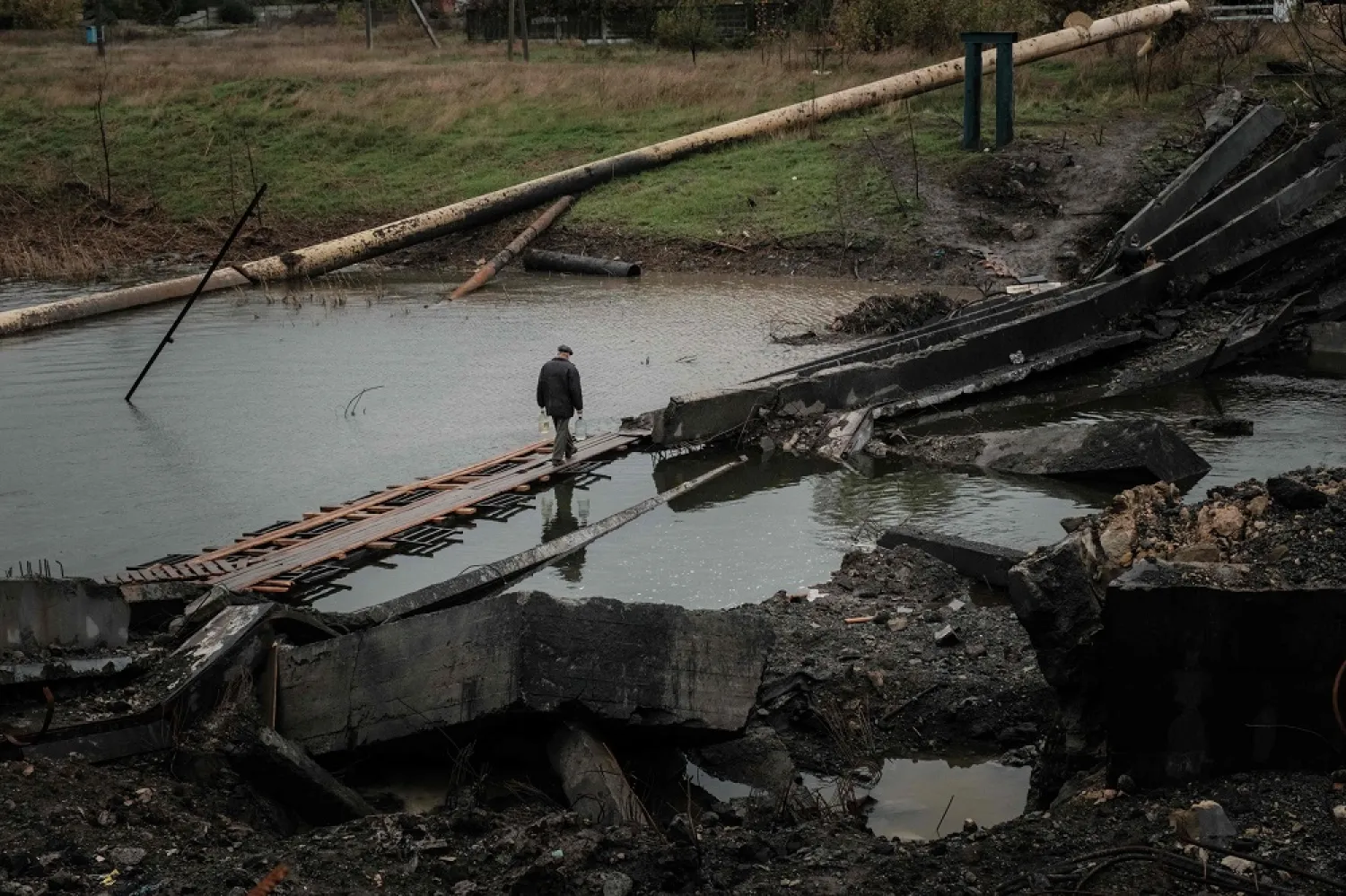
A man crosses the destroyed bridge with water bottles in the frontline town of Bakhmut in the Donetsk region on October 11, 2022, amid the Russian invasion of Ukraine. (AFP)
TT

Russia Showers Ukraine with More Missiles

A man crosses the destroyed bridge with water bottles in the frontline town of Bakhmut in the Donetsk region on October 11, 2022, amid the Russian invasion of Ukraine. (AFP)

Russian forces showered Ukraine with more missiles and munition-carrying drones Tuesday after widespread strikes killed at least 19 people in an attack the UN human rights office described as “particularly shocking” and potential war crimes.

Air raid warnings extended throughout the country for a second straight morning as Ukrainian officials advised residents to conserve energy and stock up on water. Strikes in the capital and 12 other regions Monday caused widespread power outages and pierced the relative calm that had returned to Kyiv and many other cities far from the war's front lines.

“It brings anger, not fear,” Kyiv resident Volodymyr Vasylenko, 67, said as crews worked to restore traffic lights and clear debris from the city's streets. “We already got used to this. And we will keep fighting.”

Ukrainian President Volodymyr Zelenskyy addressed the leaders of the Group of Seven industrial powers by videoconference Tuesday. After the meeting, the G-7 leaders condemned this week's blitz and said their countries “will stand firmly with Ukraine for as long as it takes.”

Russia launched the widespread attacks in retaliation for a weekend explosion that damaged a bridge linking the country to the Crimean Peninsula, which Moscow annexed from Ukraine in 2014. Russian President Vladimir Putin alleged the Ukrainian special services masterminded the Saturday attack on the Kerch Bridge.

Russia has concentrated most of its firepower during the 7 1/2-month war in eastern and southern Ukraine, and Ukrainian officials said the previous day's diffuse strikes on power plants and civilian areas made no “practical military sense.”

However, Putin’s supporters had urged the Kremlin for weeks to take more drastic steps in Ukraine and actively criticized the Russian military for a series of embarrassing battlefield setbacks. Pro-Kremlin pundits lauded Monday’s attack as an appropriate and long-awaited response to Kyiv’s recently successful counteroffensives, and many of them argued that Moscow should keep up the intensity in order to win the war.

The bombardment Tuesday struck both energy infrastructure and civilian areas, just as Monday's attacks did. One person was killed when 12 missiles slammed into public facilities in the southern city of Zaporizhzhia, setting off a large fire, the State Emergency Service said. A local official said the missiles hit a school, residential buildings and medical facilities.

Energy facilities in the western Lviv and Vinnitsya regions also took hits. Although officials said Ukrainian forces shot down an inbound Russian missile before it reached Kyiv, the capital region experienced rolling power outages as a result of the previous day's deadly strikes.

The governor of the Mykolaiv region, Vitaliy Kim, urged residents to remain in bomb shelters as “there are enough missiles still in the air.”

The State Emergency Service said 19 people died and 105 people were wounded in Monday’s strikes. At least five of the victims were in Kyiv, Mayor Vitali Klitschko said. More than 300 cities and towns lost power, from the capital to Lviv on the border with Poland.

Beside the usual sirens, a new type of loud alarm that blared automatically from mobile phones jolted Kyiv residents early Tuesday. A text message warning of the possibility of missile strikes accompanied the caustic-sounding alert.

A spokesperson for the office of the UN High Commissioner for Human Rights said Tuesday that strikes on “civilian objects,” including infrastructure such as power plants, could qualify as a war crime.

“Damage to key power stations and lines ahead of the upcoming winter raises further concerns for the protection of civilians and in particular the impact on vulnerable populations,” Ravina Shamdasani told reporters at a UN briefing in Geneva. “Attacks targeting civilians and objects indispensable to the survival of civilians are prohibited under international humanitarian law.”

As Ukrainian forces grew increasingly bold following a series of counteroffensive successes, a cornered Kremlin ratcheted up Cold War-era rhetoric in the last month and fanned concerns it might broaden the war and use nuclear weapons in Ukraine.

Russian Foreign Minister Sergei Lavrov addressed the issue Tuesday, saying Moscow would only resort to that if the Russian state faced imminent destruction. Speaking on state TV, he accused the West of encouraging false speculation about the Kremlin's intentions.

Russia’s nuclear doctrine envisages “exclusively retaliatory measures intended to prevent the destruction of the Russian Federation as a result of direct nuclear strikes or the use of other weapons that raise the threat for the very existence of the Russian state,” Lavrov said.

In Brussels, NATO Secretary-General Jens Stoltenberg said the 30-nation military alliance would hold long-planned exercises next week to test the state of readiness of its nuclear capabilities.

The exercise, dubbed “Steadfast Noon,” is held annually. It involves fighter jets capable of carrying nuclear warheads but not any live bombs. Conventional jets, and surveillance and refueling aircraft routinely take part.

Asked whether it was the wrong time for such an exercise, Stoltenberg replied: “It would send a very wrong signal now, if we suddenly cancelled a routine, long-time planned exercise because of the war in Ukraine.”

Stoltenberg said Putin’s nuclear rhetoric over the war in Ukraine is “irresponsible,” and he said that “Russia knows that a nuclear war can never be won and must never be fought.”

NATO as an organization does not possess any nuclear weapons. They remain under the control of three member countries – the US, UK and France.

Meanwhile, Russia’s deputy foreign minister, Sergei Ryabkov, warned Tuesday that Western military assistance to Kyiv, including training Ukrainian soldiers in NATO countries and feeding Ukraine real-time satellite data to target Russian forces, has “increasingly drawn Western nations into the conflict on the part of the Kyiv regime.”

Echoing Ryabkov, Kremlin spokesman Dmitry Peskov said continued US weapons deliveries to Ukraine would prolong the fighting and inflict more damage to the country.

Asked during a conference call with reporters about Washington's intention to provide Ukraine with advanced air defense systems, Peskov said the move would “only drag the conflict out and make it more painful” for Ukraine without changing Russian goals.

As Russian forces pounded three districts around the Zaporizhzhia Nuclear Power Plant overnight, Ukraine's state nuclear operator said Russian forces kidnapped the plant's deputy human resources director, Valeriy Martyniuk.

Russians previously detained plant General Director Ihor Murashow and released him following pressure from International Atomic Energy Agency Chief Rafael Mariano Grossi.



Iran Says Strike Hit Close to Its Bushehr Nuclear Facility, Killing a Guard and Damaging a Building

Iran's Bushehr nuclear reactor (Reuters)
TT

Iran Says Strike Hit Close to Its Bushehr Nuclear Facility, Killing a Guard and Damaging a Building

Iran's Bushehr nuclear reactor (Reuters)

Iran’s atomic agency says an airstrike has hit near its Bushehr nuclear facility, killing a security guard and damaging a support building. It is the fourth time the facility has been targeted during the war.

The agency announced Saturday’s attack on social media.

The US AP’s military pressed ahead Saturday in a frantic search for a missing pilot after Iran shot down an American warplane, as Iran called on people to turn the pilot in, promising a reward.

The plane, identified by Iran as a US F-15E Strike Eagle, was one of two attacked on Friday, with one service member rescued and at least one missing. It was the first time the United States lost aircraft in Iranian territory during the war, now in its sixth week, and could mark a new turning point in the campaign.

The conflict, launched by the US and Israel on Feb. 28, has rippled across the region. It has so far killed thousands, upended global markets, cut off key shipping routes, spiked fuel prices and shows no signs of slowing as Iran responds to US and Israeli airstrikes with attacks across the region.


Trump Seeks $152 Mn to Revive Alcatraz as Federal Prison

FILE PHOTO: A view of Alcatraz prison complex located on Alcatraz Island in San Francisco Bay near San Francisco, California, US July 17, 2025. REUTERS/Carlos Barria/File Photo
TT

Trump Seeks $152 Mn to Revive Alcatraz as Federal Prison

FILE PHOTO: A view of Alcatraz prison complex located on Alcatraz Island in San Francisco Bay near San Francisco, California, US July 17, 2025. REUTERS/Carlos Barria/File Photo

US President Donald Trump asked Congress on Friday for $152 million to begin rebuilding the notorious Alcatraz prison, pressing ahead with his vision to return the former island lockup to active use.

The funding request, included in the White House's proposed 2027 budget, would cover the first year of converting the San Francisco Bay site into what officials describe as a "state-of-the-art secure prison facility."

Trump has pushed for reopening Alcatraz since last year, portraying it as a symbol of a tougher approach to crime, said AFP.

In a social media post at the time, he called for a "substantially enlarged and rebuilt" facility to house the country's most dangerous offenders.

The proposal comes as part of a broader Justice Department budget that emphasizes prison investment and law enforcement, though such requests are ultimately subject to approval by Congress.

Political news outlet Axios, citing administration officials, reported that any "supermax" prison complex at the site would have to be built from scratch -- putting the total cost at somewhere around $2 billion.

Alcatraz, which opened as a federal penitentiary in 1934, was once considered among the most secure prisons in the United States due to its isolated island location and the strong currents surrounding it.

It held a relatively small number of prisoners, including high-profile inmates such as Al Capone.

The island fortress entered American cultural lore after a 1962 escape by three inmates, which became an inspiration for the film "Escape from Alcatraz" starring Clint Eastwood.

It was closed in 1963 after officials determined it was too costly to maintain.

According to the Federal Bureau of Prisons, operating expenses were nearly three times higher than at other federal facilities, largely because all supplies -- including fresh water -- had to be transported to the island.

Since the early 1970s, Alcatraz has been managed by the National Park Service as part of the Golden Gate National Recreation Area and has become one of San Francisco's most popular tourist attractions, drawing more than a million visitors annually.

The White House argues that rebuilding the site would help modernize the federal prison system and expand capacity for high-risk inmates.

But critics have questioned both the practicality and cost of the plan, noting that the island's infrastructure would likely require extensive reconstruction.

Feasibility studies have already been conducted by federal agencies to assess whether a modern correctional facility could be established on the site, though no final decision has been made.

Any move to proceed could face political resistance given competing budget priorities and the site's current status as a major tourism and historical landmark.


French, Japanese Ships Cross Strait of Hormuz in First Since War

A cargo ship in the Gulf, near the Strait of Hormuz, as seen from northern Ras al-Khaimah, near the border with Oman’s Musandam governance, amid the US-Israeli conflict with Iran, in United Arab Emirates, March 11, 2026. (Reuters)
TT

French, Japanese Ships Cross Strait of Hormuz in First Since War

A cargo ship in the Gulf, near the Strait of Hormuz, as seen from northern Ras al-Khaimah, near the border with Oman’s Musandam governance, amid the US-Israeli conflict with Iran, in United Arab Emirates, March 11, 2026. (Reuters)

One French- and another Japanese-owned vessel are among a handful of vessels to have crossed the war-torn Strait of Hormuz, maritime tracking data showed Friday.

The passage, a vital maritime route for oil and liquified natural gas, has been virtually blocked by Iran since the start of the war, said AFP.

But both ships made the crossing on Thursday, according to ship tracking company Marine Traffic's website.

The Maltese-flagged Kribi belonging to the French maritime transport group CMA CGM crossed the waterway to leave the Gulf on Thursday afternoon, Marine Traffic's data showed.

By early Friday, it was off Muscat, Oman, still broadcasting the message "owner France" on its transponder system in the field usually used to give the destination.

The vessel's navigation data showed it had crossed via an Iranian-approved route through its waters, dubbed the "Tehran Toll Booth" by leading shipping journal Lloyd's List.

- Southern route -

In addition, three tankers -- including one co-owned by a Japanese company -- crossed the Strait of Hormuz on Thursday by taking an alternative, southern route.

They hugged close to the shore of Oman's Musandam Peninsula -- a first in nearly three weeks according to Lloyd's List.

Before the war, which started more than a month ago, about a fifth of global oil and liquefied natural gas (LNG) passed through the Strait.

All three ships signaled they were an "OMANI SHIP" in the message broadcast by their transponder as they crossed the strait.

The Sohar LNG, which was empty when crossing, is co-owned by Japanese shipping company Mitsui O.S.K.

That makes it the first Japanese vessel to exit the Gulf since the start of the war, according to a company statement quoted by Japanese media.

The Hong-Kong flagged New Vision, which crossed the strait on March 1 right after the war started, is expected in the French port of Le Havre on Saturday evening.

Since the conflict started however, that has dwindled to a trickle as Iran selectively attacks ships and energy facilities throughout the Gulf in retaliation for US and Israeli attacks.

A few commercial ships crossing the Strait of Hormuz recently have passed through the Iranian-approved route in the north of the waterway.

- Down to a trickle -

Just 221 commodities vessels have crossed the Strait of Hormuz since March 1, some more than once, according to Kpler data up to Friday morning.

In peacetime, the same waterway handles around 120 daily transits, according to Lloyd's List.

Of the vessels that made the crossing, 60 percent either came from Iran or were heading there.

It was not clear from the data how many had been cleared to make the crossing by Tehran.

But it did show that, among the 118 crossings by ships carrying cargo, 37 had left the Gulf carrying crude oil.

Most of those oil tankers -- 30 of them -- came from Iran or sailed under the Iranian flag. And most ships carrying Iranian oil did not specify their destination on their transponder.

Of those who did, all but one reported they were heading to China.

In the early days of the war, transponder data showed dozens of ships broadcasting messages such as "Chinese crew" or "Chinese owner" in the field usually used for their destination.

This appeared to be an attempt by the ships to avoid being targeted by Iran.