


Merit Culture Magazine: Egyptian Woman's Struggle, Huda Shaarawi as Example

Merit Culture Magazine: Egyptian Woman's Struggle, Huda Shaarawi as Example
TT

Merit Culture Magazine: Egyptian Woman's Struggle, Huda Shaarawi as Example

Merit Culture Magazine: Egyptian Woman's Struggle, Huda Shaarawi as Example

The 64th issue of the Merit Culture Magazine (October issue) dedicates a cultural section titled a “Woman Fight for her Rights - Huda Shaarawi as an Example” including six articles: “Woman’s role in global development movement”, a lecture addressed by Shaarawi, head of the Egyptian Women Union at the time, at the American University of Cairo, on November 12, 1929; “Memoirs of Huda Shaarawi and beginnings of feminist renaissance” by Dr. Nadia Hanawi (Iraq); “From Mashrabiya to Court” by Dr. Ikram Badawi; “Huda Shaarawi…between social work and political struggle” by Dr. Asmaa Badawi; “How did Huda Shaarawi come out from ‘Harem Era’ and ‘uncovered her face’?” by researcher Samar Lashin; “Arabic feminism: influencing models and contemporary problematics” by journalist Mariana Sami.

The “Critical Views” section features six articles including “Lady Chatterley's Lover… Guardians of the Lord and Literature Inquisitions” by Dr. Mamdouh Farraj al-Nabi; “Social transformation in Jabbour Douaihy’s The American Quarter” by Dr. Huda Ali Eid (Lebanon); “In days of bright sun” by Miral al-Tahawi, in which she exposes laws and customs that subdue women; “Cultural criticism experience of Iraqi critic Fadel Abboud al-Tamimi” by Dr. Tarek Bouhala (Algeria); “Comparative Literature Studies in Moroccan Universities” by Abadati Boushaab (Morocco); “Storytelling romance in Ibtihal al-Shayeb’s ‘Familiar’ collection” by Shawky Abdul Hamid Yahya.

The “Poetry” section includes 11 poems by Ibrahim Daoud, Mahmoud Qarni, Al Sammah Abdullah, Atef Abdulaziz, Karim Abdul Salam, Hana al-Ghunaimi (Egypt), Naseer al-Sheikh (Iraq), Leila Bare’ (Morocco), Salim al-Naffar (Palestine), and Aisha al-Maghrebi (Libyan based in Paris).

The “Story” section offers stories by Al Sayed Najm, Hossam al-Mukadem, Salah Matar, Hassan al-Judi (Syria), Sanaa Shaalan (Jordan), Saad al-Nazzal (Iraq), and Sondos Abdelkader Midi (Libya).

This issue’s “Noun al-Neswa” section discusses the “Truce Nights- Pain Clashes” released by Merit Publishing House in 2020, by Egyptian novelist Mona al-Assassi, in addition to four articles.

The “Speech Innovation” section features three articles: “Views in Literary Quranic Studies” by Mohammed Yassine; “What are the historic roots of some legislations, worships in Islam” by Aya Kotob; “Sufism… understanding of heaven and hell” by Hala Ismat.

The “Around the World” section includes two translations: Asmaa Moussa Othman translated two stories by Italian novelist Andrina Christa, “Eternal Wedding” and “Renata”; and Hussein Sunbuli (Syria) translated the “Disappointment”, a novel by German novelist Thomas Man.

The “Cultures and Arts” section includes an interview by Samir Darwish with Egyptian storyteller and novelist Tarek Imam in which he admits that “Marquise is my favorite and most inspiring novelist, but I believe that Dostoevsky and Kazantzakis top the list of best novelists in history.” The “Personal View” section features “Texts against the official literary current,” an article by Dr. Faisal al-Ahmar (Algeria). The October issue of Merit includes many more articles

like Heidi Ammar’s “Philosophic Quartet in Egyptian Cinema” in the “Cinema” section; “The Codex Sinaiticus” by Dr. Majed Izzat Israel in the “Manuscript” section; “Art Treatment between Imagination and Reality” by Mina Nassef in the “Theater” section; “Eves of Apple” by Dr. Usama al-Hammoud (Syria), and “Women of Sultan Harem in the ‘Pasha’s Daughter” novel” by Khadija Masrouq (Alegria) in the “Books” section.

The cover and graphics in the “Creativity and Creatives” section are made by Syrian artists Ola al-Ayoubi, while graphics in “Noun al-Neswa” are signed by Egyptian artist Najat Farouq, and the photographs on the covers of each section and the back cover are presented by Yemeni photographer Abdullah al-Jaradi.

Merit Culture’s editorial board is composed of publishing manager Mohammed Hashem, editor-in-chief Samir Darwish, assistant editor-in-chief Adel Samih, managing editor Sara al-Iskafi. The primary maquette is gifted by Ahmed al-Loubad.

Saudi Heritage Commission Uncovers 1,774 Archaeological Finds in Madinah Region

The survey recorded 156 new archaeological sites. (SPA)
TT

Saudi Heritage Commission Uncovers 1,774 Archaeological Finds in Madinah Region

The survey recorded 156 new archaeological sites. (SPA)

Saudi Arabia's Heritage Commission concluded the second season of archaeological survey work in Al Mahd Governorate, Madinah Region, documenting 1,774 archaeological discoveries across three survey areas: Al Suwayriqiyah, Al Muwayhiyah, and Hadhah, reported the Saudi Press Agency on Tuesday.

The survey recorded 156 new archaeological sites, yielding 461 Islamic inscriptions, 34 Thamudic inscriptions, 1,259 rock art panels, 11 stone structures, three historical palaces, two caravan routes, and four wells.

Among the most notable finds are rock inscriptions bearing the name of Omar bin Al-Khattab, alongside Arabic poetry engraved on rock faces, significantly elevating the site's cultural and historical value.

The commission stressed its commitment to continuing survey and documentation programs, in support of Saudi Vision 2030's objectives to preserve cultural heritage across the Kingdom.


Between Homer and Hollywood: Troy a Source of Turkish Pride

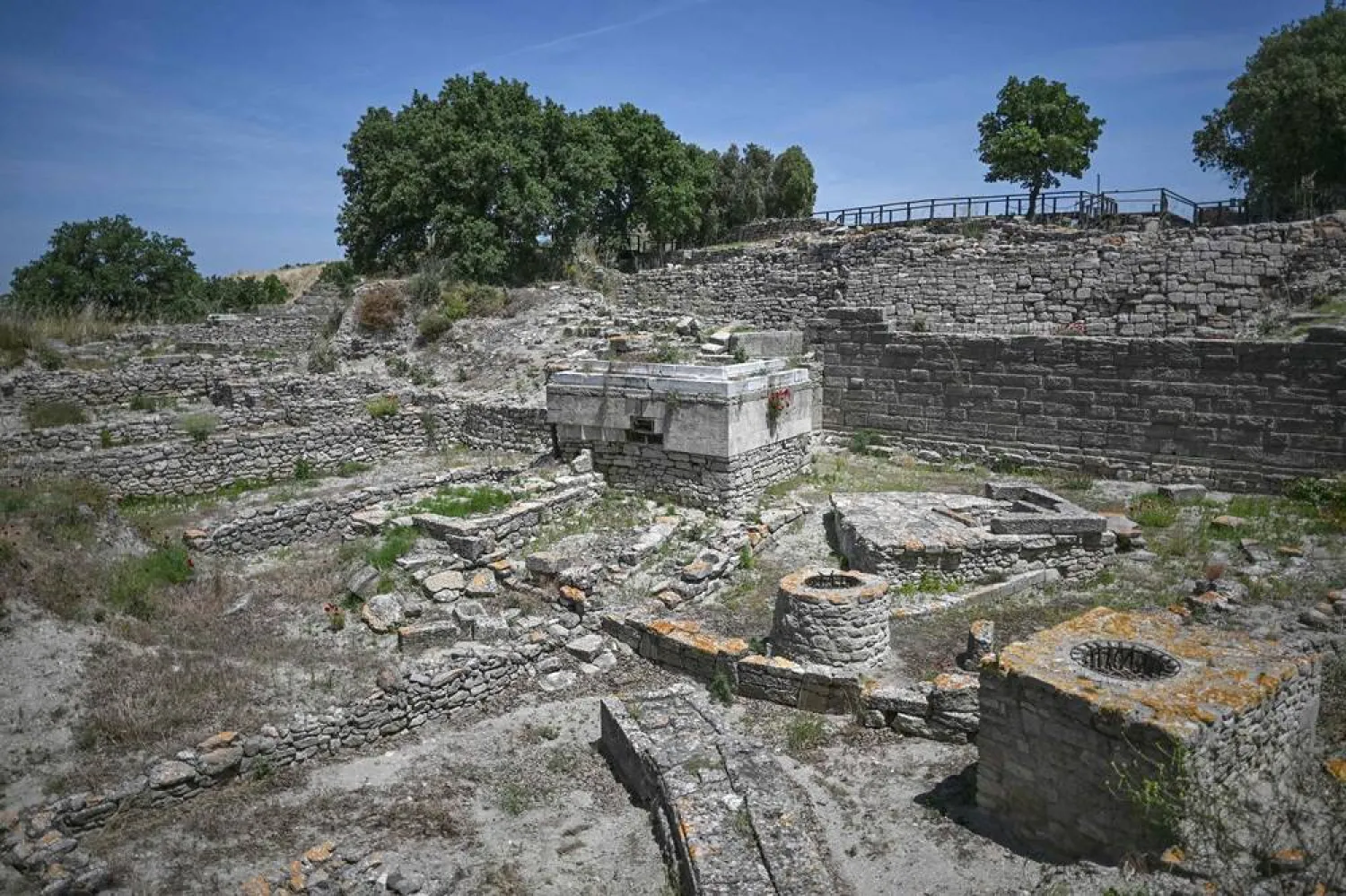
This photograph shows a general view of the ruins of the ancient city of Troy in Canakkale on June 2, 2026. (AFP)
TT

Between Homer and Hollywood: Troy a Source of Turkish Pride

This photograph shows a general view of the ruins of the ancient city of Troy in Canakkale on June 2, 2026. (AFP)

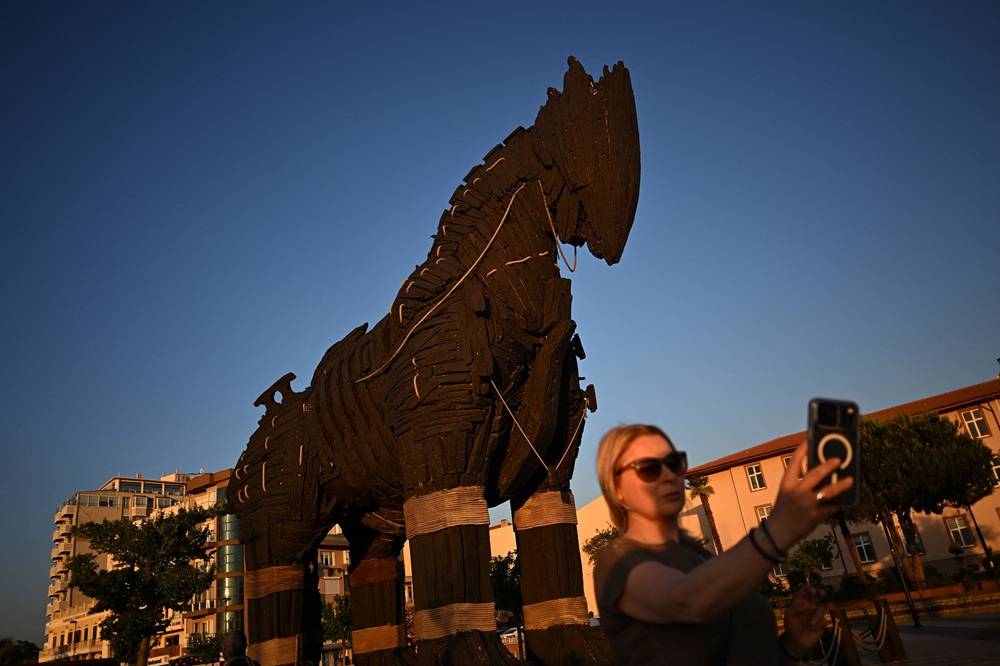
A gift from the film set of "Troy", a giant Trojan Horse replica looms over the port of Canakkale on the Dardanelles Strait in western Türkiye.

First related by Homer, then retold for the silver screen in 2004, with Brad Pitt as Achilles, the legend of the ancient city travels to Rome's Colosseum this week, where a major new exhibition opens on Friday.

Keen to showcase the city's Anatolian roots, Türkiye has loaned out more than 220 artifacts that will be on show at the exhibition, "Troy and Rome", which runs until mid-October.

"When you read Homer, you don't get a very clear idea of the Trojans' identity. But at the time of the Trojan War, they were certainly among the Anatolian peoples," said Reyhan Korpe, deputy head of the Troy excavations and an ancient history expert at Canakkale University.

Located on Türkiye's Aegean coastline, the remains of Troy are a UNESCO-listed World Heritage site comprising 185 hectares (457 acres) of stones and crumbling ramparts dotted with poppies and scampering squirrels.

For 30 years, Korpe has walked every inch of this huge site, whose layers tell the story of nine different settlements, the remains of their ramparts intertwined and layered on top of one another.

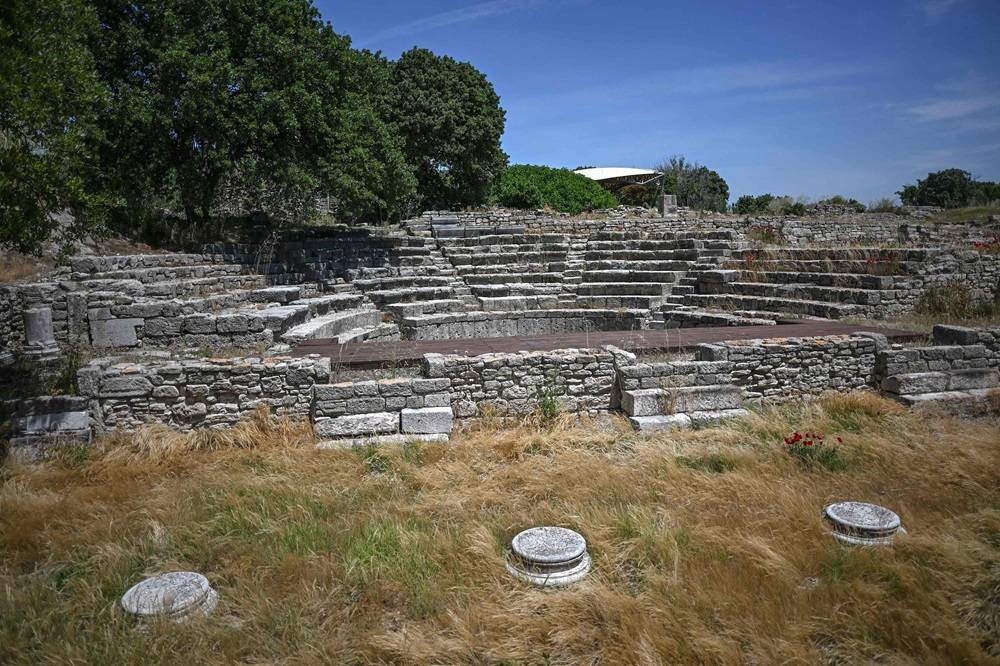
This photograph shows a view of the ancient theater in the ruins of the ancient city of Troy in Canakkale on June 2, 2026. (AFP)

- Western flank of the east -

"I spent a whole year just walking through the stones, maps in hand, trying to understand how they fit together," he told AFP.

His passion is evident for the site, which was founded in 3,000 BC and was constantly inhabited until being abandoned in the sixth century AD.

"It was the most western part of eastern civilization," which is what gave Troy its significance, Korpe said.

The Trojan War, which took place around 1,200 BC and lasted 10 years, until the siege and the city's defeat -- parts of which are recounted in the Iliad -- "was the first confrontation between the East and the West", he said of the Anatolian world and its Greek equivalent, referring to it as "the first world war".

It is an idea with strong resonance in these wooded hills, which several millennia later witnessed the World War I battles of 1915, when Allied troops suffered a bloody defeat trying to seize the Dardanelles from the Ottoman Empire.

A tourist takes a selfie photograph in front of the Trojan Horse, which was donated to be displayed at Canakkale Square following the release of the movie “Troy” in Canakkale on June 1, 2026. (AFP)

- Luwian hieroglyphics -

Of the hundreds of artifacts Türkiye has loaned to the Rome exhibition, more than 100 come from the Troy museum, some of which will be on display for the first time.

One piece is a bronze seal marked with hieroglyphics that was discovered in 1995, which offers important clues about the city's Anatolian roots.

"It's the only trace of writing found at Troy that was written in an Anatolian language, which proves that the first language spoken there was that of the Luwian peoples," explained museum director Sinem Duzgoren.

The Luwians were an ancient people who lived in western and southern Anatolia during the Bronze and early Iron Ages, whose language played a major role in the Hittite empire.

- From Wilusa to Ilion -

Although Troy was not a Hittite city, it was part of the Hittite empire, which referred to it as Wilusa. That became Ilion for the Greeks -- or Ilios for Homer.

"These pieces may not be the most spectacular, but they are the most important from a historical point of view, because they bear witness to the history of Troy," Duzgoren told AFP.

Also sent to Rome are a large number of weapons for use in war -- stones for use in a sling, knives, spears and arrowheads.

"These weapons are mentioned in the Iliad and date from the same period that they were mentioned by Homer," she said.

But it is a reality that is a far cry from the epic, romanticized fighting that plays out in Wolfgang Petersen's "Troy" (2004).

Apart from bequeathing the 12-ton replica of the Trojan Horse looming over Canakkale's waterfront, the film did a lot to fuel renewed interest in Troy, Korpe said.

"Neither the producers nor the director came here, even though that was when we made some of the most significant discoveries," he said sadly.

"But the number of tourists did grow, even if they were just looking for traces of Brad Pitt among the ruins!"


Seven Georgians Tried in France over Theft of Rare Russian Books

 A bookseller holds a book while standing at a book shop in the GUM department store, during the annual Red Square Book Festival, celebrating Alexander Pushkin's birthday in Moscow, on Friday, June 5, 2026. (AP)
A bookseller holds a book while standing at a book shop in the GUM department store, during the annual Red Square Book Festival, celebrating Alexander Pushkin's birthday in Moscow, on Friday, June 5, 2026. (AP)
TT

Seven Georgians Tried in France over Theft of Rare Russian Books

 A bookseller holds a book while standing at a book shop in the GUM department store, during the annual Red Square Book Festival, celebrating Alexander Pushkin's birthday in Moscow, on Friday, June 5, 2026. (AP)
A bookseller holds a book while standing at a book shop in the GUM department store, during the annual Red Square Book Festival, celebrating Alexander Pushkin's birthday in Moscow, on Friday, June 5, 2026. (AP)

Seven Georgian nationals will be tried in Paris starting Tuesday for the theft of rare editions of Russian literary classics from prestigious French libraries, including works by Alexander Pushkin.

The trial is the latest case seeking justice for a spate of similar thefts in recent years from libraries across Europe, suspected to be the work of an organized network.

The thefts targeted rare Russian classics worth millions of euros in total, including by 19th-century literary greats Pushkin and Nikolai Gogol.

The defendants on trial in France have been charged with criminal conspiracy and intent to commit an offence, while some of them are also charged with theft of an exhibited cultural object. They face up to 10 years in prison.

Two are being tried in absentia, with warrants out for their arrests.

Two others -- identified only as Mikheil Z. and Beqa T. -- have already been convicted and imprisoned in other countries for similar crimes and have been temporarily handed over to France.

Mikheil Z., 50, was sentenced last year in Lithuania to three years and four months in prison for the organized theft of 19th-century publications valued at 606,000 euros ($698,000).

Beqa T., 49, was sentenced to three years and six months in prison in Estonia.

French investigating judges suspect the defendants were part of "an organized criminal network", according to parts of the investigation seen by AFP.

The thefts, which also hit Germany, Switzerland and the Czech Republic, spurred the creation of a joint investigation team under the European Union police and justice coordination agencies Europol and Eurojust that led to several arrests in 2024.

- 'Strengthening its protection' -

The crimes in France took place in 2023 at the Diderot Library of the Ecole Normale Superieure (ENS) in the eastern city of Lyon, and at the National Library of France (BnF) and the University Library of Languages and Civilizations (BULAC) in Paris.

According to investigators, the thieves went to the libraries to consult rare and valuable works, photographing and measuring them, and returned later to replace them with virtually undetectable copies.

Between March and October 2023, Mikheil Z. went to the BnF 40 times to request access to manuscripts, mainly by Pushkin, claiming he was doing research on democracy in 19th-century Russian literature.

In November, the library realized nine works had been replaced with copies, with an estimated loss of 650,000 euros.

Mikheil Z. admitted to investigators that he stole the works but denied working with the other defendants, claiming he was driven by greed and had sold the books in Russia.

In June 2024, Russia's Litfond auction house listed in its catalogue a second edition of Pushkin's "The Prisoner of the Caucasus", a book corresponding to a copy stolen from the BnF.

The auction house told French authorities it had documentation proving the book was acquired from its owner in Russia in 2014/2015.

In the eyes of the investigative judges, the thefts may be linked to a desire to repatriate Russia's cultural heritage at a time when Moscow's relations with Europe have been increasingly strained over the Russian invasion of Ukraine.

None of the stolen works have been found, though BnF lawyer Alexandre de Konn said the institution "has not given up hope of recovering these works".

The library "remains true to its mission: to continue making heritage open to the public while constantly strengthening its protection", he told AFP.
