

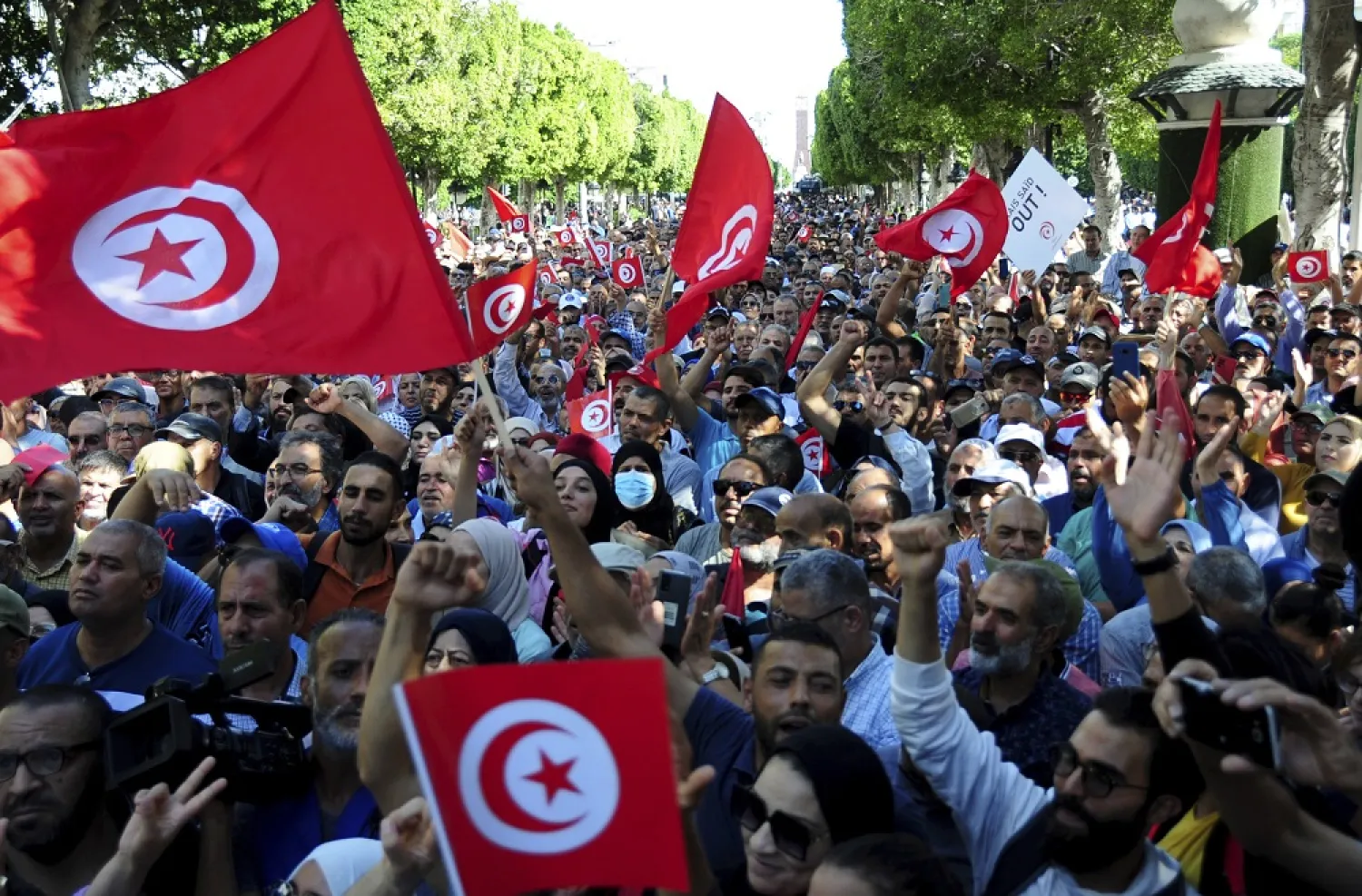

Thousands from Rival Tunisian Parties Protest against President

People take part in a demonstration by the National Salvation Front against President Kais Saïed at Avenue Habib Bourguiba in Tunis, Tunisia, Saturday Oct. 15, 2022.(AP)
TT

Thousands from Rival Tunisian Parties Protest against President

People take part in a demonstration by the National Salvation Front against President Kais Saïed at Avenue Habib Bourguiba in Tunis, Tunisia, Saturday Oct. 15, 2022.(AP)

Two rival Tunisian opposition groups staged one of the biggest days of protest so far against President Kais Saied on Saturday, denouncing his moves to consolidate political power as public anger grows over fuel and food shortages.

Thousands of supporters from the Islamist Ennahda party and the Free Constitutional Party held parallel rallies in adjacent areas of the capital, Tunis, accusing Saied of economic mismanagement and of an anti-democratic coup.

"Tunisia is bleeding. Saied is a failed dictator. He has set us back for many years. The game's over. Get out," said protester Henda Ben Ali.

Saied, who moved to rule by decree after shutting down parliament last year and expanding his powers with a new constitution passed in a July referendum, has said the measures were needed to save Tunisia from years of crisis.

In a speech on Saturday to commemorate the departure of French troops upon Tunisia's 1956 independence, he demanded the departure today of "all who want to undermine independence" - an apparent allusion to his political foes.

Saied's opponents say his actions have undermined the democracy secured through the 2011 revolution.

Ennahda and the Free Constitutional Party have long been bitter foes, but both are now more focused on their struggle against Saied.

Tunisians are meanwhile struggling to make ends meet as a crisis in state finances has contributed to shortages of subsidized goods including petrol, sugar and milk on top of years of economic malaise and entrenched unemployment.

The president, who has blamed hoarders and speculators for the shortages, appears to retain broad support among many Tunisians, but the growing hardships are causing frustration and increasing the flow of illegal migrants to Europe.

In the southern town of Zarzis this week, residents protested over the burial in unmarked graves of local people who had died in one of the many shipwrecks of migrants trying to reach Italy.

"While our youth are dying at sea in boats to escape from hell, Saied is only interested in gathering power," said Monia Hajji, a protester.

In Tunis, there have been some isolated clashes this week in poor districts between police and protesting youths, and there was a heavy police presence in the city on Saturday.

The Free Constitutional Party leader Abir Moussi criticized the stringent security arrangements in a speech to protesters, asking Saied: "Why are you afraid?".

At both rallies, protesters chanted "the people want the fall of the regime", the slogan of the 2011 revolution.

"The situation is about to explode and is dangerous for the future," said the Ennahda former prime minister Ali Larayedh.



Iraq Closes Three Iran Crossings, Pursues Those Behind Attacks on Saudi Arabia

Travelers at the Shalamsheh border crossing between Iraq and Iran after Iraqi authorities ordered its closure as a precautionary measure following the latest drone attacks on Saudi Arabia on September 12, 2026 (Reuters)
TT

Iraq Closes Three Iran Crossings, Pursues Those Behind Attacks on Saudi Arabia

Travelers at the Shalamsheh border crossing between Iraq and Iran after Iraqi authorities ordered its closure as a precautionary measure following the latest drone attacks on Saudi Arabia on September 12, 2026 (Reuters)

Iraq closed three border crossings with Iran on Saturday, officials told AFP, after a drone attack on a Saudi Arabian pipeline that both Riyadh and Baghdad said was launched from Iraq.

An Iraqi security source and a government official told AFP that authorities ordered the closing of three border crossings with Iran.

The security source said the decision was "part of an intelligence effort to track down the perpetrators and prevent their escape... and to hinder the smuggling of drones through these crossings".

Both sources, who spoke on condition of anonymity because they were not allowed to speak to the media, could not specify when the crossings would reopen.

The closed crossings are Shalamsheh in Basra province, al-Shib in Missan and al-Mandali in the central province of Diyala.

Other border crossings with Iran are still open.

A security official said that "security forces found drone launchers near the Iraq-Iran border in the al-Tib" region, a remote part of Missan, close to the al-Shib crossing. A second security source gave the same account.

Military spokesperson Sabah al-Numan said the prime minister had approved "Iran's request to conduct a joint investigation into finding drone launch platforms near the Iraq-Iran border".

The government's security media cell said earlier that authorities "have started administrative and security reorganization operations at several border crossings".

It added that they had stepped up "intelligence activities" to determine "the breaches and violations that took place at these crossings".

It later announced that passengers stranded for hours at two crossings were permitted to pass.


Al-Halbousi Condemns Attacks on Saudi Arabia

Iraqi Speaker of parliament Mohammed al-Halbousi speaks with the news media as he departs the Department of State after meeting with Secretary of State Mike Pompeo, in Washington, on March 28, 2019. (AP)
TT

Al-Halbousi Condemns Attacks on Saudi Arabia

Iraqi Speaker of parliament Mohammed al-Halbousi speaks with the news media as he departs the Department of State after meeting with Secretary of State Mike Pompeo, in Washington, on March 28, 2019. (AP)

Speaker of the Iraqi Council of Representatives Haibat Al-Halbousi strongly condemned the attacks targeting the Kingdom of Saudi Arabia that originated from within Iraqi territory.

In a statement issued on Saturday, Al-Halbousi rejected the use of Iraq's territory or airspace to threaten Saudi Arabia's security or that of any neighboring state, describing such actions as unacceptable violations that contradict Iraq's national interests, stated foreign policy, and regional relations.

Al-Halbousi emphasized the critical need to restrict weapons exclusively to the state and its constitutional institutions under the authority of the commander-in-chief of the Armed Forces.

He stressed that enforcing state control over arms is vital to reinforcing national sovereignty, preserving domestic stability, and preventing Iraq from being drawn into wider regional conflicts.


Lebanese Army Detains Bashar Assad’s Relative on Weapons and Drugs Charges

Ousted Syrian President Bashar Assad - File Photo
TT

Lebanese Army Detains Bashar Assad’s Relative on Weapons and Drugs Charges

Ousted Syrian President Bashar Assad - File Photo

Lebanese authorities have detained a relative of ousted Syrian President Bashar Assad along with the son of a notorious drug dealer in northeast Lebanon on charges of carrying weapons and drugs, officials and the Lebanese army said Saturday.

Suleiman Assad and Ali Zeiter, son of Noah Zeiter, the suspected drug trafficker arrested last year, were detained Friday near the northeastern city of Baalbek, said the two judicial officials, who spoke on condition of anonymity because they were not authorized to speak to the media. Suleiman Assad is the son of Hilal Assad, a cousin of the ousted president, The AP news reported.

A number of Syrian officials and relatives of Assad have fled from Syria to other countries including Lebanon, after the five-decade Assad family rule came to an end in December 2024, when the opposition seized power. Bashar Assad and his younger brother, Maher, have been living in Russia.

The Lebanese army said in a statement that it detained three people, including a Syrian citizen who did not have documents proving that he is staying legally in Lebanon.

The army said they had weapons with them along with hashish, a drug that is processed from cannabis that are widely planted in northeast Lebanon. The army did not release the names but the initials of their first and family names matched those of Assad and Zeiter. The army said they were questioned under the supervision of judicial officials.

The arrest of Suleiman Assad comes weeks after Lebanon handed over to Syrian authorities a retired major general who commanded a division in Bashar Assad’s army.