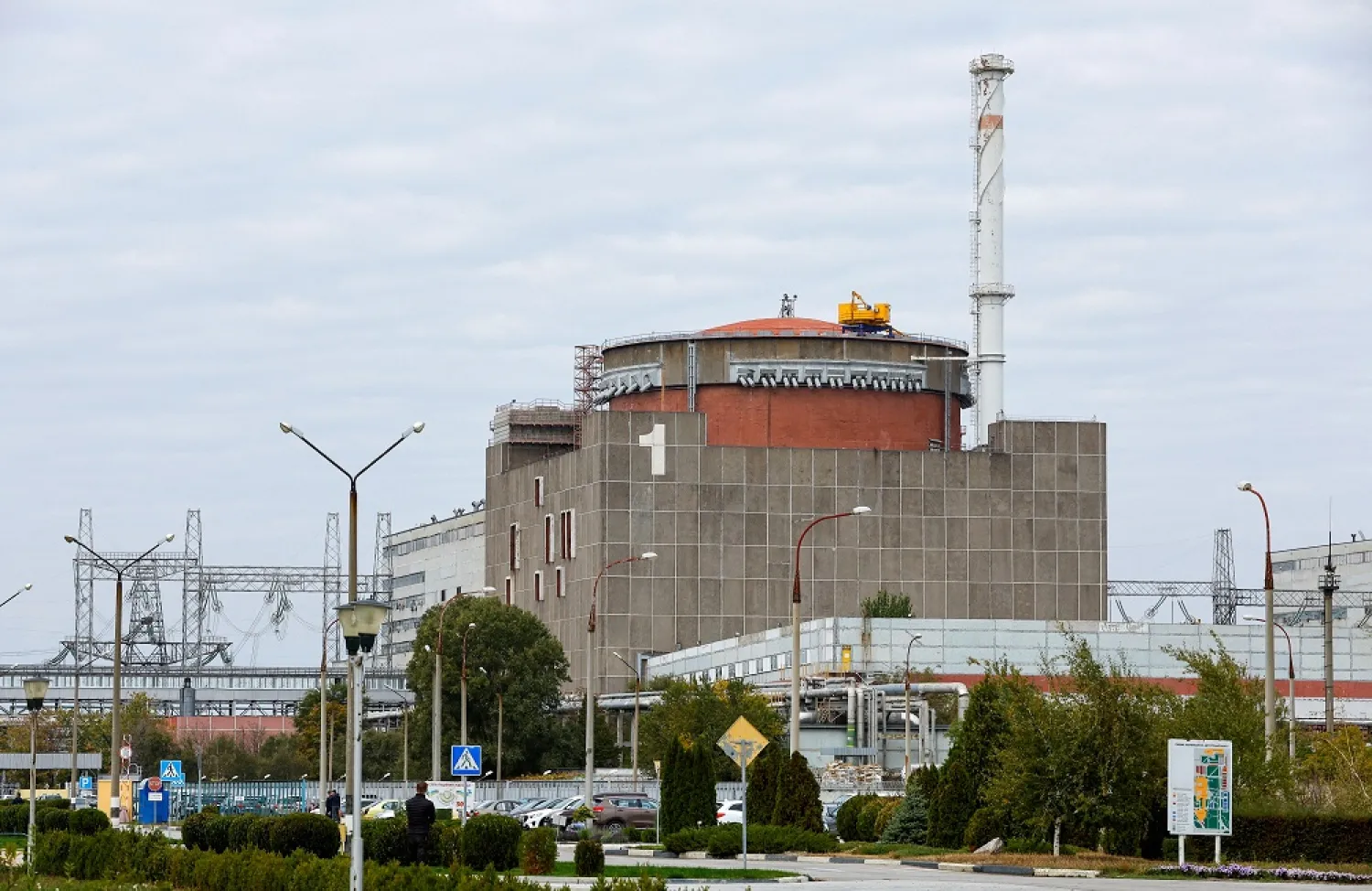
Ukraine Nuclear Plant Disconnected from Power Grid after Russian Shelling

A view shows the Zaporizhzhia Nuclear Power Plant in the course of Russia-Ukraine conflict outside Enerhodar in the Zaporizhzhia region, Russian-controlled Ukraine, October 14, 2022. (Reuters)
TT

Ukraine Nuclear Plant Disconnected from Power Grid after Russian Shelling

A view shows the Zaporizhzhia Nuclear Power Plant in the course of Russia-Ukraine conflict outside Enerhodar in the Zaporizhzhia region, Russian-controlled Ukraine, October 14, 2022. (Reuters)

Ukraine's Zaporizhzhia nuclear power plant was disconnected from the national power grid on Monday following Russian shelling, prompting backup diesel generators to kick in, state nuclear energy firm Energoatom said.

"Russian terrorists once again shelled critical infrastructure substations in Ukraine-controlled territory, resulting in the shutdown of the last 750 kV ZNPP-Dniprovska communications line at 03:59," it said in a statement.

Russian forces have occupied the plant in southern Ukraine, Europe's largest, since shortly after invading Ukraine nearly eight months ago but it is operated by Ukrainian staff.


Iran’s Slain Leader Khamenei Laid in State in Tehran for Week of Mass Funeral Events

A woman walks at the Imam Khomeini Grand Mosalla on the day International delegates participate in a farewell ceremony for Iran's late Supreme Leader Ali Khamenei, who was killed on February 28 during Israeli and US airstrikes on Iran, in Tehran, Iran July 3, 2026. (Reuters)
TT

Iran’s Slain Leader Khamenei Laid in State in Tehran for Week of Mass Funeral Events

A woman walks at the Imam Khomeini Grand Mosalla on the day International delegates participate in a farewell ceremony for Iran's late Supreme Leader Ali Khamenei, who was killed on February 28 during Israeli and US airstrikes on Iran, in Tehran, Iran July 3, 2026. (Reuters)

The body of Iran's slain Supreme Leader Ali Khamenei was lying in state in a vast hall in Tehran on Friday as clerics, officials, foreign dignitaries and other mourners paid their respects after his 37-year rule.

Iran is staging a week of mass funeral processions for Khamenei — killed in February by US and Israeli airstrikes at the start of a four-month war — in a show of public devotion to the country's theocratic state and revolutionary fire.

Khamenei's body was expected to be taken to Qom, Najaf and Karbala, the great Shiite centers of Iran and Iraq, before being laid to rest on Thursday in Mashhad, home to the country's holiest shrine.

His coffin was unveiled late on Thursday to a throng of sobbing supporters, swaying and beating their heads in time to a sung lament as flowers were thrown from the bier into the crowd. On Friday the coffin — and those of family members killed with him — was laid in state in the great prayer hall built to honor his predecessor, Khomeini.

The funeral comes at a critical moment for Iran, where the clerical rulers backed by the Iranian Revolutionary Guard Corps are riding high from surviving what they saw as ‌an existential war against their ‌greatest and most powerful foes.

But nearly five decades after the 1979 revolution, and for all the official proclamations of ‌national ⁠unity in the ⁠run-up to Khamenei's funeral, the country has rarely been so internally fractured.

Support for the clerical leadership is paper thin, analysts say, and the new Supreme Leader, Khamenei's son Mojtaba Khamenei, has not been seen in public since being wounded in the strike that killed his father.

Years of crippling sanctions have paralyzed the economy as accelerating bouts of mass nationwide protests have been put down by security forces with increasing force, culminating in the killing of thousands of demonstrators in January.

Those deep problems have been brushed aside this week, with the authorities mounting a display of state power and mass support, mobilizing what they hope will be millions of mourners to take part in the funeral.

Tehran streets were tightly controlled, with military and police vehicles lining the major roads and police and members of the black-shirted volunteer Basij paramilitary force patrolling on motorbikes. Iran warned the United States and Israel against any attacks during ⁠the funeral.

After the coffins arrived on Friday, borne high across the upraised hands of a waiting crowd, they were laid ‌in the prayer hall on a white, stepped, dais before a high, intricately tiled, arched recess, flanked by ‌national and black mourning flags.

Delegations, including from Lebanon, Iraq and Yemen, home to the strongest proxies in Iran's network of regional power, followed each other into ‌the hall to stand before the coffins.

Representatives from Russia and China were expected to attend. Iraqi President Abdul Latif Rashid, Armenian Prime Minister Nikol Pashinyan and Pakistani Interior Minister Syed Mohsin Naqvi arrived in Tehran for the funeral.

Families of Hezbollah leader Hassan Nasrallah and senior commander Imad Mughniyeh, close Lebanese allies of Iran killed in Israeli strikes, attended the ceremony.

In central Tehran overnight, a crowd stood sobbing and chanting, led by a Basij member, as others handed out posters of the late Khamenei.

"God willing, only by avenging his blood, demanding justice for it, and ensuring that our leader's blood is not left unavenged, can this sorrow of the people be somewhat alleviated," said Mobina Razaaghi, an 18-year-old student from Isfahan, attending the funeral events with classmates.

Killed alongside Khamenei, and displayed in coffins next to his, were his daughter, son-in-law and baby granddaughter, as well as the wife of his son Mojtaba.

Burials are meant to be conducted within a day of death in Islam, but because of the risks of holding a big funeral during the war it was postponed until after last month's interim truce deal was agreed.

Hotels are offering 50% discounts, schools, mosques and sports halls have been prepared to house mourners, and bus and rail networks are being diverted to serve the main events.

After what authorities are billing as a massive procession in central Tehran on Monday, the remains will be taken to the seminary city of Qom for ceremonies on Tuesday.

Ceremonies will then be held in Iraq's shrine cities of Najaf and Karbala on Wednesday with prominent attendees from Iran's regional network of proxies.

He will be buried on Thursday, after another procession, in Mashhad.


China Says Japan-India Cooperation ‘Should Not Target’ Beijing

Indian Prime Minister Narendra Modi (R) shakes hands with Japanese Prime Minister Sanae Takaichi prior to their meeting at Hyderabad House in New Delhi, India, 02 July 2026. (EPA)
TT

China Says Japan-India Cooperation ‘Should Not Target’ Beijing

Indian Prime Minister Narendra Modi (R) shakes hands with Japanese Prime Minister Sanae Takaichi prior to their meeting at Hyderabad House in New Delhi, India, 02 July 2026. (EPA)

China said on Friday that cooperation between India and Japan "should not target" Beijing, after the leaders of the other two countries agreed to work more closely on critical minerals.

The strategic commodities, which are used in everything from electric vehicles and smartphones to jet engines and guided missiles, featured prominently during talks between Indian Prime Minister Narendra Modi and Japan's Sanae Takaichi in New Delhi on Thursday.

Asked about the meeting, China's foreign ministry said countries should work to "foster understanding and trust".

"Cooperation between nations... should not target or harm the interests of third parties, let alone serve as a pretext for forming exclusive cliques or stoking confrontation," spokesperson Guo Jiakun told a news conference.

The relationship between Beijing and Tokyo has become more turbulent since Takaichi suggested in November that a potential future attack on Taiwan -- the self-ruled island claimed by China -- could warrant Japanese military involvement.

Chinese authorities have responded in part by restricting flows to Japan of rare earths, a sector China dominates globally in both mining and processing.

Modi said after his talks with Takaichi that the countries had agreed to "strengthen supply chain resilience in strategic sectors such as semiconductors, quantum technologies and critical minerals".

Takaichi warned that Japan and India were facing challenges including "weaponization of the economy and non-market policies and practices".

This week, China's commerce ministry added 20 Japanese entities to an export blacklist on the basis that they had boosted Tokyo's military capabilities.

Japan called the latest move "unacceptable and deeply regrettable", demanding its reversal.


Researchers Say EU Lawmaker Who Investigated Surveillance Was Hacked by Israeli Spyware

Logo of Israel's NSO Group, owner of the Pegasus spyware, on a smartphone placed on a keyboard. (Reuters)
TT

Researchers Say EU Lawmaker Who Investigated Surveillance Was Hacked by Israeli Spyware

Logo of Israel's NSO Group, owner of the Pegasus spyware, on a smartphone placed on a keyboard. (Reuters)

A former member of the European Parliament who served on a committee investigating abusive surveillance was himself hacked using an Israeli-made spy tool, a Canadian tech watchdog group said on Friday.

Citizen Lab said in a report that the phone of Stelios Kouloglou, a Greek television journalist-turned-lawmaker, was hacked at least three times between October 2022 and March 2023 using Pegasus spyware, a tool distributed by the Israeli company NSO Group.

At the time of the targeting, Kouloglou was serving on the European Parliament's PEGA Committee, which was set up in 2022 to examine the use of illegal phone hacking across the European Union. The committee focused mainly on ‌the use of ‌Pegasus and similar tools, finding that governments across the EU likely used spyware, "in ‌one ⁠way or another, ⁠some legitimate, some illegitimate."

Kouloglou said he was astonished at the audacity of whoever was behind the hacking.

"I was not expecting that a PEGA member would be spied on by Pegasus," he told Reuters. "I was not expecting that they would be as reckless as that."

NSO did not return messages seeking comment.

In a statement to Reuters, the European Parliament did not directly address Kouloglou's case but said its IT security services "constantly monitor cybersecurity threats as well as potential cyberattacks against its working environment."

It said spyware screening tools ⁠had been available to all lawmakers since 2022 and that a report ‌adopted last month called for their extension to all devices ‌used for parliamentary business.

The European Commission, the European Union's executive branch, did not immediately return messages seeking comment.

NSO has ‌said its spy tools are used to police serious crime and to protect national security, ‌but the company has repeatedly been accused of facilitating intrusive surveillance of journalists, political opponents, civil rights activists and religious figures around the world. NSO was blacklisted by the US government in 2021 over human rights and national security concerns.

Last year, WhatsApp owner Meta Platforms won a $168 million damages award against NSO for unlawfully hacking the ‌platform, although the award was significantly reduced. Last month, Meta accused NSO of violating the court's injunction on targeting its services and filed for ⁠a contempt order.

Citizen Lab ⁠said it believed that Kouloglou had been hacked through a vulnerability in Apple software that was not known at the time. It said Kouloglou received repeated warnings about state-sponsored hacking attempts from Apple in 2023 and 2024. Citizen Lab did not identify who actually used Pegasus to target the former lawmaker, but it linked some of the hacking activity to earlier discoveries that Pegasus was used to spy on Russian- and Belarusian-speaking journalists and activists in exile. Apple did not directly address questions about Kouloglu, but said the vulnerability referred to in the Citizen Lab report had since been patched and that it regularly issued alerts to hacking targets.

Sophie in 't Veld, a former EU lawmaker who championed the PEGA committee's creation, said the hacking of Kouloglou's phone showed how the spread of mercenary spyware had created a surveillance free-for-all.

"We're in a situation where anybody could spy on anyone and they're spying on citizens, they're spying on journalists, they're spying on NGOs, on lawyers, on politicians, and nobody knows who's behind it," she said.