Lebanese-Israeli Maritime Agreement to Be Signed within 10 Days

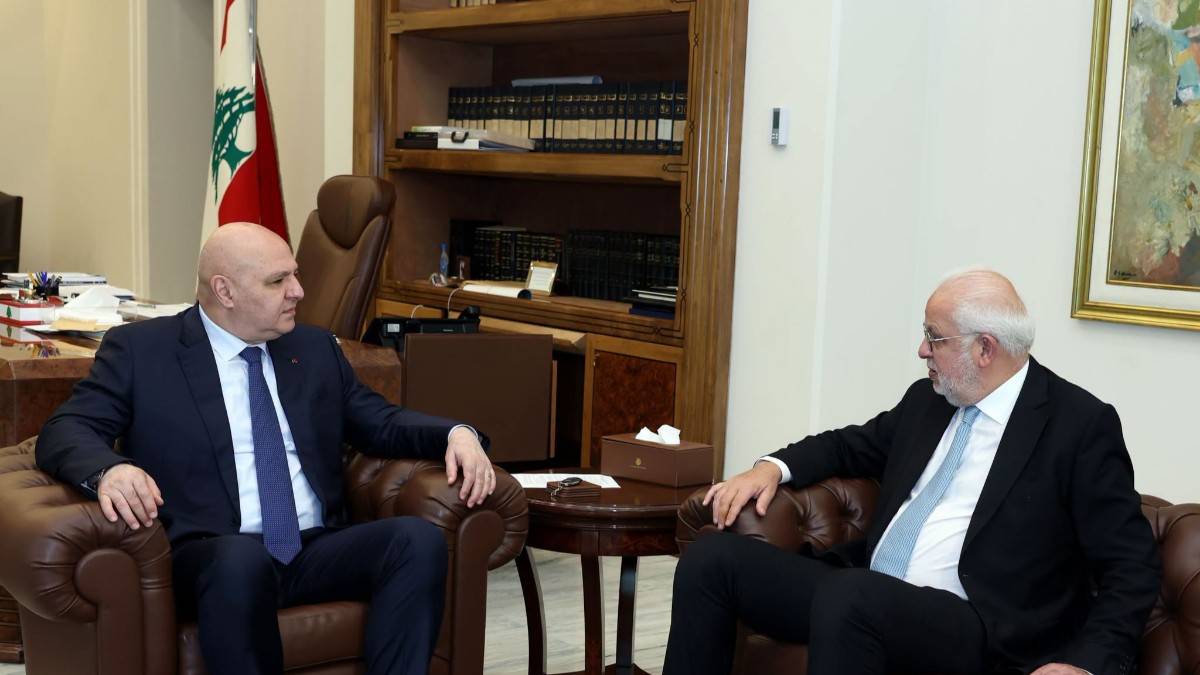
 09 September 2022, Lebanon, Baabda: Lebanese President Michel Aoun (R) speaks with US Senior Advisor for Energy Security Amos Hochstein during their meeting at the Presidential Palace. (Dalati & Nohra)
09 September 2022, Lebanon, Baabda: Lebanese President Michel Aoun (R) speaks with US Senior Advisor for Energy Security Amos Hochstein during their meeting at the Presidential Palace. (Dalati & Nohra)
TT

Lebanese-Israeli Maritime Agreement to Be Signed within 10 Days

 09 September 2022, Lebanon, Baabda: Lebanese President Michel Aoun (R) speaks with US Senior Advisor for Energy Security Amos Hochstein during their meeting at the Presidential Palace. (Dalati & Nohra)
09 September 2022, Lebanon, Baabda: Lebanese President Michel Aoun (R) speaks with US Senior Advisor for Energy Security Amos Hochstein during their meeting at the Presidential Palace. (Dalati & Nohra)

Lebanon’s deputy parliament Speaker Elias Bou Saab revealed the expected date for the completion of the demarcation settlement with Israel and the mechanism by which the agreement will be signed.

“The points that the United States has included in a letter will be sent to both Lebanon and Israel. Lebanon will respond by agreeing in writing to the message, and Israel will respond in the same way,” Bou Saab said in a television interview to be aired on Monday.

He added that the delivery of letters was likely to take place on Oct. 26 or 27 through the United Nations at Lebanon’s border area of Naqoura.

Asked about the Lebanese party that will sign the agreement letter, Bou Saab replied: “This decision is taken by the President of the Republic, who will choose the team that will head to Naqoura.”

The deputy speaker noted that the alternative to this agreement “could have been war or escalation.”

He said he believed that former Israeli Prime Minister Benjamin Netanyahu’s threat to annul the agreement if he wins elections in November “is electoral talk,” adding that any breach would put US credibility at stake.

“The agreement also guarantees that there will be no provocation on the border, neither by [Hezbollah] nor any other party,” Bou Saab stressed.

Hezbollah Secretary-General Hassan Nasrallah had praised the US proposal, even before Aoun announced Lebanon’s official approval of it.

However, the head of Hezbollah’s Loyalty to the Resistance parliamentary bloc, MP Mohammad Raad, said on Sunday: “We still don’t trust this enemy and we will never do; that’s why, we have not yet announced our position.”

Meanwhile, Hezbollah deputy Secretary-General Naim Qassem described the demarcation agreement as a “historic achievement.”

“The resistance had a great impact on securing the maritime oil and gas rights for Lebanon; it will be a historic achievement when the signing takes place... This matter would not have happened without the solidarity between the state and the resistance…” Qassem said.


Israeli Strike Kills Lebanese Forces Official, Widening Divisions Over Hezbollah

 The exterior of an apartment building hit by an Israeli strike amid escalating hostilities between Israel and Hezbollah, as the US-Israel conflict with Iran continues, in Ain Saadeh, Lebanon, April 6, 2026. (Reuters)
The exterior of an apartment building hit by an Israeli strike amid escalating hostilities between Israel and Hezbollah, as the US-Israel conflict with Iran continues, in Ain Saadeh, Lebanon, April 6, 2026. (Reuters)
TT

Israeli Strike Kills Lebanese Forces Official, Widening Divisions Over Hezbollah

 The exterior of an apartment building hit by an Israeli strike amid escalating hostilities between Israel and Hezbollah, as the US-Israel conflict with Iran continues, in Ain Saadeh, Lebanon, April 6, 2026. (Reuters)
The exterior of an apartment building hit by an Israeli strike amid escalating hostilities between Israel and Hezbollah, as the US-Israel conflict with Iran continues, in Ain Saadeh, Lebanon, April 6, 2026. (Reuters)

An Israeli strike on an apartment east of Beirut late on Sunday killed a local official from the Lebanese Forces, sharpening internal divides over Hezbollah as Israel's strikes expand to new parts of the country.

The war raging in Lebanon over the past month has deepened fractures between supporters of Hezbollah and those who blame the Iran-backed group for igniting a new conflict with Israel just 15 months after the last one.

On Sunday, an Israeli strike hit an apartment in Ain Saadeh, a predominantly Christian town in the hills east of Beirut, killing a man and two women, Lebanon's health ministry said. Ain Saadeh's mayor said the victims were one floor below the targeted apartment.

The ‌Lebanese Forces, ‌a fiercely anti-Hezbollah party, identified two of the dead as Pierre ‌Moawad, ⁠a local party official, ⁠and his wife Flavia.

"We are paying a heavy price for a war into which we have been dragged by the lawless organization Hezbollah," Lebanese Forces parliamentarian Razi El Hage told Lebanese broadcaster MTV.

Israel's full-scale air and ground campaign, launched in retaliation for Hezbollah firing into Israel on March 2 in solidarity with Iran, has killed more than 1,460 people, according to Lebanese authorities.

ISRAEL REVIEWING STRIKE

The air campaign and Israel's orders for people to leave swathes of Lebanon's south, east, and Beirut's southern suburbs have displaced more ⁠than a million people, most of them from the Shiite ‌community from which Hezbollah draws its support.

Some residents and local ‌officials in predominantly Christian areas have expressed concern that displaced communities are harboring fighters that could be targeted by Israel, ‌with local authorities vetting those seeking rented accommodation.

Nadim Gemayel, of the Kataeb party, told ‌Reuters last month he was worried Israel was deliberately pushing Shiites into other parts of Lebanon to create conflict with other communities.

There was no Israeli military order for people to flee before Sunday's strike. Residents said no displaced people were living in the targeted apartment or surrounding buildings.

"I've been in my house for 20 ‌years, I've never even seen this apartment lit. There's no one in it," Antoine Aalam, a 70-year-old man who lives across from the ⁠targeted apartment, told Reuters on ⁠Monday.

The Israeli military told Reuters it had struck a "terror target east of Beirut" without providing further details.

"Reports that several uninvolved individuals were harmed as a result of the strike are being reviewed," it said.

CIVIL PEACE IS 'RED LINE'

Although the last war with Hezbollah ended with a ceasefire in 2024, Israel continued its strikes on Lebanon and kept troops stationed in the country's south. Lebanon's calls for Israel to negotiate a new truce have fallen on deaf ears.

Sunday's strike came just hours after Lebanese President Joseph Aoun, in his first televised address since the war erupted, said the country's "primary concern is preserving civil peace, which is a red line."

A separate Israeli strike on Beirut's southern suburbs killed five people, including a teenage girl and two Sudanese migrant workers, and another on a car in southern Lebanon killed a man and his wife, and injured their two children.


Raid Hits Beirut’s Southern Suburbs as Israel Says Striking Hezbollah

Smoke rises from the site of an Israeli strike in Beirut's southern suburbs, near Camille Chamoun Sports City stadium (R), on April 6, 2026. (AFP)
TT

Raid Hits Beirut’s Southern Suburbs as Israel Says Striking Hezbollah

Smoke rises from the site of an Israeli strike in Beirut's southern suburbs, near Camille Chamoun Sports City stadium (R), on April 6, 2026. (AFP)

An Israeli strike hit Beirut's southern suburbs on Monday as Israel's army said it was targeting Hezbollah, with the raid sending a large plume of smoke billowing across the skyline.

The state-run National News Agency (NNA) reported the strike on the Hezbollah stronghold, which has been largely emptied of residents following repeated Israeli attacks and evacuation warnings.

Israel has launched strikes across Lebanon and a ground invasion in the south since March 2, when Hezbollah entered the Middle East war on the side of its backer Iran.

Israel's army said it was "striking Hezbollah terror targets in Beirut" on Monday.

Shortly before the warning, an AFP journalist in the southern suburbs saw just a few shops open, including a bakery, a pharmacy and a barbershop, as well as a gas station belonging to the Al-Amana fuel company destroyed in a previous raid.

The Israeli army said on Sunday that in recent days, it had struck two Al-Amana petrol stations "which were controlled by Hezbollah and served as significant financial infrastructure" supporting the group's activities.

Fresh portraits mourning Iran's former supreme leader Ali Khamenei, who was killed in the US-Israeli attack on February 28 that triggered the Middle East conflict, were visible along main roads in the southern suburbs.

The NNA also reported deadly strikes in the country's south and east on Monday.

A day earlier, Israel repeatedly struck the southern suburbs and also hit a site in Beirut's Jnah neighbourhood near the country's largest public medical facility.

The health ministry said that strike killed five people, including a 15-year-old girl and two Sudanese nationals.

Another strike on the town of Ain Saadeh, east of Beirut, killed three people including two women, authorities said.

Among the dead were Pierre Mouawad, a local official in the Lebanese Forces, a party strongly opposed to Hezbollah, and his wife.

Residents of the building told local media that the strike hit the apartment above Mouawad's.

Israel's military said Monday that it had struck a "terrorist target" east of Beirut.

"Reports of casualties among Lebanese civilians not involved in the fighting are being examined. All details of the incident are under review," it said.


Gaza Factions Expect Intensified Israeli Attacks after Seeking Changes to Disarmament Plan

 A Palestinian Christian woman attends a service at Saint Porphyrius Church in Gaza on Sunday (dpa). 
 A Palestinian Christian woman attends a service at Saint Porphyrius Church in Gaza on Sunday (dpa). 
TT

Gaza Factions Expect Intensified Israeli Attacks after Seeking Changes to Disarmament Plan

 A Palestinian Christian woman attends a service at Saint Porphyrius Church in Gaza on Sunday (dpa). 
 A Palestinian Christian woman attends a service at Saint Porphyrius Church in Gaza on Sunday (dpa). 

Major Palestinian factions in Gaza expect Israel to step up its military operations in the enclave after they, through Hamas, sought amendments to a proposed disarmament plan, sources told Asharq Al-Awsat.

Three Hamas sources inside Gaza said there were field indications of a broader Israeli escalation that could go beyond targeting police and security positions, armed faction members and assassinations.

Disarming Hamas is a central pillar of a plan presented by the UN’s special envoy for Gaza, Nickolay Mladenov, which he outlined at the United Nations Security Council in late March.

According to provisions reported by international and regional media, the plan calls for Hamas to dismantle its tunnel network and relinquish weapons in stages over eight months, with a full Israeli withdrawal contingent on “final verification that Gaza is free of weapons”.

Israeli escalation has intensified in recent days, with increased strikes targeting police personnel and field operatives from armed factions.

The sources said instructions had been issued to members of Hamas-run security services and armed wings to raise alert levels to the maximum and take all possible precautions to avoid repeated targeting.

Proposed amendments

A Hamas delegation that visited Cairo last week submitted, on behalf of Gaza factions, a response to the disarmament proposal during a meeting with Mladenov two days ago.

The response stressed “the need to introduce amendments to the plan, including obligating Israel to fully implement its commitments in the first phase before moving to the second,” the sources said.

Hamas believes Israel could use the request for amendments “as a pretext to intensify its attacks in the coming period, claiming the movement has refused to disarm,” one Hamas source noted, adding that the group and other factions were continuing to study the plan through various channels.

A field source from the Islamic Jihad movement said that “strict instructions” had been issued to fighters to adopt all necessary security measures to avoid detection and targeting, amid growing signs of an Israeli escalation, “especially if Iran war ends.”

Early on Sunday, Israeli forces killed four fighters from the Izzedine al-Qassam Brigades, Hamas’ armed wing, in the Shujaiyya area east of Gaza City while they were manning a checkpoint aimed at preventing infiltration by Israeli special forces or armed groups.

On Monday, a Hamas police officer was killed when an Israeli drone struck his vehicle at the entrance to Maghazi refugee camp in central Gaza. Another young man was shot dead by Israeli forces near the so-called “yellow line” south of Khan Younis.

Field sources said the targeted vehicle belonged to a Qassam Brigades member and that the police officer driving it had previously served as a bodyguard for a senior figure.

According to Gaza’s health ministry, more than 718 Palestinians have been killed by Israel since a ceasefire took effect on October 10, 2025.

Meeting with Erdogan

Separately, Hamas said on Sunday that a senior delegation had held talks with Turkish President Recep Tayyip Erdogan in Istanbul, focusing on developments in Gaza and ways to consolidate the ceasefire.

The delegation warned of the situation in Jerusalem, particularly at Al-Aqsa Mosque, cautioning against what it described as violations, and against proposed legislation concerning the execution of prisoners, which it said would contravene international law.

According to the statement, the delegation expressed appreciation for Türkiye’s support for the Palestinian cause, while Erdogan reaffirmed his country’s continued backing for Palestinian rights and its longstanding position on the Palestinian cause.