SIBF Recognizes Sudanese Historian Youssef Fadl as Figure of the Year

File photo from Sharjah International Book Fair, northeast of Dubai, 31 October 2018 (AFP)
TT

SIBF Recognizes Sudanese Historian Youssef Fadl as Figure of the Year

File photo from Sharjah International Book Fair, northeast of Dubai, 31 October 2018 (AFP)

The Sharjah Book Authority (SBA) has announced Sudanese historian Yusuf Fadl Hasan as ‘Cultural Personality of the Year’ for its upcoming 41st Sharjah International Book Fair (SIBF 2022).

Hasan is being recognized for his contributions to the field of history and documentation of the nation’s developmental journey in political, cultural and scientific fields, in addition to his substantial efforts in promoting the research and documentation movement in Africa and Asia. He also published more than 30 books.

SBA said the selection of Youssef Fadl is part of its vision to honor distinguished figures of thought, literature, and history, whose efforts represented an added value to the Arabic book library in all fields.

It also serves SIBF’s message calling for introducing, pioneering, and influencing figures in the Arabic culture to younger generations.

Ahmed Al Ameri, chairman of SBA, said, “SBA’s efforts echo the vision of Sheikh Sultan bin Muhammad Al Qasimi, Supreme Council member and ruler of Sharjah, of celebrating distinguished intellectual and creative personalities as pillars of sustainable cultural development. The Arab cultural world needs the invaluable work of distinguished figures like Prof. Yusuf Fadl Hasan to advance our realities and build our future.”

“Sudan has constantly enriched Arab culture through leading contributions by prominent individuals in various fields. The history of Arabic cultures is a witness on esteemed Sudanese intellects, researchers, novelists, and poets who enriched the Arabic library,” he added.

“Naming Prof. Yusuf the Cultural Personality of the Year is a tribute to more than 60 years of vital work in research, documentation and studies of the African and Asian continents,” Al Ameri concluded.

Born in Al Mahmiyya, Sudan, in 1932, Fadl received Bachelor degree in General Arts from Khartoum University in 1956, and Bachelor's degree with honors in History from London University in 1959, and PhD in History from the University of London in 1964. He served as a lecturer at the History department at the University of Khartoum.


New Restrictions Kick in as New Delhi Battles Pollution

Commuters ride along a street amid smog in Lahore on November 1, 2026. (Photo by Arif ALI / AFP)
TT

New Restrictions Kick in as New Delhi Battles Pollution

Commuters ride along a street amid smog in Lahore on November 1, 2026. (Photo by Arif ALI / AFP)

Authorities in New Delhi stepped up anti-pollution measures on Sunday, including higher parking fees and work-from-home orders, seeking to curb toxic smog in one of the world's most polluted capitals.

The restrictions, which came into force Sunday, include a doubling of vehicle parking charges and work-from-home arrangements for government and private-sector offices aimed at cutting traffic emissions, AFP reported.

Authorities will also bar vehicles that do not comply with mandated emission standards from entering the capital, while a ban on all dust-generating demolition and outdoor construction activity takes effect immediately.

"From November 1... Delhi's Winter Action Plan comes into effect with stricter pollution controls, stronger enforcement and 24×7 monitoring," Chief Minister Rekha Gupta's office said in a statement.

"We humbly request all Delhiites to follow the guidelines and contribute towards making Delhi's air cleaner and healthier."

Delhi's government has already rolled out a range of pollution-control measures over the past month, including a ban on rubbish burning and restrictions on food stalls using coal or firewood.

But similar efforts in previous years have done little to prevent the annual smog that engulfs the megacity from November to January, when cooler temperatures trap pollutants close to the ground.

Major sources of pollution include vehicle emissions, coal-fired power plants, industrial activity, construction dust and the burning of crop residue in neighboring states.

Vehicles account for 23 percent of Delhi's winter pollution, while biomass burning, including farm stubble fires, contributes 20 percent, according to India's environment ministry.

Industry, including coal-fired power plants, contributes about nine percent.

Levels of PM2.5, tiny cancer-causing particles that can penetrate deep into the lungs and bloodstream, frequently exceed 300 micrograms per cubic meter during peak winter months, around 20 times the World Health Organization's recommended daily limit.

Last year, pollution levels peaked at 846 micrograms per cubic meter, or 56 times the WHO guideline.

On Sunday, monitors recorded PM 2.5 at 201 micrograms per cubic meter, over 13 times the safe limit, a reading that was likely helped by intermittent rain over the last few days.

A 2024 study published in The Lancet Planetary Health estimated that 3.8 million deaths in India between 2009 and 2019 were linked to air pollution.


From Italy to Croatia, a Warming Climate Threatens Prized White Truffles

Truffles hunter Tino Marolo checks truffle found with his dog Stella in the woods in Vezza d'Alba, near Alba, northern Italy, Thursday, Oct. 1, 2026. (AP Photo/Antonio Calanni)
TT

From Italy to Croatia, a Warming Climate Threatens Prized White Truffles

Truffles hunter Tino Marolo checks truffle found with his dog Stella in the woods in Vezza d'Alba, near Alba, northern Italy, Thursday, Oct. 1, 2026. (AP Photo/Antonio Calanni)

Guided by the beam of a flashlight, Tino Marolo follows his dog Stella through the darkness of a Piedmont woodland, searching for one of Italy’s most prized culinary treasures hidden beneath the soil.

In the hills around Alba, home to the world’s most famous white truffles, hunters known as “trifolau” traditionally begin their season on Oct. 1. But increasingly, they are confronting a challenge above ground: climate change.

Months of heat and drought have raised concerns about the future of the prized white truffle, a fungus that depends on cool, moist soils and a delicate relationship with tree roots.

“The entire month of October was affected by the lack of rain in July and August and the high temperatures, so it was characterized by poor production and poor truffle shelf life,” said Antonio Degiacomi, president of Italy’s National Centre for Truffle Studies.

According to Degiacomi, dry and compacted soils have also produced smaller truffles this season.

The difficult harvest comes as Alba and the surrounding Langhe hills welcome visitors for the International White Truffle Fair, one of Italy’s best-known food events, which opened on Oct. 10 and runs until Dec. 6.

A changing climate, a changing harvest For Axel Iberti, president of the fair, the season began slowly, with smaller truffles emerging after a hot, dry summer. More recent rains have improved conditions, helping larger specimens appear.

Despite tighter supplies, demand remains strong. Prices at Alba’s truffle market are running about 20% to 30% higher than last year, Iberti said, while hotels and other accommodations have largely sold out during the fair period.

The concerns extend beyond this year’s crop.

“This year certainly stands out from a trend we all know has been going on for five or six years now,” Degiacomi said, citing hotter summers and increasingly erratic rainfall patterns.

Back in the woods, Marolo says uncertainty has always been part of the hunt.

“You certainly come home empty-handed more often than you do with a truffle,” The Associated Press quoted him as saying. “It’s really the thrill of saying: I don’t know what I’m going to find.”

Similar concerns are emerging elsewhere in Europe’s truffle-producing regions, suggesting a challenge extending beyond any single forest or region.

Across the Adriatic in Croatia, truffle hunters and scientists describe many of the same challenges, from shrinking harvests to declining habitat suitability.

In oak forests outside Zagreb, truffle hunter Petar Alebic says years of drought have made the prized fungi harder to find.

“Each year for the past seven or eight years has been worse than the last,” Alebic said. “Due to the drought, unfortunately, truffles are becoming smaller and scarcer.”

Alebic estimates this year’s harvest is about 30% below normal and increasingly supplements his income with truffle-hunting tours for tourists.

Scientists studying truffles in Croatia report similar findings. Croatia is home to about a dozen truffle species, according to mycologist Armin Mesic of the Rudjer Boskovic Institute. The most prized, the white truffle, can fetch as much as 4,000 euros ($4,500) per kilogram.

“Drought, a lack of rainfall and high temperatures have a significant impact on both the quantity and quality of truffles,” Mesic said.

“Quantities are declining, as is the geographical area where white truffles grow,” he added.

Forests are part of the solution Yet experts in Piedmont reject the idea that the white truffle is doomed.

“I don’t think we’re facing extinction; we’re facing a challenge,” Degiacomi said.

Researchers are studying ways to help truffle habitats adapt, including improved forest management and experimental irrigation during prolonged droughts.

“We’re trying to do what nature does, and do it artificially,” Degiacomi said.

In Alba, the response increasingly centers on restoring and protecting forests.

Iberti has expanded the fair’s focus beyond tourism to include environmental education and conservation efforts.

“The truffle is the sum, but it’s also the vector,” Iberti said. “People come to Alba and the Langhe to discover everything the territory has to offer.”

Working with municipalities, truffle hunters and landowners, communities have begun creating new public truffle grounds and planting trees that could eventually support truffle growth.

“The forest is an act of love and faith for the next two or three generations,” Iberti said.

Advocates say reforestation can help lower soil temperatures, retain moisture and reduce erosion, although it can take more than a decade before newly planted trees become suitable hosts for truffles.

Science looks underground Researchers are also investigating the role of soil microorganisms and looking for tree varieties better suited to hotter and drier conditions.

Attempts to cultivate the prized white truffle continue, but reliable commercial production remains elusive.

Unlike black truffles, which can be cultivated, white truffles have largely resisted large-scale production.

As autumn progresses, the size of this year’s harvest will become clearer, along with its effect on prices and supplies reaching restaurants and markets.

For now, however, the ancient partnership between hunters, dogs and forests endures.

One evening in the woods, Stella eventually stops and begins to dig.

The dog has found a truffle.

Whether future generations will continue to enjoy such moments may depend on a mix of science, conservation and adaptation to a warmer climate.


'Air-con Nation' Singapore Eyes Alternatives to Cool Down

This photo taken on August 26, 2026, shows rows of the air conditioning compressors installed on the rear of buildings at Boat Quay in Singapore. (Photo by Roslan RAHMAN / AFP)
TT

'Air-con Nation' Singapore Eyes Alternatives to Cool Down

This photo taken on August 26, 2026, shows rows of the air conditioning compressors installed on the rear of buildings at Boat Quay in Singapore. (Photo by Roslan RAHMAN / AFP)

Long dubbed an "air-conditioned nation", Singapore is experimenting with cooling alternatives from chilled beams to "passive displacement" to curb its thirst for energy-guzzling air conditioning.

The city-state has the highest per-capita air conditioner ownership rate in Southeast Asia, with about 99 percent of private residences equipped with cooling units.

Singapore's local building sector accounts for one-fifth of its emissions, while cooling itself accounts for 40 to 60 percent of a building's energy consumption, according to studies.

A stroll down renowned thoroughfare Orchard Road highlights that dependence. Shoppers are greeted by blasts of cool air that waft into the street as doors swing open -- a major draw given daytime highs hover between 31C and 33C year-round.

But air conditioning can make the heat problem worse. Compressor units belch hot air back out into the environment, and the electricity that powers the systems can contribute to climate change if generated from fossil fuels.

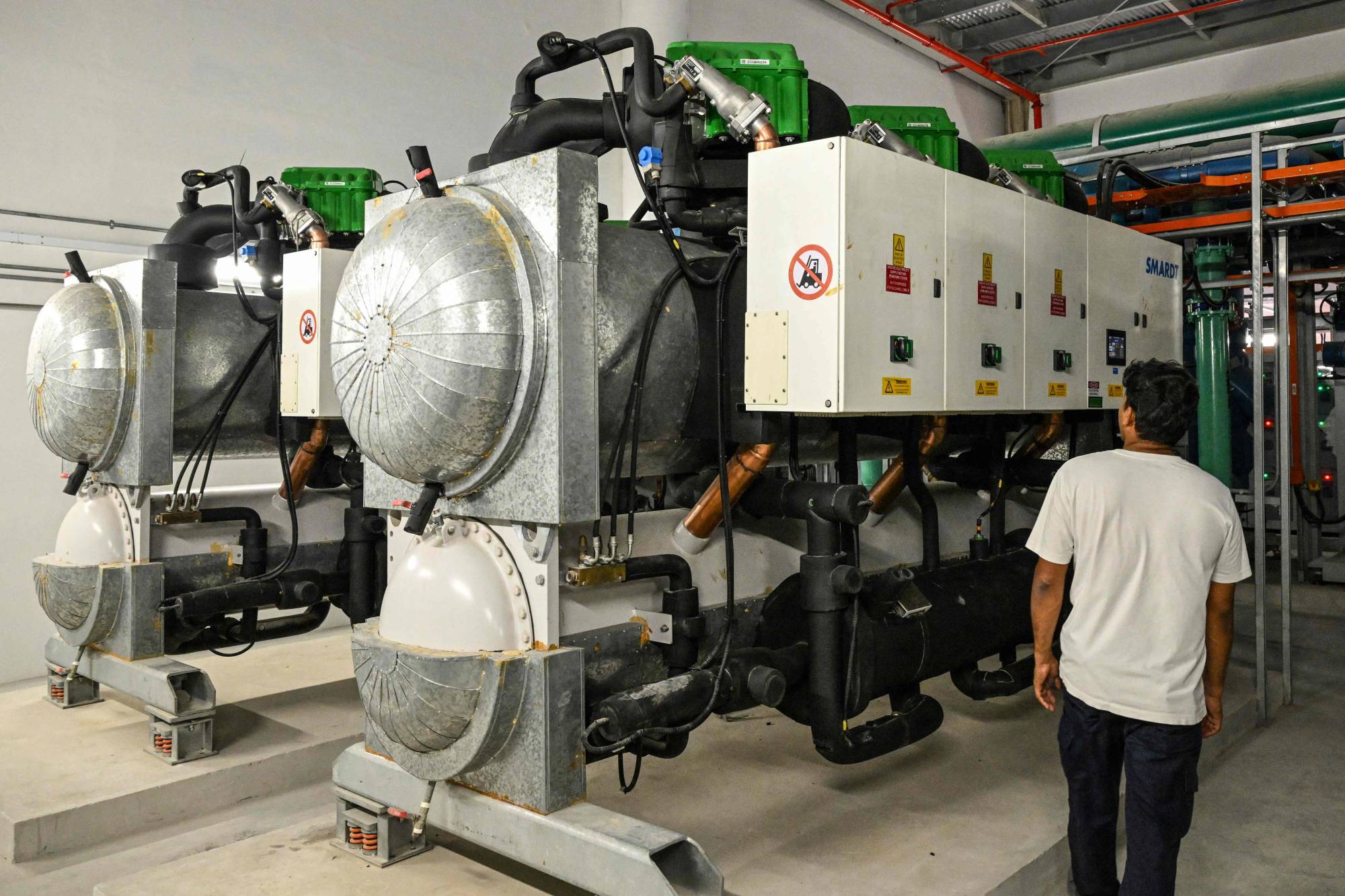
Some buildings in Singapore are looking at other options, including active chilled beams, which are perforated panels equipped with cooling coils that are mounted on ceilings.

A chiller plant on the building's top floor cools water down to 9C, then pumps it into the coils. Simultaneously, air is blasted through small nozzles inside the beams.

The jets of air create a low-pressure zone that sucks up warmer air from the room below so it passes over the coils and is cooled before recirculating.

The technology keeps the offices at the eight-story Paya Lebar Green building in eastern Singapore at a comfortable 24C.

This photo taken on August 21, 2026, shows a technician checking the chillers that produce a hybrid cooling method at an office building in Singapore. (Photo by Roslan RAHMAN / AFP)

A visiting AFP team felt noticeably cooler air flowing from the sleek white panels on the ceiling of the building, described as one of Singapore's "greenest".

The system is also quiet, without the constant hum of air conditioning units.

When HR professional Renuga Shekar first moved into an office space at Paya Lebar Green last November, the 30-year-old and her colleagues just thought the exposed pipes and panels on the ceiling was a "warehouse kind of look".

"We didn't really think much about it. No one really commented about it," she told AFP.

It was only months later, after noticing how quiet the office was and hearing technicians mention "ACB" during maintenance, that they realized it was cooled by active chilled beams.

"We didn't even realize how different the air cooling system is because it was very seamless, and in terms of the temperature, ideal for everybody in the office," she said.

Together, the system cut energy use by more than 30 percent compared with conventional air conditioning, according to the building's designers, DP Architects.

A similar system is in use at Singapore's ports authority maintenance building at western Tuas harbor.
The building uses passive displacement cooling, which taps natural airflow to reduce reliance on mechanical fans.

Ceiling cooling coils chill the air, which sinks before naturally rising back to the coils as it warms. This continuous cycle reduces the need for fans, cutting energy use and noise.

Another alternative is radiant cooling, where water chilled to between 14C and 18C flows through pipes or panels and absorbs heat radiating from people or objects to reduce ambient temperatures.

The push to find new cooling solutions has government backing.

A 2024 government study identified alternative cooling technologies (ACTs) as a key strategy which found they could save the city up to 48 percent in energy.

By mid-2026, at least 33 public and 14 private buildings had adopted ACTs, Singapore's building authorities said. The city-state has an ambitious goal to achieve net-zero carbon emissions by 2050.

The figures are still relatively small, and it can be challenging to find an ACT that is acceptable to users familiar with tried-and-tested air conditioners.

Supporters of alternative systems acknowledge that they cost more to install than conventional air-conditioning, but say they more than make up for it over time with much lower running costs thanks to big energy savings.

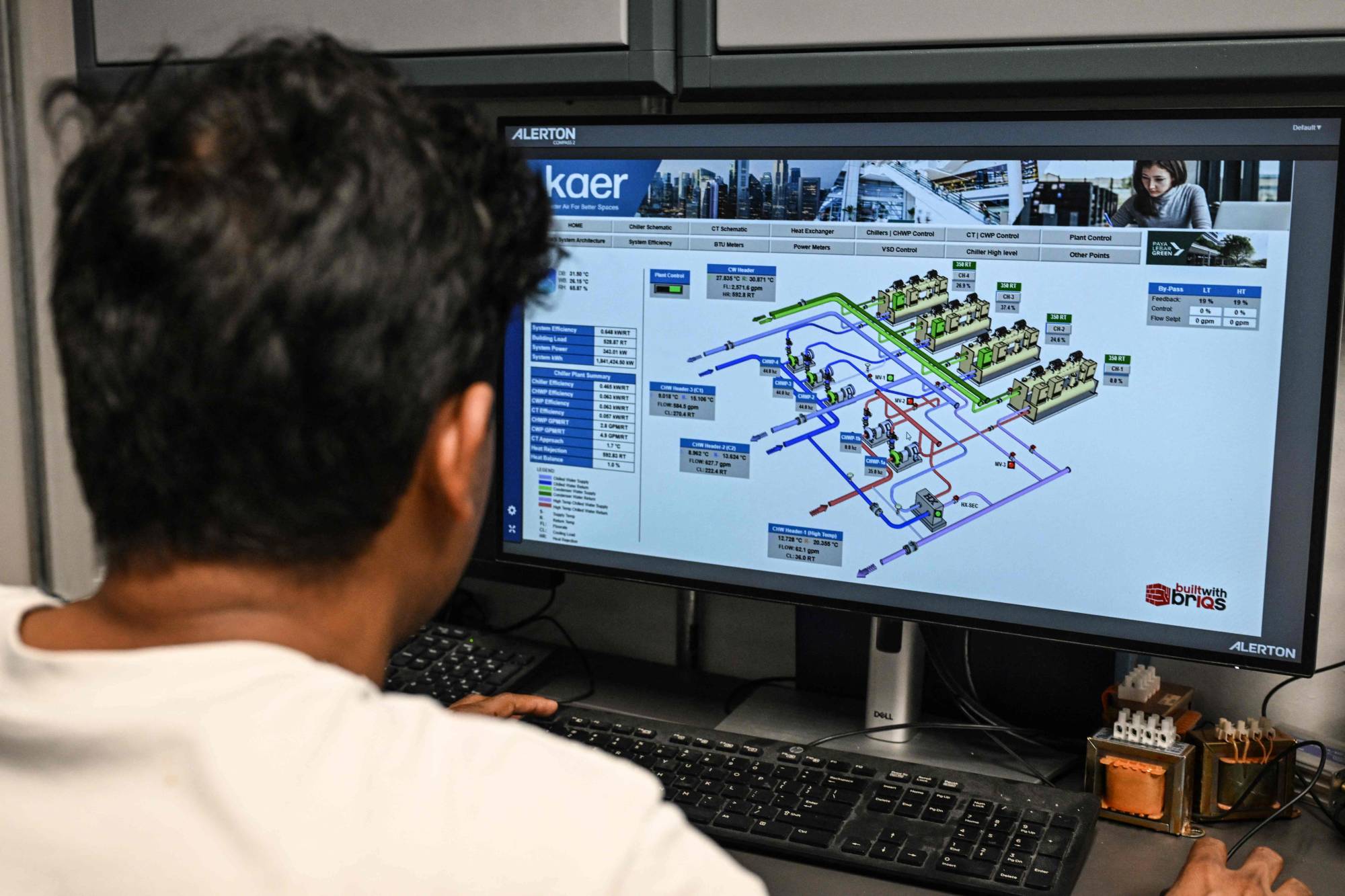
This photo taken on August 21, 2026, shows a technician monitoring remotely the chillers operation that produce a hybrid cooling method at an office building in Singapore. (Photo by Roslan RAHMAN / AFP)

The most popular alternative method remains hybrid cooling -- simply turning up air conditioning to a higher temperature of 25.5C to 27C, and pairing it with fans.

"Everybody's more used to having air-conditioned office spaces, so for them to suddenly accept 26 degrees, I think the mindset shift has not reached a threshold where it's generally accepted yet," said Chua Zi Jun, director at DP Architects.

Demand for cooling is only increasing as climate change raises temperatures and humidity in Singapore and beyond.

Traditional air-conditioning systems rely on vapor compression, using refrigerants to move heat from one place to another.

ACTs use the same basic principle, but either spend less energy moving cool air or reduce run-time by leaning on people's ability to adapt to slightly higher temperatures.

"The technologies are a step in the right direction and should eventually incorporate more sophisticated controls, including predictive systems that adjust temperatures before rooms become too hot or cold," said Wan Man Pun, a cooling tech expert at Nanyang Technological University.

But "we still haven't found any alternative cooling methods that have a higher coefficient of performance, or efficiency, than vapor compression", Wan said.