


Saudi Arabia Supports UNRWA with $27 Million

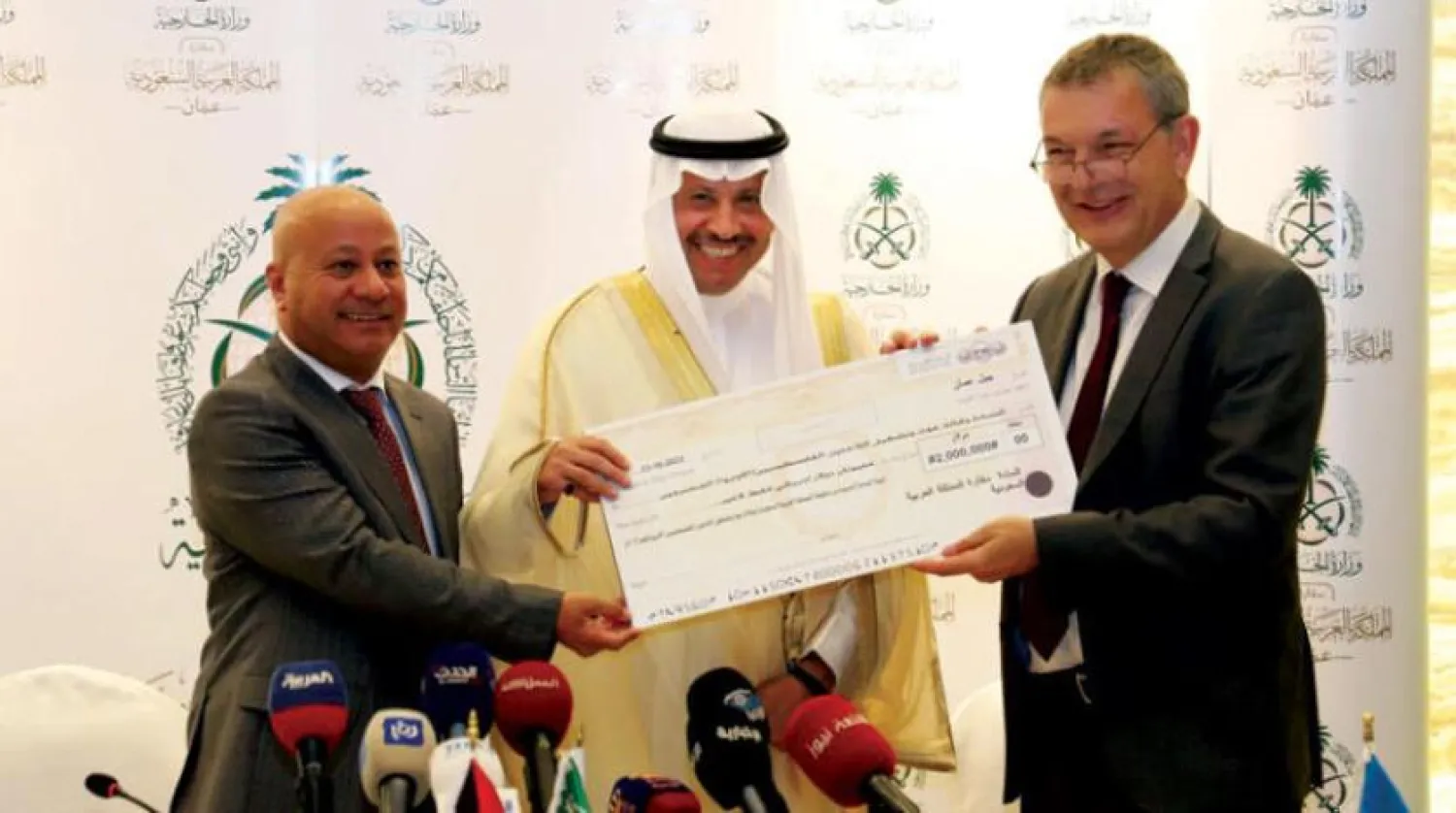
Saudi Ambassador to Jordan Nayef Al-Sudairy handed the Commissioner-General of UNRWA, Philippe Lazzarini, a check in support of UNRWA’s programs and operations in the region. (Asharq Al-Awsat)
TT

Saudi Arabia Supports UNRWA with $27 Million

Saudi Ambassador to Jordan Nayef Al-Sudairy handed the Commissioner-General of UNRWA, Philippe Lazzarini, a check in support of UNRWA’s programs and operations in the region. (Asharq Al-Awsat)

Saudi Arabia has announced a contribution of $27 million to the United Nations Relief and Works Agency for Palestine Refugees in the Near East (UNRWA), during a press conference held in Amman on Sunday.

Saudi Ambassador to Jordan Nayef Al-Sudairy handed the Commissioner-General of UNRWA, Philippe Lazzarini, a check for UNRWA’s budget, in support of the agency’s programs and operations in the region.

In remarks on the occasion, Al-Sudairy said: “The Kingdom of Saudi Arabia has historically been devoted to providing political and socio-economic support to the Palestinian cause. This includes supporting the rights of the Palestinian people in United Nations and humanitarian organizations and the historic cooperation with UNRWA through continuous support for the services it provides.”

The ambassador noted that the total Saudi support for Palestine exceeded $5.2 billion since 1999, including funding for the budgets of the Palestinian National Authority, direct support for a number of sectors related to infrastructure, health, education, food and agricultural security, as well as government, Palestinian civil society, water and environmental reform.

Al-Sudairy stressed that the security and stability of the Middle East region required a just and comprehensive solution to the Palestinian cause, in accordance with international resolutions and the Arab Peace Initiative, as well as the establishment of an independent Palestinian state on the 1967 borders with East Jerusalem as its capital.

He added that Riyadh “condemns all unilateral measures that undermine the two-state solution and calls for their immediate and complete halt.”

Sunday’s press conference, which was organized by the Saudi embassy in Amman, was attended by the head of the refugee affairs department in the Palestine Liberation Organization, Ahmed Abu Houli, the head of the Palestine Committee in the Jordanian Senate, Nayef Al-Kadi, and a number of deputies and politicians.

“Generous commitment”

“We are delighted to receive this generous contribution from the Kingdom of Saudi Arabia” said Philippe Lazzarini, UNRWA Commissioner General.

“This renewed commitment to the work of UNRWA is in line with the Kingdom’s longstanding generosity towards Palestine refugees and in solidarity with them,” he added.

Lazzarini continued: “There are few sources of stability in the lives of Palestine refugees. Access to basic services like education and primary health care are among them. Following decades of partnership with the Kingdom of Saudi Arabia, UNRWA looks forward to further deepening it to promote a dignified life, especially in the face of growing needs and deteriorating conditions in the Palestinian camps across the region.”

Palestinian demands

Abu Houli, for his part, called on the donor countries to follow the Saudi example and fulfill their obligations and pledges, noting that the financial donations would contribute to helping the agency overcome its financial crisis.

He also praised the Saudi support and its “stance and actions at all Arab, regional and international levels to mobilize political and financial support to the United Nations Relief and Works Agency for Palestine Refugees (UNRWA).”

Jordan - in cooperation with UNRWA, Sweden, Japan and Turkey – is expected to organize a conference in support of the international agency on the sidelines of the United Nations General Assembly meetings this month.

Abu Houli called on the international community and the United Nations to assume their responsibilities and move quickly to protect the agency as an international institution, and to save its financial situation “before it is too late.”

Historical Evidence

Saudi support for the Palestinian cause on all political, economic and social levels dates back to the era of King Abdulaziz bin Abdul Rahman, at the London Conference in 1935.

Riyadh was also present at conferences and meetings on the Palestinian issue, including King Fahd’s peace initiative at the Fez Summit in 1982, the Madrid Conference, and the Arab Peace Initiative, which was proposed by then Saudi Crown Prince, King Abdullah bin Abdulaziz and adopted as a unified Arab project at the Beirut Summit in March 2002.

Observers emphasize that the Palestinian issue has always been at the forefront of Saudi Arabia’s priorities. The Kingdom has called on Israel to abide by the relevant international legitimacy resolutions, which stipulate the complete withdrawal from all Arab lands occupied since 1967. It has also repeatedly urged the international community to intervene urgently to stop the Israeli attacks against the Palestinian people.

Riyadh also condemned the Israeli occupation’s construction of a separation wall, and submitted a protest note in this regard to the International Court of Justice in The Hague, in a move that ended with the court’s decision that the apartheid wall was illegal and demanded its removal.

Over the past decades, Riyadh has provided many initiatives and projects, including the King Fahd Peace Project, or the Arab Peace Project, announced during the Arab Summit held in the Moroccan city of Fez in 1982.

The project was approved by the Arab countries, and became the basis for the Madrid peace conference in 1991.

The project included a number of items, starting with Israel’s withdrawal from all the Arab lands occupied in 1967, including Jerusalem, and the removal of Israeli settlements in the occupied lands after the aforementioned year, in addition to affirming the Palestinians’ right to return to their homeland.



Saudi Crown Prince Receives Message on Bilateral Ties from President of Kazakhstan

Prince Mohammed bin Salman bin Abdulaziz Al Saud, Saudi Crown Prince and Prime Minister. (SPA file)
TT

Saudi Crown Prince Receives Message on Bilateral Ties from President of Kazakhstan

Prince Mohammed bin Salman bin Abdulaziz Al Saud, Saudi Crown Prince and Prime Minister. (SPA file)

Prince Mohammed bin Salman bin Abdulaziz Al Saud, Saudi Crown Prince and Prime Minister, received on Tuesday a written message from President of Kazakhstan Kassym-Jomart Tokayev on bilateral relations between their two countries.

The message was received by Minister of Foreign Affairs Prince Faisal bin Farhan bin Abdullah during a meeting with his Kazakh counterpart Yermek Kosherbayev in Riyadh.


Princes and Officials Take Oath Before Custodian of the Two Holy Mosques

Custodian of the Two Holy Mosques King Salman bin Abdulaziz Al Saud and other officials are seen during the ceremony in Riyadh on Tuesday. (SPA)
TT

Princes and Officials Take Oath Before Custodian of the Two Holy Mosques

Custodian of the Two Holy Mosques King Salman bin Abdulaziz Al Saud and other officials are seen during the ceremony in Riyadh on Tuesday. (SPA)

Princes and officials appointed by royal orders to their new positions took the oath of office before Custodian of the Two Holy Mosques King Salman bin Abdulaziz Al Saud in Riyadh on Tuesday.

They included Deputy Governor of Al-Baha Region Prince Fahd bin Saad bin Abdullah bin Abdulaziz bin Turki; Member of the Shura Council Prince Dr. Saad bin Saud bin Mohammed bin Abdulaziz; Deputy Governor of Madinah Region Prince Saud bin Nahar bin Saud; Deputy Governor of Northern Borders Region Prince Mohammed bin Abdullah bin Abdulaziz; and Minister of Investment Fahd Al-Saif.

They swore to be faithful to their religion, then their King and country, not to reveal any of the state’s secrets, to preserve its interests and regulations, and to perform their duties with honesty, trustworthiness, and sincerity.


Saudi Arabia Reiterates Its Categorical Rejection of Israel’s ‘State Land’ Decision in West Bank

Custodian of the Two Holy Mosques King Salman bin Abdulaziz Al Saud chairs the Cabinet meeting in Riyadh. (SPA)
TT

Saudi Arabia Reiterates Its Categorical Rejection of Israel’s ‘State Land’ Decision in West Bank

Custodian of the Two Holy Mosques King Salman bin Abdulaziz Al Saud chairs the Cabinet meeting in Riyadh. (SPA)

The Saudi government condemned on Tuesday Israel’s decision to West Bank lands as "state lands."

Reiterating its absolute rejection of these illegal measures, the Cabinet warned that they undermine peace efforts and violate the Palestinian people's inherent right to establish an independent, sovereign state within the 1967 borders, with East Jerusalem as its capital.

Custodian of the Two Holy Mosques King Salman bin Abdulaziz Al Saud chaired the Cabinet session that was held in Riyadh.

The Cabinet congratulated citizens and Muslims on the advent of the holy month of Ramadan, expressing gratitude for the Kingdom's honor in caring for the two holy mosques and their visitors.

The Cabinet highlighted the success of the Hajj and Umrah seasons, noting that the Kingdom welcomed 19.5 million international pilgrims and Umrah performers in 2025, setting new records that reflect rapid progress toward the goals of Vision 2030 and the Pilgrim Experience Program.

The Cabinet described the Kingdom's Founding Day celebration on February 22 as an expression of pride in the Saudi state's nearly three-century history, underscoring the foundations of justice, unity, and development established by leaders and citizens throughout history to ensure the nation remains a global leader in all fields.

The Cabinet was briefed on recent talks between Saudi Arabia and various nations, which focused on strengthening bilateral and multilateral cooperation and boosting coordination to foster regional and international security, stability, and prosperity.

The session further reviewed the Kingdom's economic, cultural, and social activities, stressing the state's commitment to social solidarity and giving. This includes continued support for the sixth National Campaign for Charitable Work, set to begin on Friday.

The Cabinet commended the success of the third World Defense Show held in Riyadh under the Custodian of the Two Holy Mosques' patronage, during which strategic partnerships, agreements, and memoranda of understanding were signed to localize military technologies and strengthen local supply chains in alignment with Vision 2030 objectives.