

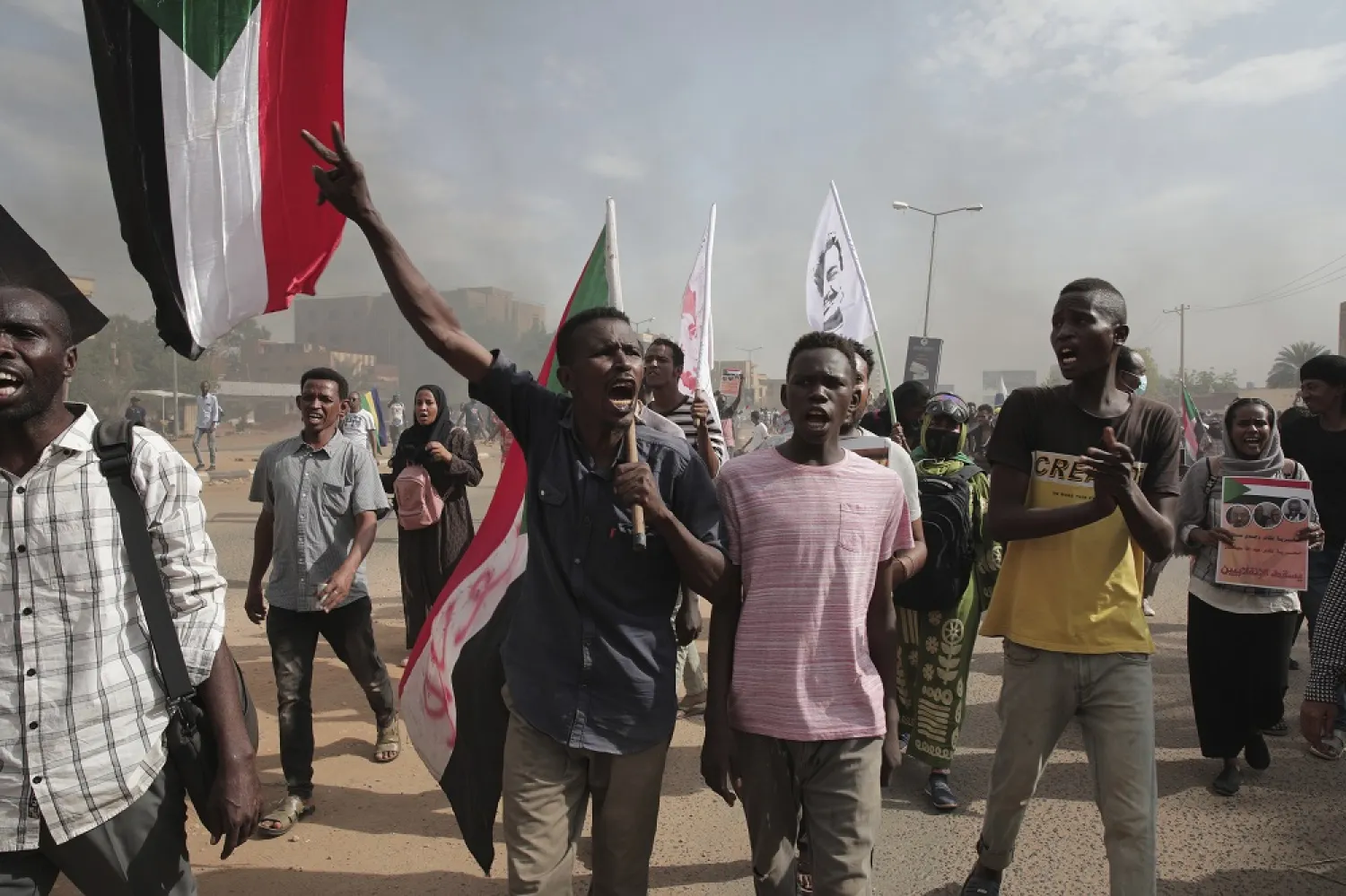

Thousands March in Khartoum on 1st Anniversary of Sudan Coup

Sudanese demonstrators attend a rally to demand the return to civilian rule nearly a year after a military coup led by Gen. Abdel Fattah al-Burhan, in Khartoum, Sudan, Friday, Oct. 21, 2022. (AP)
TT

Thousands March in Khartoum on 1st Anniversary of Sudan Coup

Sudanese demonstrators attend a rally to demand the return to civilian rule nearly a year after a military coup led by Gen. Abdel Fattah al-Burhan, in Khartoum, Sudan, Friday, Oct. 21, 2022. (AP)

Thousands of demonstrators took to the streets of Sudan's capital of Khartoum on Tuesday, marking the first anniversary of a military coup that upended the nation’s short-lived transition to democracy.

Videos published on social media showed marchers with flags and drums, most of them bound for the Presidential Palace. Other footage showed protesters standing in front of convoys of security forces.

Netblocks, an online network tracker, announced early Tuesday that internet services across the country were blocked. Various Sudanese pro-democracy activists and local journalists reported security forces fired tear gas at protesters and earlier closed off bridges leading into Khartoum. The Associated Press has been unable to verify these claims.

Since its takeover, the military has cracked down and suppressed near-weekly pro-democracy marches, with as many as 118 protesters killed, according to statistics published by the Sudan Doctors Committee.

Sudan’s top general, Gen. Abdel-Fattah Burhan, and paramilitary deputy Gen. Mohammed Hamdan Dagalo were meant to oversee a democratic transition after Sudan's longtime ruler Omar al-Bashir was toppled in a popular uprising in 2019.

But last year, Burhan dissolved the ruling Sovereign Council, arrested the transitional prime minister and unseated the civilian faction of a power-sharing government that had been in place. He later said he acted to stop a civil war.

Rights groups say hundreds have been detained since the military takeover, many without charge.

In recent weeks, internationally backed talks between Sudan’s pro-democracy movement and the ruling military have made some progress.

According to The Forces for the Declaration of Freedom and Change — an alliance of political parties and protest groups — the military has agreed on a draft constitutional document written by the country’s Bar Association. This would allow the appointment of a civilian prime minister who would lead the country through elections by 2024.

But Sudan’s more ardent pro-democracy groups, including the grassroots Resistance Committees who spearhead anti-coup street protests, reject any settlement with the military. Along with the Communist Party, they have demanded that those responsible for the year's deadly crackdown on demonstrations be tried in court.

“I have no trust in the army’s intentions, the new negotiation is just a new division of wealth and power,” said Ammar Yahya, the spokesperson for a Khartoum branch of the Resistance Committees.

The coup has plunged Sudan’s already inflation-riddled economy into deeper peril. International aid has dried up while bread and fuel shortages, caused in part by the war in Ukraine, have become increasingly routine.

The year has also seen a resurgence of deadly tribal clashes in the country’s neglected peripheries. Fierce clashes between the Hausa and Berta people last week killed at least 230 people in southern Blue Nile province.

Many analysts consider the rising violence in the south a product of the power vacuum caused by the military takeover, with the ruling generals' clampdown focused on the center of power, Khartoum and the country's heartland, while the peripheries descend into chaos.

Burhan and Dagalo have separately promised to step back from politics following the reinstatement of a civilian government.



Wife of Iraqi Official Accused of Corruption Allegedly Burns Millions of Dollars in Clay Oven

Iraqi Prime Minister Ali al-Zaidi. (AP) 
TT

Wife of Iraqi Official Accused of Corruption Allegedly Burns Millions of Dollars in Clay Oven

Iraqi Prime Minister Ali al-Zaidi. (AP) 

As the Iraqi government intensifies its anti-corruption campaign, the arrests of senior officials across several ministries have been accompanied by allegations that read almost like fiction.

Two senior officials from the Oil and Electricity Ministries have reportedly confessed to embezzling millions of US dollars and billions of Iraqi dinars, as well as participating in what authorities describe as one of the country’s largest money-laundering operations.

The officials and their alleged backers—widely known in Iraq as the “whales of corruption”—are now at the center of a widening investigation.

At the same time, social media platforms and local news outlets have been awash with stories about how illicit wealth was concealed, whether in fortified homes or on private estates.

One of the most widely circulated claims alleges that the wife and sister of former Oil Ministry official Adnan al-Jumaili burned more than $5 million and billions of Iraqi dinars in a traditional clay oven at a family farm in Salahuddin province before security forces arrived to conduct a search.

An Iraqi source told Asharq Al-Awsat that teams from the Integrity Commission, headed by Mohammed Ali al-Lami and operating under directives from Prime Minister Ali al-Zaidi, have not officially confirmed whether large sums of money were actually destroyed or whether additional cash was found at specific homes and orchards.

According to the source, recovered funds have been deposited in the state treasury pending further investigations into whether the confessed crimes were carried out independently or on behalf of a broader network.

“The scale of these funds and the manner in which they were obtained leave no doubt that those responsible, enjoyed protection from powerful figures,” the source said. “They may have been little more than front men.”

Iraq’s judiciary has issued arrest warrants for the wife and sister of detained former Oil Ministry undersecretary Adnan Mohammed Mahmoud al-Jumaili, accusing them of burning billions of dinars and more than $5 million before security forces reached the property.

According to a statement from the Supreme Judicial Council, headed by Faiq Zaidan, investigators seized assets linked to al-Jumaili valued at roughly $10 million, in addition to real estate, gold and weapons. Al-Jumaili served as undersecretary for refining affairs at the Oil Ministry.

The statement said preliminary investigations uncovered nearly 40 properties in Baghdad, Salahuddin and Erbil, along with approximately $10 million in cash and 3 billion Iraqi dinars.

Authorities also confiscated about 1.5 kilograms of gold jewelry and large quantities of light and medium weapons. Investigations remain ongoing to identify all individuals and entities connected to the case.

From “Most Honest Employee” to Corruption Suspect

Days after al-Jumaili’s arrest, authorities detained Alaa Samir al-Jubouri, director general of the Middle Electricity Distribution Company and the recipient of Iraq’s 2023 “Most Honest Employee” award. Interior Ministry reports said he was caught in possession of tens of billions of Iraqi dinars.

Following al-Jumaili’s arrest, Communications Minister Mustafa Sanad accused him on Facebook of acting as a conduit for political-party corruption and the sale of government posts within the Oil Ministry.

Commenting on the broader anti-corruption drive, Ghaleb al-Daami, a media professor at Mustansiriyah University, said the campaign reflects an unprecedented level of coordination among the government, judiciary and Integrity Commission.

“This is the first time since 2003 that state institutions have worked together in this way,” al-Daami told Asharq Al-Awsat. “In the past, conflicts between executive and judicial authorities often undermined accountability. Today, the process appears markedly different.”


Lebanese President Discusses Israel Truce with Senior US, Qatari Officials

Israeli military vehicles maneuver on the Lebanese side of the Israel-Lebanon border, as seen from the Upper Galilee, in northern Israel, 21 June 2026. (EPA)
TT

Lebanese President Discusses Israel Truce with Senior US, Qatari Officials

Israeli military vehicles maneuver on the Lebanese side of the Israel-Lebanon border, as seen from the Upper Galilee, in northern Israel, 21 June 2026. (EPA)

Lebanese President Joseph Aoun spoke with senior US and Qatari officials on Monday about consolidating a ceasefire in Lebanon and forming a "de-confliction cell", his office said, after US-Iran negotiations in Switzerland. 

Fighting between Israel and Hezbollah, which drew Lebanon into the Middle East war on March 2 with rocket fire at Israel in support of its backer Iran, has repeatedly threatened to derail regional peace efforts. 

After a first round of talks in Switzerland on ending the regional conflict, mediators Pakistan and Qatar said on Monday that Tehran and Washington had agreed to set up a "de-confliction cell" with Lebanon "to ensure the adherence of the termination of military operations" there. 

Aoun received "a telephone call from US Vice President JD Vance, senior adviser to the US president Jared Kushner, and the Qatari Prime Minister" Sheikh Mohammed bin Abdulrahman Al Thani, a statement from the Lebanese presidency said. 

They discussed "the issue of consolidating the ceasefire in Lebanon, stopping the Israeli military escalation, and steps that should be taken in this regard, including the possibility of forming a cell for this purpose", the statement added. 

After the talks in Switzerland, Iran's Foreign Minister Abbas Araghchi wrote on X: "1st real test: Lebanon de-confliction cell." 

The talks came after Washington and Tehran last week signed a memorandum of understanding to end the broader Middle East war that includes "an immediate and permanent termination of military operations on all fronts, including in Lebanon". 

Israeli strikes and clashes with Hezbollah late last week threatened to derail the deal, but fighting in Lebanon has been paused since Saturday evening, after Iran said it had closed the strategic Strait of Hormuz again in response to Israel's attacks. 

Prime Minister Benjamin Netanyahu said on Sunday that Israeli forces would remain in southern Lebanon "as long as necessary", while Hezbollah chief Naim Qassem rejected any Israeli "security zone" inside Lebanon. 

Defense Minister Israel Katz said Israeli forces had standing orders to act against any threat they encountered inside Lebanon. 

Israel also said all war-related restrictions in its northern border areas were lifted from Monday morning. 

The developments come ahead of a fifth round of direct talks between Lebanese and Israeli officials in Washington set to begin on Tuesday. 

Lebanese authorities are seeking the withdrawal of Israeli troops from the country and have sought to separate the negotiations from the US-Iran deal, to determine the future of ties between the two nations after decades of hostilities. 


Palestinian Media Says Israel Holding Bodies of Two Teens Killed in West Bank

 A Palestinian woman walks at a market near the Ibrahimi Mosque in the old city of Hebron, in the Israeli-occupied West Bank, June 17, 2026. (Reuters)
A Palestinian woman walks at a market near the Ibrahimi Mosque in the old city of Hebron, in the Israeli-occupied West Bank, June 17, 2026. (Reuters)
TT

Palestinian Media Says Israel Holding Bodies of Two Teens Killed in West Bank

 A Palestinian woman walks at a market near the Ibrahimi Mosque in the old city of Hebron, in the Israeli-occupied West Bank, June 17, 2026. (Reuters)
A Palestinian woman walks at a market near the Ibrahimi Mosque in the old city of Hebron, in the Israeli-occupied West Bank, June 17, 2026. (Reuters)

Israeli authorities are holding the bodies of two Palestinian teenagers shot dead near a West Bank settlement, Palestinian media reported Monday, while the military said the pair were killed after throwing Molotov cocktails.

Official Palestinian news agency Wafa identified the two as Reda Sami Awad, 15, and Arafat Ismail Awad, 19.

"Israeli forces are holding their bodies," Wafa said.

According to Israel's military, soldiers opened fire late Sunday on a group of people burning tires and hurling petrol bombs towards the settlement.

Two were killed and a third was "neutralized", the military said.

It said the incident occurred during a "counter-terrorism operation" in the area.

Israel has occupied the West Bank since 1967. More than 500,000 Israeli settlers live in the territory, excluding east Jerusalem, among some three million Palestinians.

The United Nations recently warned that settler violence against Palestinians has reached record levels, with an average of six attacks daily causing casualties or damage.

Violence has escalated in the West Bank since the start of the Gaza war, which was triggered by an unprecedented attack on Israel by the Palestinian movement Hamas on October 7, 2023.

Israeli soldiers or settlers have killed at least 1,082 Palestinians since then, including both gunmen and civilians, according to an AFP tally based on Palestinian health ministry data.

Official Israeli figures show at least 46 Israelis, both civilians and soldiers, have been killed in Palestinian attacks or during Israeli military operations in the same period.