New PM Rishi Sunak Pledges to Lead Britain Out of Economic Crisis

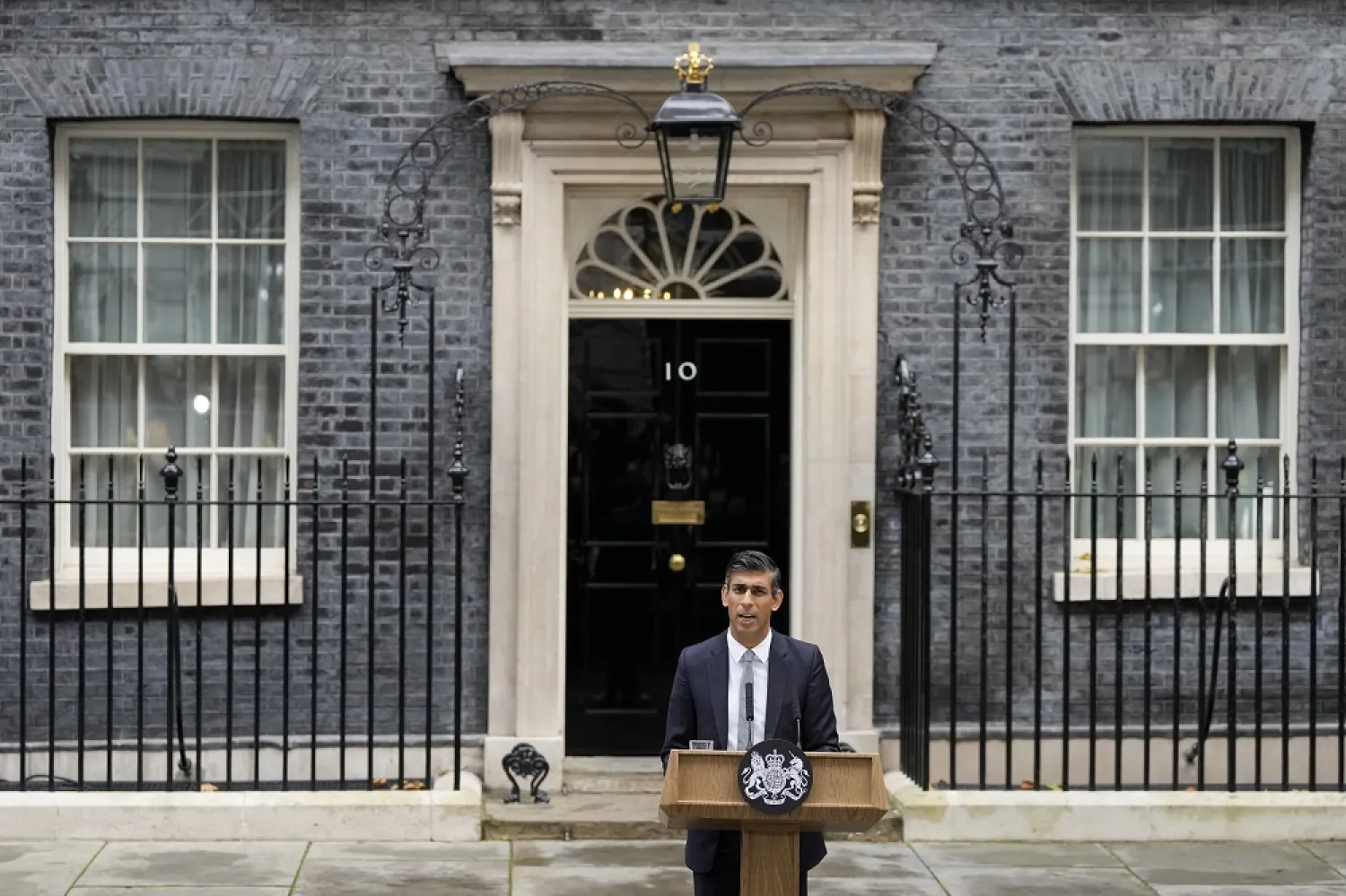
British Prime Minister Rishi Sunak delivers a speech at Downing Street in London, Tuesday, Oct. 25, 2022. (AP)
TT

New PM Rishi Sunak Pledges to Lead Britain Out of Economic Crisis

British Prime Minister Rishi Sunak delivers a speech at Downing Street in London, Tuesday, Oct. 25, 2022. (AP)

Rishi Sunak became Britain's third prime minister in two months on Tuesday and pledged to lead the country out of a profound economic crisis and rebuild trust in politics.

Sunak quickly reappointed Jeremy Hunt as his finance minister in a move designed to calm markets that had balked at his predecessor's debt-fueled economic plans.

The former hedge fund boss said he would unite the country and was expected to name a cabinet drawn from all wings of the party to end infighting and abrupt policy changes that have horrified investors and alarmed international allies.

Speaking outside his official Downing Street residence, Sunak praised the ambition of his predecessor Liz Truss to reignite economic growth but acknowledged mistakes had been made.

"I have been elected as leader of my party and your prime minister, in part to fix them," said Sunak, who broke with the tradition of standing beside his family and cheering political supporters.

"I understand, too, that I have work to do to restore trust, after all that has happened. All I can say is that I am not daunted. I know the high office I have accepted and I hope to live up to its demands."

Sunak said difficult decisions lay ahead as he looks to cut public spending. Hunt, who Truss appointed to calm markets roiled by her dash for growth, has been preparing a new budget alongside borrowing and growth forecasts due out on Monday.

The new prime minister also restored Dominic Raab to the post of deputy prime minister, a role he lost in Truss's 44 days in office.

With his new appointments, Sunak was seen to be drawing ministers from across the Conservative Party while leaving others in post - a move that should ease concerns that Sunak might appoint loyalists rather than try to unify the party.

Tough decisions

Sunak, one of the richest men in parliament, is expected to slash spending to plug an estimated 40-billion-pound ($45 billion) hole in the public finances created by an economic slowdown, higher borrowing costs and an energy support scheme.

He will now need to review all spending, including on politically sensitive areas such as health, education, defense, welfare and pensions. But with his party's popularity in freefall, he will face growing calls for an election if he ditches too many of the promises that the Conservatives win election in 2019.

Economists and investors have welcomed Sunak's appointment - Ryanair boss Michael O'Leary said the adults had taken charge again - but they warn he has few options to fix the country's finances when millions are battling a cost-of-living crunch.

Sunak, who ran the Treasury during the COVID-19 pandemic, promised to put economic stability and confidence at the heart of the agenda. "This will mean difficult decisions to come," he said, shortly after he accepted King Charles's request to form a government.

Sunak also vowed to put the public's need above politics, in recognition of the growing anger at Britain's political class and the ideological battles that have raged ever since the historic 2016 vote to leave the European Union.

Workers heading towards London's financial district said Sunak, at 42 Britain's youngest prime minister for more than 200 years and its first leader of color, appeared to be the best of a bad bunch.

"I think he was competent, and that's really what we should hope for at the moment," said management consultant, James Eastbook, 43.

With two prime ministers appointed in two months without a popular vote, some called for a general election now but others hoped Sunak would stay until the next scheduled election, due by January 2025.

Political machinations

Sunak, a Goldman Sachs analyst who only entered parliament in 2015, faces a challenge ending the factional infighting that has brought his party low. Many Conservatives remain angry with him for quitting as finance minister in July and triggering a wider rebellion that ended Boris Johnson's premiership.

Others question how a multi-millionaire can lead the country when millions of people are struggling with surging food and energy bills.

"I think this decision sinks us as a party for the next election," one Conservative lawmaker told Reuters.

Historian and political biographer Anthony Seldon said Sunak would also be constrained by the mistakes of his immediate predecessor.

"There is no leeway on him being anything other than extraordinarily conservative and cautious," he told Reuters.

Many politicians and officials abroad, having watched as a country once seen as a pillar of economic and political stability descended into brutal infighting, welcomed Sunak's appointment.

Sunak, a Hindu, also becomes Britain's first prime minister of Indian origin.

US President Joe Biden described it as a "groundbreaking milestone", while leaders from India and elsewhere welcomed the news. Sunak's billionaire father-in-law, N.R. Narayana Murthy, said he would serve the United Kingdom well.

"We are proud of him and we wish him success," the founder of software giant Infosys said in a statement.


US Airports Slowly Return to Normal After Three Days of Disruption

Passengers wait at Ronald Reagan Washington National Airport (DCA), in Arlington, Virginia, just outside Washington, DC, on November 14, 2026. (AFP)
TT

US Airports Slowly Return to Normal After Three Days of Disruption

Passengers wait at Ronald Reagan Washington National Airport (DCA), in Arlington, Virginia, just outside Washington, DC, on November 14, 2026. (AFP)

US air travel was slowly returning to normal on Monday after three days of widespread disruption following an extraordinary no-takeoff order issued by US aviation authorities.

The ground stop issued Friday afternoon was only the second time such a directive had been issued nationwide in the busy US airspace since planes were grounded following the 9/11 attacks, and was blamed by the Trump administration on a faulty upgrade to communications equipment.

On Monday morning, more than 250 US-related flights -- those traveling within, into or out of the United States -- scheduled for the same day were cancelled, according to industry tracker FlightAware.

That marked a dramatic shift from the more than 2,300 flights cancelled on Sunday.

There were delays to more than 700 US-related flights scheduled for Monday, compared to more than 10,000 the previous day.

The Trump administration sought to reassure weary flyers as questions remained over how such chaos could unfold in the world's largest economy, a country that prides itself on its technological prowess.

Throughout the weekend, stranded passengers wandered through chaotic airports and sat on floors, waiting for updates or to be rebooked.

Officials blamed Friday's colossal snafu on faulty work to upgrade air traffic control communication cables.

President Donald Trump on Sunday ended uncharacteristic days of silence on the ground stop, but only to blame his predecessor Joe Biden for the debacle.

Trump insisted he inherited a mess from the Biden administration and said Congress, which his party has controlled for two years, must approve funds to upgrade America's outdated air traffic control system.

"The Biden Administration was an FAA disaster," Trump said, referring to the Federal Aviation Administration.

"Everything they touched turned bad. Big money spent unwisely, making an old and broken system worse than when they began," Trump said.

FAA chief Bryan Bedford said Saturday that air travel for millions of Americans stranded at airports would return to normal by the close of business on Sunday.

But Transportation Secretary Sean Duffy said Sunday morning it will actually take longer to get planes, crews and travelers to where they need to be.

"We're going to see things come back to normal today, but probably fully normal tomorrow," Duffy said on ABC News.

"We had airplanes and crews out of position because of Friday, so it takes a little bit of time to do that."

- 'I'm the secretary' -

Duffy also rejected calls for his resignation over the travel chaos, insisting he inherited woefully outdated air traffic control infrastructure such as radar equipment that dates back to the 1960s.

"So when we do work and things go wrong, of course I'm the secretary. But I also have to acknowledge what was delivered to me," Duffy said in an interview on CNN.

The ground stop not only plunged US air travel into chaos, but it also raised serious concerns about the country's aging infrastructure.

Duffy has appealed for $50 billion in funds to upgrade and modernize the air traffic control system, and called for Congress, which controls the purse strings of the US government, to "meet this moment."

But Democrats quickly pounced to say Congress under Trump's Republicans could already have done this.


Republican 2028 Field Takes Shape After Midterm Drubbing

 US Vice President JD Vance delivers remarks during a Veterans Day ceremony at Arlington National Cemetery in Arlington, Virginia, on November 11, 2026. (AFP)
US Vice President JD Vance delivers remarks during a Veterans Day ceremony at Arlington National Cemetery in Arlington, Virginia, on November 11, 2026. (AFP)
TT

Republican 2028 Field Takes Shape After Midterm Drubbing

 US Vice President JD Vance delivers remarks during a Veterans Day ceremony at Arlington National Cemetery in Arlington, Virginia, on November 11, 2026. (AFP)
US Vice President JD Vance delivers remarks during a Veterans Day ceremony at Arlington National Cemetery in Arlington, Virginia, on November 11, 2026. (AFP)

The Republican Party's midterm drubbing has opened the door to a crowded battle to succeed President Donald Trump, with a wide field of potential 2028 contenders gearing up for presidential bids, according to interviews with more than a dozen people involved in prospective campaigns.

Allies and operatives around Vice President JD Vance, US Senator Ted Cruz of Texas, Florida Governor Ron DeSantis and former Virginia Governor Glenn Youngkin have begun making early preparations or assessing potential campaigns, the people said.

They are "at least trying to get their ducks in order to run," said one Republican operative familiar with the activity.

More Republicans are expected to join them, according to Republican donors, strategists and influential conservative leaders, some of whom spoke on the condition of anonymity to describe private conversations.

Some potential candidates are also considering sitting out 2028 and waiting until 2032, calculating that Trump's unpopularity and the party's midterm losses could make the next presidential election an especially difficult one for the Republican nominee.

After those losses, many Republicans no longer view Vance as Trump's inevitable successor. While potential rivals explore bids, donors are holding back their money and some Republicans are taking a fresh look at governors who can claim distance from Washington and the Trump administration.

"What happened (in the midterms) was a major reset and changed everything as it relates to presidential politics," said Bob Vander Plaats, an Iowa evangelical leader and chief executive of The Family Leader, a conservative Christian advocacy organization.

Had Republicans fared better, "JD Vance would have been a lock in terms of the heir apparent," Vander Plaats said. Now, "he’ll probably have competition and a lot of competition."

VANCE STILL THE MAN TO BEAT

Vance appears likely to ‌run, according to four ‌people familiar with his thinking, but has not yet formally decided as he weighs the souring political environment for Republicans and the effect of a ‌campaign on ⁠his young family.

A ⁠Vance ally, speaking on the condition of anonymity, said Vance and his political operation expected Republican figures opposed to the vice president's brand of conservatism would emerge after the midterms to promote rival presidential candidates.

The person said Vance favored a competitive primary instead of an early Trump endorsement because it would prove his mettle for a general election.

Vance would enter the race with formidable advantages as the sitting vice president with a national profile. One Republican operative who worked on a competitive House race described the nomination as Vance's to lose.

"I think if he wants the nomination, he probably wins it in an ugly fashion," the operative said, predicting a potentially nasty contest.

But running from the vice presidency could complicate his path. After largely avoiding public disagreement with Trump, Vance blamed the Iran war for Republicans’ midterm defeat. A week later, Trump directed him to focus on domestic issues instead of efforts to secure a peace deal with Iran.

The fallout from the conflict will likely prove a challenge for the broader Republican field, as candidates navigate how much to distance themselves from a war that Trump continues to defend.

The Vance ally said the vice president considered the midterm ⁠result a rejection of the Iran war rather than voters' verdict on the Trump presidency. When the war ends, the person said, Vance and populist ‌Republicans will be able to rebuild Trump's coalition of voters.

CRUZ, OTHER RIVALS SEE AN OPENING

Cruz has spoken openly with associates about another White House ‌run, after his failed attempt for the nomination in 2016, and has begun early preparations, according to two people familiar with the activity. Representatives for Cruz did not respond to a request for comment.

Over a steak dinner with conservative ‌economist Stephen Moore before the midterms, Cruz said he planned to launch a bid, Moore told Reuters. On Texas Lieutenant Governor Dan Patrick's podcast in August, Cruz was similarly direct: “It's no secret that I want ‌to be president."

Cruz has spent months positioning himself as a conservative who would return Republicans to a market-first domestic policy and a more traditional approach to international relations, emphasizing that any military action must be in US national interests and not aimed at nation-building.

"He says he's the mantle to the Reagan Republican wing of the party," Moore said.

One Republican donor said calls from potential candidates to major funders are likely to pick up soon, followed by donor retreats and trips to primary states early next year.

Hovering over the emerging field is Trump. He has said the Republican Party has a deep bench but suggested after the midterms that he may not endorse anyone in the primary.

Several strategists said Trump's backing could ‌reshape the Republican nominating race.

"Unless the president swoops in with an endorsement early, there’s plenty of time," said Kellyanne Conway, Trump's 2016 campaign manager and first-term senior counselor. "His endorsement is still the biggest get in all of politics."

DISTANCE FROM TRUMP MAY BENEFIT GOVERNORS

Some Republicans see a lane for conservative ⁠governors who could tout their executive experience and distance ⁠themselves from Washington and Trump's sagging popularity.

DeSantis is keeping his options open for 2028 and considering waiting until 2032, believing Trump’s low approval rating could make it difficult for any Republican to win in the upcoming election cycle, according to a party operative familiar with his thinking. Florida was one of the few Republican strongholds to withstand the Democratic wave in the midterms.

Youngkin is also considering a run, according to Moore and another person familiar with his thinking. He has remained active in national Republican politics since winning the Virginia governorship in 2021 despite the state's leftward turn in recent decades. In August, he began a nationwide education advocacy group widely seen in party circles as a possible launching pad for a presidential bid.

Youngkin, whose term ended in January, supports Trump but is not seen as close to him, which could potentially help him if the party is looking for a reset.

"I know Glenn Youngkin very well and if he can find an avenue, he’s likely to get in the race," Moore said.

Another potential contender is Secretary of State Marco Rubio, who three Republican donors said they hoped would enter the race.

But several people familiar with Rubio's thinking said a 2028 bid appears unlikely for now, with some close to him expecting him to spend time in the private sector. A former aide pointed instead to a possible 2032 run.

The latest Reuters/Ipsos poll showed some 45% of Republican voters said they believed Rubio would be an "excellent" presidential candidate, with 43% saying the same of Vance.

Representatives for DeSantis, Youngkin and Rubio did not respond to requests for comment.

The early jockeying comes as some Republicans have grown pessimistic about their party's 2028 prospects.

Robert Bigelow, a major conservative donor who gave around $14 million to the main pro-Trump super PAC in the 2024 election, blamed Trump for the midterm defeats and said he expected Democrats to win the White House in 2028.

Still, Bigelow said he likes both Vance and Rubio and had suggested them as a potential ticket when Trump asked him in February who should succeed him.

Despite thinking the Democrats’ election "tsunami” could last a decade, Bigelow said Vance should run.

“You can run again," he said. "But not to run at all is a mistake.”


France Expects EU Sanctions on Iran in December Over Fridge Hack

 France's Foreign Affairs Minister Jean-Noel Barrot speaks to the press at the end of the second day of the G7 foreign ministers summit at the Quai d'Orsay in Paris, Tuesday, Nov. 10, 2026. (AP)
France's Foreign Affairs Minister Jean-Noel Barrot speaks to the press at the end of the second day of the G7 foreign ministers summit at the Quai d'Orsay in Paris, Tuesday, Nov. 10, 2026. (AP)
TT

France Expects EU Sanctions on Iran in December Over Fridge Hack

 France's Foreign Affairs Minister Jean-Noel Barrot speaks to the press at the end of the second day of the G7 foreign ministers summit at the Quai d'Orsay in Paris, Tuesday, Nov. 10, 2026. (AP)
France's Foreign Affairs Minister Jean-Noel Barrot speaks to the press at the end of the second day of the G7 foreign ministers summit at the Quai d'Orsay in Paris, Tuesday, Nov. 10, 2026. (AP)

France expects the EU to approve new sanctions against Iran in December over a major cyberattack on supermarket fridges that Paris blames on Tehran, Foreign Minister Jean-Noel Barrot said Monday.

Arriving at a meeting of European Union foreign ministers in Brussels, Barrot said he was "confident" that measures targeting those responsible for the hack would be agreed at the next such gathering on December 14.

"I have come to Brussels today to present evidence concerning those primarily responsible for this extremely serious cyberattack, and to request that European sanctions be imposed against them within one month," Barrot told reporters.

"I am pleased to have secured the support of a vast majority of European Union member states".

Hundreds of French supermarkets were hit in the October 11 and 12 cyberattacks, which raised the temperatures in their refrigerators and freezers, forcing many to throw away entire inventories of perishable food.

Last week Paris pointed the finger at Iran's Revolutionary Guard Corps (IRGC), accusing it of being responsible for what was the first such large-scale cyber sabotage on French territory.

Tehran has dismissed the accusation as "baseless".

Similar incidents were reported in at least 11 other European countries in early November.