


Russia Suspends Participation in Ukraine Grain Exports Deal

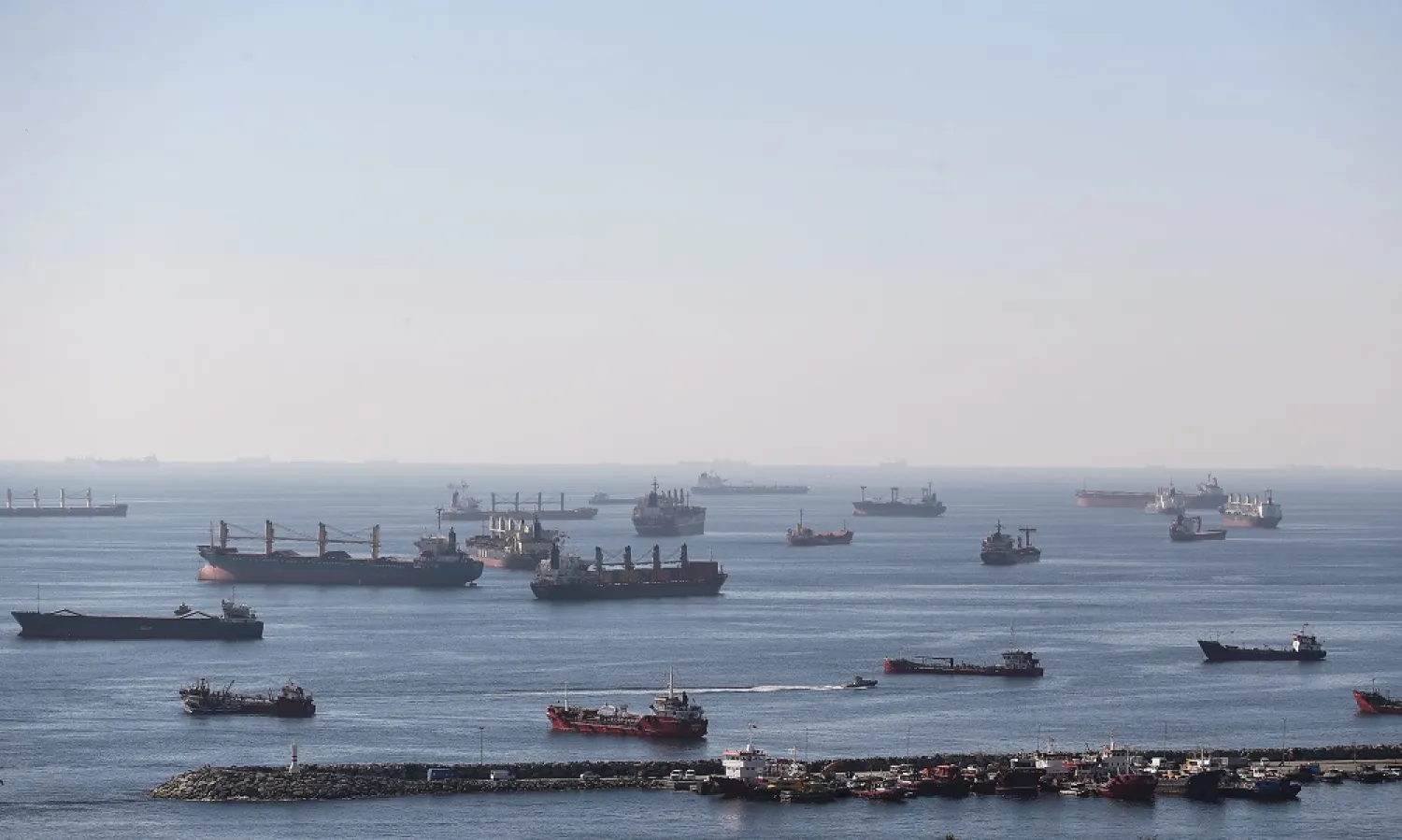
Cargo ships carrying Ukraine grain are anchored as they wait in line for the inspection on the Marmara sea, Istanbul, Türkiye, 22 October 2022. (EPA)
TT

Russia Suspends Participation in Ukraine Grain Exports Deal

Cargo ships carrying Ukraine grain are anchored as they wait in line for the inspection on the Marmara sea, Istanbul, Türkiye, 22 October 2022. (EPA)

Russia has suspended participation in a UN-brokered deal to export agricultural produce from Ukrainian ports after attacks on ships in Crimea, Russia's defense ministry said on Saturday, dealing a blow to a three-month agreement aimed at easing a global squeeze on grain supplies.

Russia said that Ukrainian forces, with the help of drones, attacked ships from the Black Sea Fleet in Sevastopol, the biggest city in Russian-annexed Crimea, in the early hours of Saturday.

"Taking into account... the terrorist act by the Kyiv regime with the participation of British experts against the ships of the Black Sea Fleet and civilian vessels involved in ensuring the security of the 'grain corridor', the Russian side suspends participation in the implementation of agreements on the export of agricultural products from Ukrainian ports," the ministry said in a statement.

The ministry said earlier that the drone attacks on Saturday were largely repelled, with minor damage to a Russian minesweeper.

The Ukrainian president's chief of staff, Andriy Yermak, accused Russia of "blackmail" and "invented terror attacks" on its own territory on Saturday following explosions in the Crimea peninsula on Saturday.

His comments were an apparent response to Russian accusations that Ukraine was behind the blasts.

Separately, Russian Agriculture Minister Dmitry Patrushev said earlier on Saturday that Russia was ready to supply up to 500,000 tons of grain to poor countries in the next four months for free, with assistance from Türkiye, and supplant supplies of Ukrainian grains.

"Taking into account this year's harvest, the Russian Federation is fully prepared to replace Ukrainian grain and deliver supplies at affordable prices to all interested countries," he said.

Since Russia and Ukraine signed the UN-backed Black Sea Grain Initiative in Türkiye on July 22, several million tons of corn, wheat, sunflower products, barley, rapeseed and soya have been exported from Ukraine.

United Nations aid chief Martin Griffiths had said only on Wednesday that he was "relatively optimistic" that the deal would be extended beyond mid-November.

Under the agreement, Ukraine was able to restart its Black Sea grain and fertilizer exports, which had stalled when Russia invaded its neighbor on Feb. 24. The Ukraine export deal was initially agreed for 120 days.

In a separate statement, the Russian foreign ministry said that following the attacks on Russian ships "the Russian side cannot guarantee the safety of civilian dry cargo ships participating in the "Black Sea Initiative", and suspends its implementation from today for an indefinite period.

"Relevant instructions were given to Russian representatives at the Joint Coordination Center in Istanbul, which controls the transportation of Ukrainian food," it added, referring to Türkiye’s role in implementing the deal.

Late on Friday a spokesman for UN Secretary-General Antonio Guterres had appealed to the parties to renew the pact.

"We underline the urgency of doing so to contribute to food security across the world, and to cushion the suffering that this global cost-of-living crisis is inflicting on billions of people," UN spokesperson Stephane Dujarric said.

Dujarric said that "governments, shipping companies, grain and fertilizer traders and farmers all over the world" were looking for clarity on the future of the deal.



Türkiye May Consider Role in Hormuz Demining After Iran-US Deal, Minister Says

Türkiye’s Foreign Minister Hakan Fidan speaks to the reporters at Antalya Diplomacy Forum in Antalya, Türkiye, April 19, 2026. (Reuters)
TT

Türkiye May Consider Role in Hormuz Demining After Iran-US Deal, Minister Says

Türkiye’s Foreign Minister Hakan Fidan speaks to the reporters at Antalya Diplomacy Forum in Antalya, Türkiye, April 19, 2026. (Reuters)

Turkish Foreign Minister Hakan Fidan said that Türkiye could consider taking part in demining operations in the Strait of Hormuz following a possible peace agreement between Iran and the United States.

Fidan, speaking to reporters in London on Friday ‌evening, said a ‌technical team was ‌expected ⁠to carry out ⁠mine-clearing work in the strait after any agreement, adding that Türkiye viewed such efforts positively in principle as a humanitarian duty.

Fidan said ‌any demining work would be ‌carried out by a technical team ‌from various countries, formed after a possible Iran-US peace agreement

Türkiye would have "no problem" with ‌participating in mine-clearing operations under those conditions

Fidan cautioned ⁠that ⁠ Türkiye would reassess its position if any future technical coalition of countries became a party to renewed conflict

He also said he believed issues related to Iran's nuclear program could be resolved at the next round of talks in Pakistan


Iran Resumes Commercial Flights from Tehran’s International Airport

A passenger walks through the terminal hall after flights resumed at Imam Khomeini International Airport, amid a ceasefire between US and Iran, in Tehran, Iran, April 25, 2026. Majid Asgaripour/WANA (West Asia News Agency) via Reuters
TT

Iran Resumes Commercial Flights from Tehran’s International Airport

A passenger walks through the terminal hall after flights resumed at Imam Khomeini International Airport, amid a ceasefire between US and Iran, in Tehran, Iran, April 25, 2026. Majid Asgaripour/WANA (West Asia News Agency) via Reuters

US envoys are expected to travel to Pakistan on Saturday in a new bid to salvage ceasefire talks with Tehran, even as Iran ruled out direct negotiations with US representatives as its top diplomat arrived in Islamabad.

The latest effort to broker a deal comes as an indefinite ceasefire has paused most fighting, but the economic fallout is still mounting with global energy shipments disrupted by the closure of the Strait of Hormuz.

On Saturday, Iran resumed commercial flights from Tehran’s international airport for the first time since the conflict with the US and Israel began about two months ago.

Iran’s state-run television reported that flights took off from the Imam Khomeini International Airport in Tehran bound for Istanbul, Oman’s capital of Muscat and the Saudi city of Madinah.

Iran partly reopened its airspace earlier this month amid a ceasefire with the US which halted fighting between the two countries.

The airport opening comes as Iran’s Foreign Minister Abbas Araghchi met twice with Pakistan's top military and political leaders since arriving in Islamabad on Friday night, officials said.

According to Pakistan's Foreign Ministry, the Iranian delegation will hold talks with Pakistan’s senior leadership as the US envoys were expected to travel to Islamabad Saturday. Officials have not specified when Steve Witkoff and Jared Kushner are due to arrive.


US Imposes Sanctions on Chinese ‘Teapot’ Refinery for Buying Iranian Oil

A view of an oil refinery in China's Shandong province. (Reuters)
TT

US Imposes Sanctions on Chinese ‘Teapot’ Refinery for Buying Iranian Oil

A view of an oil refinery in China's Shandong province. (Reuters)

The Trump administration said on Friday it had imposed sanctions on an independent "teapot" refinery in China for buying billions of dollars' worth of Iranian oil, as Washington and Tehran head into another round of peace talks over the weekend.

The Treasury Department targeted Hengli Petrochemical (Dalian) Refinery, which it said is one of Iran's largest customers of crude oil and petroleum products. The department's Office of Foreign Assets Control said it also imposed sanctions on about 40 shipping companies and vessels that operate ‌as part of Iran's ‌shadow fleet.

China has said it opposes "illegal" unilateral sanctions.

On Friday, ‌its ⁠embassy in Washington ⁠said normal trade should not be harmed and called on Washington to stop "abusing" sanctions to target Chinese companies.

"We call on the US to stop politicizing trade and sci-tech issues and using them as a weapon and a tool and stop abusing various kinds of sanction to hit Chinese companies," a spokesperson for the Chinese embassy said in a statement.

The Trump administration last year imposed sanctions on teapots Hebei Xinhai Chemical Group, Shandong Shouguang Luqing Petrochemical and Shandong ⁠Shengxing Chemical.

That created some hurdles for the refiners, including difficulties receiving ‌crude and having to sell refined products under different ‌names. Teapots account for a quarter of Chinese refinery capacity, operate with narrow and sometimes ‌negative margins and have been squeezed recently by tepid domestic demand.

CHINA BUYS MOST SHIPPED IRANIAN ‌OIL

The US sanctions, which block US assets of those designated and prevent Americans from doing business with them, have deterred some larger independent refiners from buying Iranian oil. China buys more than 80% of Iran's shipped oil, 2025 data from analytics firm Kpler showed.

Sanctions experts have long said, however, ‌that the independent refineries are somewhat immune to the full effect of US sanctions as they have little exposure to the ⁠US financial system. Imposing ⁠sanctions on Chinese banks that help facilitate the purchases would have a larger effect on purchases of Iranian oil, they say.

Treasury Secretary Scott Bessent said the US is imposing a "financial stranglehold" on the Iranian government.

"Treasury will continue to constrict the network of vessels, intermediaries, and buyers Iran relies on to move its oil to global markets," Bessent said.

Bessent told reporters at the White House on April 15 that Treasury has written to two Chinese banks and "told them that if we can prove that there is Iranian money flowing through your accounts, then we are willing to put on secondary sanctions."

The teapot refiners recently have had to buy Iranian oil at premiums to international Brent oil prices after Washington's temporary waiver of sanctions on Iranian oil at sea raised expectations that India might buy more of the oil. The US last week allowed the waiver to expire.