


China iPhone Factory under Lockdown Boosts Bonuses for Workers Who Stay

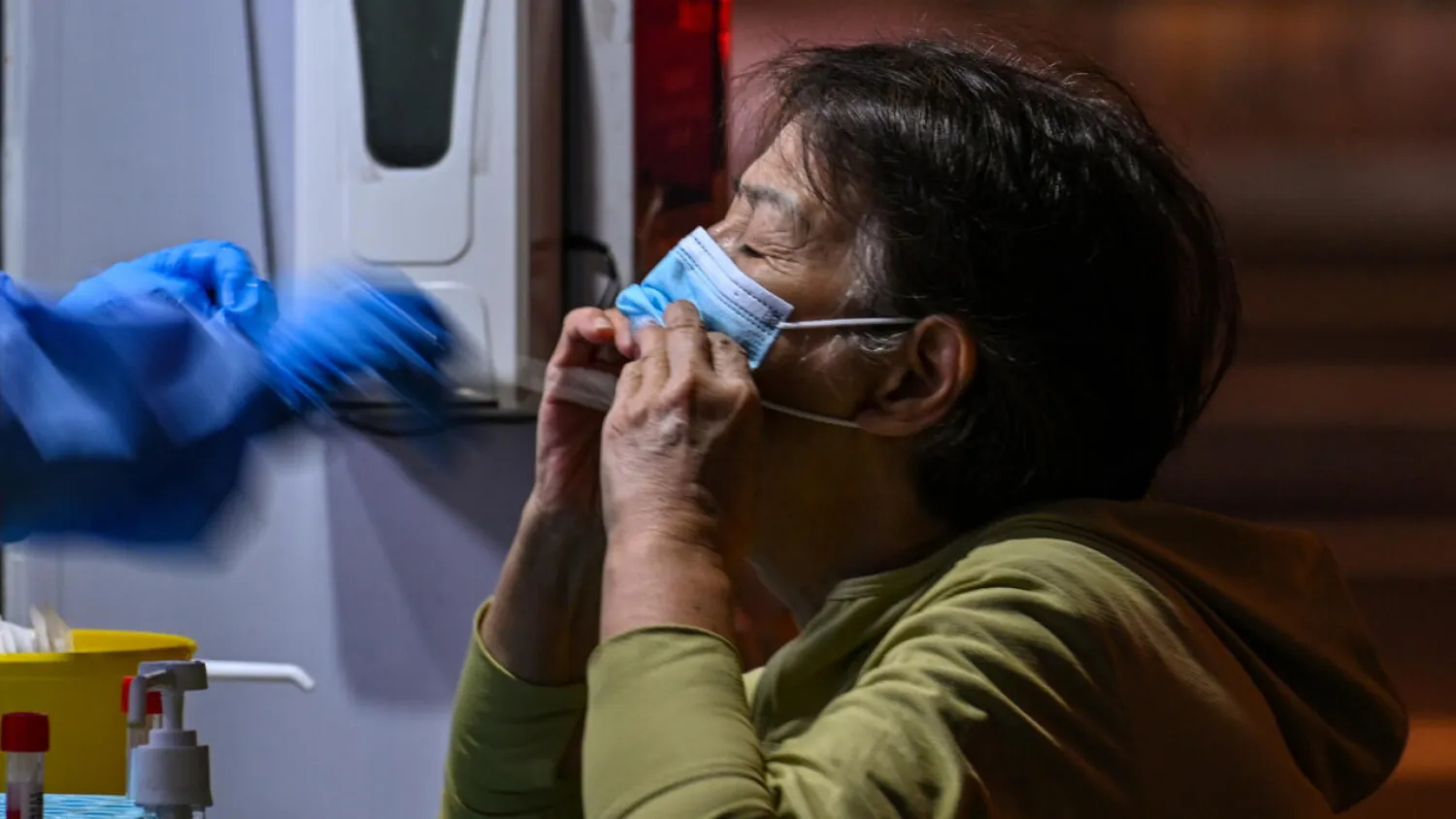
China is the last major economy committed to a zero-Covid strategy, persisting with snap lockdowns, mass testing and quarantine in a bid to curb outbreaks Hector RETAMAL AFP/File
TT

China iPhone Factory under Lockdown Boosts Bonuses for Workers Who Stay

China is the last major economy committed to a zero-Covid strategy, persisting with snap lockdowns, mass testing and quarantine in a bid to curb outbreaks Hector RETAMAL AFP/File

The world's largest iPhone factory in central China told staff Tuesday it would quadruple their bonuses if they remained at the plant after scores of workers fled a Covid outbreak at the facility.

China is the last major economy committed to a zero-Covid strategy, persisting with snap lockdowns, mass testing and lengthy quarantines in a bid to stamp out emerging outbreaks, AFP said.

But new variants have tested local officials' ability to snuff out flare-ups faster than they can spread, causing much of the country to live under an ever-changing mosaic of Covid curbs.

Taiwanese tech giant Foxconn's plant in Zhengzhou has been under lockdown since mid-October, with the company saying it is testing employees daily and keeping them in a closed loop.

But complaints from workers circulating on Chinese social media have alleged poor working conditions and inadequate virus protection for employees who are not infected.

Videos shared online over the weekend showed Foxconn employees fleeing the company's campus and returning to their hometowns on foot, in a bid to avoid Covid travel restrictions.

Foxconn's Zhengzhou plant said on its official WeChat account that, starting from Tuesday, employees will receive a daily bonus of 400 yuan ($55) for showing up to work -- quadruple the previous subsidy of 100 yuan a day.

Staff will also receive additional bonuses if they attend work for 15 days or longer in November, reaching 15,000 yuan if they record full attendance this month.

Foxconn -- which supplies iPhones to US tech firm Apple -- has promised to do more to help employees and organize buses to transport workers back to their hometowns should they wish to leave, in what it has called a "protracted battle" against the virus.

Local governments in the area surrounding the city asked fleeing workers to register with authorities if they returned home and to complete several days of quarantine upon arrival.

The southern semi-autonomous territory of Macau also announced mass testing of its 700,000 population Tuesday after a handful of cases were discovered, triggering a lockdown of one of its casinos.

It is a fresh blow for the city's struggling gambling industry, which had been poised for recovery after plans to relax travel between mainland China and the former Portuguese colony this month.

China reported more than 2,000 fresh domestic infections Tuesday for the second straight day, as curbs ramped up in response to a wave of regional outbreaks.

The southern Chinese manufacturing hub of Guangzhou also announced partial lockdowns in several districts Monday in response to rising case numbers.

Guangzhou reported more than 520 fresh infections on Tuesday.

New outbreaks have also emerged in northern cities near China's border with Russia and North Korea as winter approaches.




Musk Launches 'Terafab' Project to Make Own AI Chips

(FILES) CEO of SpaceX and Tesla, South African-Canadian-US businessman Elon Musk speaks during the World Economic Forum (WEF) annual meeting in Davos on January 22, 2026. (Photo by Fabrice COFFRINI / AFP)
TT

Musk Launches 'Terafab' Project to Make Own AI Chips

(FILES) CEO of SpaceX and Tesla, South African-Canadian-US businessman Elon Musk speaks during the World Economic Forum (WEF) annual meeting in Davos on January 22, 2026. (Photo by Fabrice COFFRINI / AFP)

Elon Musk announced Saturday a plan to make chips for artificial intelligence, robotics and data centers in space, in the latest bold project by the world's richest person.

The "Terafab", a manufacturing facility based near Austin, Texas, will aim to produce one terawatt of computing power per year, Musk said.

A terawatt is equivalent to one trillion watts. That is slightly less than the total power generation capacity of the United States, according to an industry group.

Musk said the project would be run jointly by his electric-vehicle firm Tesla and his rocket company SpaceX.

He did not disclose the initial investment. Previous US media reports have put the figure between $20 billion and $25 billion, AFP said.

Musk, who has no prior experience in semiconductors, said the Terafab was necessary because Tesla and SpaceX's demand for computing power was expected to far exceed that of global chip suppliers.

"We're very grateful to our existing supply chain, to Samsung, TSMC, Micron, and others... but there's a maximum rate at which they're comfortable expanding," Musk said.

"That rate is much less than we would like... and we need the chips, so we're going to build the Terafab."

An "advanced technology fab" in Austin will have the facilities to design, manufacture, test and improve each chip, Musk said.

Eventually, the project aims to make chips to support 100 to 200 gigawatts of computing power on Earth, and a terawatt in space.

Musk did not give a timeline for the Terafab's output, and has previously promised grand results from other projects on compressed time scales.

He said the Terafab would ultimately help humanity become a "galactic civilization" capable of harnessing the resources of other planets and stars.


Tencent Integrates WeChat with OpenClaw AI Agent Amid China Tech Battle

FILE PHOTO: Tencent's logo is displayed at its booth at the China International Fair for Trade in Services (CIFTIS) in Beijing, China, September 11, 2025. REUTERS/Maxim Shemetov/File Photo
TT

Tencent Integrates WeChat with OpenClaw AI Agent Amid China Tech Battle

FILE PHOTO: Tencent's logo is displayed at its booth at the China International Fair for Trade in Services (CIFTIS) in Beijing, China, September 11, 2025. REUTERS/Maxim Shemetov/File Photo

Tencent launched a tool on Sunday to integrate its WeChat messaging platform with the OpenClaw agent, deepening its push into AI agents that have become a key battleground among China's technology companies.

The software, called ClawBot, will appear as a contact within WeChat, allowing users of China's most popular app with over 1 billion monthly active users to connect directly ⁠with OpenClaw, Reuters reported.

Users can send ⁠and receive commands to interact with the AI agent through the messaging interface.

The integration comes as OpenClaw, an open-source AI agent that can perform tasks such as transferring files and ⁠sending emails on users' behalf, has gained traction in recent weeks.

Users have rushed to install and experiment with agent products, prompting tech firms to explore business opportunities even as authorities warn of security risks.

Tencent's WeChat integration follows the company's launch earlier this month of its own AI agent suite, comprising QClaw for individual ⁠users, ⁠Lighthouse for developers and WorkBuddy for enterprises.

Last week, Alibaba launched Wukong, an artificial intelligence platform for enterprises that coordinates multiple AI agents to handle complex business tasks including document editing and meeting transcription within a single interface.

Baidu quickly followed with a series of AI agents built on OpenClaw, spanning desktop software, cloud services, mobile tools and smart-home devices.


OpenAI to Introduce Ads to All ChatGPT Free and Go Users in US

The ChatGPT app icon on a smartphone in this illustration taken October 27, 2025. (Reuters)
TT

OpenAI to Introduce Ads to All ChatGPT Free and Go Users in US

The ChatGPT app icon on a smartphone in this illustration taken October 27, 2025. (Reuters)

OpenAI will begin showing ads to all users of the free and Go versions of ChatGPT in the United States in the coming weeks, a company spokesperson said in an emailed statement to Reuters.

The move was ‌first reported ‌by The Information.

OpenAI has ‌recently ⁠integrated Criteo, an ⁠advertising technology firm that provides an interface for buying ads and improving targeting, into its advertising pilot for the free and Go versions of ChatGPT in ⁠the US, Criteo said in ‌a statement earlier ‌this month.

Criteo has been pitching advertisers ‌on committing between $50,000 and $100,000 ‌in spending, according to The Information.

OpenAI has also advised advertisers that supplying more variations of ad text and ‌visuals can increase how often ads are shown and improve ⁠performance, ⁠the Information added.

OpenAI has been exploring advertising as a new revenue stream as usage of ChatGPT has surged, Reuters has reported.

The company is seeking to diversify revenue as it faces rising costs for computing infrastructure amid intensifying competition in generative AI.