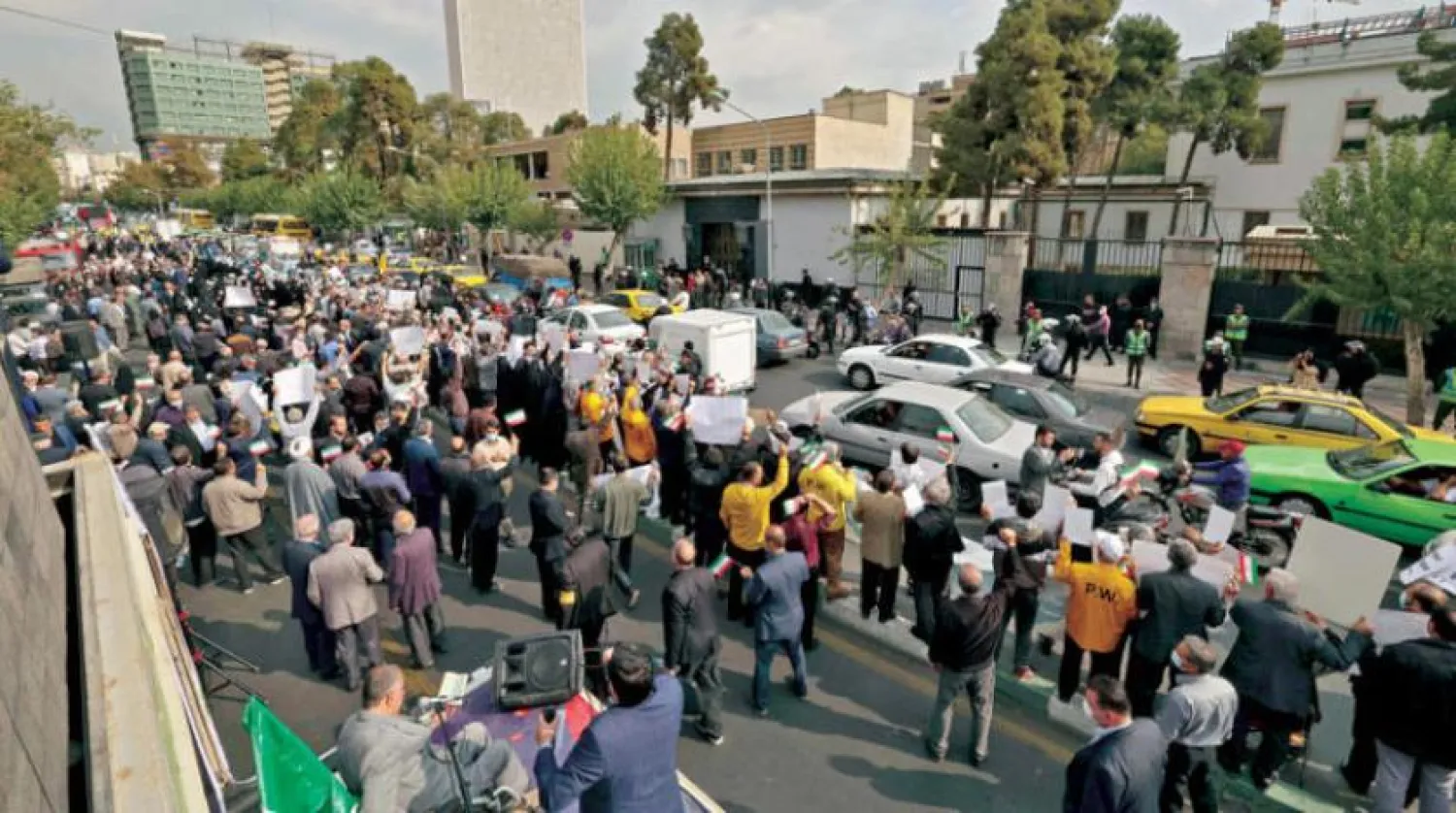
Warnings of Imminent Iranian Attacks on Regional Countries

Supporters of the Iranian regime stage a rally in front of the German embassy in Tehran on Tuesday. (AFP)
TT

Warnings of Imminent Iranian Attacks on Regional Countries

Supporters of the Iranian regime stage a rally in front of the German embassy in Tehran on Tuesday. (AFP)

The United States is concerned about threats from Iran against Saudi Arabia and will not hesitate to respond if necessary, a White House spokesperson said on Tuesday.

The Wall Street Journal reported that Saudi Arabia had shared intelligence with the US, warning of an imminent attack from Iran on targets in the Kingdom.

The US, Saudi Arabia and other countries in the Middle East are on an elevated alert level without providing further details, it added.

Saudi officials said Iran is poised to carry out attacks on the Kingdom and Erbil, Iraq, to distract attention from domestic protests that have swept the country since September.

"We are concerned about the threat picture, and we remain in constant contact through military and intelligence channels with the Saudis," said a National Security Council spokesperson.

"We will not hesitate to act in defense of our interests and partners in the region."

Head of Iran's National Security and Foreign Policy Committee MP Vahid Jalalzadeh had said if Saudi Arabia did not stop supporting the protests, it would "face countermeasures" from Tehran.

Jalalzadeh revealed that Tehran had sent messages to Riyadh "through friendly countries," adding that Saudi Arabia “should stop supporting the rioters”.

Iran's Intelligence Ministry and the Intelligence Organization of the Revolutionary Guard accused on Friday Saudi Arabia, the US, the UK, and Israel of supporting the protests.

Meanwhile, the US and Albania will hold an informal UN Security Council gathering on Wednesday, according to a note outlining the event to highlight the ongoing repression of women and girls in Iran.

The US mission said Wednesday's meeting aims to "highlight the ongoing repression of women and girls and members of religious and ethnic minority groups in Iran."

"It will identify opportunities to promote credible, independent investigations into the Iranian government's human rights violations and abuses."

Iranian Nobel Peace Prize laureate Shirin Ebadi and Iranian-born actress and activist Nazanin Boniadi are set to speak before the meeting.

Tehran urged countries not to attend the Washington-organized meeting.

In a letter to the UN members, Iran's UN ambassador and permanent representative Amir Saeed Iravani said the US has no true and genuine concern about the human rights situation in Iran or elsewhere.

He described the protests as an internal issue, saying it would be "counterproductive to the promotion of human rights" if the UN Security Council discussed the issue.

"The United States lacks the political, moral, and legal qualifications to hold such a meeting, distorting the basic principles of human rights," Iravani wrote.

He questioned the US commitment to defending Iranian women and "strongly urged" UN member states to disassociate themselves from and "explicitly object to such reckless and dangerous practices through which the US attempts to create such a dangerous precedent and politicize human rights issues to achieve its political agenda."

Meanwhile, supporters of the Iranian regime held a sit-in outside the German embassy in Tehran to denounce Berlin's alleged role in fueling the protests.

Germany had recently issued a strongly-worded statement criticizing the suppression of protesters in Iran.

German Foreign Minister Annalena Baerbock condemned the attack on a protest rally in front of the Iranian embassy in Berlin and again sharply criticized the Iranian government.

Speaking from the Uzbek capital, Baerbock said it is wrong to believe that protesters can be intimidated in Germany, adding that the rule of law will be applied.

She explained that any threat to freedom of expression would not be tolerated.

Unknown assailants attacked a bus carrying a mobile home near the Iranian embassy, which is used as a protest headquarters.

According to the police, four bus passengers fought with two masked men, injuring three. It is believed that the suspects fled by car after the attack.


Louvre Blocked as France Grapples with Unrest

TOPSHOT - A protester waving a French national flag walks past a fire during clashes prior to the start of a demonstration to protest against the "high cost of living", in Marseille, southern France, on October 17, 2026 as part of a nationwide call for mobilization bringing together various groups expressing their anger: former "Yellow Vests", secondary school and university students, climate activists and even farmers. (Photo by Thibaud MORITZ / AFP)
TT

Louvre Blocked as France Grapples with Unrest

TOPSHOT - A protester waving a French national flag walks past a fire during clashes prior to the start of a demonstration to protest against the "high cost of living", in Marseille, southern France, on October 17, 2026 as part of a nationwide call for mobilization bringing together various groups expressing their anger: former "Yellow Vests", secondary school and university students, climate activists and even farmers. (Photo by Thibaud MORITZ / AFP)

Protesters blocked the entrance to the Louvre in Paris on Monday, as French authorities scrambled to stem public discontent fueling mass cost-of-living demonstrations that over the weekend spilled over into some of the worst street violence in recent years.

President Emmanuel Macron ordered a security review as the country's interior minister admitted that the police "had lost control" during the weekend's unrest.

Undeterred, the Yellow Vests movement which organized the weekend's rallies called for a new round of protests Saturday, said AFP.

Italy, Spain and Portugal, where anger over rising prices has also led to protests, were keeping a nervous eye on the developments after smaller clashes broke out in Milan over the weekend and protests about housing costs persisted in Spanish cities.

Some half a million people turned out across France to protest the surging cost of living, a culmination of four weeks of protests that began with high school students demanding better conditions at their schools.

What started as peaceful demonstrations morphed into violence in some places, as masked groups on the sidelines of the protests attacked law enforcement, broke into town halls and other public buildings, setting many of them ablaze, looted shops, and set fire to cars, bicycles and scooters on the streets.

Interior Minister Laurent Nunez offered to resign on Monday after more than 2,500 people were arrested and nearly 1,000 members of the security forces injured. Protesters were also hurt, with one demonstrator's hand blown off by a police crowd-control grenade.

"On Saturday, in some major cities, you couldn't look shopkeepers in the eye after hundreds of shops had been looted and tell them we hadn't lost control," Nunez said.

Macron refused Nunez's resignation, even as he acknowledged security and intelligence failures in the government response, despite the some 60,000 law enforcement personnel deployed across the country on Saturday.

Nationwide, more than 2,330 people were taken into police custody over the weekend, 70 percent of whom were adults, Justice Minister Gerald Darmanin said Monday.

More than 2,000 shops were expected to have been affected by the weekend's violence across France, with damage running into "hundreds of millions of euros", according to chamber of commerce president Alain Di Crescenzo.

In an address to the nation Sunday evening, Macron slammed the "unbridled" violence and said local authorities would be able to ban -- "if necessary" -- certain rallies in coming days.

But he stopped short of announcing drastic measures, such as a state of emergency or curfew.

City authorities in Marseille said on Monday that public gatherings would be banned from noon to 08:00 pm (1000-1800 GMT).

- Louvre blocked -

The public discontent showed no signs of subsiding on Monday, with demonstrators blocking the entrance to Paris's iconic Louvre Museum, the most visited in the world.

"We are proud to announce that we are blocking the world's largest museum," read a leaflet posted outside the museum, as management and unions said the protest was led by students from Ecole du Louvre.

Rising prices have fueled anger in France, where diesel prices have jumped nearly 40 percent and petrol by 25 percent since March and where food prices have risen by 25 percent since 2021.

- Elections -

The unrest in France has flared just months before a key presidential election where centrist Macron cannot stand again and Marine Le Pen, the far-right presidential candidate for the National Rally party, is riding high in the polls.

Ministers have blamed "ultra-left" groups for the violence, while Le Pen claimed that the party of her far-left rival for the presidency, Jean-Luc Melenchon, had "legitimized the violence".

The left has accused Macron of ignoring protesters' demands, while the right is calling on him to take a firmer line.

- Europe -

With costs of living rising across Europe, smaller demonstrations have broken out in other countries.

During the weekend, clashes broke out on the sidelines of a cost-of-living demonstration in Milan, with Mayor Giuseppe Sala warning: "I'm very worried because it's a new phenomenon, which also originates from an international scenario and therefore feeds itself."

In Spain, hundreds of tents have occupied Madrid's central Puerta del Sol square since September, when the eviction of an 87-year-old woman from her lifelong flat sparked nationwide protests in a country with soaring housing costs.

Dozens of tents have also sprung up in Portugal's main cities of Lisbon and Porto, with protesters demanding action over rising costs of housing.


At Least Two Dead as Floods Hit Eastern Spain

Parked cars are half-submerged in a flooded park area after heavy rainfall that hit the area early in the morning, in the town of Algeciras, southern Spain, 18 October 2026. (EPA)
TT

At Least Two Dead as Floods Hit Eastern Spain

Parked cars are half-submerged in a flooded park area after heavy rainfall that hit the area early in the morning, in the town of Algeciras, southern Spain, 18 October 2026. (EPA)

At least two people have died after heavy rain triggered flooding in eastern Spain, authorities said Monday, as rescuers worked to evacuate stranded residents and officials urged people in the Valencia region to stay indoors.

Videos released by Valencia's regional meteorological agency showed streets turned into torrents, sweeping away vehicles in several towns in the provinces of Valencia and Alicante.

"Road travel is impossible, you must stay at home," Juan Carlos Valderrama, the Valencia region's emergency chief, said on Monday morning, warning that intense and persistent rainfall was causing severe flooding.

One person died in Sagunto, local authorities said overnight from Sunday to Monday, while firefighters in neighboring Catalonia reported the death of a woman who fell into a stream.

Emergency services and soldiers from Spain's military emergency response unit were working early on Monday to evacuate people whose homes had flooded, including residents who had taken refuge on rooftops.

"Rescue operations are continuing in areas that are difficult to access. People are urged to avoid all travel," Prime Minister Pedro Sanchez said on X, describing the situation in the Valencia region as "very difficult".

Scientists say human-driven climate change is intensifying the Mediterranean storms that typically hit eastern Spain in autumn as the sea absorbs heat during the summer, leading to increased evaporation and heavier rainfall.

National weather agency AEMET announced Friday that last month was mainland Spain's hottest September on record, after the country registered its warmest summer between June and August.


Nations Seek Reset at UN Talks as Nature Goals off Track

Armenia is hosting the UN COP17 biodiversity talks in its capital Yerevan. KAREN MINASYAN / AFP
TT

Nations Seek Reset at UN Talks as Nature Goals off Track

Armenia is hosting the UN COP17 biodiversity talks in its capital Yerevan. KAREN MINASYAN / AFP

Nearly 200 nations are gathering in Armenia on Monday for critical negotiations as governments come under pressure to salvage a landmark nature pact whose goals are slipping out of reach.

Most countries joined a historic call four years ago to halt and reverse the destruction of nature by 2030 but governments have been slow to act on these pledges, said AFP.

Many goals of the so-called "Paris Agreement for Nature" are falling behind, including a centerpiece commitment to protect 30 percent of Earth's land and oceans.

Some of the toughest objectives of the pact, such as cutting subsidies for fossil fuels and other powerful industries, have made little progress.

"We must honestly admit that collectively, we are not yet on track as needed," Armenia's Prime Minister Nikol Pashinyan said Friday ahead of the formal UN negotiations known as COP17.

The summit comes at a difficult time, with public finances under strain and political attention fixed on conflicts, geopolitical tensions and a global energy crisis.

Only a handful of world leaders, including UN chief Antonio Guterres but mostly heads of state from nearby Central Asian nations, turned up for a high-level session ahead of the formal negotiations.

But the stakes could not be higher, Guterres said at the event on Friday, describing an unrelenting "war on nature" that threatened the very livability of the planet for future generations.

"We need more action, more speed and more will," he said.

"Halfway to 2030, Yerevan is our moment of accountability. It is time to ask ourselves -- are we doing enough?"

- Falling short -

A United Nations scorecard issued ahead of COP17 reported that progress toward the 23 biodiversity targets was being made -- but unevenly, and not at pace to meet the 2030 deadline.

A major tension at the summit will be money, with the report finding that the effort to close a yawning gap in necessary finance "falls far short" of what is needed.

European and other wealthy nations obligated to provide biodiversity finance have been pushing for large emerging economies like China to also contribute.

But attention is likely to focus more on how private capital, not public finances, might help plug the shortfall.

A key priority will be encouraging corporations to donate a share of profits to a near-empty UN fund to support conservation in developing countries.

Guterres also fixed the spotlight on state incentives for extractive industries, scolding governments for "spending money on the wrong things" despite pledging to reform harmful subsidies.

"Subsidizing fossil fuels is subsidizing suicide," said Guterres of the coal, oil and gas that are "boiling our planet and are the scourge of biodiversity".

For the mountainous Caucasus nation of Armenia, the summit is one of the largest international events it has ever hosted, with thousands of visitors expected over the next two weeks.

The hosts have stressed that action -- not new pledges -- would define success at COP17.

"The world does not need a new vision. We have one. What it needs is delivery," Adil Najam, global president of WWF International, said Friday.