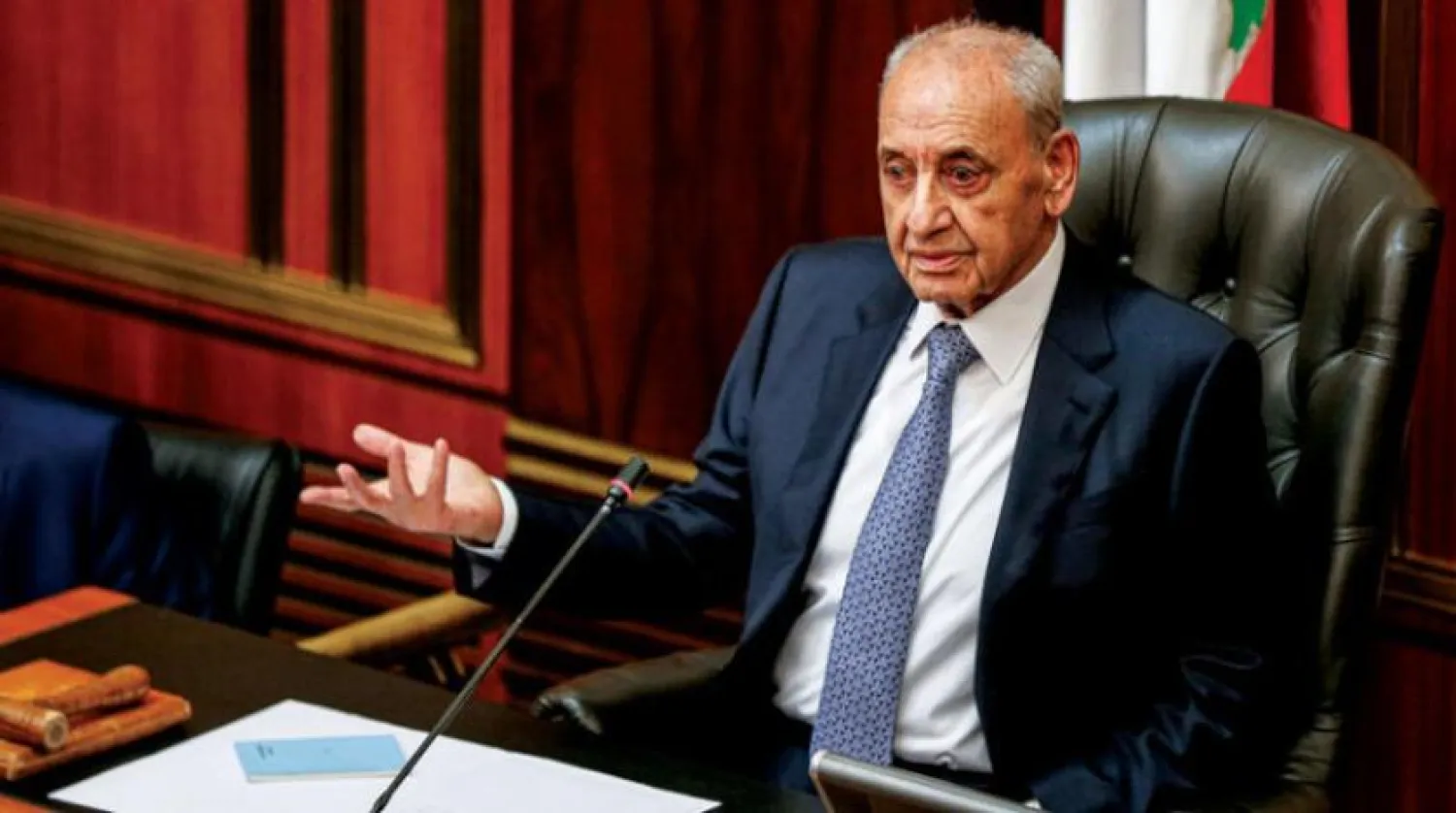
Lebanon: Berri Slams Slogan of ‘Strong President’

Parliament Speaker Nabih Berri (DPA)
TT

Lebanon: Berri Slams Slogan of ‘Strong President’

Parliament Speaker Nabih Berri (DPA)

Lebanon’s Speaker Nabih Berri has stressed that the idea of the “strong president” that former President Michel Aoun had carried as a slogan for his tenure has “failed miserably.”

During a meeting on Monday with a Press Syndicate delegation, headed by Awni Kaaki, Berri said that a strong president “is the one, who brings the Lebanese people together and around state institutions, not the one who exercises the power of exclusion and fuels differences.”

He told his visitors that rising poverty, severe power cuts and a series of other crises should prompt lawmakers to immediately elect a new president.

Berri added that he was hinging on the factor of time for the concerned parties to reach consensus on a candidate amid lack of quorum at the parliament.

“Lebanon and the Lebanese cannot tolerate a further deterioration” in the economic and political situation, he warned.

The speaker affirmed that he will continue to call for a weekly session to elect a president.

On the other hand, he emphasized that security was under control.

Asked about his alleged support for the central bank governor, Berri said: “Ask those who extended his term.”

He added: “If he’s implicated (in corruption), then I do not cover him.”


French Plan for Post-UNIFIL Lebanon Calls for Phased Withdrawal of Int’l Forces

A UNIFIL peacekeeper stands beside a UN vehicle in the occupied Lebanese area of Naqoura in southern Lebanon last Tuesday (AP)
TT

French Plan for Post-UNIFIL Lebanon Calls for Phased Withdrawal of Int’l Forces

A UNIFIL peacekeeper stands beside a UN vehicle in the occupied Lebanese area of Naqoura in southern Lebanon last Tuesday (AP)

France is drafting a UN resolution to avert a security vacuum in southern Lebanon when the mandate of the United Nations Interim Force in Lebanon (UNIFIL) expires at the end of this year. Paris plans to present the draft to the Security Council's permanent members to head off a potential veto.

The proposed resolution would revise the withdrawal timetable for UNIFIL's military contingents, pushing back the deadline for its full withdrawal by six months.

European countries are backing Lebanon's bid to extend UNIFIL's mission by six months, a move opposed by Israel and the United States. Washington is demanding progress toward securing the Lebanese state's monopoly on arms and pressing for direct coordination between the Lebanese and Israeli armies, which Beirut rejects.

Securing Security Council Consensus

Lebanon previously asked the Security Council to extend UNIFIL's mandate by six months to a year as a transitional measure to avert a security vacuum in the south ahead of its expiration on December 31, 2026.

Lebanese sources following international consultations told Asharq Al-Awsat: “Everything being discussed today amounts to proposals to avert a security vacuum in the south. Nothing has been settled yet.”

Negotiations will focus on the Security Council's five permanent members — the United States, Russia, China, France and Britain — to secure an understanding that would avert a veto, the sources said.

“Diplomatic efforts have now begun in earnest. France is working on a draft UN resolution following consultations with international and Lebanese parties,” they added.

A proposal is taking shape and will serve as the basis for intensified diplomatic efforts and negotiations that will determine where the parties stand.

A Phased Withdrawal

The proposal is expected to be unveiled next week, with a draft already in the hands of relevant parties in Lebanon and abroad.

Lebanese sources familiar with international consultations said the emerging proposal would delay UNIFIL's withdrawal by up to six months through adjustments to its withdrawal timetable.

“There is consensus among the countries involved in Lebanon on the need to prevent a vacuum in the south, and they do not oppose extending UNIFIL's presence under an international mandate,” the sources said.

The proposal envisages a staggered withdrawal, allowing some military contingents to remain longer. As contingents gradually pull out, those remaining would continue carrying out their duties to prevent a security vacuum in their area of operations.

The plan would push back UNIFIL's final withdrawal by six months beyond the end of 2027, allowing the force to continue its duties throughout that period.

This would mark a departure from UN Security Council Resolution 2790, which stipulates that UNIFIL's mandate and operations in their current form end on December 31, 2026. A yearlong drawdown and withdrawal would then begin, with the force due to leave Lebanon entirely by the end of 2027.

US Conditions

Despite international momentum behind the proposed extension, there is no sign that all five permanent members of the Security Council are prepared to endorse it.

“Washington is making any arrangement to prevent a vacuum in the south conditional on Hezbollah handing over its weapons within a set timeframe,” the sources said.

Beirut considers that condition unfeasible for now, given Hezbollah's refusal to disarm before Israel withdraws from occupied Lebanese territory. Washington is also pushing for direct coordination between the Lebanese and Israeli armies, which Beirut continues to reject.

Several proposals put to Lebanon in recent weeks have failed to gain traction.

Among them was a proposal to merge Resolution 1701 with the US-sponsored tripartite framework agreement involving Lebanon and Israel.

The proposal fell through because it would require a new Security Council resolution, and securing both international and domestic consensus remains unfeasible.

The Shiite alliance of Hezbollah and the Amal Movement rejects the framework agreement outright and remains committed to Resolution 1701, arguing that it defines Lebanon's borders by reference to the 1949 Armistice Agreement and the Blue Line.

Another proposal envisaged deploying a multinational force to replace UNIFIL. Hezbollah said, however, that it would treat any international force operating outside the UN framework as an occupying force, effectively scuttling the proposal.


Syria Launches 'Liberation Season 2026,' Marking Anniversary of 'Deterrence of Aggression' Offensive

Participants march toward the Umayyad Mosque as “Liberation Season 2026” celebrations get underway in Damascus on Friday. (AFP)
TT

Syria Launches 'Liberation Season 2026,' Marking Anniversary of 'Deterrence of Aggression' Offensive

Participants march toward the Umayyad Mosque as “Liberation Season 2026” celebrations get underway in Damascus on Friday. (AFP)

Syria kicked off its "Liberation Season 2026" celebrations on Friday with a mass sporting march through Damascus, marking the second anniversary of the offensive that set in motion the fall of Bashar al-Assad’s regime, ending an era of repression, injustice, killings and torture.

Organized by the Damascus Governorate in coordination with the Ministry of Emergency and Disaster Management, the march brought together people of all ages, cyclists, skaters and civil defense teams to commemorate the launch of the “Deterrence of Aggression” offensive.

Participants gathered at Umayyad Square in the morning, waving national flags and white banners bearing the Islamic declaration of faith: “There is no god but Allah, and Muhammad is the Messenger of Allah.”

The procession wound through the capital, passing the National Museum, Victoria Bridge, the Hejaz district, Damascus Citadel and the famed al-Hamidiyah souk before reaching the Umayyad Mosque.

Footage published by a news platform showed crowds prostrating in gratitude to God outside the mosque, amid chants of “Allahu Akbar” (God is greatest) and jubilant ululations from women and girls celebrating Liberation Day.

From ‘Deterrence of Aggression’ to Liberation

The Damascus Governorate unveiled the program for “Liberation Season 2026” on Thursday. Celebrations run from November 27, the second anniversary of the offensive’s launch, through December 8, marking the day Syria was freed from Assad’s rule in 2024.

Internal security forces were deployed extensively across Damascus to secure the march route, keep traffic flowing and ensure public safety.

Abdulrahman al-Sarouji, director of public relations at the Damascus Governorate, told the official Syrian Arab News Agency (SANA) that the authorities had organized events to reinforce the significance of the anniversary, with the march designed to engage Syrians of all ages and walks of life.

The program features sporting, cultural, social, artistic and economic activities, including discounts across the capital, events at the former fairgrounds and the welcoming of Syrian expatriates arriving from abroad.

It also includes premiere screenings at the Opera House of films commemorating the Syrian revolution and its events, alongside intellectual lectures at the National Library.

Celebrations will culminate in a main event at Umayyad Square on Liberation Day, December 8.

The anniversary also resonated in Friday sermons across several Damascus mosques, where preachers hailed the victory as “a blessing bestowed by God upon Syrians.”

They urged worshippers to safeguard that achievement by supporting the families of martyrs, comforting the wounded, helping those in need, honoring past sacrifices and contributing to reconstruction.

They also stressed the importance of cooperation, solidarity, justice and compassion, warning against division, factionalism and hatred.

‘Building It Together’

Under the slogan “We reclaimed it ... and together we will rebuild it,” the Ministry of Information’s Foreign Media Department launched an interactive digital platform to track and document Syrian National Day celebrations worldwide and highlight the participation of Syrian communities abroad.

The “Deterrence of Aggression” offensive began on November 27, 2024, under the Military Operations Command led by Hayat Tahrir al-Sham (HTS).

Rapid territorial gains by armed opposition factions, coupled with the crumbling of Assad’s forces and widespread defections, marked an unprecedented shift in the balance of control since the outbreak of the Syrian revolution.

The dramatic developments left Syrians at home and abroad anxiously following the course of the offensive. Just 12 days after it began, Assad’s regime fell.

Local news platforms reported anniversary celebrations in the town of Qabtan al-Jabal in western rural Aleppo, while a motorcade along the seafront in Tartous province marked the occasion.

Strategic military and security expert Ismat al-Absi told Asharq Al-Awsat that Liberation Day represented a defining moment in Syria’s national history.

“Liberation Day is not merely another festive occasion on the calendar. It is a founding milestone, marking the end of half a century of rule by a single family and Syria’s transition from a captive state to one that determines its own course,” he said.

Al-Absi said the offensive carried a dual significance: the collapse in just 12 days of a military apparatus built on loyalty rather than competence, and the rise of a revolutionary army that demonstrated its capacity for leadership, organization and planning.

On the regional level, Assad’s downfall reshaped the balance of power in the Levant and severed a supply line that had sustained cross-border smuggling, militias and drug trafficking, he said.

Domestically, however, its greatest significance lay in the fact that the people who had taken up arms now held the reins of the state for the first time in decades.

Those who bet on the failure of the new Syria had lost twice, Al-Absi said: first, when the state survived the regime’s collapse despite predictions of chaos, and again when Syria broke out of its isolation and forged Arab and international partnerships rather than descending into collapse.

The new leadership inherited a bankrupt, fractured country beset by challenges, yet accomplished in two years what entire governments had failed to achieve, he said, citing relative security stability, the dismantling of hundreds of terrorist cells, drug trafficking and criminal networks, and the restoration of state authority.

“Predicting failure is an arrow anyone can fire at no cost. Building a state from the rubble, however, is a test that words alone cannot meet,” Al-Absi said.

“Nevertheless, the government remains accountable for its results. Celebration does not absolve us of accountability. It should strengthen our resolve to finish the work.”

Among the achievements of the past two years, Al-Absi cited the establishment of institutions governing the new state, the launch of a political and constitutional process, the gradual consolidation of arms under state control and the dismantling of hundreds of terrorist cells and drug trafficking networks.

He also highlighted Syria’s return to the Arab and Islamic fold, the lifting of sanctions and the return of thousands of families to their homeland.

The hardest tasks, however, lie ahead, he said.

They include completing the formation of a unified national army rooted in the revolution and built to professional standards, delivering transitional justice without revenge or impunity, reviving the economy and improving living conditions.

Security and stability, he stressed, could only be measured by the well-being of the people.

He also called for the consolidation of state sovereignty across the south, Sweida and the coastal region, without exception.

“My priorities, in order, are the army, justice and the economy,” Al-Absi concluded. “A state that cannot protect, hold to account or feed its people remains incomplete, no matter how much it celebrates.”



Son of Hamas Chief Survives Israeli Strike, Hamas Says

Palestinians ride a motorcycle past destroyed buildings in Gaza City, Thursday, Nov. 26, 2026. (AP)
TT

Son of Hamas Chief Survives Israeli Strike, Hamas Says

Palestinians ride a motorcycle past destroyed buildings in Gaza City, Thursday, Nov. 26, 2026. (AP)

The son of Hamas chief Khalil al-Hayya survived an assassination attempt by the Israeli military on Friday, senior Hamas official Basem Naim said.

He told Reuters that Izzeldeen al-Hayya and his family had survived a dawn airstrike and Hamas sources said several people, including Hayya's daughter-in-law, had been wounded but there had been no deaths.

The Israeli military had ‌no immediate ‌comment.

Naim described Izzeldeen al-Hayya, ‌born ⁠in 1997, as ⁠the Hamas chief's last surviving son, with four others having been killed by Israeli forces.

The family of one of the late sons survived Friday's strike, Naim said.

Hamas said in a statement that the Israeli military had targeted ⁠a residential apartment, and linked ‌the attack to threats ‌Israeli Defense Minister Israel Katz has made against Hayya.

Hamas ‌accused Israel of seeking to undermine ‌a 2025 Gaza ceasefire agreement and said Israel bore full responsibility for the consequences of its continued attacks.

Izzeldeen is the twin brother of Hamam ‌Khalil al-Hayya, who was killed in a 2025 Israeli airstrike targeting Hamas leaders in ⁠Qatar, ⁠Naim said.

Named Hamas' overall leader in July, Hayya narrowly escaped assassination himself in the Qatar strike.

Hayya warned of possible retaliation on Thursday after Israeli attacks killed at least 10 people in Gaza.

Separately, three Palestinians were killed and two others injured on Friday in an Israeli strike on the city of Rafah, medical sources told Reuters. There was no immediate Israeli comment on the strike.