

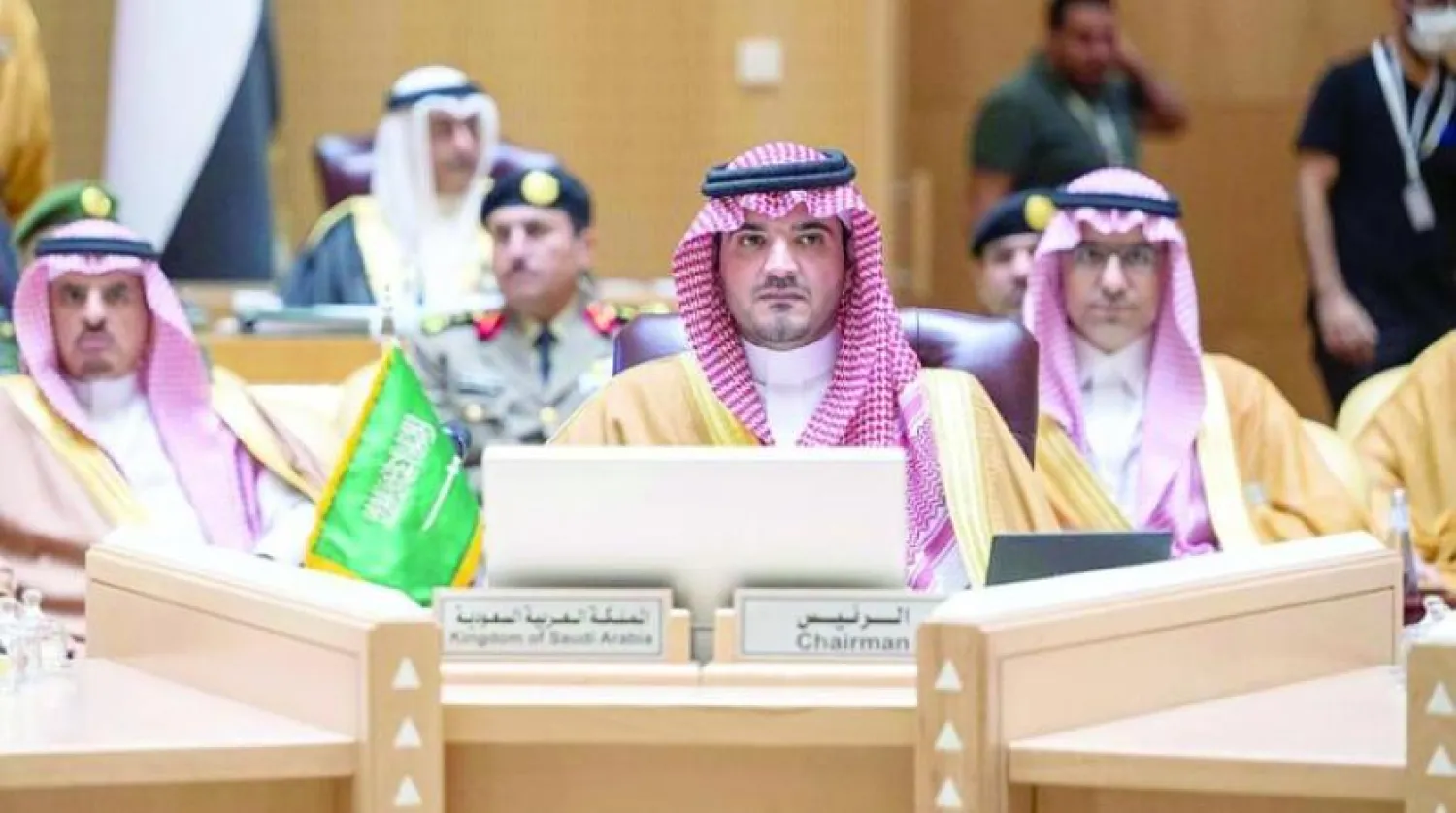

GCC Interior Ministers Discuss Common Security Issues

Saudi Interior Minister Prince Abdulaziz bin Saud bin Naif chairing the meeting (SPA)
TT

GCC Interior Ministers Discuss Common Security Issues

Saudi Interior Minister Prince Abdulaziz bin Saud bin Naif chairing the meeting (SPA)

The Interior Ministers of the Gulf Cooperation Council (GCC) have held their thirty-ninth meeting in Riyadh under the chairmanship of Saudi Interior Minister Prince Abdulaziz bin Saud bin Naif.

Prince Abdulaziz delivered a speech in which he conveyed the greetings of the Custodian of the Two Holy Mosques, King Salman bin Abdulaziz Al Saud, and Crown Prince Mohammad bin Salman and their wishes for the meeting's success.

The Minister stressed that the meeting embodied the spirit of brotherhood and joint Gulf cooperation in confronting and eliminating security challenges.

"Our meeting takes place amid dangers and challenges facing some countries in the world, which threaten their security and stability," he said, stressing that it is crucial to adhere to the unity of the council, boost joint action, and increase the cooperation and coordination among security services.

The Prince said the council must "confront everything that threatens the security and safety of citizens and residents and maintain the security, stability, development, and growth that our countries have achieved."

The ministers discussed the agenda and common security issues, in addition to the reports on the joint tactical exercise of the security services in the GCC countries "Arab Gulf Security 3", organized by the Saudi Ministry of Interior (2022), and the ongoing preparations for the upcoming exercise "Arab Gulf Security 4", which will be organized by the Qatari Ministry of Interior (2023).

The meeting was also attended by UAE's Deputy Prime Minister and Minister of Interior, Sheikh Saif bin Zayed Al Nahyan, Bahrain's Minister of Interior, Sheikh Rashid bin Abdullah Al Khalifa, Oman's Minister of Interior Sayyid Hamoud bin Faisal Al Busaidi, Kuwait's Minister of Interior Sheikh Talal Khaled Al Ahmad Al Sabah, Qatar's Undersecretary of the Ministry of Interior Sheikh Abdulaziz bin Faisal bin Mohammad Al Thani, and GCC Sec-Gen Nayef al-Hajraf.



Saudi Leadership Offers Condolences to Sisi Over Fire Victims

Custodian of the Two Holy Mosques King Salman bin Abdulaziz Al Saud and Crown Prince Mohammed bin Salman bin Abdulaziz Al Saud. SPA
TT

Saudi Leadership Offers Condolences to Sisi Over Fire Victims

Custodian of the Two Holy Mosques King Salman bin Abdulaziz Al Saud and Crown Prince Mohammed bin Salman bin Abdulaziz Al Saud. SPA

Custodian of the Two Holy Mosques King Salman bin Abdulaziz Al Saud has sent a cable of condolences and sympathy to Egyptian President Abdel Fattah El-Sisi over the victims of the fire in Al-Warraq District, Giza Governorate.

The Saudi King expressed his deepest condolences and sincere sympathy to the president, the families of the deceased, and the Egyptian people.

Prince Mohammed bin Salman bin Abdulaziz Al Saud, Saudi Crown Prince and Prime Minister, also sent a cable of condolences to El-Sisi.


Saudi Arabia Strongly Condemns Iran's Heinous Aggression Against Kuwait

The Saudi Ministry of Foreign Affairs logo
TT

Saudi Arabia Strongly Condemns Iran's Heinous Aggression Against Kuwait

The Saudi Ministry of Foreign Affairs logo

The Saudi Ministry of Foreign Affairs on Thursday condemned in the strongest terms Iran's heinous aggression against Kuwait, which targeted a vital site, resulting in several deaths and injuries.

In a statement, the ministry said: “The continued Iranian attacks lead to further tensions and instability. The Kingdom reiterates that these violations undermine international efforts aimed at restoring security and stability in the region.”

“The Kingdom holds Iran responsible for the consequences of its continued brutal attacks, demands an immediate cessation of these violations, and reaffirms its full solidarity with the brotherly State of Kuwait in all measures it takes to safeguard its sovereignty,” the ministry added.


Saudi Arabia Stresses Human Responsibility in AI Use

Acting Chargé d'Affaires of the Kingdom's Permanent Mission to the UN in New York Faris Al-Otaibi (Saudi mission)
TT

Saudi Arabia Stresses Human Responsibility in AI Use

Acting Chargé d'Affaires of the Kingdom's Permanent Mission to the UN in New York Faris Al-Otaibi (Saudi mission)

Saudi Arabia has stressed that the use of artificial intelligence technologies must adhere to fundamental principles, foremost among them human responsibility.

The Kingdom also stressed the importance of transparency in explaining the capabilities, limitations, and potential risks of AI systems, as well as the need to implement appropriate precautionary measures.

The remarks were delivered by Acting Chargé d'Affaires of the Kingdom's Permanent Mission to the UN in New York Faris Al-Otaibi during an open Security Council debate on conflict resolution amid rapid technological change.

He noted that the rapid development of military technologies necessitates compliance with international humanitarian law, the protection of civilians, and the preservation of human oversight and accountability.

He warned against the exploitation of emerging technologies by terrorist groups, including components that could be used to develop military capabilities.

He also called for stronger international cooperation, capacity building, and the exchange of expertise to enable countries to benefit from modern technologies while ensuring their safe and responsible use.