


Yemenis Condemn 'Feeble' Int’l Stances Regarding Houthi Terrorism

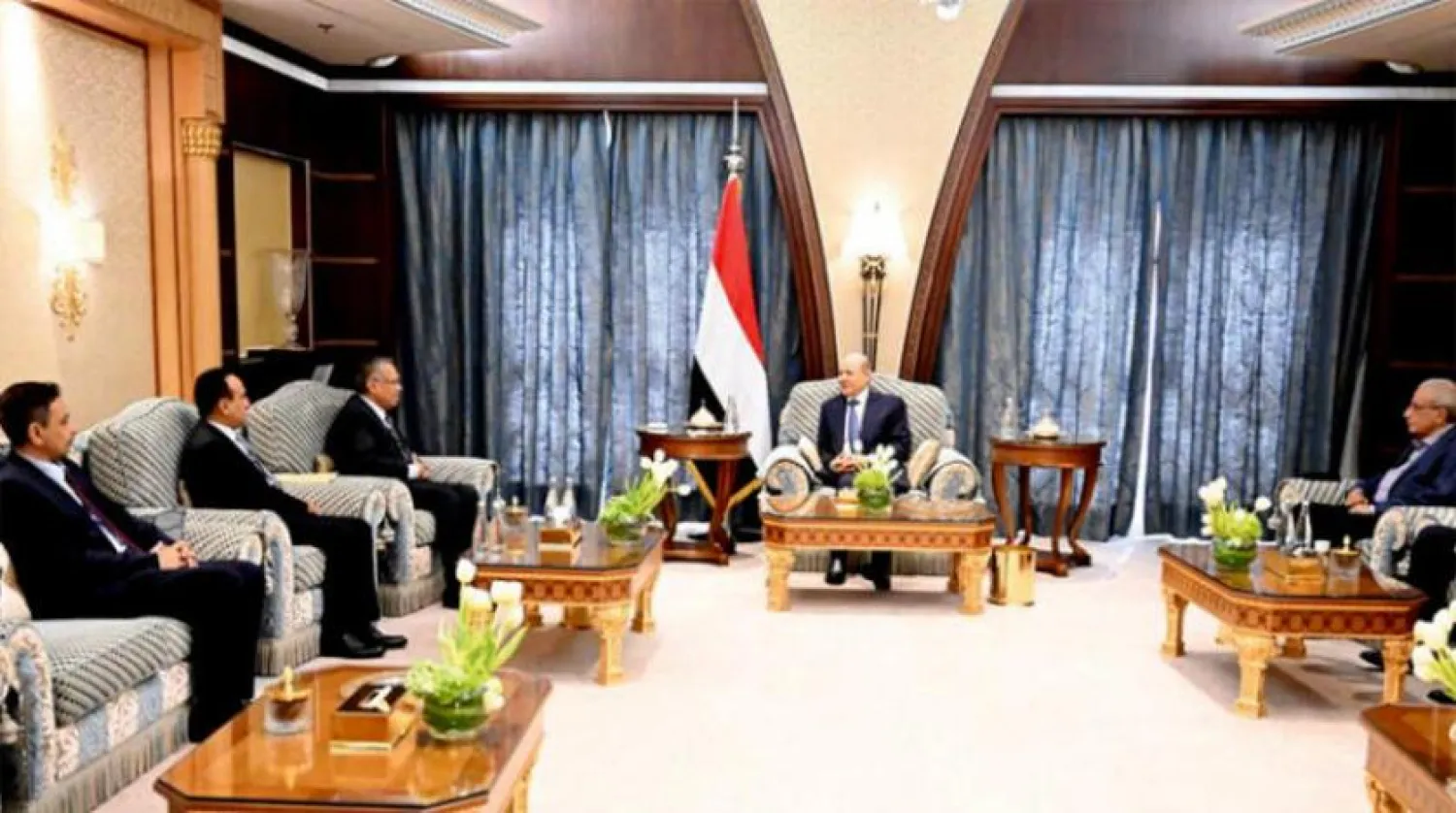
The Head of the Yemeni Presidential Leadership Council, Rashad al-Alimi, meets with the Presidency of the Shura Council (Saba)
TT

Yemenis Condemn 'Feeble' Int’l Stances Regarding Houthi Terrorism

The Head of the Yemeni Presidential Leadership Council, Rashad al-Alimi, meets with the Presidency of the Shura Council (Saba)

UN Special Envoy to Yemen Hans Grundberg is scheduled to brief the UN Security Council on the developments of his efforts to renew the truce in the coming week.

The briefing comes amid growing official and widespread anger among Yemenis over the repeated Houthi attacks on oil export ports and the lean international positions towards its terrorism.

The Houthi militia rejected the envoy's proposal to extend and expand the collapsed truce, as it sought to blackmail the legitimate government to obtain economic and political gains and threatened to continue launching terrorist attacks on oil export ports.

In response, the Yemeni parliament issued a statement calling for the resumption of military operations, an option that observers consider possible if international efforts fail to reach a breakthrough that convinces the militias to choose peace.

The parliamentary statement called on the Presidential Leadership Council (PLC) to do what is necessary to "teach these militias the lessons" and destroy their military capabilities as a "just" response to their "aggressive options."

The statement also called for speedy decision-making to deter the Houthis, restore the state by various means, and save the Yemeni people from the crimes that they practice daily.

The parliament described the international and Western efforts as a "waste of time."

Several officials in the legitimate government criticized the state of global stagnation and inaction, which resort to issuing "denunciation statements" after every Houthi escalation.

- Setting a time limit

In his interview with Asharq Al-Awsat, the Undersecretary of the Yemeni Ministry of Justice, Faisal al-Majidi, said he believes that there can't be an "endless dialogue" with the Houthis, recalling the series of talks and negotiations with the militias and the international resolutions that did not see the light of day.

Majidi said that Security Council Resolution 2216, issued in April 2015, emphasized in its preamble that the Secretary-General must submit a report every ten days on the implementation of the resolution.

However, this is not the case despite later decisions stressing the need to implement this resolution, which means that the UN and its envoy do not put time into their considerations.

Majidi reviewed the 2016 talks in Kuwait amid international presence and UN representation. He recalled the road map for the final political solution in Yemen, which was signed by the Yemeni government and rejected by the militias based on Iranian instructions.

The Undersecretary stressed the need to specify a period for agreements related to a lasting truce or a peace process.

After six weeks of failed efforts to extend the truce, Majidi suggested supporting the government by putting Houthis on the list of international terrorism, activating agreements and protocols signed with Arab and Western countries in this regard, and canceling any international representation of the movement.

The official stressed the importance of freezing the assets of the Houthi militia as an entity and not only as individuals, and tightening the siege on the smuggled Iranian weapons and oil, to "green light" the legitimate government to implement the constitution and restore Hodeidah and then Sanaa, in implementation of Security Council resolutions issued under Chapter VII.

- Criticism of international performance

Yemeni political and media analyst, Mohammad al-Mekhlafi, condemned the international performance against Houthi escalation, that doesn't set time limits for reaching solutions.

Mekhlafi told Asharq Al-Awsat that the UN envoy, and even ambassadors, are often asked about setting a time frame, and they always respond that there is no endpoint for the efforts to establish peace in Yemen.

He admitted that the UN envoy is just an international employee trying to maintain the sustainability of his job and achieve breakthroughs that may be counted as personal success, regardless of whether this success is fair or will benefit the party that commits massacres and violations.

The analyst recalled the Stockholm Agreement, which was seen as an "unprecedented success" for former envoy Martin Griffiths, and he was rewarded with assuming a higher position at the UN.

He added: "To this day, the United Nations is still glorifying this failed agreement," which led to the withdrawal of the internationally recognized government party, the Houthi seizure of Hodeidah with all its resources, and the use of the port to smuggle Iranian drones that threaten international navigation.

The world will "one day wake up to intercontinental terrorism that originates in Yemen if it continues to deal recklessly with Iranian terrorism through the Houthi proxy in Yemen," warns Mekhlafi



How Gaza Armed Gangs Recruit New Members

Security personnel guard trucks carrying aid as they arrive in Rafah, amid the ongoing conflict between Israel and the Palestinian Islamist group Hamas, in the southern Gaza Strip January 17, 2024. (Reuters)
TT

How Gaza Armed Gangs Recruit New Members

Security personnel guard trucks carrying aid as they arrive in Rafah, amid the ongoing conflict between Israel and the Palestinian Islamist group Hamas, in the southern Gaza Strip January 17, 2024. (Reuters)

As Hamas moves to strike armed gangs operating in areas of the Gaza Strip under Israeli army control, the groups are responding with defiance, stepping up efforts to recruit young men and expand their ranks.

Videos posted on social media show training exercises and other activities, signaling that the gangs remain active despite pressure from Hamas security services.

Platforms affiliated with Hamas security say some members have recently turned themselves in following mediation by families, clans and community leaders. The gangs have not responded to those statements. Instead, they occasionally broadcast footage announcing new recruits.

Among the most prominent was Hamza Mahra, a Hamas activist who appeared weeks ago in a video released by the Shawqi Abu Nasira gang, which operates north of Khan Younis and east of Deir al-Balah.

Mahra’s appearance has raised questions about how these groups recruit members inside the enclave.

Field sources and others within the security apparatus of a Palestinian armed faction in Gaza told Asharq Al-Awsat that Mahra’s case may be an exception. They described him as a Hamas activist with no major role, despite his grandfather being among the founders of Hamas in Jabalia.

His decision to join the gang was driven by personal reasons linked to a family dispute, they said, not by organizational considerations.

The sources said the gangs exploit severe economic hardship, luring some young men with money, cigarettes and other incentives. Some recruits were heavily indebted and fled to gang-controlled areas to avoid repaying creditors.

Others joined in search of narcotic pills, the sources said, noting that some had previously been detained by Hamas-run security forces on similar charges. Economic hardship and the need for cigarettes and drugs were among the main drivers of recruitment, they added, saying the gangs, with Israeli backing, provide such supplies.

Resentment toward Hamas has also played a role, particularly among those previously arrested on criminal or security grounds and subjected to what the sources described as limited torture during interrogations under established procedures.

According to the sources, some founders or current leaders of the gangs previously served in the Palestinian Authority security services.

They cited Shawqi Abu Nasira, a senior police officer; Hussam al-Astal, an officer in the Preventive Security Service; and Rami Helles and Ashraf al-Mansi, both former officers in the Palestinian Presidential Guard.

These figures, the sources said, approach young men in need and at times succeed in recruiting them by promising help in settling debts and providing cigarettes. They also tell recruits that joining will secure them a future role in security forces that would later govern Gaza.

The sources described the case of a young man who surrendered to Gaza security services last week. He said he had been pressured after a phone call with a woman who threatened to publish the recording unless he joined one of the gangs.

He later received assurances from another contact that he would help repay some of his debts and ultimately agreed to enlist.

During questioning, he said the leader of the gang he joined east of Gaza City repeatedly assured recruits they would be “part of the structure of any Palestinian security force that will rule the sector.”

The young man told investigators he was unconvinced by those assurances, as were dozens of others in the same group.

Investigations of several individuals who surrendered, along with field data, indicate the gangs have carried out armed missions on behalf of the Israeli army, including locating tunnels. That has led to ambushes by Palestinian factions.

In the past week, clashes in the Zaytoun neighborhood south of Gaza City and near al-Masdar east of Deir al-Balah left gang members dead and wounded.

Some investigations also found that the gangs recruited young men previously involved in looting humanitarian aid.


Israel Permits 10,000 West Bank Palestinians for Friday Prayers at Al Aqsa

Palestinians attend Friday prayers in a mosque following an attack that local Palestinians said was carried out by Israeli settlers, in the village of Deir Istiya near Salfit in the Israeli-occupied West Bank November 14, 2025. REUTERS/Sinan Abu Mayzer
TT

Israel Permits 10,000 West Bank Palestinians for Friday Prayers at Al Aqsa

Palestinians attend Friday prayers in a mosque following an attack that local Palestinians said was carried out by Israeli settlers, in the village of Deir Istiya near Salfit in the Israeli-occupied West Bank November 14, 2025. REUTERS/Sinan Abu Mayzer

Israel announced that it will cap the number of Palestinian worshippers from the occupied West Bank attending weekly Friday prayers at the Al-Aqsa Mosque in east Jerusalem at 10,000 during the holy month of Ramadan, which began Wednesday.

Israeli authorities also imposed age restrictions on West Bank Palestinians, permitting entry only to men aged 55 and older, women aged 50 and older, and children up to age 12.

"Ten thousand Palestinian worshippers will be permitted to enter the Temple Mount for Friday prayers throughout the month of Ramadan, subject to obtaining a dedicated daily permit in advance," COGAT, the Israeli defense ministry agency in charge of civilian matters in the Palestinian territories, said in a statement, AFP reported.

"Entry for men will be permitted from age 55, for women from age 50, and for children up to age 12 when accompanied by a first-degree relative."

COGAT told AFP that the restrictions apply only to Palestinians travelling from the West Bank, which Israel has occupied since the 1967 Arab-Israeli war.

"It is emphasised that all permits are conditional upon prior security approval by the relevant security authorities," COGAT said.

"In addition, residents travelling to prayers at the Temple Mount will be required to undergo digital documentation at the crossings upon their return to the areas of Judea and Samaria at the conclusion of the prayer day," it said, using the Biblical term for the West Bank.

During Ramadan, hundreds of thousands of Palestinians traditionally attend prayers at Al-Aqsa, Islam's third holiest site, located in east Jerusalem, which Israel captured in 1967 and later annexed in a move that is not internationally recognized.

Since the war in Gaza broke out in October 2023, the attendance of worshippers has declined due to security concerns and Israeli restrictions.

The Palestinian Jerusalem Governorate said this week that Israeli authorities had prevented the Islamic Waqf -- the Jordanian-run body that administers the site -- from carrying out routine preparations ahead of Ramadan, including installing shade structures and setting up temporary medical clinics.

A senior imam of the Al-Aqsa Mosque, Sheikh Muhammad al-Abbasi, told AFP that he, too, had been barred from entering the compound.

"I have been barred from the mosque for a week, and the order can be renewed," he said.

Abbasi said he was not informed of the reason for the ban, which came into effect on Monday.

Under longstanding arrangements, Jews may visit the Al-Aqsa compound -- which they revere as the site of the first and second Jewish temples -- but they are not permitted to pray there.

Israel says it is committed to upholding this status quo, though Palestinians fear it is being eroded.

In recent years, a growing number of Jewish ultranationalists have challenged the prayer ban, including far-right politician Itamar Ben Gvir, who prayed at the site while serving as national security minister in 2024 and 2025.


EU Exploring Support for New Gaza Administration Committee, Document Says

Palestinians push a cart past the rubble of residential buildings destroyed during the two-year Israeli offensives, in Gaza City, February 17, 2026. REUTERS/Mahmoud Issa
TT

EU Exploring Support for New Gaza Administration Committee, Document Says

Palestinians push a cart past the rubble of residential buildings destroyed during the two-year Israeli offensives, in Gaza City, February 17, 2026. REUTERS/Mahmoud Issa

The European Union is exploring possible support for a new committee established to take over the civil administration of Gaza, according to a document produced by the bloc's diplomatic arm and seen by Reuters.

"The EU is engaging with the newly established transitional governance structures for Gaza," the European External Action Service wrote in a document circulated to member states on Tuesday.

"The EU is also exploring possible support to the National Committee for the Administration of Gaza," it added.

European foreign ministers will discuss the situation in Gaza during a meeting in Brussels on February 23.