

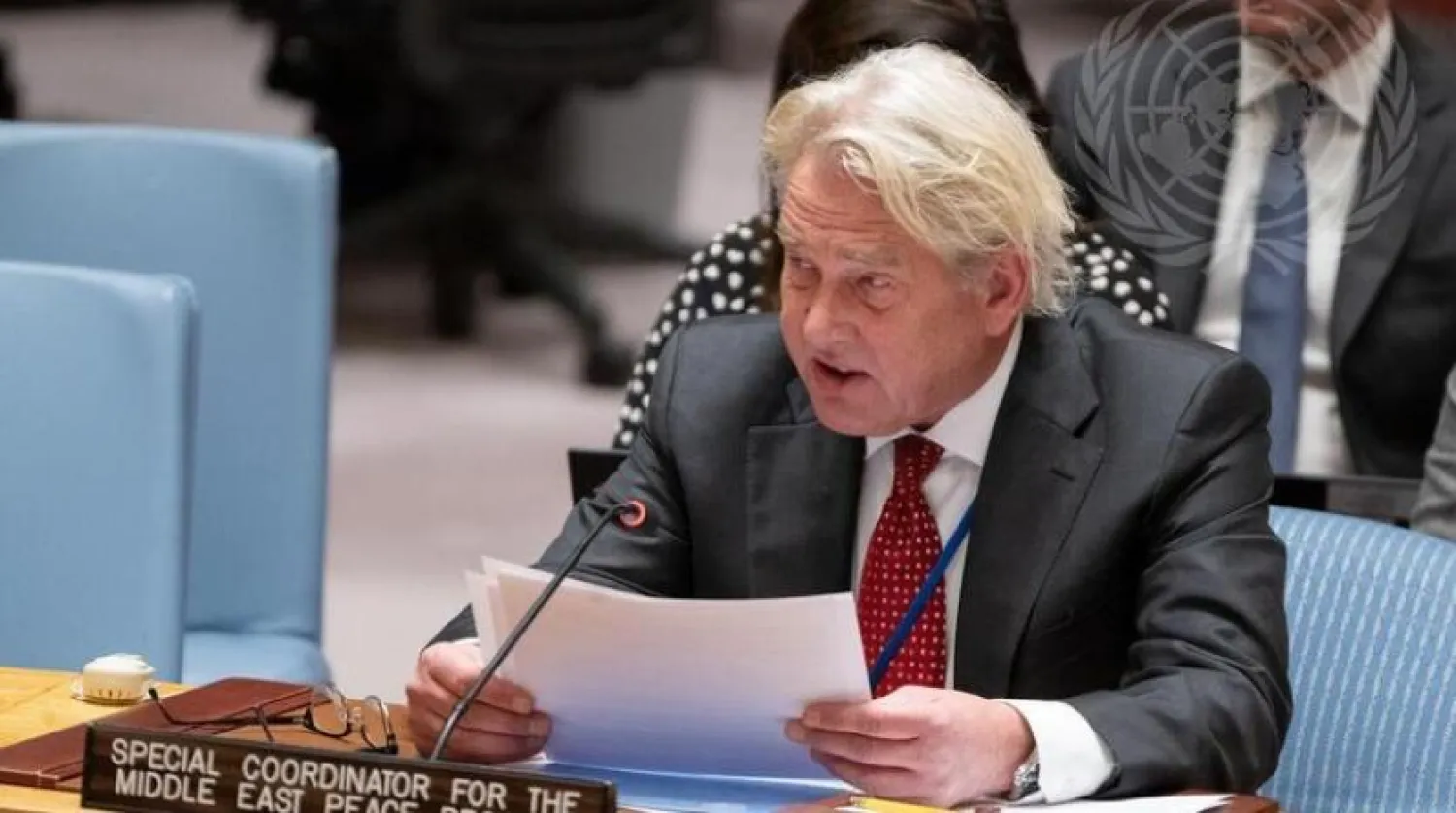

UN Special Coordinator Warns Oslo Accords Are ‘Slipping Away’

UN Special Coordinator for the Middle East Peace Process, Tor Wennesland. (UN)
TT

UN Special Coordinator Warns Oslo Accords Are ‘Slipping Away’

UN Special Coordinator for the Middle East Peace Process, Tor Wennesland. (UN)

The UN Special Coordinator for the Middle East Peace Process, Tor Wennesland, warned that the Palestinian-Israeli once again reached a "boiling point," stressing that the settlement expansion and restrictions continue to squeeze the "economic and physical space for developing a viable Palestinian State."

He warned that the current context leads to the disappearance of the principles that underpin the Oslo Accords, including the two-state solution.

Wennesland was briefing the Security Council on the situation in the Middle East and noted that after decades of persistent violence, illegal settlement expansion, dormant negotiations, and deepening occupation, "the conflict is again reaching a boiling point."

He indicated that "high levels" of violence in the occupied West Bank and Israel in recent months, including attacks against Israeli and Palestinian civilians, increased use of arms, and settler-related violence, have "caused grave human suffering."

He condemned the recent bombings in Jerusalem that killed two Israelis, calling for "a clear rejection of such terrorist acts," and the violent attack by Israeli settlers against Palestinians in Hebron that risks aggravating an already tense environment.

The official asserted that all parties were responsible for acting against extremists and speaking out against such acts of violence and incitement.

Wennesland noted that the "fragile calm" was recently interrupted by the launching of four rockets toward Israel by Palestinian gunmen and subsequent Israeli airstrikes against what it said were Hamas movement targets.

"Once again, we are reminded that the mix of militant activity, debilitating closures, absence of the legitimate Palestinian Government, and hopelessness create an ever-present risk of escalation."

"My team and I have in recent weeks visited areas where violence has been severe, and I continue to hold discussions with a range of Palestinian and Israeli officials, as well as international and regional actors, to address the dangerous dynamics," he added.

The UN official warned that demography is moving faster than politics.

"In a few years, exponential population growth in the West Bank and Gaza will make it increasingly difficult, if not impossible, to manage the economic, political, and security situation."

Moreover, he warned that the principles that underpin the Oslo Accords are "slipping away," noting that "political leadership is required to reset the trajectory toward a two-state solution."

"Failing to address the underlying causes of conflict, as well as the negative trends I just outlined, and without demonstrating a clear political path forward, the conflict will only escalate, causing more bloodshed and misery, and have a deeply destabilizing effect on the entire region."

Wennesland urged taking necessary steps towards a two-state solution, which still garners considerable support among Palestinians and Israelis.

"Through incremental but tangible steps, we can build a bridge between where we are now and the conditions necessary for a peaceful resolution of the conflict based on United Nations resolutions, international law, and previous agreements," he said.

He called on both sides to "stop unilateral steps that undermine peace, including settlement expansion or legalization, demolitions, and displacement.

Furthermore, Wennesland urged all parties and the international community to strengthen Palestinian institutions, improve governance, and shore up the fiscal health of the Palestinian Authority (PA).

However, he stressed that a "common approach" where the "two-state solution is the guiding political direction is essential to halting the current negative trajectory."

"Neither can turn away from the realities of geography and demography that are reshaping the landscape, which, combined with [fast] expanding settlements east of the 1967 lines, reflects an increase in friction points and a deepening conflict."


UN: Drone Attack Hits Sudan Aid Truck

Shops operate beneath a war-damaged building in Omdurman, on the outskirts of Khartoum, Sudan, Thursday, April 23, 2026. (AP Photo/Bernat Armangue)
TT

UN: Drone Attack Hits Sudan Aid Truck

Shops operate beneath a war-damaged building in Omdurman, on the outskirts of Khartoum, Sudan, Thursday, April 23, 2026. (AP Photo/Bernat Armangue)

A drone attack hit an aid truck in Sudan's North Darfur state, destroying all the supplies on board, the UN refugee agency said on Sunday, without identifying who was responsible.

Drone strikes by both the Sudanese army and the Rapid Support Forces (RSF), who have been locked in a brutal war since April 2023, have escalated in recent months, often killing dozens at a time.

The UNHCR-operated vehicle "came under drone attack" on Friday while transporting emergency shelter kits to Tawila, home to more than 700,000 displaced people who fled fighting elsewhere in the western Darfur region, AFP quoted the agency as saying.

The driver escaped unhurt, but all supplies were destroyed in the resulting fire, it added.

UNHCR condemned the attack, warning that it would "leave 1,314 families living in desperate conditions in Tawila without shelter" at a time when humanitarian needs are already overwhelming.

More than 127,000 people fled El-Fasher, North Darfur's capital and the army's last stronghold in the region, after it fell to paramilitary forces in October, with reports of mass killings, sexual violence, looting and rape following the takeover.

Fighting has since spread to neighboring Kordofan, now the main theatre of the war, and the southeastern Blue Nile state, raising fears of a longer and increasingly fragmented conflict.

According to the UN, nearly 700 civilians have been killed in drone strikes by both sides since January alone.

UNHCR voiced "deep concern" over the rising use of drones, calling repeated attacks on humanitarian operations "particularly abhorrent".

According to an assessment by the UN's Food and Agriculture Organization, 28.9 million people, around 62 percent of Sudan's population, are facing acute food insecurity.

That includes 10.2 million who face severe food insecurity, in particular in the wider Darfur region and South Kordofan state.

Famine was declared last year in El-Fasher and Kadugli, the capital of South Kordofan, with 20 other areas at risk in Darfur and Kordofan, a UN-backed assessment found.

The conflict has already killed tens of thousands, uprooted over 11 million and created the world's largest displacement and hunger crises.


Palestinian Leader's Loyalists Win Local Elections, including Some in Gaza

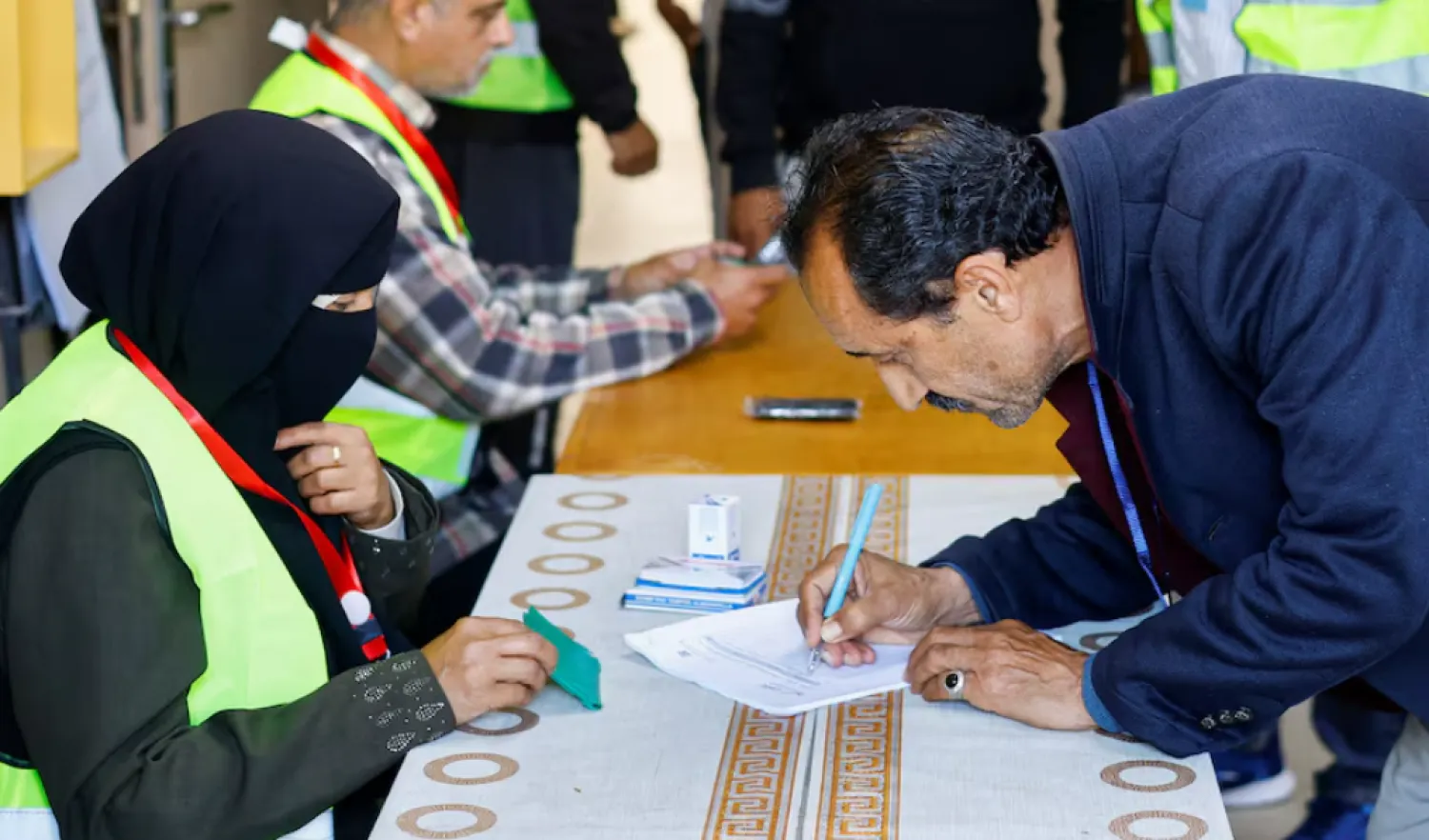
A Palestinian man votes during the municipal election at a polling station in Deir al-Balah, central Gaza Strip April 25, 2026. REUTERS/Mahmoud Issa
TT

Palestinian Leader's Loyalists Win Local Elections, including Some in Gaza

A Palestinian man votes during the municipal election at a polling station in Deir al-Balah, central Gaza Strip April 25, 2026. REUTERS/Mahmoud Issa

Loyalists of President Mahmoud Abbas won most races in Palestinian municipal elections, election officials said on Sunday, in a vote that for the first time in nearly two decades included a city in the Gaza Strip run by rival Hamas.

Saturday’s ballot marked the first elections of any kind in Gaza since 2006 and the first Palestinian polls since the Gaza war began more than two years ago with Hamas' cross-border attack on southern Israel.

Abbas' West Bank–based Palestinian Authority (PA) said the inclusion of the Gaza city Deir al-Balah, which suffered less damage than other areas of the coastal territory during the war, was intended to show that Gaza was an inseparable part of a future Palestinian state.

The elections, in which voter turnout was low, had been held "at a highly sensitive moment amid complex challenges and exceptional circumstances", Palestinian Prime Minister Mohammad Mustafa said as results were announced on Sunday.

But they represented "an important first step in a broader national process aimed at strengthening democratic life ... and ultimately achieving the unity of the land", he said.

POSSIBLE INDICATOR OF HAMAS SUPPORT

Hamas, which ousted the PA from Gaza in 2007, did not formally nominate candidates in Gaza and boycotted the race in the Israeli-occupied West Bank, where Fatah's victory was widely expected.

But some candidates on one of the Deir al-Balah lists were widely seen by residents and analysts as aligned with the movement, making the vote a potential indicator of support for the Islamist group.

Preliminary results showed that the list, known as Deir al-Balah Brings Us Together, won only two of the 15 seats contested in Gaza.

The Nahdat Deir al-Balah list, backed by Abbas' Fatah party and the Western-backed PA, secured six seats. The remaining seats were won by two other Gaza-based groups, Future of Deir al-Balah and Peace and Building, not affiliated with either faction.

Abbas loyalists swept the election in the West Bank, running unchallenged in many seats.

"By electing figures linked to Fatah, voters appear to be seeking unrestricted international support for municipal governance and a gradual political shift that could extend beyond the local level," said Palestinian political analyst Reham Ouda.

The recent war has left much of Gaza reduced to rubble, with many residents displaced and focused on survival. Israel has continued conducting strikes despite an October ceasefire.

In Gaza voter turnout reached just 23%, while in the West Bank it was 56%, according to Chairman of the Central Elections Commission Rami al-Hamdallah.

Al-Hamdallah said some of the ballot boxes and voting equipment did not make it into the enclave because of Israeli security restrictions, though those challenges were overcome.

Hamas' Gaza spokesperson, Hazem Qassem, downplayed the significance of the election results, saying that they had no impact on wider national issues.


Arab Parliament Condemns Attack Targeting Two Border Posts in Kuwait

Arab Parliament logo
TT

Arab Parliament Condemns Attack Targeting Two Border Posts in Kuwait

Arab Parliament logo

Arab Parliament Speaker Mohammed Al-Yamahi has condemned the blatant attack that targeted two sites at the northern land border posts of Kuwait using two explosive-laden drones coming from Iraq, SPA reported.

In a statement, Al-Yamahi stressed the Arab Parliament’s condemnation and categorical rejection of any infringement on the sovereignty of Kuwait or any attempt to undermine its security and stability.

He stressed the Arab Parliament’s full solidarity and support for Kuwait in confronting such attacks, reiterating its backing for all measures taken to protect its security and noting that the security of Kuwait is an integral part of Arab national security.