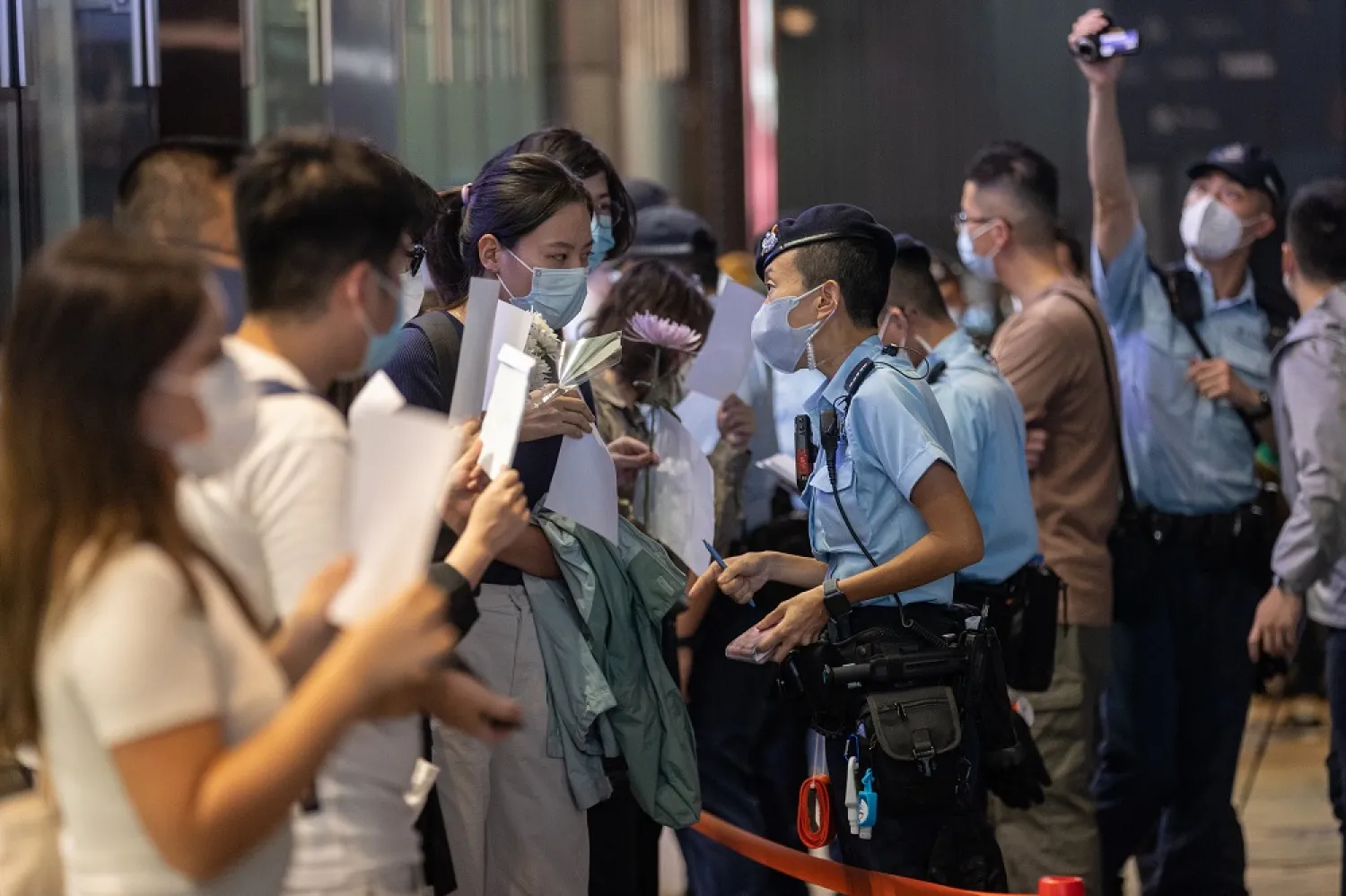
China Cities under Heavy Policing after Protests

Police check mourners during a vigil for the victims of China’s zero-COVID policy and the victims of the Urumqi fire in Hong Kong, China, 28 November 2022. (EPA)
TT

China Cities under Heavy Policing after Protests

Police check mourners during a vigil for the victims of China’s zero-COVID policy and the victims of the Urumqi fire in Hong Kong, China, 28 November 2022. (EPA)

China's major cities of Beijing and Shanghai were blanketed with security on Tuesday in the wake of nationwide rallies calling for political freedoms and an end to Covid lockdowns.

The country's leadership faced a weekend of protests not seen in decades, as anger over unrelenting lockdowns fuels deep-rooted frustration with the country's political system as a whole.

A deadly fire last week in Urumqi, the capital of northwest China's Xinjiang region, was the catalyst for the wave of outrage, with protesters taking to the streets of cities around the country.

The demonstrators said Covid restrictions were to blame for hampering rescue efforts -- claims the government has denied as it accused "forces with ulterior motives" of linking the fire deaths to the strict Covid controls.

Anger over lockdowns has widened to calls for political change, with protesters holding up blank sheets of paper to symbolize the censorship the world's most populous country is subjected to.

'So many police'

More protests were planned for Monday night but did not materialize, with AFP journalists in Beijing and Shanghai noting a heavy police presence of hundreds of vehicles and officers on the streets.

People who had attended weekend rallies told AFP Monday they had received phone calls from law enforcement officers demanding information about their movements.

In Shanghai, near a site where weekend protests saw bold calls for the resignation of President Xi Jinping, bar staff told AFP they had been ordered to close at 10:00 pm (1400 GMT) for "disease control".

Small clusters of officers were deployed to metro exits near the protest site.

Throughout Monday, AFP journalists saw officers detaining four people, later releasing one, with a reporter counting 12 police cars within 100 meters along Wulumuqi street in Shanghai, the focal point of Sunday's rally.

Despite the overwhelming police deployment, the frustration with zero-Covid remained palpable.

"The (zero-Covid) policies now -- they're just too strict. They kill more people than Covid," one 17-year-old passerby who did not want to be named told AFP, saying he had been surrounded by police when passing through the area.

In an audio recording shared with AFP, a man can be heard asking for his address, to which the passerby -- who asked to be named Ray -- insists law enforcement officers do not "have the right" to demand it.

Elsewhere, rallies did go ahead.

In semi-autonomous Hong Kong, where mass democracy protests erupted in 2019, dozens gathered at the Chinese University to mourn the victims of the Urumqi fire.

"Don't look away. Don't forget," protesters shouted.

In Hangzhou, just over 170 kilometers (106 miles) southwest of Shanghai, there was strict security and sporadic protests in the city's downtown, with one attendee telling AFP that 10 people were detained.

"The atmosphere was disorderly. There were few people and we were separated. There were lots of police, it was chaos," she said.

Such widespread rallies are exceptionally rare, with authorities harshly clamping down on all opposition to the central government.

But China's strict control of information and continued travel curbs have made verifying protester numbers across the vast country challenging.

US President Joe Biden is monitoring the unrest, the White House said Monday.

Around the world, solidarity protests also mushroomed.

"Officials are borrowing the pretext of Covid, but using excessively strict lockdowns to control China's population," one 21-year-old Chinese participant in a Washington protest who gave only his surname, Chen, told AFP.

"They disregarded human lives and caused many to die in vain," he said.

‘Will calm down soon’

China's leaders are committed to zero-Covid, which compels local governments to impose snap lockdowns and quarantine orders, and limit freedom of movement in response to minor outbreaks.

But there are signs that some local authorities are taking steps to relax some of the rules and dampen the unrest.

In Urumqi, an official said Tuesday the city would give a one-off payment of 300 yuan ($42) to each person with "low income or no income", and announced a five-month rent exemption for some households.

Beijing has banned "the practice of barring building gates in closed-off residential compounds", official news agency Xinhua said on Sunday.

The practice has fueled public anger as people found themselves locked in their homes during minor outbreaks.

And an influential state media commentator suggested that Covid controls could be further relaxed -- while insisting the public "will soon calm down".

"I can give an absolute prediction: China will not become chaotic or out of control," Hu Xijin, with the state-run tabloid Global Times, said on Twitter -- which is banned in China.

"China may walk out of the shadow of Covid-19 sooner than expected."


China Says Xi-Putin-Trump Meeting Has ‘Groundbreaking Significance’

US President Donald Trump looks at Chinese President Xi Jinping as Xi arrives ahead of a state visit at Joint Base Andrews, Maryland, US, September 23, 2026. (Reuters)
TT

China Says Xi-Putin-Trump Meeting Has ‘Groundbreaking Significance’

US President Donald Trump looks at Chinese President Xi Jinping as Xi arrives ahead of a state visit at Joint Base Andrews, Maryland, US, September 23, 2026. (Reuters)

China's Foreign Ministry said on Monday that this week's trilateral meeting between the Chinese, US and Russian leaders is of "groundbreaking significance" and will promote world peace and stability.

The meeting between Chinese President Xi Jinping, US President Donald Trump and Russian President Vladimir Putin will take place on Thursday in China's southern city of Shenzhen, the site of this week's APEC summit.

Trump will raise efforts to reduce nuclear arms at the meeting, ‌the White House ‌said last week. China has rebuffed attempts ‌to ⁠talk about nuclear ⁠arms with Russia and the United States, which have the largest stockpiles of such weapons.

Chinese Foreign Ministry spokesperson Mao Ning told reporters in Beijing this would be the first face-to-face meeting among the heads of state of China, Russia, and the United States.

"They will exchange views in ⁠depth on safeguarding world peace and promoting strategic ‌stability in major-power relations, which ‌is of groundbreaking significance," she added.

Under the current circumstances, the ‌three countries bear an important responsibility to cooperate in ‌addressing global challenges and to promote world peace and stability, Mao said.

"Stronger communication among China, Russia, and the United States, along with managing differences and stabilizing relations, serves the interests of all ‌three countries," she added.

It also meets the expectations of the international community, and helps "stabilize the ⁠global situation ⁠and advance dialogue and cooperation".

Mao did not give details of what exactly is on the agenda for the trilateral meeting.

Speaking in Manila on Monday, UN chief Antonio Guterres said the United Nations is prepared to support any denuclearization effort that may arise from the summit meeting of the three countries.

China has said it was more appropriate for Russia and the US to speak directly because of their large arsenals.

The UN has long advocated nuclear disarmament, warning that rising geopolitical tension and growing rivalry among major powers have fueled global nuclear risks.


Ukraine Hits Russia’s Crimea Bridge in 1,300-Drone Barrage

A view taken on October 14, 2022 shows the Kerch Bridge that links Crimea to Russia, near Kerch, which was hit by a blast on October 8, 2022. (AFP)
TT

Ukraine Hits Russia’s Crimea Bridge in 1,300-Drone Barrage

A view taken on October 14, 2022 shows the Kerch Bridge that links Crimea to Russia, near Kerch, which was hit by a blast on October 8, 2022. (AFP)

Ukraine fired hundreds of drones at Russia overnight, aiming towards Moscow and hitting a symbolic bridge that links the annexed Crimean peninsula to Russia.

The strike on the bridge appeared to inflict only minor damage, though drew an angry response from Russian-installed officials.

Ukraine launched 1,336 drones in the barrage, Moscow's defense ministry said in a statement -- the second-highest daily figure so far this year, according to an AFP tally of official Russian statements.

The barrage came days before a summit in Shenzhen between President Vladimir Putin, US President Donald Trump and Chinese President Xi Jinping. US officials say Russia's war against Ukraine is not expected to be a focus of the talks.

"The enemy has hit the Crimea bridge," Crimean's Russian-installed governor Sergey Aksyonov wrote on Telegram. "As a result, traffic will be restricted, likely until the afternoon."

He did not say whether anyone was killed or wounded in the strike. Social media channels close to the Russian army indicated no serious damage had been sustained in the attack.

The bridge has been a key target for Ukraine since Russia launched its offensive in February 2022.

It has been struck several times, including an October 2022 blast in which an explosive-packed truck was detonated on the bridge, causing months of disruption.

Around 600 of the drones were intercepted on approach to the Russian capital, Moscow Mayor Sergei Sobyanin said.

The interceptions came hours after Ukrainian forces struck a major Russian petrochemical plant, an oil refinery and a military production site.

Kyiv says its retaliatory strikes are justified retribution for Moscow's own missile and drone barrages of its cities and energy grid -- attacks that have killed hundreds of civilians and regularly knock out power and heating for millions.

- 'World peace' -

Diplomatic efforts on ending the almost five-year war have so far gone nowhere.

After a fresh round of talks in Abu Dhabi last week, Russian President Vladimir Putin reiterated his hardline territorial demands and said any deployment of foreign troops would be seen in Moscow as a "continuation of war."

Ukrainian President Volodymyr Zelensky said the United States had proposed Kyiv ceding some territory in exchange for being given NATO membership.

Moscow has repeatedly said it will not accept Ukraine being admitted to the US-led alliance.

Against that backdrop, China confirmed on Monday that Xi would hold talks with Trump and Putin in Shenzhen on November 19 on the sidelines of the Asia-Pacific Economic Cooperation (APEC) summit.

The Kremlin and White House had previously confirmed the meeting.

Beijing said the trio would discuss "world peace".

Trump has said he intends to discuss denuclearization and the Iran war.

He is not expected to discuss Russia's war against Ukraine in the trilateral talks, according to US officials.

Zelensky has warned that the Shenzhen meeting risks becoming a 21st-century version of the 1945 Yalta conference, where major powers could attempt to redraw spheres of influence without smaller countries at the table.


Israeli Opposition Chiefs Denounce Netanyahu Over ‘Attempted Coup’

 Israeli Prime Minister Benjamin Netanyahu, Former military chief Gadi Eisenkot, and other Israeli officials gather for a family photo on the day of the inauguration of Israel's 26th parliament, at the Knesset in Jerusalem, November 10, 2026. (Reuters)
Israeli Prime Minister Benjamin Netanyahu, Former military chief Gadi Eisenkot, and other Israeli officials gather for a family photo on the day of the inauguration of Israel's 26th parliament, at the Knesset in Jerusalem, November 10, 2026. (Reuters)
TT

Israeli Opposition Chiefs Denounce Netanyahu Over ‘Attempted Coup’

 Israeli Prime Minister Benjamin Netanyahu, Former military chief Gadi Eisenkot, and other Israeli officials gather for a family photo on the day of the inauguration of Israel's 26th parliament, at the Knesset in Jerusalem, November 10, 2026. (Reuters)
Israeli Prime Minister Benjamin Netanyahu, Former military chief Gadi Eisenkot, and other Israeli officials gather for a family photo on the day of the inauguration of Israel's 26th parliament, at the Knesset in Jerusalem, November 10, 2026. (Reuters)

Two Israeli opposition leaders denounced Monday an "attempted coup" following press reports that outgoing Prime Minister Benjamin Netanyahu's office tried to frame members of an Arab-Israeli party ahead of last month's election.

"As more and more details come to light, it becomes clear: This wasn't an attempt to disrupt the elections. It was an attempted coup," wrote Yair Lapid on X, who headed the opposition in the previous legislature and co-chairs the Beyachad list.

Israel's Channel 12 reported Sunday that on the eve of the October 27 election, Netanyahu's chief of staff Ido Norden had phoned in a complaint to the police about members of the Arab-Israeli Raam party.

Norden reportedly pointed the police to a purported intelligence source -- a former employee of Netanyahu's office -- who provided information that led to the arrest of three Raam members.

The three men were later released when the police determined that the information was unfounded.

Netanyahu subsequently accused Arab parties of electoral fraud after they gained a record number of seats. His Likud party issued a statement denying the latest allegations.

The Israeli newspaper Haaretz also reported that David Zini, head of the Shin Bet domestic security service, sought to wiretap leaders of the other Arab slate, the Joint List, but the attorney general turned down his request due to lack of evidence.

Following the report, Joint List leader Yousef Jabareen also denounced an "attempted coup by Netanyahu".

"If the findings are confirmed, this is a criminal mechanism that operated from the heart of government to rig the election results. Everyone found responsible must be held accountable, including Netanyahu," he wrote on X.

Raam's number two, former police chief Yoav Segalovitz, called for an urgent investigation.

"These suspicions require an immediate, independent and thorough criminal investigation that reaches everyone involved, at every level and in every role," he wrote on X.

"Netanyahu cried out that his election was being stolen, while he himself tried to steal the country and is still trying to do so now," he added.

Netanyahu's main rival, former army chief of staff Gadi Eisenkot, wrote on Sunday that the caretaker prime minister "cannot remain at the head of the government for a minute longer".

Neither Netanyahu's bloc nor Eisenkot's opposition secured the 61 seats required to form a government following last month's election.

The two Arab parties, the Joint List and Raam, have indicated support for Eisenkot.