


‘End of an Era’: Former Chinese President Jiang Zemin Dies at 96

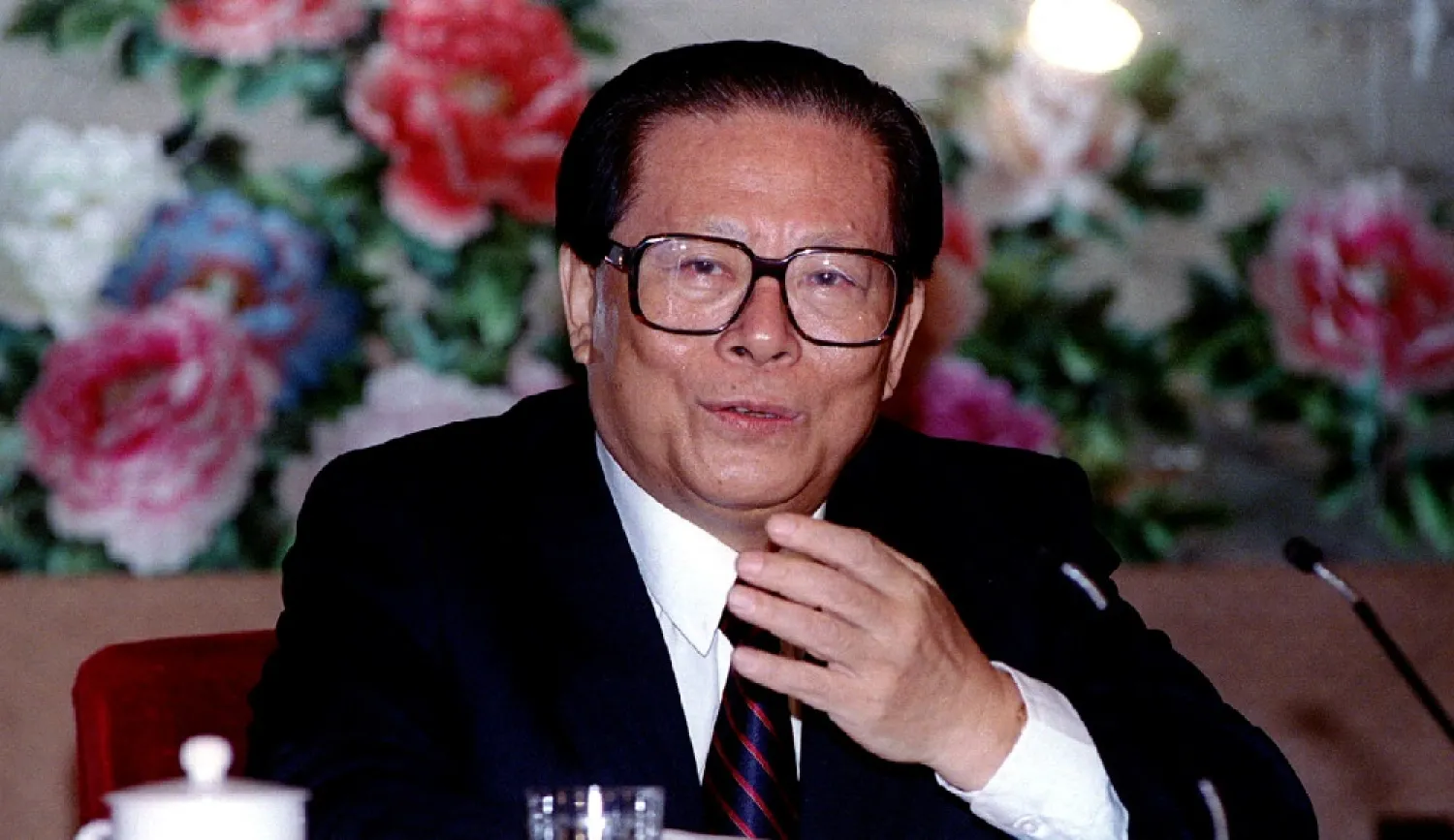
China's President Jiang Zemin gestures during his press conference in Beijing, China, September 2, 1994. (Reuters)
TT

‘End of an Era’: Former Chinese President Jiang Zemin Dies at 96

China's President Jiang Zemin gestures during his press conference in Beijing, China, September 2, 1994. (Reuters)

Former Chinese President Jiang Zemin, who led the country for a decade of rapid economic growth after the Tiananmen crackdown in 1989, died on Wednesday at the age of 96, Chinese state media reported.

Jiang died in his home city of Shanghai just after noon on Wednesday of leukemia and multiple organ failure, Xinhua news agency said, publishing a letter to the Chinese people by the ruling Communist Party, parliament, Cabinet and the military.

"Comrade Jiang Zemin's death is an incalculable loss to our Party and our military and our people of all ethnic groups," the letter read, saying its announcement was with "profound grief".

Jiang's death comes at a tumultuous time in China, where authorities are grappling with rare widespread street protests among residents fed up with heavy-handed COVID-19 curbs nearly three years into the pandemic.

The zero-COVID policy is a hallmark of President Xi Jinping, who recently secured a third leadership term that cements his place as China's most powerful leader since Mao Zedong and has taken China in an increasingly authoritarian direction since replacing Jiang's immediate successor, Hu Jintao.

China is also in the midst of a sharp economic slowdown exacerbated by zero-COVID.

Numerous users of China's Twitter-like Weibo platform described the death of Jiang, who remained influential after finally retiring in 2004, as the end of an era.

"I'm very sad, not only for his departure, but also because I really feel that an era is over," a Henan province-based user wrote.

"As if what has happened wasn't enough, 2022 tells people in a more brutal way that an era is over," a Beijing Weibo user posted.

The online pages of state media sites including People's Daily and Xinhua turned to black and white in mourning.

Wednesday's letter described "our beloved Comrade Jiang Zemin" as an outstanding leader of high prestige, a great Marxist, statesman, military strategist and diplomat and a long-tested communist fighter.

Jiang was plucked from obscurity to head China's ruling Communist Party after the bloody Tiananmen crackdown on pro-democracy protesters in 1989, but broke the country out of its subsequent diplomatic isolation, mending fences with the United States and overseeing an unprecedented economic boom.

He served as president from 1993 to 2003 but held China's top job, as head of the ruling Communist Party, from 1989 and handed over that role to Hu in 2002. He only gave up the position as head of the military in 2004, which he also assumed in 1989.

When Jiang retired, it was said by sources close to the leadership at the time that everywhere Hu looked he would see the supporters of his predecessor.

Jiang had stacked China's most powerful leadership body, the Politburo Standing Committee, with his own protégées, many of them from the so-called "Shanghai Gang".

But in the years after Jiang retired from his final post, the military commission chairmanship in 2004, Hu consolidated his grip, neutralized the Shanghai Gang and successfully anointed Xi as a successor.



Trump Says 'World Is Not Secure' Unless US Controls Greenland

Danish soldiers walk in front of Joint Arctic Command in Nuuk, Greenland, January 16, 2026. REUTERS/Marko Djurica
TT

Trump Says 'World Is Not Secure' Unless US Controls Greenland

Danish soldiers walk in front of Joint Arctic Command in Nuuk, Greenland, January 16, 2026. REUTERS/Marko Djurica

President Donald Trump told the Norwegian prime minister in a message published Monday that the world would not be secure unless the US controlled the Danish autonomous territory of Greenland.

"The World is not secure unless we have Complete and Total Control of Greenland," Trump said in the message to Jonas Gahr Store.

The authenticity of the message was confirmed to AFP by Store's office.


Death Toll in Spanish Train Collision Rises to at Least 39 as Rescue Efforts Continue

Members of the Spanish Civil Guard, along with other emergency personnel, work next to one of the trains involved in the accident, at the site of a deadly derailment of two high-speed trains near Adamuz, in Cordoba, Spain, January 19, 2026. (Reuters)
TT

Death Toll in Spanish Train Collision Rises to at Least 39 as Rescue Efforts Continue

Members of the Spanish Civil Guard, along with other emergency personnel, work next to one of the trains involved in the accident, at the site of a deadly derailment of two high-speed trains near Adamuz, in Cordoba, Spain, January 19, 2026. (Reuters)

Spanish police said Monday that at least 39 people are confirmed dead in a high-speed train collision the previous night in the south of the country, and rescue efforts were continuing.

Video and photos showed twisted train cars lying on their sides under floodlights. Passengers reported climbing out of smashed windows, with some using emergency hammers to break the windows, according to Salvador Jiménez, a journalist for Spanish broadcaster RTVE, who was on board one of the derailed trains.

He told the network by phone Sunday that “there was a moment when it felt like an earthquake and the train had indeed derailed.”

The crash occurred when the tail end of a train carrying some 300 passengers on the route from Malaga to the capital, Madrid, went off the rails at 7:45 p.m. It slammed into an incoming train traveling from Madrid to Huelva, another southern Spanish city, according to rail operator Adif.

The collision took place near Adamuz, a town in the province of Cordoba, about 370 kilometers (about 230 miles) south of Madrid.

Spanish police said 159 people were injured, of whom five were in critical condition. A further 24 were in serious condition, authorities said. Transport Minister Óscar Puente said the death toll was not final.

In Adamuz, a sports center was turned into a makeshift hospital and the Spanish Red Cross set up a help center offering assistance to emergency services and people seeking information. Members of Spain’s civil guard and civil defense worked on site throughout the night.

Puente early Monday said the cause of the crash was unknown.

He called it “a truly strange” incident because it happened on a flat stretch of track that had been renovated in May. He also said the train that jumped the track was less than 4 years old. That train belonged to the private company Iryo, while the second train, which took the brunt of the impact, was part of Spain’s public train company, Renfe.

According to Puente, the back part of the first train derailed and crashed into the head of the other train, knocking its first two carriages off the track and down a 4-meter (13-foot) slope. He said the worst damage was to the front section of the Renfe train.

When asked by reporters how long an inquiry into the crash’s cause could take, he said it could be a month.

Spanish Prime Minister Pedro Sánchez expressed his condolences to the victims' families. “Tonight is a night of deep pain for our country,” he wrote on X.

Spain has the largest rail network in Europe for trains moving over 250 kph (155 mph), with more than 3,100 kilometers (1,900 miles) of track, according to the European Union.

The network is a popular, competitively priced and safe mode of transport. Renfe said more than 25 million passengers took one of its high-speed trains in 2024.

Train services Monday between Madrid and cities in Andalusia were canceled.

Spain’s worst train accident this century occurred in 2013, when 80 people died after a train derailed in the country’s northwest. An investigation concluded the train was traveling 179 kph (111 mph) on a stretch with an 80 kph (50 mph) speed limit when it left the tracks.


Thousands March in US to Back Iranian Anti-government Protesters

Protesters participate in a demonstration in support of the nationwide mass protests in Iran against the government, in Berlin, Germany, Sunday, Jan. 18, 2026. (AP Photo/Ebrahim Noroozi)
TT

Thousands March in US to Back Iranian Anti-government Protesters

Protesters participate in a demonstration in support of the nationwide mass protests in Iran against the government, in Berlin, Germany, Sunday, Jan. 18, 2026. (AP Photo/Ebrahim Noroozi)

Thousands in the United States staged large demonstrations Sunday denouncing the Iranian government's deadly crackdown on anti-government protesters in Iran.

Several thousand people marched in Los Angeles, home to the world's largest Iranian diaspora, while several hundred others gathered in New York, AFP journalist's in both cities reported.

US protesters could be seen carrying signs condemning a "New Holocaust," a "genocide in the making," and the "terror" of the Iranian government.

"My heart is heavy and my soul is crushed, I'm at loss for words to describe how angry I am," said Perry Faraz at the demonstration in Los Angeles, the second-largest city in the US.

The 62-year-old payroll manager, who fled Iran in 2006, learned this week that one of her young cousins had been killed during the overseas rallies held in her native country.

"He wasn't even 10 years old, that's horrible," she said.

Demonstrations sparked by anger over economic hardship exploded into protests late December in what has been widely seen as the biggest challenge to the Iranian leadership in recent years.

The rallies subsided after a government crackdown in Iran that rights groups have called a "massacre" carried out by security forces under the cover of a communications blackout that started on January 8.

Norway-based Iran Human Rights says it has verified the deaths of 3,428 protesters killed by security forces, confirming cases through sources within Iran’s health and medical system, witnesses and independent sources.

The NGO warned that the true toll is likely to be far higher. Media cannot independently confirm the figure and Iranian officials have not given an exact death toll.

- Calls for US intervention -

"This mass murdering of the population is terribly upsetting," Ali Parvaneh, a 65-year-old lawyer protesting in LA said.

Like many protesters, Parvaneh carried a "Make Iran Great Again" sign and said he wanted US President Donald Trump to intervene by targeting the country's powerful Iranian Revolutionary Guard Corps (IRGC).

Some in the crowd in LA went as far as to call for the assassination of Iranian Supreme Leader Ali Khamenei, who has been in power for more than 25 years.

After having attacked Iranian nuclear sites in June, Trump sent mixed signals on possible US intervention this week.

The Republican first threatened to intervene if Iranian protesters were killed, but then said he was satisfied by Iranian assurances that demonstrators would not be executed.

"I really hope that Trump will go one step beyond just voicing support," Parvaneh said.

Many protesting in the Californian city chanted slogans in support of the US president and Reza Pahlavi, the son of the former Shah of Iran who was deposed by the popular uprising in 1979.

- 'Don't need a puppet' -

Parvaneh echoed Pahlavi's popularity among some segments of Iran's exiled and expatriate population.

"Had the monarchy stayed in place, it would be much different and Iran would be in a much better situation," he said.

Pahlavi's support base is concentrated abroad while his political sway within Iran is limited.

The former Shah's son, who lives in exile near Washington, said this week he would be ready to return to Iran -- but it is unclear if most Iranians want this.

The Iranian opposition remains divided, and memories of the Shah's brutal repression of his left-wing opponents remain vivid.

Last week, a man caused minor injuries when he drove a truck into a demonstration held by Iranians in Los Angeles, carrying a sign that read: "No Shah. No Regime. USA: Don't Repeat 1953. No Mullah."

The sign was referring to the 1953 coup that saw Iran's government overthrown in a US- and UK-backed operation that had seen Pahlavi installed as the country's leader.

In Los Angeles's Westwood neighborhood, nicknamed "Tehrangeles," Roozbeh Farahanipour believes the diaspora must support Iranians without infringing on their "right to decide their own future."

"They don't need a puppet implanted by the West," said the 54-year-old restaurant owner.

Others in California also share that view.

"Trump is playing the Iranian people," said poet Karim Farsis, a resident of the San Francisco Bay area.

Farsis, an academic, stresses that it is US sanctions -- including those imposed by Trump -- and the Republican's ripping up of a nuclear deal that have contributed in large part to the suffering of the Iranian people.

She also criticized the almost complete ban on Iranians entering the US since June.

"We're living in a really twisted moment," she said. "Trump is saying to Iranians: 'Keep protesting, take over your institutions.'

"But if they find themselves in danger, they can't even find refuge in the United States."