

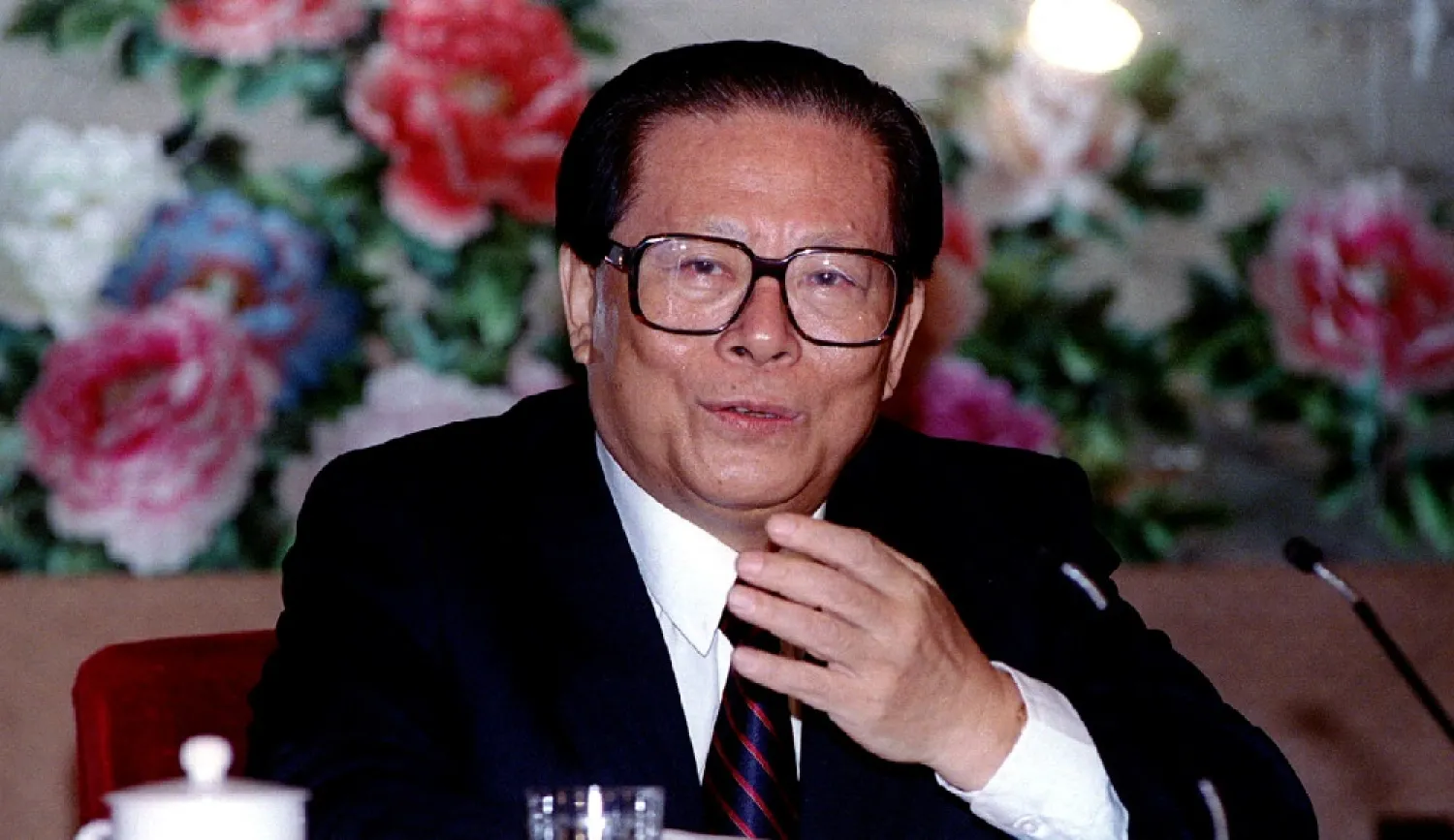

‘End of an Era’: Former Chinese President Jiang Zemin Dies at 96

China's President Jiang Zemin gestures during his press conference in Beijing, China, September 2, 1994. (Reuters)
TT

‘End of an Era’: Former Chinese President Jiang Zemin Dies at 96

China's President Jiang Zemin gestures during his press conference in Beijing, China, September 2, 1994. (Reuters)

Former Chinese President Jiang Zemin, who led the country for a decade of rapid economic growth after the Tiananmen crackdown in 1989, died on Wednesday at the age of 96, Chinese state media reported.

Jiang died in his home city of Shanghai just after noon on Wednesday of leukemia and multiple organ failure, Xinhua news agency said, publishing a letter to the Chinese people by the ruling Communist Party, parliament, Cabinet and the military.

"Comrade Jiang Zemin's death is an incalculable loss to our Party and our military and our people of all ethnic groups," the letter read, saying its announcement was with "profound grief".

Jiang's death comes at a tumultuous time in China, where authorities are grappling with rare widespread street protests among residents fed up with heavy-handed COVID-19 curbs nearly three years into the pandemic.

The zero-COVID policy is a hallmark of President Xi Jinping, who recently secured a third leadership term that cements his place as China's most powerful leader since Mao Zedong and has taken China in an increasingly authoritarian direction since replacing Jiang's immediate successor, Hu Jintao.

China is also in the midst of a sharp economic slowdown exacerbated by zero-COVID.

Numerous users of China's Twitter-like Weibo platform described the death of Jiang, who remained influential after finally retiring in 2004, as the end of an era.

"I'm very sad, not only for his departure, but also because I really feel that an era is over," a Henan province-based user wrote.

"As if what has happened wasn't enough, 2022 tells people in a more brutal way that an era is over," a Beijing Weibo user posted.

The online pages of state media sites including People's Daily and Xinhua turned to black and white in mourning.

Wednesday's letter described "our beloved Comrade Jiang Zemin" as an outstanding leader of high prestige, a great Marxist, statesman, military strategist and diplomat and a long-tested communist fighter.

Jiang was plucked from obscurity to head China's ruling Communist Party after the bloody Tiananmen crackdown on pro-democracy protesters in 1989, but broke the country out of its subsequent diplomatic isolation, mending fences with the United States and overseeing an unprecedented economic boom.

He served as president from 1993 to 2003 but held China's top job, as head of the ruling Communist Party, from 1989 and handed over that role to Hu in 2002. He only gave up the position as head of the military in 2004, which he also assumed in 1989.

When Jiang retired, it was said by sources close to the leadership at the time that everywhere Hu looked he would see the supporters of his predecessor.

Jiang had stacked China's most powerful leadership body, the Politburo Standing Committee, with his own protégées, many of them from the so-called "Shanghai Gang".

But in the years after Jiang retired from his final post, the military commission chairmanship in 2004, Hu consolidated his grip, neutralized the Shanghai Gang and successfully anointed Xi as a successor.



South Korea’s Ex-President Yoon Apologizes After Life Sentence Over Martial Law 

South Korean President Yoon Suk Yeol  delivers a speech to declare martial law in Seoul, South Korea, December 3, 2024. (The Presidential Office/Handout via Reuters/File Photo)
South Korean President Yoon Suk Yeol delivers a speech to declare martial law in Seoul, South Korea, December 3, 2024. (The Presidential Office/Handout via Reuters/File Photo)
TT

South Korea’s Ex-President Yoon Apologizes After Life Sentence Over Martial Law 

South Korean President Yoon Suk Yeol  delivers a speech to declare martial law in Seoul, South Korea, December 3, 2024. (The Presidential Office/Handout via Reuters/File Photo)
South Korean President Yoon Suk Yeol delivers a speech to declare martial law in Seoul, South Korea, December 3, 2024. (The Presidential Office/Handout via Reuters/File Photo)

Former ‌South Korean President Yoon Suk Yeol apologized on Friday for his short-lived declaration of martial law in December 2024, a day after a Seoul court sentenced him to life in prison for masterminding an insurrection.

In a statement released by his lawyers, Yoon said that while he was sorry for the "frustration and hardship" brought upon the people by his martial law decree, he stood behind the "sincerity and purpose" behind his actions.

The Seoul Central District Court's decision ‌to hand him ‌a life sentence on Thursday was "predetermined," he ‌said, ⁠adding that the verdict ⁠against him was political retaliation.

"Forces that seek to smear a decision made to save the nation as an 'insurrection' and to use it beyond political attacks as an opportunity to purge and eliminate their opponents will only grow more rampant going forward," he said.

Yoon also questioned ⁠whether an appeal would have meaning ‌in what he described as an ‌environment where judicial independence could not be guaranteed, while telling ‌supporters to "unite and rise."

His lawyers separately said the statement ‌did not amount to an intention to forgo an appeal.

Yoon's martial law declaration lasted around six hours before being voted down by parliament, but it sent shockwaves through the country and ‌sparked street protests.

The court found Yoon guilty of subverting constitutional order by deploying troops ⁠to storm ⁠parliament and move to detain opponents, capping a dramatic fall that saw him stripped of office and end up behind bars.

Yoon, a former career prosecutor, denied the charges, arguing he had presidential authority to declare martial law and his action was aimed at sounding the alarm over opposition parties' obstruction of government.

A special prosecutor had sought the death penalty for Yoon, though South Korea has not carried out an execution since 1997.

A prosecutor said on Thursday the team had some "regret" over the sentencing, but declined to say whether they planned to appeal.


Russia Hits Ukraine's Oil, Gas Infrastructure in Poltava Region, Naftogaz Says

FILE PHOTO: A Ukrainian service member of the 14th Unmanned Aerial Systems Regiment prepares a deep strike unmanned aerial vehicle before its launch toward Russian territory, amid Russia's attack on Ukraine, in an undisclosed location in Ukraine, undisclosed date, 2025. REUTERS/Valentyn Ogirenko/File Photo
TT

Russia Hits Ukraine's Oil, Gas Infrastructure in Poltava Region, Naftogaz Says

FILE PHOTO: A Ukrainian service member of the 14th Unmanned Aerial Systems Regiment prepares a deep strike unmanned aerial vehicle before its launch toward Russian territory, amid Russia's attack on Ukraine, in an undisclosed location in Ukraine, undisclosed date, 2025. REUTERS/Valentyn Ogirenko/File Photo

Russian drones hit Ukraine's oil and gas infrastructure in the central Poltava region, causing ‌damage ‌and a ‌fire, ⁠the state energy company ⁠Naftogaz said on Friday.

"This is yet another targeted ⁠attack on ‌our ‌oil and ‌gas infrastructure. ‌Since the beginning of the year, the ‌enemy has attacked Naftogaz Group facilities ⁠more ⁠than 20 times," Sergii Koretskyi, Naftogaz CEO said in a post on Facebook.


Kim Jong Un Vows to Boost Living Standards as He Opens Rare Congress 

This picture taken on February 19, 2026 and released by North Korea's official Korean Central News Agency (KCNA) on February 20, 2026 shows North Korean leader Kim Jong Un delivering the opening address at the Ninth Congress of the Workers' Party of Korea in Pyongyang. (KCNA VIA KNS / AFP)
TT

Kim Jong Un Vows to Boost Living Standards as He Opens Rare Congress 

This picture taken on February 19, 2026 and released by North Korea's official Korean Central News Agency (KCNA) on February 20, 2026 shows North Korean leader Kim Jong Un delivering the opening address at the Ninth Congress of the Workers' Party of Korea in Pyongyang. (KCNA VIA KNS / AFP)

North Korean leader Kim Jong Un vowed to lift living standards as he opened a landmark congress, state media said Friday, offering a glimpse of economic strains within the sanctions-hit nation.

Supreme Leader Kim took center stage with a speech to start the Workers' Party congress, a gathering that directs state efforts on everything from house building to war planning.

Held just once every five years, the days-long congress offers a rare glimpse into the workings of a nation where even mundane details are shrouded in secrecy.

"Today, our party is faced with heavy and urgent historic tasks of boosting economic construction and the people's standard of living and transforming all realms of state and social life as early as possible," Kim said in his opening speech.

"This requires us to wage a more active and persistent struggle without allowing even a moment's standstill or stagnation."

For decades, nuclear weapons and military prowess came before everything else in North Korea, even as food stocks dried up and famine took hold.

But since assuming power in 2011, Kim has stressed the need to also fortify the impoverished nation's economy.

At the last party congress in 2021, Kim made an extremely rare admission that mistakes had been made in "almost all areas" of economic development.

Analysts believe such language is designed to head off public discontent stirred by food shortages, military spending, and North Korea's continued support for Russia's war effort in Ukraine.

Kim said North Korea had overcome its "worst difficulties" in the last five years, and was now entering a new stage of "optimism and confidence in the future".

North Korea's economy has for years languished under heavy Western sanctions that aim to choke off funding for its nuclear weapons program.

But Pyongyang refuses to surrender its atomic arsenal.

Kim has already declared this year's congress will unveil the next phase in the nation's nuclear weapons program.

- Ruling dynasty -

Thousands of party elites packed the cavernous House of Culture in Pyongyang for the opening day of the congress.

It is just the ninth time the Workers' Party congress has convened under the Kim family's decades-long rule.

The meeting was shelved under Kim's father Kim Jong Il, but was revived in 2016.

Kim Jong Un has spent years stoking his cult of personality in reclusive North Korea, and the congress offers another chance to demonstrate his absolute grip on power.

Footage showed Kim stepping out of a black limousine and striding into the meeting flanked by officials.

Delegates broke into hearty applause as he took his place at the center of the imposing rostrum overlooking proceedings.

Analysts will scour photographs to see which officials are seated closest to Kim, and who is banished to the back row.

Particular attention will be placed on the whereabouts of Kim's teenage daughter Ju Ae, who has emerged as North Korea's heir apparent, according to Seoul's national intelligence service.

- 'Biggest enemy' -

The ruling parties of China and Russia -- North Korea's longtime allies -- sent friendly messages to mark the start of the meeting.

"In recent years, under the strategic guidance of the top leaders of the two parties and two countries, China-DPRK relations have entered a new historical period," said a telegram from the Chinese Communist Party, using the official acronym for North Korea.

Kim appeared alongside China's Xi Jinping and Russia's Vladimir Putin at a military parade in Beijing last year -- a striking display of his elevated status in global politics.

At the previous congress five years ago, Kim declared that the United States was his nation's "biggest enemy".

There is keen interest in whether Kim might use the congress to soften this stance, or double down.

US President Donald Trump stepped up his courtship of Kim during a tour of Asia last year, saying he was "100 percent" open to a meeting.

Kim has so far largely shunned efforts to resume top-level diplomatic dialogue.