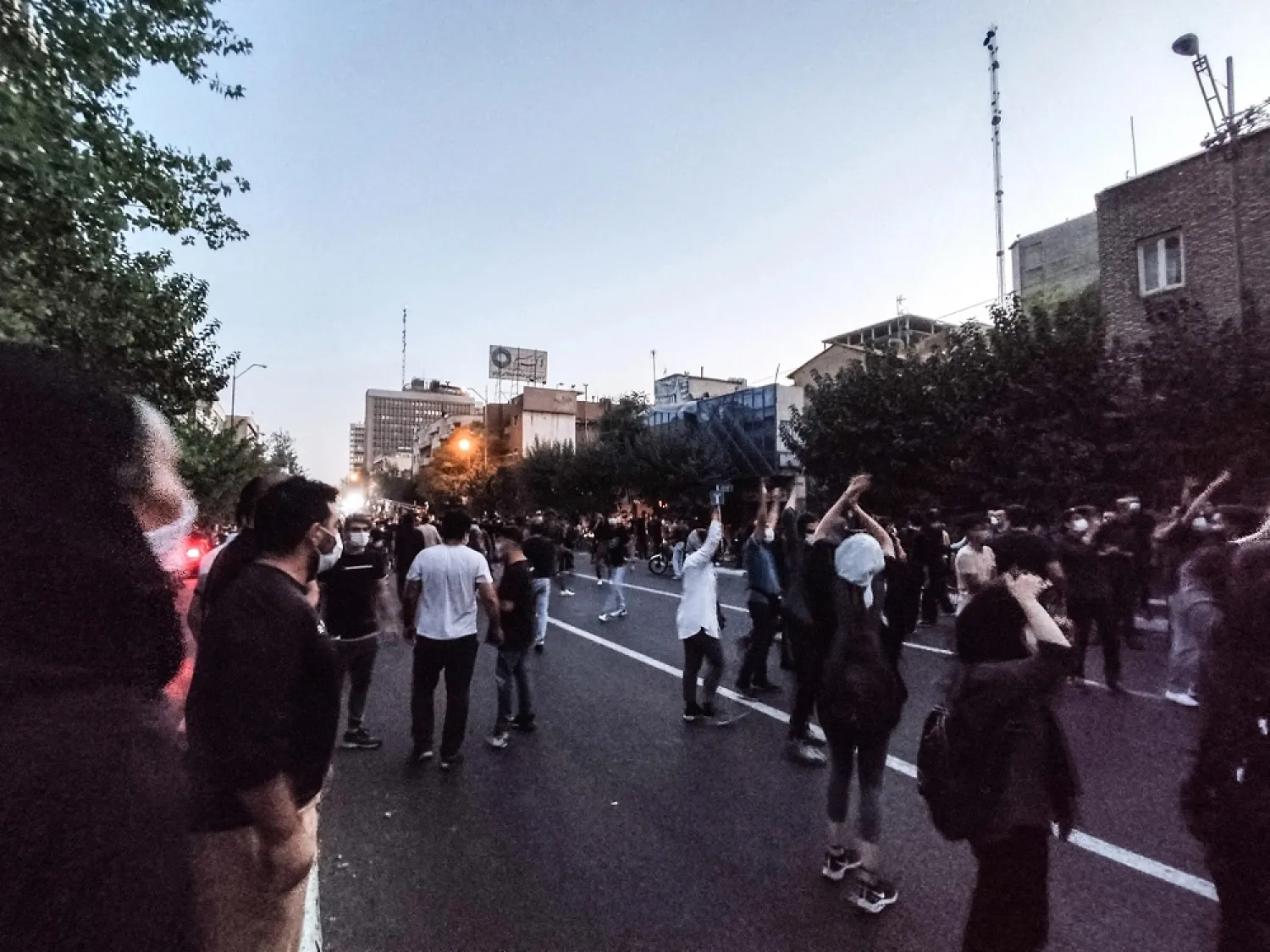
Women Join Protests in Iran’s Conservative Southeast 

Women in Iran's Sistan-Baluchistan province on Friday joined nationwide protests sparked by Mahsa Amini's death. (AFP file photo)
TT

Women Join Protests in Iran’s Conservative Southeast 

Women in Iran's Sistan-Baluchistan province on Friday joined nationwide protests sparked by Mahsa Amini's death. (AFP file photo)

Black-clad women in Iran's Sistan-Baluchistan province on Friday joined nationwide protests sparked by Mahsa Amini's death, in what a rights group called a "rare" move in the staunchly conservative region. 

Online videos showed dozens of women on the streets of the provincial capital Zahedan holding banners that declared "Woman, life, freedom" -- one of the main slogans of the protest movement that erupted in mid-September.  

"Whether with hijab, whether without it, onwards to revolution," women dressed in body-covering chador garments chanted in videos posted on Twitter and verified by AFP. 

Women-led protests have swept Iran since Amini, a 22-year-old Iranian of Kurdish origin, died following her arrest in Tehran for an alleged breach of the Islamic republic's dress code based on sharia law.  

Security forces have killed at least 448 protesters, with the largest toll in Sistan-Baluchistan on Iran's southeastern border with Afghanistan and Pakistan, according to Iran Human Rights, an Oslo-based non-governmental organization.  

"It is indeed rare," IHR director Mahmood Amiry-Moghaddam said of the protests by women in Zahedan, which has seen men take to the streets after Friday prayers for more than two months.  

"The ongoing protests in Iran are the beginning of a revolution of dignity," he told AFP.  

"Women and minorities, who have for more than four decades been treated as second class citizens, are empowered through these protests to come out to the streets and demand their fundamental human rights."  

Baluchi women were among the "most oppressed" in Iran and their protests were the most organized by them so far since demonstrations broke out across the country, Amiry-Moghaddam added.  

Scores of men also took to the streets again on Friday, chanting "we don't want a child-killing government", footage posted online by activists showed.  

Security forces were seen opening fire with bird shot and tear gas on male protesters in Taftan, a locality in Sistan-Baluchistan, in a video published by IHR.  

'Bloody Friday' 

Mainly Sunni Muslim Sistan-Baluchistan is Iran's poorest region whose ethnic Baluch inhabitants feel discriminated against.  

At least 128 people have been killed in Sistan-Baluchistan during the protest crackdown, according to IHR, by far its biggest toll for deaths recorded in 26 of Iran's 31 provinces.  

More than 90 of them were killed on September 30 alone -- a massacre that activists have dubbed "Black Friday".  

Those protests were triggered by the alleged rape in custody of a 15-year-old girl by a police commander in the province's port city of Chabahar.  

Analysts say the Baluchi were inspired by the protests that flared over Amini's death, which were initially driven by women's rights but expanded over time to include other grievances.  

"Iran's Baluchi minority face entrenched discrimination that curtails their access to education, health care, employment, adequate housing and political office," Amnesty International said on Tuesday.  

"The Baluchi minority have borne the brunt of the vicious crackdown by security forces during the uprising that has swept across Iran since September," Amnesty said in a statement.  

The second province on IHR's list is Amini's home province of Kurdistan on Iran's western border with Iraq, another epicenter of the protests with a Sunni majority, where 53 people died.  

Iran accuses its arch enemy the United States and its allies Britain and Israel of fomenting what it calls "riots".  

State news agency IRNA on Friday reported that authorities had summoned foreign diplomats 12 times since the protests erupted "in reaction... to unprecedented pressure" imposed on Tehran by their countries.  

Foreign Minister Hossein Amir-Abdollahian meanwhile complained, in a phone call with UN chief Antonio Guterres, about "actions carried out by the United States and other Western countries to incite riots in Iran", IRNA said.  

Iran has blamed protest-related violence in Kurdistan on separatists, and has repeatedly launched deadly cross-border strikes on Kurdish groups exiled in Iraq.  

An Iranian general said this week that "more than 300 martyrs and people" have been killed in the unrest.  

Thousands of Iranians and around 40 foreigners have been arrested during the demonstrations and more than 2,000 people have been charged, according to the country's judicial authorities.  

On Friday, UN experts urged Iran to release prominent rights activist Arash Sadeghi from "unlawful" detention, saying he suffers from "life-threatening bone cancer". 


Israeli Opposition Chiefs Denounce Netanyahu Over ‘Attempted Coup’

 Israeli Prime Minister Benjamin Netanyahu, Former military chief Gadi Eisenkot, and other Israeli officials gather for a family photo on the day of the inauguration of Israel's 26th parliament, at the Knesset in Jerusalem, November 10, 2026. (Reuters)
Israeli Prime Minister Benjamin Netanyahu, Former military chief Gadi Eisenkot, and other Israeli officials gather for a family photo on the day of the inauguration of Israel's 26th parliament, at the Knesset in Jerusalem, November 10, 2026. (Reuters)
TT

Israeli Opposition Chiefs Denounce Netanyahu Over ‘Attempted Coup’

 Israeli Prime Minister Benjamin Netanyahu, Former military chief Gadi Eisenkot, and other Israeli officials gather for a family photo on the day of the inauguration of Israel's 26th parliament, at the Knesset in Jerusalem, November 10, 2026. (Reuters)
Israeli Prime Minister Benjamin Netanyahu, Former military chief Gadi Eisenkot, and other Israeli officials gather for a family photo on the day of the inauguration of Israel's 26th parliament, at the Knesset in Jerusalem, November 10, 2026. (Reuters)

Two Israeli opposition leaders denounced Monday an "attempted coup" following press reports that outgoing Prime Minister Benjamin Netanyahu's office tried to frame members of an Arab-Israeli party ahead of last month's election.

"As more and more details come to light, it becomes clear: This wasn't an attempt to disrupt the elections. It was an attempted coup," wrote Yair Lapid on X, who headed the opposition in the previous legislature and co-chairs the Beyachad list.

Israel's Channel 12 reported Sunday that on the eve of the October 27 election, Netanyahu's chief of staff Ido Norden had phoned in a complaint to the police about members of the Arab-Israeli Raam party.

Norden reportedly pointed the police to a purported intelligence source -- a former employee of Netanyahu's office -- who provided information that led to the arrest of three Raam members.

The three men were later released when the police determined that the information was unfounded.

Netanyahu subsequently accused Arab parties of electoral fraud after they gained a record number of seats. His Likud party issued a statement denying the latest allegations.

The Israeli newspaper Haaretz also reported that David Zini, head of the Shin Bet domestic security service, sought to wiretap leaders of the other Arab slate, the Joint List, but the attorney general turned down his request due to lack of evidence.

Following the report, Joint List leader Yousef Jabareen also denounced an "attempted coup by Netanyahu".

"If the findings are confirmed, this is a criminal mechanism that operated from the heart of government to rig the election results. Everyone found responsible must be held accountable, including Netanyahu," he wrote on X.

Raam's number two, former police chief Yoav Segalovitz, called for an urgent investigation.

"These suspicions require an immediate, independent and thorough criminal investigation that reaches everyone involved, at every level and in every role," he wrote on X.

"Netanyahu cried out that his election was being stolen, while he himself tried to steal the country and is still trying to do so now," he added.

Netanyahu's main rival, former army chief of staff Gadi Eisenkot, wrote on Sunday that the caretaker prime minister "cannot remain at the head of the government for a minute longer".

Neither Netanyahu's bloc nor Eisenkot's opposition secured the 61 seats required to form a government following last month's election.

The two Arab parties, the Joint List and Raam, have indicated support for Eisenkot.


France Temporarily Bans Firework Mortars Amid School Protests

Protesters clash with riot police during a demonstration against rising living costs and cuts to public services in Paris, France, 14 November 2026. (EPA)
TT

France Temporarily Bans Firework Mortars Amid School Protests

Protesters clash with riot police during a demonstration against rising living costs and cuts to public services in Paris, France, 14 November 2026. (EPA)

France has temporarily banned the sale and use of firework mortars that some protesters have used against police forces and near schools during nationwide street protests and school blockades, ‌the Interior ‌Ministry said on ‌X.

⁠The ban, which ⁠will be in effect until November 27, is aimed at "preventing the risk of serious disturbances to ⁠public order during blockades outside ‌secondary ‌schools and universities, as well ‌as during demonstrations, ‌resulting from the use of pyrotechnic devices and fireworks," it said.

France has ‌been swept by protests that began ⁠in ⁠September, when students demanded the renovation of school buildings, more teachers and university reforms.

These demonstrations grew into broader cost-of-living protests, drawing in trade unions and political activists, which sometimes turned violent.


Pakistan Vows US-Iran Diplomacy

 Pakistan's Foreign Minister Ishaq Dar, right, greets to his Iranian counterpart Abbas Araghchi upon arrival to attend the Economic Cooperation Organization (ECO) Council of Ministers meeting, in Islamabad, Pakistan, Monday, Nov. 16, 2026. (AP)
Pakistan's Foreign Minister Ishaq Dar, right, greets to his Iranian counterpart Abbas Araghchi upon arrival to attend the Economic Cooperation Organization (ECO) Council of Ministers meeting, in Islamabad, Pakistan, Monday, Nov. 16, 2026. (AP)
TT

Pakistan Vows US-Iran Diplomacy

 Pakistan's Foreign Minister Ishaq Dar, right, greets to his Iranian counterpart Abbas Araghchi upon arrival to attend the Economic Cooperation Organization (ECO) Council of Ministers meeting, in Islamabad, Pakistan, Monday, Nov. 16, 2026. (AP)
Pakistan's Foreign Minister Ishaq Dar, right, greets to his Iranian counterpart Abbas Araghchi upon arrival to attend the Economic Cooperation Organization (ECO) Council of Ministers meeting, in Islamabad, Pakistan, Monday, Nov. 16, 2026. (AP)

Pakistan Foreign Minister Ishaq Dar said his country would proceed with diplomatic efforts to ease tensions between the United States and Iran with the support of other regional countries gathered Monday at a meeting of the Economic Cooperation Organization.

The meeting of the 10-member ECO in Pakistan’s capital Islamabad was attended by foreign ministers and senior diplomats from several Asian countries, including Iranian Foreign Minister Abbas Araghchi.

The meeting is expected to focus on expanding regional cooperation, particularly in trade and commerce, through stronger transportation and trade links between members including Afghanistan, Iran, Pakistan, Türkiye and several former Soviet republics.

Dar also said improved ties with neighboring Afghanistan depended on the Afghan Taliban government’s actions to stop terrorism. There was no diplomat from Afghanistan at the meeting on Monday.

Tensions between Pakistan and Afghanistan have escalated this year during repeated border clashes and Pakistani airstrikes, deepening a longstanding dispute over militant activity.

Pakistan says regional stability key to economic development

Pakistan hosted the first round of direct talks in April between the US and Iran. The two sides signed an interim deal in June to end the conflict while accusing each other of prolonging the standoff over the Strait of Hormuz.

At the ECO meeting Monday, Dar said peace and stability were essential for economic development and that Pakistan remained “deeply concerned about conflict and instability” in the region.

“Their consequences extend beyond national boundaries, disrupting trade routes, energy supplies, investment, and the economic projects of our peoples,” he said. “Peace and development reinforce each other.”

Araghchi urged ECO members to strengthen cooperation and turn shared commitments into concrete action, adding that Iran had consistently upheld international law and the peaceful settlement of disputes, Iran’s state-run IRNA news agency reported.

“Over the past two years, Iran has remained committed to diplomatic engagement and peaceful solutions,” he said.

Araghchi accused the US of pursuing “aggression, threats, targeted assassinations, economic coercion, and blockades,” which he described as violations of international law and the UN Charter. He blamed the US and Israel for insecurity in the Arabian Gulf and developments surrounding the Strait of Hormuz.

“This reality cannot be misrepresented,” Araghchi said.

Pakistan has consistently advocated for “the peaceful resolution of disputes through dialogue and diplomacy in accordance with international law and the United Nations Charter,” Dar said, adding that Pakistan Prime Minister Shehbaz Sharif and army chief Field Marshal Asim Munir remained closely engaged with regional countries and international partners to facilitate peaceful outcomes.

“Pakistan will continue these diplomatic efforts in support of dialogue, de-escalation and lasting regional stability,” Dar said.

Pakistan has repeatedly called for reopening the Strait of Hormuz. The closure of the strategic waterway has caused a sharp increase in oil prices and impacted Pakistan's ailing economy.

Pakistan seeks ‘meaningful progress’ with Afghanistan

Pakistan wants its neighbor Afghanistan to be peaceful, prosperous and stable, fully integrated into the ECO framework and at peace with itself and neighboring countries, Dar said.

“Such an outcome would serve not only the Afghan people, but also the wider region, opening important avenues for trade, transit and economic cooperation,” he said. “At the same time, meaningful progress requires the Afghan authorities to address the legitimate security concerns of the neighboring countries, particularly the threat of terrorism.”

Pakistan frequently accuses Afghanistan’s Taliban government of sheltering the Pakistani Taliban, known as Tehrik-e-Taliban Pakistan, or TTP, as well as the outlawed Baloch Liberation Army, or BLA, and al-Qaeda in the Indian Subcontinent, an affiliate of the global extremist network.

The TTP is separate but closely allied with Afghanistan’s Taliban and has been emboldened since the Taliban returned to power in 2021. Pakistan says militant violence has surged because of the Afghan government's support of TTP and other Pakistani militants, a charge Kabul denies.