

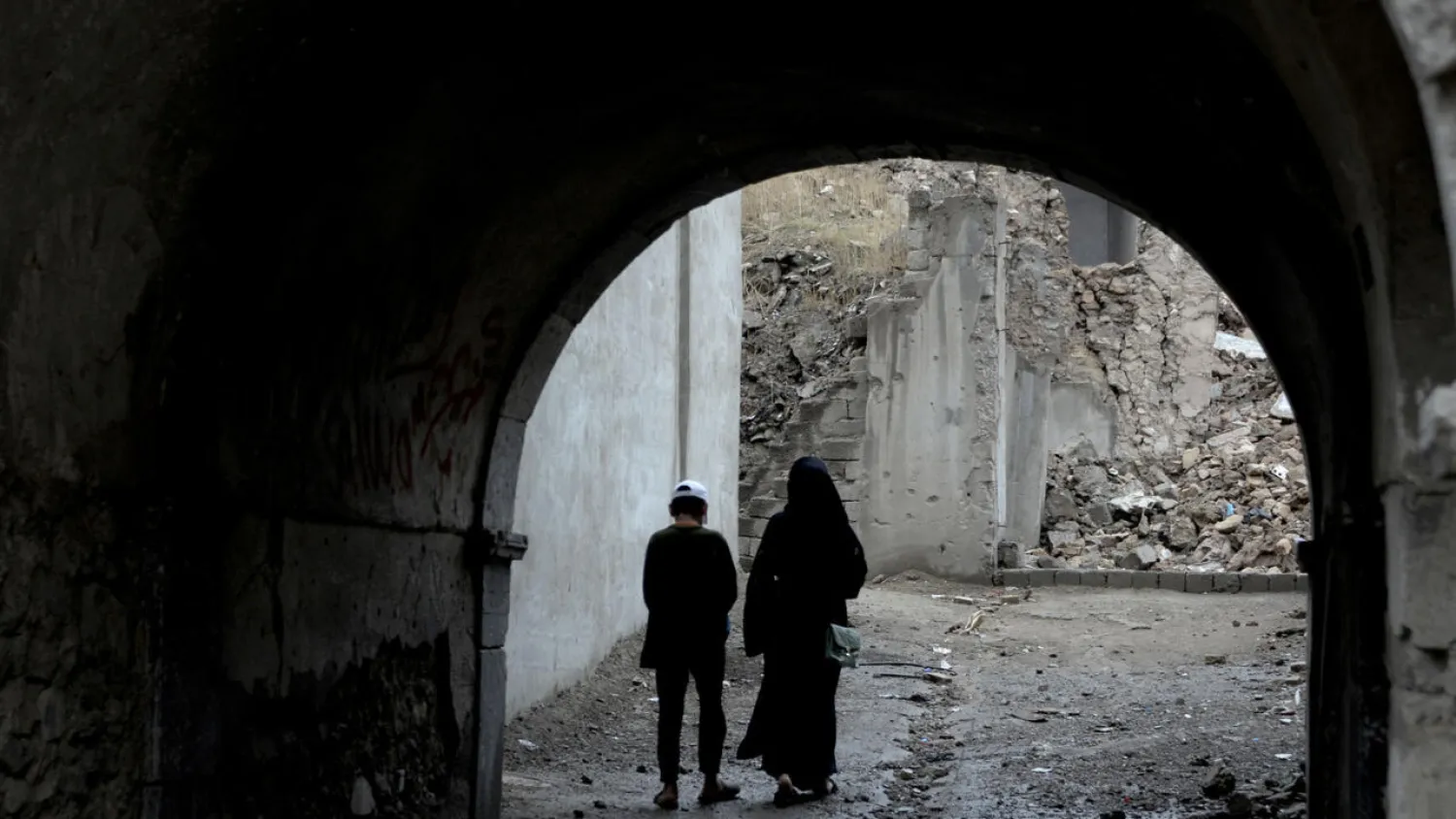

Iraq's Mosul Healing Slowly, Five Years after ISIS Defeat

Ramshackle public services and deep economic difficulties continue to hamper people's daily lives in Mosul and elsewhere in Iraq. Zaid AL-OBEIDI / AFP
TT

Iraq's Mosul Healing Slowly, Five Years after ISIS Defeat

Ramshackle public services and deep economic difficulties continue to hamper people's daily lives in Mosul and elsewhere in Iraq. Zaid AL-OBEIDI / AFP

Five years after it emerged from the ISIS group's extremist rule, Iraq's once thriving cultural center of Mosul has regained a semblance of normalcy despite sluggish reconstruction efforts.

However, like in much of oil-rich but war-ravaged Iraq, ramshackle public services and deep economic difficulties continue to hamper people's daily lives, AFP said.

Ghazwan Turki is just one of Mosul's many residents who struggle to make ends meet in the former ISIS stronghold, where the extremists declared the establishment of a "caliphate" in 2014.

Mosul urgently needs "job opportunities for families that have no income, to improve their living conditions", Turki said.

The father of 12 and aged in his 40s, who lived for years in displacement camps, juggles shifts as a taxi driver and different odd jobs.

"We have to borrow money and get into debt to cover half of our family's needs," said Turki, who shares a single-storey house with his brother.

While acknowledging "progress" in rebuilding efforts, he described "overcrowded schools, where there are 60 or 70 students in a classroom".

Iraqi forces with the help of a US-led coalition wrested back Mosul in July 2017 after grueling street fighting, and Iraq claimed victory over ISIS on December 9 that year.

Signs of reconstruction dot the city of 1.5 million, with workers constructing a new bridge, and cafes and restaurants buzzing.

But many buildings and public hospitals are still in ruins, and in the Old City, some areas are still just piles of rubble.

- 'Lack of jobs' -
Mosul, Iraq's second city, has historically been among the Arab world's most culturally significant settlements -- a hub for trade and home to mosques, churches, shrines, tombs and libraries.

Today, in the wider Nineveh province, a third of people are estimated to be unemployed and 40 percent live in poverty, according to local authorities.

The Norwegian Refugee Council, which has provided aid to some 100,000 Mosul residents, has noted "rising unemployment, high dropout rates (at schools), and limited economic opportunities across the city".

NRC's communication coordinator Noor Taher said that although reconstruction continues, many people are particularly worried about "under-resourced schools, overstretched teachers and lack of jobs".

The International Rescue Committee says that "economic conditions in Mosul remain dire for many families".

An IRC survey of over 400 homes reported "an alarming spike" in child labor rates, with around 90 percent of families sending at least one minor to work and some three-quarters toiling in "informal and dangerous roles" such as construction, or litter and scrap metal collection.

Mayor Amin al-Memari said the city was working on several "strategic projects", but funding remained a key obstacle.

Despite the construction of about 350 schools in just two years, Mosul still needs 1,000 more to end the "chokehold" in education, Memari added.

There is also "a significant shortage in the health sector," he said, with more hospitals needed, including with oncology and cardiovascular surgery departments.

"Before, we had all of this in Mosul," Memari said.

- 'Spirit of Old Mosul' -
In Mosul's war-damaged Old City -- only steps from the iconic Al-Nuri mosque, where former ISIS leader Abu Bakr al-Baghdadi made his only confirmed public appearance -- Bytna ("Our Home") café is busy.

But when co-founder Bandar Ismail opened it in 2018, people were skeptical.

"We tried to revive the spirit of Old Mosul by opening this café, to attract residents and draw them back to this neighborhood," 26-year-old Ismail said.

"At first... people mocked us and said 'who will come here?' The whole area was destroyed, there must have been just two families here."

Today, customers sip coffee and smoke their hookahs in the café, which also hosts musical performances and art events.

Even French President Emmanuel Macron dropped by during a visit in 2021.

Nearby, bakeries and restaurants have reopened.

"There is more stability, more security," Ismail said.


Israel Military Says Soldier Killed in Gaza 

A drone view shows the destruction in a residential neighborhood, after the withdrawal of the Israeli forces from the area, amid a ceasefire between Israel and Hamas in Gaza, in Gaza City, October 21, 2025. (Reuters)
TT

Israel Military Says Soldier Killed in Gaza 

A drone view shows the destruction in a residential neighborhood, after the withdrawal of the Israeli forces from the area, amid a ceasefire between Israel and Hamas in Gaza, in Gaza City, October 21, 2025. (Reuters)

The Israeli military announced that one of its soldiers had been killed in combat in southern Gaza on Wednesday, but a security source said the death appeared to have been caused by "friendly fire".

"Staff Sergeant Ofri Yafe, aged 21, from HaYogev, a soldier in the Paratroopers Reconnaissance Unit, fell during combat in the southern Gaza Strip," the military said in a statement.

A security source, however, told AFP that the soldier appeared to have been "killed by friendly fire", without providing further details.

"The incident is still under investigation," the source added.

The death brings to five the number of Israeli soldiers killed in Gaza since a ceasefire took effect on October 10.


Syria: SDF’s Mazloum Abdi Says Implementation of Integration Deal May Take Time

People sit outdoors surrounded by nature, with the Tigris river flowing in the background, following a long atmospheric depression, near the Syrian-Turkish border in Derik, Syria, February 16, 2026 REUTERS/Orhan Qereman
TT

Syria: SDF’s Mazloum Abdi Says Implementation of Integration Deal May Take Time

People sit outdoors surrounded by nature, with the Tigris river flowing in the background, following a long atmospheric depression, near the Syrian-Turkish border in Derik, Syria, February 16, 2026 REUTERS/Orhan Qereman

Mazloum Abdi, commander of the Syrian Democratic Forces, said the process of merging the SDF with Syrian government forces “may take some time,” despite expressing confidence in the eventual success of the agreement.

His remarks came after earlier comments in which he acknowledged differences with Damascus over the concept of “decentralization.”

Speaking at a tribal conference in the northeastern city of Hasakah on Tuesday, Abdi said the issue of integration would not be resolved quickly, but stressed that the agreement remains on track.

He said the deal reached last month stipulates that three Syrian army brigades will be created out of the SDF.

Abdi added that all SDF military units have withdrawn to their barracks in an effort to preserve stability and continue implementing the announced integration agreement with the Syrian state.

He also emphasized the need for armed forces to withdraw from the vicinity of the city of Ayn al-Arab (Kobani), to be replaced by security forces tasked with maintaining order.


Israeli Far-Right Minister to Push for ‘Migration’ of West Bank, Gaza Palestinians 

A Palestinian man checks leather belts as people prepare for Ramadan, in the old city of Hebron in the Israeli-occupied West Bank, February 17,2026. (Reuters)
TT

Israeli Far-Right Minister to Push for ‘Migration’ of West Bank, Gaza Palestinians 

A Palestinian man checks leather belts as people prepare for Ramadan, in the old city of Hebron in the Israeli-occupied West Bank, February 17,2026. (Reuters)

Israel's far-right Finance Minister Bezalel Smotrich said he would pursue a policy of "encouraging the migration" of Palestinians from the occupied West Bank and Gaza Strip, Israeli media reported Wednesday.

"We will eliminate the idea of an Arab terror state," said Smotrich, speaking at an event organized by his Religious Zionism Party late on Tuesday.

"We will finally, formally, and in practical terms nullify the cursed Oslo Accords and embark on a path toward sovereignty, while encouraging emigration from both Gaza and Judea and Samaria.

"There is no other long-term solution," added Smotrich, who himself lives in a settlement in the West Bank.

Since last week, Israel has approved a series of measures backed by far-right ministers to tighten control over the West Bank, including in areas administered by the Palestinian Authority under the Oslo Accords, in place since the 1990s.

The measures include a process to register land in the West Bank as "state property" and facilitate direct purchases of land by Jewish Israelis.

The measures have triggered widespread international outrage.

On Tuesday, the UN missions of 85 countries condemned the measures, which critics say amount to de facto annexation of the Palestinian territory.

"We strongly condemn unilateral Israeli decisions and measures aimed at expanding Israel's unlawful presence in the West Bank," they said in a statement.

"Such decisions are contrary to Israel's obligations under international law and must be immediately reversed.

"We underline in this regard our strong opposition to any form of annexation."

UN Secretary-General Antonio Guterres on Monday called on Israel to reverse its land registration policy, calling it "destabilizing" and "unlawful".

The West Bank would form the largest part of any future Palestinian state. Many on Israel's religious right view it as Israeli land.

Israeli NGOs have also raised the alarm over a settlement plan signed by the government which they say would mark the first expansion of Jerusalem's borders into the occupied West Bank since 1967.

The planned development, announced by Israel's Ministry of Construction and Housing, is formally a westward expansion of the Geva Binyamin, or Adam, settlement situated northeast of Jerusalem in the West Bank.

The current Israeli government has fast-tracked settlement expansion, approving a record 52 settlements in 2025.

Excluding Israeli-annexed east Jerusalem, more than 500,000 Israelis live in West Bank settlements and outposts, which are illegal under international law.
