


Israel’s Netanyahu Says He Has Formed New Government

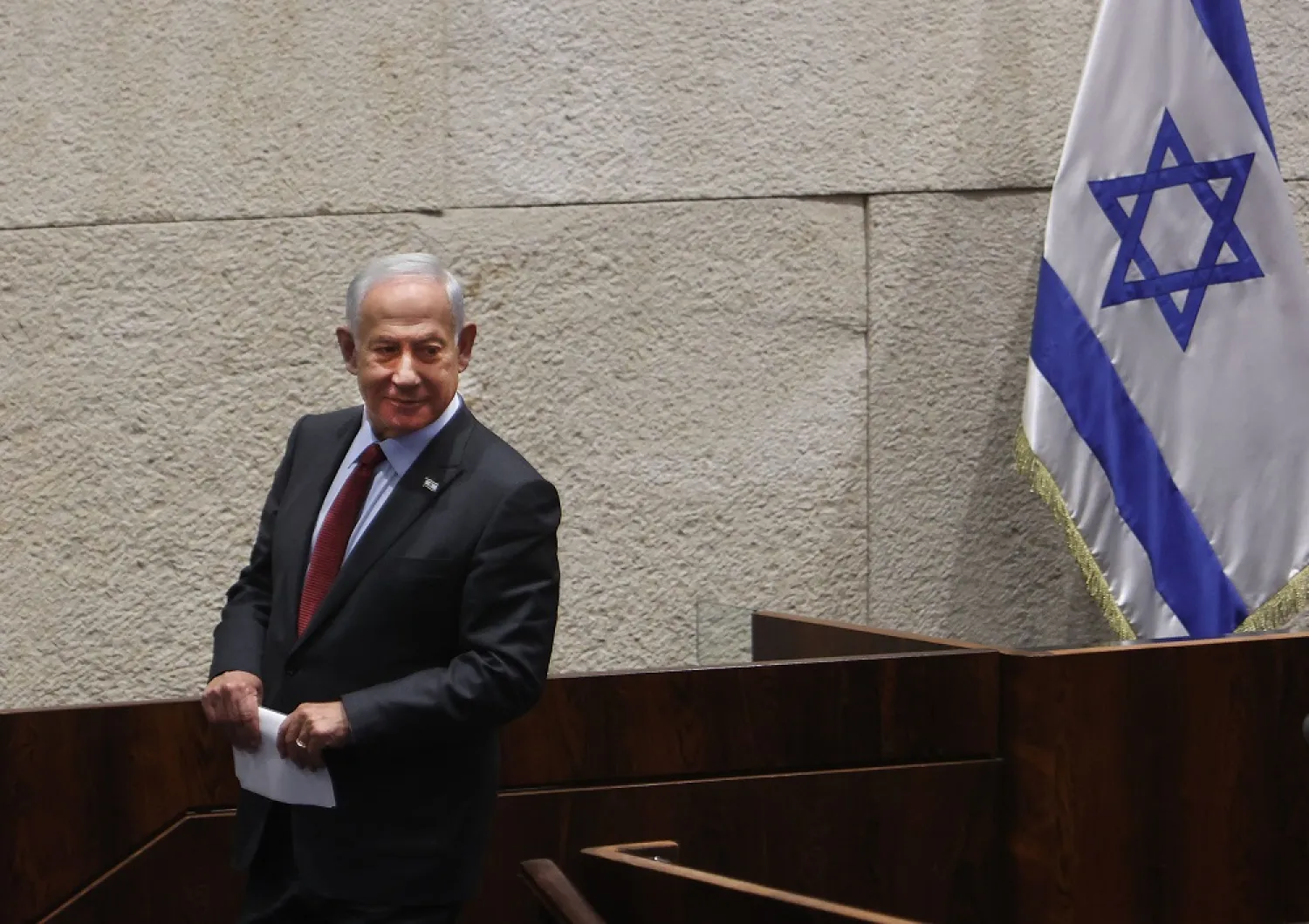
In this file photo taken on December 12, 2022 Israeli prime minister-designate Benjamin Netanyahu looks on after a speech at the Knesset (Israeli parliament) Plenum Hall during a session to elect the new speaker of the assembly in Jerusalem. (AFP)
TT

Israel’s Netanyahu Says He Has Formed New Government

In this file photo taken on December 12, 2022 Israeli prime minister-designate Benjamin Netanyahu looks on after a speech at the Knesset (Israeli parliament) Plenum Hall during a session to elect the new speaker of the assembly in Jerusalem. (AFP)

Designated Prime Minister Benjamin Netanyahu announced late Wednesday that he has successfully formed a new coalition, setting the stage for him to return to power as head of the most right-wing Israeli government ever to hold office.

Netanyahu made the announcement in a phone call to President Isaac Herzog moments before a midnight deadline. His Likud Party released a brief video clip of the smiling Netanyahu and a recording of the conversation.

“I wanted to announce to you that thanks to the amazing public support we received in the elections, I have succeeded in forming a government that will take care of all the citizens of Israel,” Netanyahu said.

The move came after weeks of surprisingly difficult negotiations with his partners – who still have need to finalize their power-sharing deals with Netanyahu’s Likud Party. Nonetheless, Netanyahu said he intends to complete the process “as soon as possible next week” A date for its swearing-in wasn't immediately announced.

Even if he is successful, Netanyahu faces a difficult task ahead. He will preside over a coalition dominated by far-right and ultra-Orthodox partners pushing for dramatic changes that could alienate large swaths of the Israeli public, raise the risk of conflict with the Palestinians and put Israel on a collision course with some of its closest supporters, including the United States and the Jewish American community.

Netanyahu already has reached agreements with some of the most controversial figures in Israeli politics.

Itamar Ben-Gvir, who once was convicted of incitement to racism and supporting a terrorist organization, has been appointed security minister — a new position that will place him in charge of the national police force.

His running mate, Bezalel Smotrich, a West Bank settler leader who believes Israel should annex the occupied territory, is set to receive widespread authority over West Bank settlement construction, in addition to serving as finance minister.

Another ally, Avi Maoz, head of a small religious faction, has been placed in control of parts of the country’s national education system. Maoz, who is openly hostile to the liberal streams of Judaism popular in the US, also has been appointed a deputy minister in charge of “Jewish identity.”

In the Nov. 1 election, Netanyahu and his allies captured a majority of 64 seats in the 120-member Knesset, and he vowed to quickly put together a coalition. But that process turned out to be more complicated than anticipated, in part because his ultra-Orthodox and far-right partners demanded firm guarantees on the scope of their powers.

Before the government is sworn in, Netanyahu will try to push through a series of laws needed to expand Ben-Gvir’s authority over the police and to create a new ministerial position granting Smotrich powers in the West Bank that in the past were held by the defense minister.

The parliament will also try to approve legislation to allow Aryeh Deri, a veteran politician who once served a prison sentence in a bribery case, to serve as a government minister while he is on probation for another conviction earlier this year on tax offenses.

The ultra-Orthodox, meanwhile, are seeking increases in subsidies for their autonomous education system, which has drawn heavy criticism for focusing on religious studies while providing its students few skills for the employment world.

Likud lawmakers have been competing for a shrinking collection of assignments after Netanyahu gave away many plumb jobs to his governing partners.

Netanyahu, who himself is on trial for alleged corruption, is eager to return to office after spending the past year and a half as opposition leader. He and his partners are expected to push through a series of laws shaking up the country’s judiciary and potentially clearing Netanyahu of any charges.

Netanyahu is Israel's longest-serving prime minister, serving a total of 15 years before he was ousted last year. He has claimed he is a victim of overzealous police, prosecutors and judges. But critics say the plans, including an expected proposal that would allow parliament to overturn Supreme Court decisions, will destroy the country’s democratic institutions and system of checks and balances.

Netanyahu has sought to portray himself as the responsible adult in the emerging government, saying in interviews that he will set policies. But his partners are likely to test his limits at every chance.

Ben-Gvir, for instance, who is known his anti-Arab rhetoric and provocative stunts such as brandishing a pistol in a tense Palestinian neighborhood, has called for loosening the rules of engagement allowing security forces to shoot at suspected Palestinian assailants. He also wants to grant soldiers immunity from prosecution in such cases.

He also wants to ease restrictions on Jewish visits to Jerusalem’s most sensitive holy site — a hilltop compound revered by Jews and Muslims. Even the smallest changes at the site have in the past sparked violent clashes, and Ben-Gvir’s plans already have drawn warnings from the Hamas militant group in the Gaza Strip.

Smotrich’s plans to expand West Bank settlement construction and legalize dozens of illegally built outposts could also raise tensions with the Palestinians and the international community. His partners’ animosity toward the Reform and Conservative streams of Judaism have rankled Jewish American groups.

At home, Netanyahu’s expected concessions to the ultra-Orthodox and plans to overhaul the country’s legal system could infuriate many in the country’s secular middle class. Dozens of executives from the powerful high-tech sector last week signed a petition warning that the proposals could drive away investors, and protests against the incoming coalition have already begun.

The US and European Union have both said they will judge the new government by its policies, not its personalities. But in a recent speech, US Secretary of State Antony Blinken made clear he expects it to uphold “shared values” and not take actions that could preclude the establishment of a Palestinian state.

Yohanan Plesner, a former Knesset member who is now president of the Israel Democracy Institute, a Jerusalem think tank, said he expects to see a stable coalition take power in the coming days.

“It’s in the interest of all members of the new coalition to form this government,” he said. “All of them have a lot to gain and much to lose if it’s not formed.”



Turkish FM to Attend Trump’s Board of Peace Meeting in Washington, Italy as ‘Observer’ 

28 November 2025, Berlin: Turkish Foreign Minister Hakan Fidan during a joint press conference with German Foreign Minister Wadephul. (dpa)
TT

Turkish FM to Attend Trump’s Board of Peace Meeting in Washington, Italy as ‘Observer’ 

28 November 2025, Berlin: Turkish Foreign Minister Hakan Fidan during a joint press conference with German Foreign Minister Wadephul. (dpa)

‌Turkish Foreign Minister Hakan Fidan will travel to Washington in lieu of President Recep Tayyip Erdogan for the inaugural meeting of US President Donald Trump's "Board of Peace" on Thursday, the foreign ministry said on Wednesday.

A Turkish diplomatic source told Reuters ‌that Fidan, during the ‌talks, would call ‌for ⁠determined steps to ⁠resolve the Palestinian issue and emphasize that Israel must end actions to hinder the flow of aid into Gaza and stop its ceasefire violations.

Fidan ⁠will also reiterate Türkiye's ‌readiness ‌to contribute to Gaza's reconstruction and its ‌desire to help protect Palestinians ‌and ensure their security, the source said.

He will also call for urgent action against Israel's "illegal ‌settlement activities and settler violence in the West Bank", ⁠the ⁠source added.

According to a readout from Erdogan's office, the president separately told reporters on Wednesday that he hoped the Board of Peace would help achieve "the lasting stability, ceasefire, and eventually peace that Gaza has longed for", and would focus on bringing about a two-state solution.

The board, of which Trump is the chairman, was initially designed to oversee the Gaza truce and the territory's reconstruction after the war between Hamas and Israel.

Meanwhile, Italy will be present at the meeting as an "observer", Italian Foreign Minister Antonio Tajani said Wednesday.

"I will go to Washington to represent Italy as an observer to this first meeting of the Board of Peace, to be present when talks occur and decisions are made for the reconstruction of Gaza and the future of Palestine," Tajani said according to ANSA news agency.

Italy cannot be present as anything more than an observer as the country's constitutional rules do not allow it to join an organization led by a single foreign leader.

But Tajani said it was key for Rome to be "at the forefront, listening to what is being done".

Since Trump launched the Board of Peace at the World Economic Forum in Davos in January, at least 19 countries have signed its founding charter.


Energy Secretary: US to Stop Iran's Nuclear Ambitions 'One Way or the Other'

US Secretary of Energy Chris Wright speaks during a press conference after a meeting with Venezuela's acting president Delcy Rodriguez at the Miraflores Presidential Palace in Caracas on February 11, 2026. (Photo by Juan BARRETO / AFP)
TT

Energy Secretary: US to Stop Iran's Nuclear Ambitions 'One Way or the Other'

US Secretary of Energy Chris Wright speaks during a press conference after a meeting with Venezuela's acting president Delcy Rodriguez at the Miraflores Presidential Palace in Caracas on February 11, 2026. (Photo by Juan BARRETO / AFP)

The United States will deter Iran from acquiring nuclear weapons "one way or the other", US Energy Secretary Chris Wright warned on Wednesday.

"They've been very clear about what they would do with nuclear weapons. It's entirely unacceptable," Wright told reporters in Paris on the sidelines of meetings of the International Energy Agency.

"So one way or the other, we are going to end, deter Iran's march towards a nuclear weapon," Wright said.

US and Iranian officials held talks in Geneva on Tuesday aimed at averting the possibility of US military intervention to curb Tehran's nuclear program.

Iran said following the talks that they had agreed on "guiding principles" for a deal to avoid conflict.

US Vice President JD Vance, however, said Tehran had not yet acknowledged all of Washington's red lines.


Iran, Russia to Conduct Joint Drills in the Sea of Oman 

This handout photo released by Iran's Revolutionary Guards Corps (IRGC)'s official website Sepanews on February 17, 2026, shows boats maneuvering around a tanker vessel during a military exercise by members of the IRGC and navy in the Strait of Hormuz. (Sepahnews / AFP)
TT

Iran, Russia to Conduct Joint Drills in the Sea of Oman 

This handout photo released by Iran's Revolutionary Guards Corps (IRGC)'s official website Sepanews on February 17, 2026, shows boats maneuvering around a tanker vessel during a military exercise by members of the IRGC and navy in the Strait of Hormuz. (Sepahnews / AFP)

Iran and Russia will conduct naval maneuvers in the Sea of Oman on Thursday, following the latest round of talks between Tehran and Washington in Geneva, Iranian media reported.

On Monday, the Revolutionary Guards, the ideological arm of Iran's military, also launched exercises in the strategic Strait of Hormuz, a challenge to US naval forces deployed in the region.

"The joint naval exercise of Iran and Russia will take place tomorrow (Thursday) in the Sea of Oman and in the northern Indian Ocean," the ISNA agency reported, citing drill spokesman, Rear Admiral Hassan Maghsoudloo.

"The aim is to strengthen maritime security and to deepen relations between the navies of the two countries," he said, without specifying the duration of the drill.

The war games come as Iran struck an upbeat tone following the second round of Oman-mediated negotiations in Geneva on Tuesday.

Previous talks between the two foes collapsed following the unprecedented Israeli strike on Iran in June 2025, which sparked a 12-day war that the United States briefly joined.

US President Donald Trump has deployed a significant naval force in the region, which he has described as an "armada."

Iranian officials have repeatedly threatened to block the Strait of Hormuz, particularly during periods of tension with the United States, but it has never been closed.

A key passageway for global shipments of oil and liquefied natural gas, the Strait of Hormuz has been the scene of several incidents in the past and has returned to the spotlight as pressure has ratcheted amid the US-Iran talks.

Iran announced on Tuesday that it would partially close it for a few hours for "security" reasons during its own drills in the strait.