58 Rohingya Muslims Land on Beach in Indonesia’s Aceh

A boat used to carry ethnic Rohingya rests on Indra Patra beach in Ladong village, Aceh province, Indonesia, Sunday, Dec. 25, 2022. (AP)
TT

58 Rohingya Muslims Land on Beach in Indonesia’s Aceh

A boat used to carry ethnic Rohingya rests on Indra Patra beach in Ladong village, Aceh province, Indonesia, Sunday, Dec. 25, 2022. (AP)

Dozens of hungry and weak Rohingya Muslims were found on a beach in Indonesia’s northernmost province of Aceh on Sunday after weeks at sea, officials said. 

The group of 58 men arrived on Indrapatra beach at Ladong, a fishing village in Aceh Besar district, early Sunday, said local police chief Rolly Yuiza Away. Villagers who saw the group of ethnic Rohingya on a rickety wooden boat helped them to land and then reported their arrival to authorities, he said. 

“They look very weak from hunger and dehydration. Some of them are sick after a long and severe voyage at sea,” said Away, adding that the men received food and water from villagers and others as they waited for further instructions from immigration and local officials in Aceh. 

At least three of the men were rushed to a health clinic for medical care, and others are also receiving various medical treatments, Away said. 

The United Nations and other groups on Friday urged countries in South Asia to rescue as many as 190 people believed to be Rohingya refugees aboard a small boat that has been adrift for several weeks in the Andaman Sea. 

“Reports indicate those onboard have now remained at sea for a month in dire conditions with insufficient food or water, without any efforts by States in the region to help save human lives,” the UN refugee agency, UNHCR, said in a statement. “Many are women and children, with reports of up to 20 people dying on the unseaworthy vessel during the journey.” 

Away said it wasn’t clear where the group was traveling from or if they were part of the group of 190 Rohingya refugees that has been adrift in the Andaman Sea. But one of the men who spoke some Malay said they had been at sea for more than a month and had aimed to land in Malaysia to seek a better life and work there. 

More than 700,000 Rohingya Muslims have fled from Buddhist-majority Myanmar to refugee camps in Bangladesh since August 2017, when the Myanmar military launched a clearance operation in response to attacks by a rebel group. Myanmar security forces have been accused of mass rapes, killings and the burning of thousands of homes. 

Groups of Rohingya have attempted to leave the crowded camps in Bangladesh and travel by sea in hazardous voyages to other Muslim-majority countries in the region. 

Muslim-dominated Malaysia has been a common destination for the boats, and traffickers have promised the refugees a better life there. But many Rohingya refugees who land in Malaysia face detention. 

Although Indonesia is not a signatory to the United Nations’ 1951 Refugee Convention, the UNHCR said that a 2016 presidential regulation provides a national legal framework governing the treatment of refugees on boats in distress near Indonesia and to help them disembark. 

These provisions have been implemented for years, most recently last month when about 219 Rohingya refugees, including 63 women and 40 children, were rescued off the coast of North Aceh district aboard two rickety boats. 

“We urge the government of Indonesia to rescue the boats and allow them to safely disembark,” Amnesty International Indonesia's executive director Usman Hamid said. “We also urge the Indonesian government to lead a regional initiative to resolve the refugee crisis.” 

On Thursday, the UN special rapporteur on the situation of human rights in Myanmar, Tom Andrews, urged governments in South and Southeast Asia “to immediately and urgently coordinate search and rescue for this boat and ensure safe disembarkation of those aboard before any further loss of life occurs.” 

“While many in the world are preparing to enjoy a holiday season and ring in a new year, boats bearing desperate Rohingya men, women and young children, are setting off on perilous journeys in unseaworthy vessels,” Andrews said in a statement. 


US Intel Says Iran Still Has 2,500 Missiles

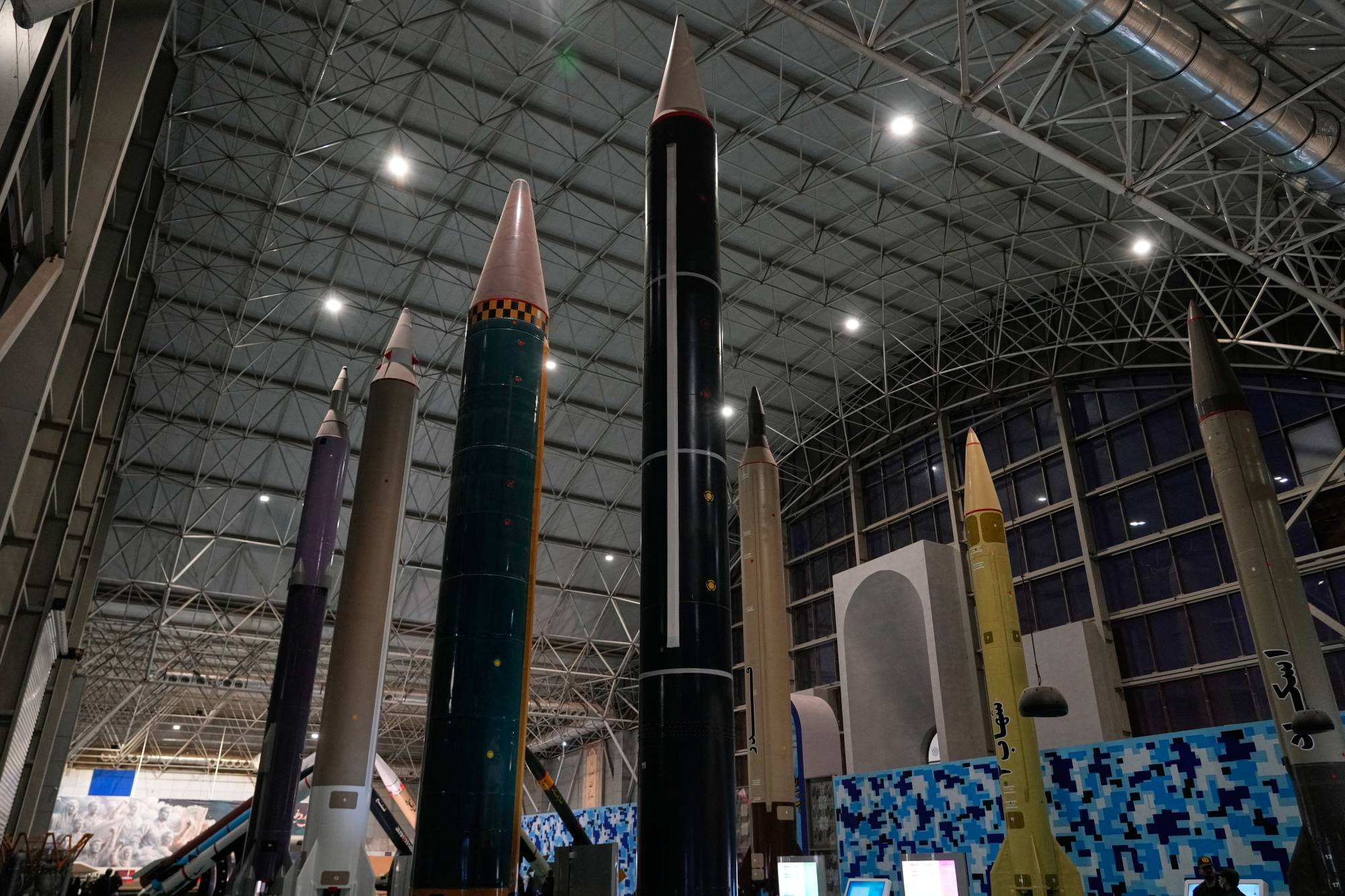
 A woman visits a permanent exhibition of the National Aerospace Park of the Revolutionary Guard, just outside Tehran, Iran, Monday, Nov. 9, 2026. (AP)
A woman visits a permanent exhibition of the National Aerospace Park of the Revolutionary Guard, just outside Tehran, Iran, Monday, Nov. 9, 2026. (AP)
TT

US Intel Says Iran Still Has 2,500 Missiles

 A woman visits a permanent exhibition of the National Aerospace Park of the Revolutionary Guard, just outside Tehran, Iran, Monday, Nov. 9, 2026. (AP)
A woman visits a permanent exhibition of the National Aerospace Park of the Revolutionary Guard, just outside Tehran, Iran, Monday, Nov. 9, 2026. (AP)

The US intelligence community assesses that Iran has between 1,500 and 2,500 missiles in its arsenal, leaving Tehran with significant capacity to attack US and allied targets if all-out war resumes, the Wall Street Journal reported Sunday, citing US officials.

That is a low-confidence assessment, the officials said, due to the complications of tracking the precise number of missiles Iran has ready for launch or in storage. Even so, officials said it was clear Iran retained a formidable stockpile.

Despite the damage inflicted on Iran's missile production facilities by US and Israeli strikes, Tehran has continued replenishing its arsenal, albeit at a slower pace than before the war, relying primarily on components it had stored in advance, according to the WSJ. Iran also retains a large number of drones and short-range missiles, the officials said.

Iran's efforts to replenish its arsenal contradict statements by senior US administration officials, including President Donald Trump himself, that its military had been destroyed.

According to the officials, the rebuilding effort is also influencing internal discussions within the Trump administration over whether to launch another offensive against Iran alongside Israel.

Israeli military officials, meanwhile, estimate that Iran still possesses more than 1,500 ballistic missiles, although assessments vary among officials in the region because of the difficulty of determining the exact number.

Simone Ledeen, who served as deputy assistant secretary of defense for the Middle East during Trump's first term, said that even the lowest estimate of 1,500 missiles would mean Iran had replenished more than half of its estimated prewar stockpile.

She said Tehran rebuilt its arsenal between the 12-day war in June 2025 and the start of the current war in February.

50 missiles a month

Last week, western intelligence assessment cited by Bloomberg indicated that Iran can produce roughly 50 ballistic missiles per month, about half its prewar capacity, despite months of US and “Israeli” airstrikes that have heavily damaged its industrial base.

According to a Western official citing military intelligence reports, Iran most likely retains at least 1,700 ballistic missiles and continues building more at roughly half the prewar rate.

Its conventional military forces have largely been wiped out by the air campaign, yet the remaining stockpile and production capacity provide significant retaliatory potential.

Israel had estimated Iran possessed about 2,500 ballistic missiles before the war.

Since the conflict began on Feb. 28, Iran has launched more than 4,900 Shahed propeller-driven cruise missiles and at least 2,200 ballistic missiles, according to Bloomberg Economics.

Meanwhile, a bigger issue for US forces is missile interceptors: the more than 6,000 weapons Iran launched around the region ate up at least 1,000 Lockheed Martin Corp. Patriot PAC-3 interceptors, according to Bloomberg Economics analysis, $4 million weapons that are produced at a rate of just 650 a year.

Missiles are displayed in a permanent exhibition of the National Aerospace Park of the Revolutionary Guard, just outside Tehran, Iran, Monday, Nov. 9, 2026. (AP)

A WSJ report in April said Iran had thousands of short- and medium-range ballistic missiles at underground sites. US and Israeli strikes had blocked the entrances to some of these facilities. However, satellite images later showed that Iran had managed to clear the debris and regain access to some of them.

An Israeli official said the missiles stored at the underground sites likely survived intact.

Sophisticated tactics

Israeli and US officials said Iran's use of ballistic missiles, drones and more sophisticated tactics to target US military facilities, radar installations and early-warning systems across the Middle East prompted Washington to relocate numerous US military assets to Israel, which is considered safer.

Iran has also improved the effectiveness of its attacks by enhancing its intelligence and targeting data, with the help of allies, including Russia, and through tactics such as combining missiles and drones.

Bilal Saab, senior managing director of Washington-based geopolitical risk firm Trends US, said the number of missiles is not the only thing that matters.

“It's not just the size of that arsenal. It's how Iran uses it, and its commanders have learned a few tricks to be more effective,” he said.

Iran’s messages

In recent days, Iran has sought to send messages regarding the resumption and expansion of its ballistic missile program, after the US and Israeli militaries targeted most of its known missile bases during the recent war.

Iran’s Revolutionary Guard Corps spokesman General Hossein Mohebbi confirmed the removal of the 2,000-kilometer ceiling.

“That restriction has been lifted for us,” he declared, without specifying a new range or whether Iran possessed missiles exceeding the previous limit. He promised to demonstrate those capabilities “in practice.”

Iran is known to possess missiles with a range not exceeding 2,000 kilometers.

Earlier this month, Supreme Leader Mojtaba Khamenei had issued an order to respond to threats of any scale or type with an “immediate and effective response without geographical restrictions.”

Khamenei issued the directives during his first publicly announced meeting with senior military commanders since taking office.

Meanwhile, Iranian state television displayed an inspection of a strategic missile facility belonging to the IRGC.

It aired footage on Tuesday describing the underground complex as a new “missile city.”

During his inspection of the strategic missile facility, Armed Forces Chief of Staff Maj. Gen. Ali Abdollahi said, “If the enemy makes a foolish move, our response will extend beyond the region,” promising further “surprises” in the next war.

On Saturday, Iran’s Tasnim news agency said the country could introduce technical modifications to its long-range missiles, enabling them to reach US territory.

The agency said modifications to the Khorramshahr-4’s warhead could increase its range to 3,000 or 4,000 kilometers by reducing the weight of its warhead to 1,500-kilogram instead of 2,000.


UN to Debate Rules for ‘Killer Robots’

Activists from the Campaign to Stop Killer Robots, a coalition of non-governmental organizations opposing lethal autonomous weapons or so-called "killer robots", stage a protest at Brandenburg Gate in Berlin, Germany, March, 21, 2019. (Reuters)
TT

UN to Debate Rules for ‘Killer Robots’

Activists from the Campaign to Stop Killer Robots, a coalition of non-governmental organizations opposing lethal autonomous weapons or so-called "killer robots", stage a protest at Brandenburg Gate in Berlin, Germany, March, 21, 2019. (Reuters)

Countries will debate whether to start talks on binding rules for autonomous weapons systems -- dubbed "killer robots" by critics -- at the UN from Monday, as concerns grow about their increasing use on the battlefield.

Warfare is undergoing a radical transformation as armies seek to capitalize on the boom in artificial intelligence to boost their fighting abilities by identifying and striking targets more quickly and more accurately.

But a chorus of voices, from campaigners to UN chief Antonio Guterres and Pope Leo XIV, have warned against the dangers of handing the power of life and death to fully autonomous machines.

"The need to regulate autonomous weapons has taken on new urgency" with developments in artificial intelligence, said Laurent Gisel, head of the Weapons and Conduct of Hostilities Unit at the International Committee of the Red Cross (ICRC).

Russia has reportedly used fully autonomous drones to deadly effect in its war on Ukraine, while Ukraine's own defense industry is pushing to develop autonomous "drone swarms".

Human Rights Watch said the meeting in Geneva this week of the UN's Review Conference of the Convention on Conventional Weapons (CCW) would leave civilians "dangerously exposed" if it failed to act decisively.

The meeting will bring together 128 countries to decide whether to open negotiations on legally binding rules.

- 'Carefully cultivated ambiguity' -

But while many states are in favor of tighter rules, as with other advanced military capabilities such as nuclear weapons, countries that have acquired the technology are reluctant to have their hands tied.

At the UN General Assembly last month, 163 states adopted a resolution calling for negotiations on rules governing autonomous weapons.

Five countries voted against -- the United States, Russia, Belarus, Israel and North Korea, which last week boasted of a new AI-enabled torpedo system.

Nine abstained, including Iran and China, which has maintained a "carefully cultivated ambiguity", said Laure de Roucy-Rochegonde of the French Institute of International Relations.

Washington has proposed a five-year process to develop a non-binding instrument, while NGOs and the ICRC are advocating for a one-year timeline.

In 2023, Guterres and ICRC President Mirjana Spoljaric Egger called on states to ban autonomous weapons before 2026.

The ICRC is calling for a ban on two categories of autonomous weapons: so-called "unpredictable autonomous weapons" and those designed or used to directly target humans.

Given the opposition from leading international powers, observers say it looks unlikely agreement will be reached this week to start talks on binding rules.


2 Planes Collide on the Ground in Miami, Only Minor Injuries Reported

FILE - Vehicles drive past the entrance to Miami International Airport in Miami May 12, 2020, (AP Photo/Wilfredo Lee, File)
TT

2 Planes Collide on the Ground in Miami, Only Minor Injuries Reported

FILE - Vehicles drive past the entrance to Miami International Airport in Miami May 12, 2020, (AP Photo/Wilfredo Lee, File)

Federal aviation safety officials on Sunday were investigating a minor collision between two planes at a taxiway intersection at Miami International Airport, where one aircraft's wingtip struck the nose of another, authorities said. Two people reported minor injuries.

The accident happened at about 9 p.m. Saturday and involved a Copa Airlines Boeing 737 passenger aircraft with 172 people aboard and a UPS Boeing 767 cargo plane, according to the National Transportation Safety Board and Copa Airlines. The wing of the Copa flight and the nose of the UPS plane collided, the NTSB said.

Photos taken at the scene show the UPS plane nose with a horizontal gash on one side and a larger hole in the middle, The Associated Press reported.

On audio recorded by ATC.com, a pilot on the UPS plane told air traffic control that he went too far at the intersection and his plane was clipped by the Copa flight. Air traffic control told the UPS pilot that he was supposed to yield to the Copa aircraft.

The NTSB said it was gathering information and may provide an update on Sunday.

The Copa plane had just arrived from Panama City and the UPS plane was headed to Bogota, Colombia, officials said.

In a statement on social media, Copa called the collision minor and said two of its passengers were treated at the scene for minor injuries.

UPS said it was working with authorities to determine what happened.

“We cannot speculate on the details of the incident,” UPS said in a statement.

“The National Transportation Safety Board is responsible for investigating incidents like this and will control the flow of information.”

The mishap came two months after an Amazon cargo plane careened off a runway at Miami International and smashed into a van carrying workers for a company that cleans airplanes, killing five people.