
Iran Executes British-Iranian Accused of Spying, Prompts Western Condemnation 

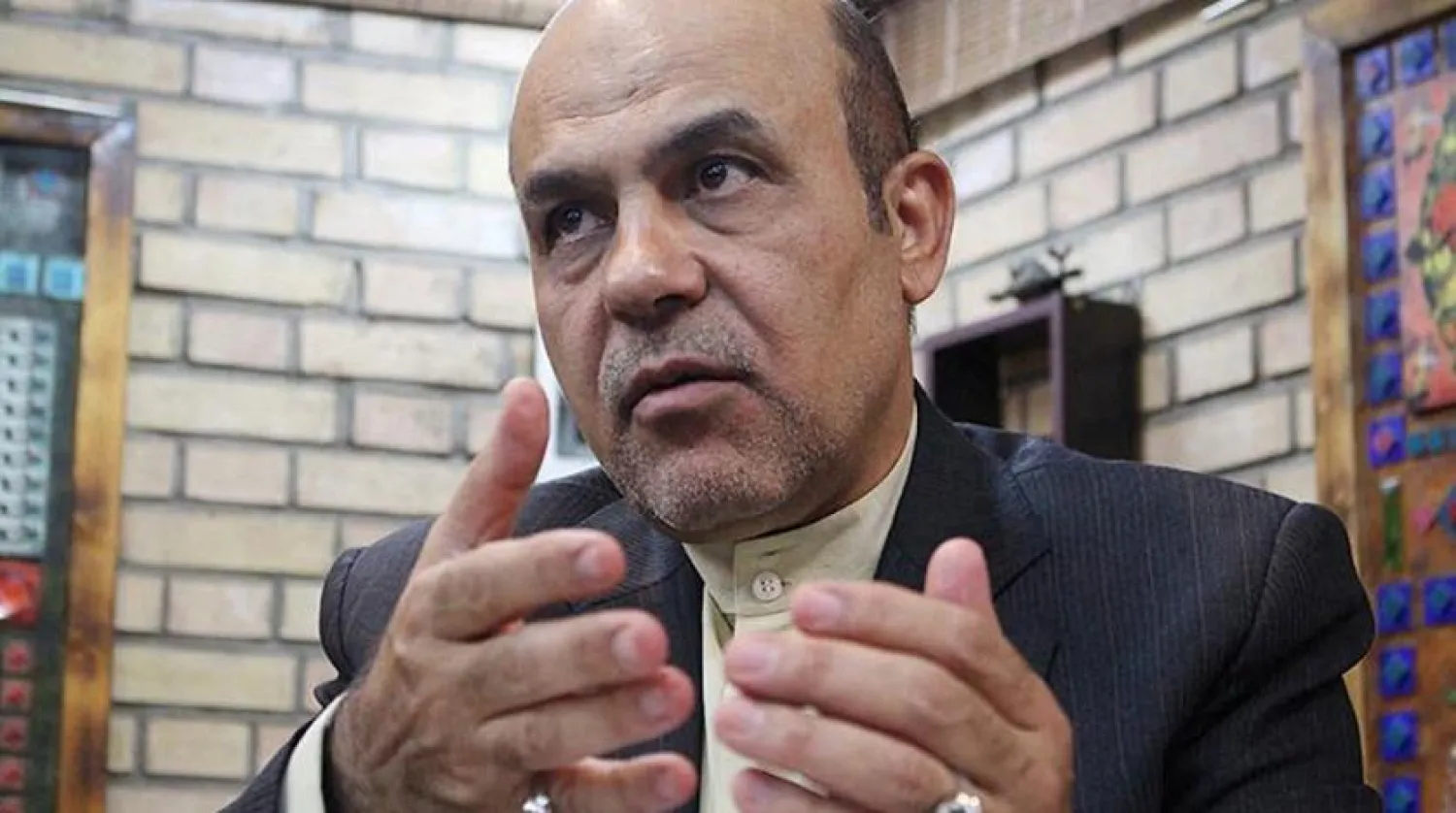
Alireza Akbari, Iran's former deputy defense minister, speaks during an interview with Khabaronline in Tehran, Iran, in this undated picture obtained on January 12, 2023. Khabaronline/WANA (West Asia News Agency)/Handout via Reuters
TT

Iran Executes British-Iranian Accused of Spying, Prompts Western Condemnation 

Alireza Akbari, Iran's former deputy defense minister, speaks during an interview with Khabaronline in Tehran, Iran, in this undated picture obtained on January 12, 2023. Khabaronline/WANA (West Asia News Agency)/Handout via Reuters

Iran has executed a British-Iranian national who once served as its deputy defense minister, its judiciary said, defying calls from London and Washington for his release after he was handed the death sentence on charges of spying for Britain. 

Britain, which had declared the case against Alireza Akbari politically motivated, condemned the execution, with Prime Minister Rishi Sunak calling it "a callous and cowardly act carried out by a barbaric regime". 

Akbari, 61, was arrested in 2019. 

The Iranian judiciary's Mizan news agency reported the execution without saying when it had taken place. Late on Friday, British Foreign Secretary James Cleverly had said Iran must not follow through with the sentence. 

The execution looks set to further worsen Iran's long-strained relations with the West, which have deteriorated since talks to revive its 2015 nuclear deal hit deadlock and as Tehran unleashed a deadly crackdown on protesters last year. 

France and the United States both condemned the execution. 

In an audio recording purportedly from Akbari and broadcast by BBC Persian on Wednesday, he said he had confessed to crimes he had not committed after extensive torture. 

"Alireza Akbari, who was sentenced to death on charges of corruption on earth and extensive action against the country’s internal and external security through espionage for the British government's intelligence service ... was executed," Mizan said. 

The Mizan report accused Akbari of receiving payments of 1,805,000 euros ($1.95 million), 265,000 pounds ($323,989.00), and $50,000 for spying. 

Sunak said on Twitter he was "appalled by the execution", saying Tehran had "no respect for the human rights of their own people".  

Cleverly said in a statement it would "not stand unchallenged", later announcing Britain had imposed sanctions on Iran's prosecutor general. 

US Ambassador to London Jane Hartley called the execution "appalling and sickening". 

The US State Department on Saturday described the execution as being politically motivated and unjust, adding it was working with the UK and other allies to hold Iran accountable for alleged human rights abuses. 

British statements on the case have not addressed the Iranian charge that Akbari spied for Britain. 

Iran's foreign ministry summoned the British ambassador on Saturday over what it called London's "meddling in Iran's national security realm", the state news agency IRNA reported. 

Iranian state media, which have portrayed Akbari as a super spy, broadcast a video on Thursday, which they said showed that he played a role in the 2020 assassination of Iran's top nuclear scientist, Mohsen Fakhrizadeh, killed in an attack outside Tehran which authorities blamed at the time on Israel. 

In the video, Akbari did not confess to involvement in the assassination but said a British agent had asked for information about Fakhrizadeh. 

Iran’s state media often airs purported confessions by suspects in politically charged cases. 

Reuters could not establish the authenticity of the state media video and audio, or when or where they were recorded. 

Akbari was a close ally of Ali Shamkhani, now the secretary of Iran’s Supreme National Security Council, who was defense minister from 1997 to 2005, when Akbari was his deputy as part of the administration of reformist President Mohammad Khatami. 

He fought during the Iran-Iraq war in the 1980s as a member of the Revolutionary Guards. 

It marks a rare case of the Islamic Republic executing a serving or former senior official. One of the last occasions was in 1984, when Iranian navy commander Bahram Afzali was executed after being accused of spying for the Soviet Union. 

‘3,500 hours of torture’ 

French President Emmanuel Macron said the execution was a "despicable and barbaric act". "His name adds to too long a list of victims of repression and the death penalty in Iran," he wrote on Twitter. 

Iran's ties with the West have also been strained by its support for Russia in Ukraine, where Western states say Moscow has used Iranian drones during the invasion. 

Britain, which has a long history of fraught ties with Iran, and other Western states have been fiercely critical of Tehran's crackdown on anti-government protests, sparked by the death in custody of a young Iranian-Kurdish woman in September. 

Iran has issued dozens of death sentences as part of the crackdown, executing at least four people. 

In the audio recording broadcast by BBC Persian, Akbari said he had made false confessions as a result of torture. 

"With more than 3,500 hours of torture, psychedelic drugs, and physiological and psychological pressure methods, they took away my will. They drove me to the brink of madness... and forced me to make false confessions by force of arms and death threats," he said. 

Amnesty International said the execution displayed again Tehran's "abhorrent assault on the right to life". 

In Akbari's case "it is particularly horrific given the violations he revealed he was subjected to in prison," it said in a Tweet. 

The Iranian authorities have not responded to accusations that Akbari was tortured. 

An Iranian state TV report - details of which Reuters could not independently verify - said he was arrested on espionage charges in 2008 before he was freed on bail and left Iran. 

It 2009 he went to Austria under the pretext of medical treatment, then to Spain and eventually to England, the report said. 

In an interview with BBC Persian broadcast on Friday, Akbari's brother Mehdi said he had returned to Iran in 2019 based on an invitation from Shamkhani. 


UK Foreign Minister to Meet Rubio amid Tensions over Joint Air Base

British Foreign Secretary Yvette Cooper, president of the United Nations Security Council for February speaks during a press conference before the Security Council meeting, at UN headquarters in New York City, US, February 19, 2026. REUTERS/Jeenah Moon
TT

UK Foreign Minister to Meet Rubio amid Tensions over Joint Air Base

British Foreign Secretary Yvette Cooper, president of the United Nations Security Council for February speaks during a press conference before the Security Council meeting, at UN headquarters in New York City, US, February 19, 2026. REUTERS/Jeenah Moon

Britain's foreign minister Yvette Cooper ‌will meet with US Secretary of State Marco Rubio on Friday, after President Donald Trump renewed his criticism of London for ceding sovereignty of ​the Chagos Islands, which is home to a US-UK air base.
Last year, British Prime Minister Keir Starmer agreed a deal to transfer sovereignty of the Indian Ocean islands to Mauritius, while keeping control of one - Diego Garcia - through a 99-year lease that preserved US operations at the base, Reuters said.
Washington last year gave its blessing to the agreement, but Trump has since ‌changed his mind ‌several times. In January, Trump described it ​as ‌an ⁠act ​of "great stupidity", ⁠but earlier this month said he understood the deal was the best Starmer could make, before then renewing his criticism this week.
Cooper is meeting Rubio to discuss defense and security issues in Washington as Trump also toughens his rhetoric on Iran, saying Tehran must make a deal over its nuclear program in the ⁠next 10 to 15 days, or "really bad ‌things" will happen.
The Diego Garcia ‌base has recently been used for ​operations in the Middle East against ‌Yemen's Houthis and in humanitarian aid to Gaza.
Although on Tuesday ‌Rubio's State Department said it backed the Chagos accord, the next day Trump said Britain was making a big mistake.
"DO NOT GIVE AWAY DIEGO GARCIA!" Trump wrote in a post on Truth Social, saying the ‌base could be called upon in any future military operation to "eradicate a potential attack" from ⁠Iran.
Under the ⁠conditions for using the joint base, Britain would need to agree in advance to any operations out of Diego Garcia.
On Thursday, Britain's The Times newspaper reported that Trump's latest criticism of the Chagos deal came because Britain was yet to give permission to use the bases for future strikes against Iran, owing to concerns they may breach international law.
Asked about The Times report, Britain's Ministry of Defence said on Thursday it does not comment on operational matters and that Britain supported ​the ongoing political process between ​the US and Iran.


Turkish Police Detain Deutsche Welle Journalist over Social Media Posts

19 February 2026, Canada: Deutsche Welle (DW) logo is seen displayed on a smartphone screen. Photo: Thomas Fuller/SOPA Images via ZUMA Press Wire/dpa
TT

Turkish Police Detain Deutsche Welle Journalist over Social Media Posts

19 February 2026, Canada: Deutsche Welle (DW) logo is seen displayed on a smartphone screen. Photo: Thomas Fuller/SOPA Images via ZUMA Press Wire/dpa

Turkish police have detained investigative journalist Alican Uludag on suspicion of insulting President Recep Tayyip Erdogan and spreading misinformation, sparking outrage among journalism groups.
Uludag, who works for German broadcaster Deutsche Welle’s Turkish service, was taken from his home in Ankara late Thursday as part of an investigation into social media posts. The Istanbul Chief Prosecutor’s Office said he is suspected of “insulting the president” and “disseminating misleading information.”
The journalist, whose reporting focuses mainly on the judiciary and on corruption cases, was later transferred to Istanbul for questioning.
His detention drew sharp condemnation from press freedom advocates, who described it as an attack on media independence and democratic norms, The Associated Press said.
Deutsche Welle’s director‑general, Barbara Massing, demanded his release, calling the arrest “a deliberate act of intimidation.”
On Friday, journalists gathered outside Istanbul’s Çaglayan Courthouse to protest Uludag’s detention and to call for his immediate release.
The advocacy group, Reporters Without Borders considers Türkiye to be one of the most repressive countries for journalists, nothing that most media organizations are under government control and journalists face frequent legal pressure or intimidation.
At least 14 journalists or media sector workers are currently in prison, according to the Turkish Journalists Syndicate.


South Korea’s Ex-President Yoon Apologizes After Life Sentence Over Martial Law 

South Korean President Yoon Suk Yeol  delivers a speech to declare martial law in Seoul, South Korea, December 3, 2024. (The Presidential Office/Handout via Reuters/File Photo)
South Korean President Yoon Suk Yeol delivers a speech to declare martial law in Seoul, South Korea, December 3, 2024. (The Presidential Office/Handout via Reuters/File Photo)
TT

South Korea’s Ex-President Yoon Apologizes After Life Sentence Over Martial Law 

South Korean President Yoon Suk Yeol  delivers a speech to declare martial law in Seoul, South Korea, December 3, 2024. (The Presidential Office/Handout via Reuters/File Photo)
South Korean President Yoon Suk Yeol delivers a speech to declare martial law in Seoul, South Korea, December 3, 2024. (The Presidential Office/Handout via Reuters/File Photo)

Former ‌South Korean President Yoon Suk Yeol apologized on Friday for his short-lived declaration of martial law in December 2024, a day after a Seoul court sentenced him to life in prison for masterminding an insurrection.

In a statement released by his lawyers, Yoon said that while he was sorry for the "frustration and hardship" brought upon the people by his martial law decree, he stood behind the "sincerity and purpose" behind his actions.

The Seoul Central District Court's decision ‌to hand him ‌a life sentence on Thursday was "predetermined," he ‌said, ⁠adding that the verdict ⁠against him was political retaliation.

"Forces that seek to smear a decision made to save the nation as an 'insurrection' and to use it beyond political attacks as an opportunity to purge and eliminate their opponents will only grow more rampant going forward," he said.

Yoon also questioned ⁠whether an appeal would have meaning ‌in what he described as an ‌environment where judicial independence could not be guaranteed, while telling ‌supporters to "unite and rise."

His lawyers separately said the statement ‌did not amount to an intention to forgo an appeal.

Yoon's martial law declaration lasted around six hours before being voted down by parliament, but it sent shockwaves through the country and ‌sparked street protests.

The court found Yoon guilty of subverting constitutional order by deploying troops ⁠to storm ⁠parliament and move to detain opponents, capping a dramatic fall that saw him stripped of office and end up behind bars.

Yoon, a former career prosecutor, denied the charges, arguing he had presidential authority to declare martial law and his action was aimed at sounding the alarm over opposition parties' obstruction of government.

A special prosecutor had sought the death penalty for Yoon, though South Korea has not carried out an execution since 1997.

A prosecutor said on Thursday the team had some "regret" over the sentencing, but declined to say whether they planned to appeal.