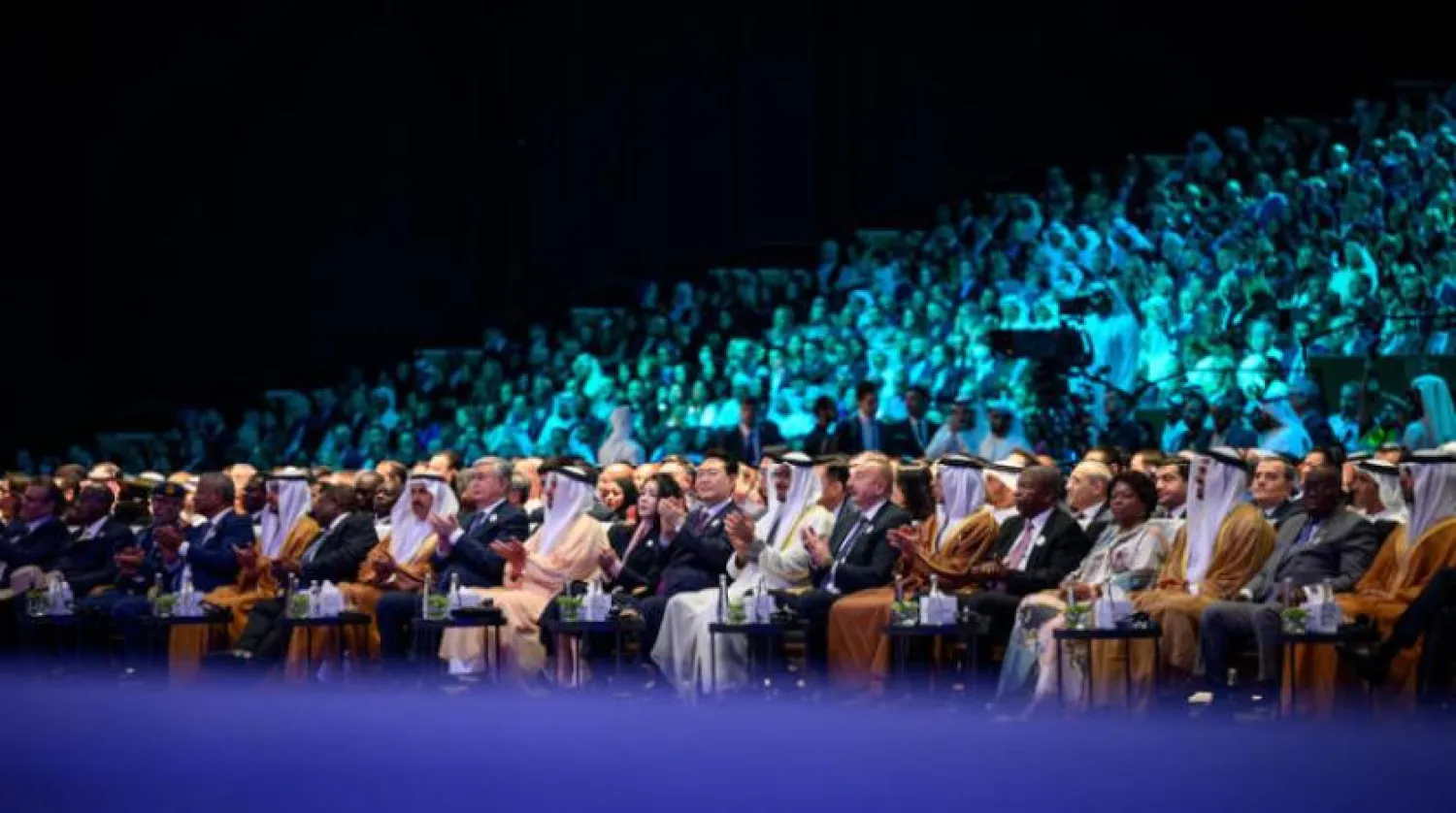
UAE Looking Forward to Effective Partnership on Climate Issues at COP28

UAE President Sheikh Mohamed bin Zayed Al Nahyan and a number of heads of state attend the opening ceremony of Abu Dhabi Sustainability Week. (WAM)
TT

UAE Looking Forward to Effective Partnership on Climate Issues at COP28

UAE President Sheikh Mohamed bin Zayed Al Nahyan and a number of heads of state attend the opening ceremony of Abu Dhabi Sustainability Week. (WAM)

The United Arab Emirates underscored its efforts for the upcoming United Nations Climate Change Conference (COP28) to serve as an opportunity to forge effective partnerships, in order to achieve tangible and real progress on climate issues.

The UAE is holding the Abu Dhabi Sustainability Week (ADSW), bringing together heads of state, policy-makers, industry leaders, investors, entrepreneurs and youth to discuss and engage on bold climate action and innovation to build a more sustainable future for future generations.

The UAE will host COP28 in November.

UAE President Sheikh Mohamed bin Zayed Al Nahyan said his country was exerting intensive efforts to find feasible and pragmatic solutions to climate change issues.

He stressed that ADSW was a global platform that reflects the UAE’s commitment to convening the international community and ensuring collaboration in driving sustainable economic and social development.

Sheikh Mohamed added that the UAE strategic initiative to achieve net zero emissions by 2050 was a natural progression of the comprehensive approach, which aims to build a prosperous and sustainable future through commitment to protecting nature and preserving the environment.

He emphasized that the ADSW this year was an essential step towards the UAE hosting COP28.

He noted that his country’s selection to host the conference reflected the UAE’s continued efforts to promote practical climate action, sustainable economic development, and progress towards desired global goals.

Addressing ADSW, President of Azerbaijan Ilham Aliyev stressed the depth of the bilateral relations between the UAE and his country.

He highlighted Azerbaijan’s ambition to strengthen its reliance on clean energy sources as an essential part of national development efforts, and to contribute to the global drive for a more environmentally friendly economy.


Red Sea Global Announces Reopening of Al Wajh International Airport

The airport’s architectural design draws inspiration from the historic urban character of Al Wajh - SPA
TT

Red Sea Global Announces Reopening of Al Wajh International Airport

The airport’s architectural design draws inspiration from the historic urban character of Al Wajh - SPA

Red Sea Global (RSG) has announced the reopening of Al Wajh International Airport (EJH) in northwestern Saudi Arabia following a comprehensive two-year redevelopment and modernization program, culminating in the official resumption of commercial flight operations on May 24, 2026.

According to a press release issued by the RSG on Monday, commercial services commenced with five scheduled weekly flights operated by Saudia, including three flights from Riyadh and two from Jeddah, meeting current connectivity requirements for the region while paving the way for future international services, SPA reported.

This milestone reinforces Red Sea Global’s role as a key contributor to national infrastructure development beyond its tourism projects, reflecting its growing commitment to strengthening regional connectivity, enhancing public services, and supporting economic growth.

CEO of Red Sea Global Group John Pagano said: "This project goes far beyond upgrading an existing airport. It represents an investment in connecting communities, supporting economic development, and creating new opportunities for local residents. Today, Tabuk Region has an airport capable of receiving international flights, strengthening links with the rest of the Kingdom and the world."

Following the upgrade, Al Wajh International Airport is now capable of accommodating and operating most narrow-body commercial aircraft, including the Airbus A320 and Boeing 737, as well as seaplanes, providing operational flexibility to support future aviation growth.

The release added that passenger terminal capacity has increased from 100,000 to 500,000 passengers annually, with the airport capable of handling 330 passengers per hour during peak periods through four arrival and departure gates.

The airport’s architectural design draws inspiration from the historic urban character of Al Wajh and the coastline of Tabuk Region, reflecting local identity and celebrating the area’s cultural heritage.

The modernization program also included significant upgrades to passenger facilities, featuring expanded parking facilities. In addition, the airport is equipped to support seaplane and helicopter operations, further enhancing the integrated mobility ecosystem serving AMAALA.


Saudi Insurers’ Profits Jump to $251 Million on Investment Boom

Two employees of Bupa Arabia pose beside one of the company’s office buildings. (Bupa Arabia website)
TT

Saudi Insurers’ Profits Jump to $251 Million on Investment Boom

Two employees of Bupa Arabia pose beside one of the company’s office buildings. (Bupa Arabia website)

Saudi Arabia’s insurance sector is enjoying a period of strong recovery and growing operational stability, driven by the economic momentum generated by Vision 2030 projects and a tightening regulatory framework.

Reflecting this maturity, the combined net profits of 26 insurance companies listed on the Saudi Exchange (Tadawul) rose 34 percent in the first quarter of 2026 to SAR 943 million ($251.2 million), up from SAR 701 million ($186.8 million) a year earlier.

The sharp increase was fueled by a dual engine: continued growth in mandatory and health insurance business and a significant rise in investment income from insurers’ portfolios.

Industry profits were supported by expanding insurance activity, rising enrollment in health and motor insurance programs, stronger investment returns among leading companies, operational expansion, improved underwriting quality, and more effective risk management and reinsurance strategies.

Market Leaders Dominate Growth

Quarterly results highlighted an increasing concentration of profits among the sector’s largest players, widening the gap between market leaders and smaller insurers.

Seventeen companies reported profits, including 11 that recorded year-on-year earnings growth, while nine companies posted quarterly losses. Analysts say the divergence could accelerate mergers and acquisitions as smaller firms face mounting solvency requirements.

Bupa Arabia emerged as the sector’s dominant performer, accounting for roughly 41 percent of total industry profits. The company reported net earnings of SAR 387.3 million, supported by lower retained reinsurance contract expenses and stronger investment performance.

The Company for Cooperative Insurance (Tawuniya) ranked second with net profit of SAR 288.1 million, up 10 percent from a year earlier. The increase was driven by higher recoveries from reinsurance companies and growth in its investment portfolio.

Al Rajhi Takaful placed third, posting a 25 percent increase in profit to SAR 113.5 million, benefiting from operational expansion and stable investment returns.

Risk Management and Investment Gains

Commenting on the results, Dr. Suleiman Al-Humaid Al-Khalidi, a financial markets analyst and member of the Saudi Economic Association, said the first-quarter performance reflects the sustained operational momentum the sector has enjoyed in recent years.

“The sector continues to benefit from growth in health and motor insurance, along with improved risk-management and investment practices among major insurers,” Al-Khalidi told Asharq Al-Awsat.

He added that continued expansion in health insurance and strong investment returns should provide further support through 2026, particularly if interest rates remain favorable and Vision 2030-related economic activity continues.

According to Al-Khalidi, most of the sector’s earnings growth came from leading companies such as Bupa Arabia, Tawuniya, and Al Rajhi Takaful, which possess large insurance portfolios and broad customer bases. Their scale gives them a greater ability to generate sustainable growth and capitalize on operational efficiencies.

He also cited improved reinsurance outcomes, stronger investment returns, more disciplined underwriting, enhanced pricing practices, and better claims management as key contributors to profitability.

Consolidation on the Horizon

Mohamed Hamdy Omar, chief executive of G World, said the results indicate that the sector has entered a phase of strong recovery and operational stability.

He noted that market concentration has become increasingly apparent, with the largest companies capturing most of the industry’s earnings. The trend highlights the competitive gap between leading insurers and smaller firms.

Omar attributed the record profits to a combination of strategic and operational factors, particularly improvements in risk management and reinsurance. Disclosures from major insurers showed declining net retained reinsurance costs and higher recoveries from reinsurers, suggesting more effective contract structuring and risk transfer.

Omar expects the sector’s upward trajectory to continue, accompanied by a wave of mergers and acquisitions. With nine companies still reporting losses, pressure is likely to increase on smaller insurers to consolidate into financially stronger entities capable of meeting regulatory and competitive demands.

He also pointed to expanding opportunities in health and motor insurance, as well as newer products such as latent-defect insurance, travel insurance, and property-related coverage. However, he warned that aggressive price competition remains one of the industry’s main challenges, emphasizing the need for risk-based pricing to prevent profit erosion.

New Capital Framework

The sector’s outlook is also being shaped by regulatory reform. In April, the Saudi Insurance Authority announced the mandatory adoption of a Risk-Based Capital (RBC) Framework beginning Jan. 1, 2027. The framework will replace the current solvency regime for insurance and reinsurance companies.

The authority said the move is part of the National Insurance Sector Strategy and aims to strengthen efficiency, sustainability, and the sector’s contribution to Vision 2030 goals.

Under the new framework, insurers will be required to maintain capital levels that correspond to the nature and scale of the risks they assume, enhancing confidence in the sector and improving risk-management standards. The authority also said the framework would provide insurers with greater flexibility in investment allocation and allow them to raise capital through subordinated debt instruments.

The reform will help increase risk-based capital in Saudi Arabia’s insurance sector from SAR 25 billion to SAR 50 billion by 2030, broadly aligning the Kingdom’s solvency standards with international models while adapting them to the Saudi market.



Eni and Petronas Launch Gas Joint Venture in Southeast Asia

FILE PHOTO: The logo of Malaysian energy group National Petroleum Limited, commonly known as PETRONAS, is displayed at their booth during the LNG 2023 energy trade show in Vancouver, British Columbia, Canada, July 12, 2023. REUTERS/Chris Helgren/File Photo
TT

Eni and Petronas Launch Gas Joint Venture in Southeast Asia

FILE PHOTO: The logo of Malaysian energy group National Petroleum Limited, commonly known as PETRONAS, is displayed at their booth during the LNG 2023 energy trade show in Vancouver, British Columbia, Canada, July 12, 2023. REUTERS/Chris Helgren/File Photo

Italy's Eni and Malaysia's Petronas have established Searah, a 50-50 joint venture combining key energy businesses across Indonesia and Malaysia, the two companies said on Monday.

The move is part of Eni's so called 'satellite strategy' ⁠to spin off specific ⁠assets and develop them separately with the help of a partner, Reuters reported.

The new company will start from an initial production base of over 300,000 ⁠barrels of oil equivalent per day (boe/d), aiming to exceed 500,000 boe/d of sustainable production within the next three years, a joint statement said.

It will hold a portfolio of 19 gas-producing and development assets, 14 in Indonesia and five in Malaysia.

"Searah ⁠is ⁠a strong new entity in Southeast Asia, combining our expertise with that of Petronas to support the development of energy resources in Indonesia and Malaysia, with a strong commitment to environmental protection and local growth," Eni CEO Claudio Descalzi said.