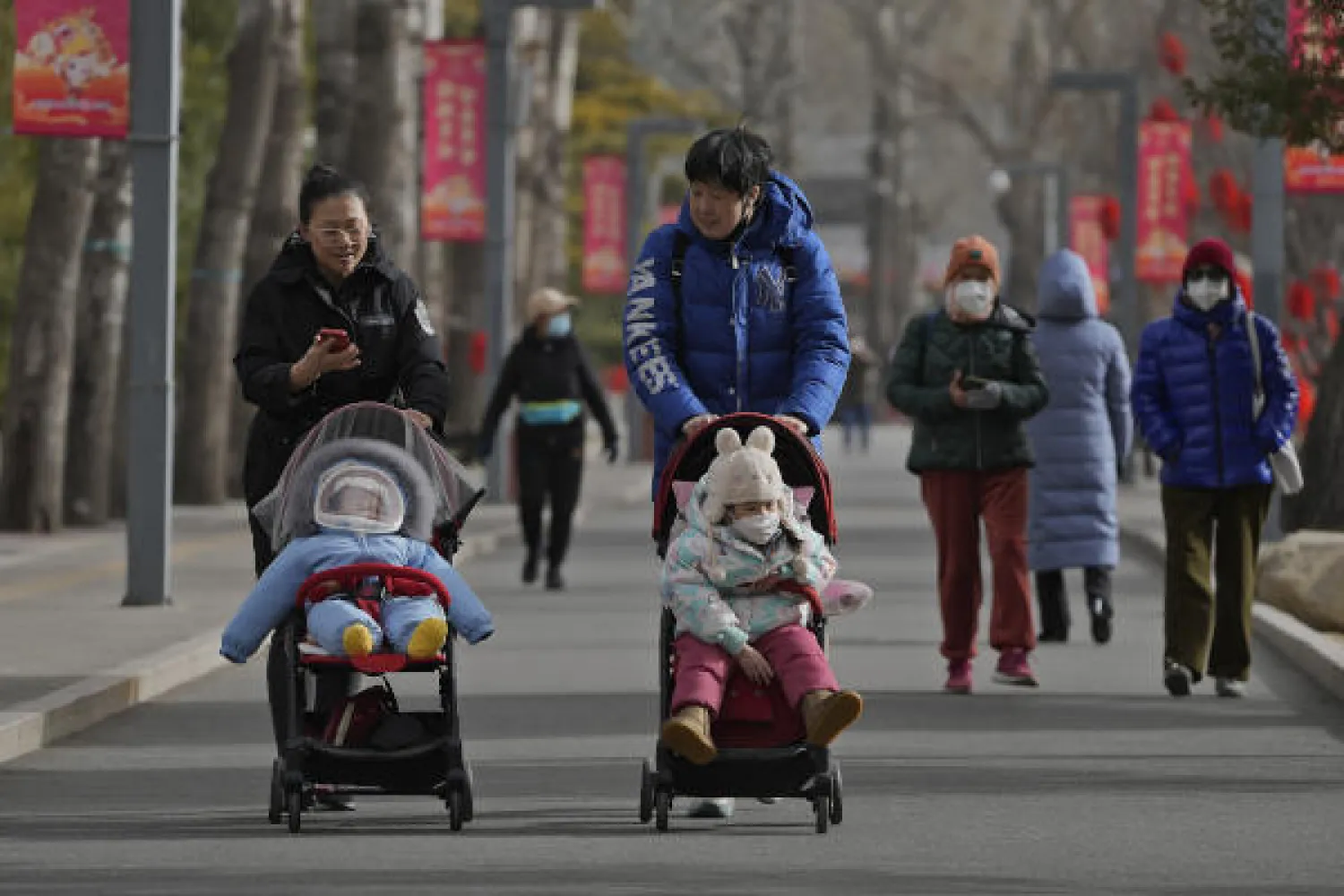
Zero-Covid Left in Dust as Chinese Revelers Fuel Travel Boom

Women walk with their toddlers as residents visit a public park in Beijing, Thursday, Jan. 19, 2023. (AP Photo/Andy Wong)
TT

Zero-Covid Left in Dust as Chinese Revelers Fuel Travel Boom

Women walk with their toddlers as residents visit a public park in Beijing, Thursday, Jan. 19, 2023. (AP Photo/Andy Wong)

Armed with selfie sticks and freshly recovered from Covid, Chinese tourists ambled through bar streets in the country's backpacker haven of Dali, partying the stress of the past three years into oblivion.

As Lunar New Year approaches, China is seeing a domestic travel boom after the government abruptly dismantled its longstanding zero-Covid strategy last month.

"I feel so free," said Hu, from Beijing, while visiting Dali in southwestern Yunnan province, AFP said.

"As I was walking down the bar street, I heard someone singing a song I really like... I feel like everyone is so happy," she told AFP last weekend.

Just two months ago, traveling involved navigating a maze of onerous restrictions and multiple testing requirements.

But now shuttered PCR testing booths dot the sidewalks of major cities like relics of a bygone era, some covered in a crust of disinfectant residue and others broken into by street cats.

While the first weeks of reopening saw millions get Covid, overwhelming hospitals and crematoriums, a recent slowdown in infections now has allowed many to take advantage of the loosening up.

Watering holes and street food stalls in Dali's bustling old town were packed when AFP visited, the sounds of firecrackers punctuating the night as people celebrated the Kitchen God festival.

Zhou Hua, a tourist from Chengdu visiting with his family, said he came to enjoy the mountain air and "clean out his lungs" after recovering from Covid.

"We've been stuck at home for three years already, so we rushed out here," he said.

Similar scenes unfolded in Xishuangbanna prefecture, also in Yunnan province, famed for its temples and tropical landscape.

A line of visitors jostled to enter a crowded night market as a cacophony of pop songs blared from bars across the Lancang River, as the upper half of the Mekong is known in China.

Women in heavy makeup and outfits inspired by traditional dress stood on the banks as hired photographers snapped pictures.

"No vacancy" signs hung on hotels in the main tourist district, and diners waited for up to an hour for tables at popular restaurants.

Adding to the travel rush is the heavy traffic traditionally seen before Lunar New Year.

Transport authorities predict more than two billion trips will be made during a 40-day period between January and February -- nearly double the figure last year and 70 percent of pre-pandemic levels.

Many fear that cases will surge as millions travel home, with China's President Xi Jinping saying Wednesday he was "concerned" about the virus situation in the countryside.

But many locals AFP spoke to in Yunnan played down fears of an outbreak -- and much of the infrastructure that sustained the zero-Covid policy was gone.

Along the province's southern border with Myanmar, multiple Covid checkpoints used for testing drivers and goods stood abandoned when AFP visited last week.

Dusty road barriers were piled up haphazardly under a corrugated metal roof at one unstaffed facility near Yunnan's Cangyuan county.

A sign for free PCR tests had fallen on the ground and workers had left two disinfectant-spraying machines in one cleared-out office room.

"Obey the pandemic's commands," large signs proclaimed at another checkpoint.

"Prevention is our responsibility."


UN to Debate Rules for ‘Killer Robots’

Activists from the Campaign to Stop Killer Robots, a coalition of non-governmental organizations opposing lethal autonomous weapons or so-called "killer robots", stage a protest at Brandenburg Gate in Berlin, Germany, March, 21, 2019. (Reuters)
TT

UN to Debate Rules for ‘Killer Robots’

Activists from the Campaign to Stop Killer Robots, a coalition of non-governmental organizations opposing lethal autonomous weapons or so-called "killer robots", stage a protest at Brandenburg Gate in Berlin, Germany, March, 21, 2019. (Reuters)

Countries will debate whether to start talks on binding rules for autonomous weapons systems -- dubbed "killer robots" by critics -- at the UN from Monday, as concerns grow about their increasing use on the battlefield.

Warfare is undergoing a radical transformation as armies seek to capitalize on the boom in artificial intelligence to boost their fighting abilities by identifying and striking targets more quickly and more accurately.

But a chorus of voices, from campaigners to UN chief Antonio Guterres and Pope Leo XIV, have warned against the dangers of handing the power of life and death to fully autonomous machines.

"The need to regulate autonomous weapons has taken on new urgency" with developments in artificial intelligence, said Laurent Gisel, head of the Weapons and Conduct of Hostilities Unit at the International Committee of the Red Cross (ICRC).

Russia has reportedly used fully autonomous drones to deadly effect in its war on Ukraine, while Ukraine's own defense industry is pushing to develop autonomous "drone swarms".

Human Rights Watch said the meeting in Geneva this week of the UN's Review Conference of the Convention on Conventional Weapons (CCW) would leave civilians "dangerously exposed" if it failed to act decisively.

The meeting will bring together 128 countries to decide whether to open negotiations on legally binding rules.

- 'Carefully cultivated ambiguity' -

But while many states are in favor of tighter rules, as with other advanced military capabilities such as nuclear weapons, countries that have acquired the technology are reluctant to have their hands tied.

At the UN General Assembly last month, 163 states adopted a resolution calling for negotiations on rules governing autonomous weapons.

Five countries voted against -- the United States, Russia, Belarus, Israel and North Korea, which last week boasted of a new AI-enabled torpedo system.

Nine abstained, including Iran and China, which has maintained a "carefully cultivated ambiguity", said Laure de Roucy-Rochegonde of the French Institute of International Relations.

Washington has proposed a five-year process to develop a non-binding instrument, while NGOs and the ICRC are advocating for a one-year timeline.

In 2023, Guterres and ICRC President Mirjana Spoljaric Egger called on states to ban autonomous weapons before 2026.

The ICRC is calling for a ban on two categories of autonomous weapons: so-called "unpredictable autonomous weapons" and those designed or used to directly target humans.

Given the opposition from leading international powers, observers say it looks unlikely agreement will be reached this week to start talks on binding rules.


2 Planes Collide on the Ground in Miami, Only Minor Injuries Reported

FILE - Vehicles drive past the entrance to Miami International Airport in Miami May 12, 2020, (AP Photo/Wilfredo Lee, File)
TT

2 Planes Collide on the Ground in Miami, Only Minor Injuries Reported

FILE - Vehicles drive past the entrance to Miami International Airport in Miami May 12, 2020, (AP Photo/Wilfredo Lee, File)

Federal aviation safety officials on Sunday were investigating a minor collision between two planes at a taxiway intersection at Miami International Airport, where one aircraft's wingtip struck the nose of another, authorities said. Two people reported minor injuries.

The accident happened at about 9 p.m. Saturday and involved a Copa Airlines Boeing 737 passenger aircraft with 172 people aboard and a UPS Boeing 767 cargo plane, according to the National Transportation Safety Board and Copa Airlines. The wing of the Copa flight and the nose of the UPS plane collided, the NTSB said.

Photos taken at the scene show the UPS plane nose with a horizontal gash on one side and a larger hole in the middle, The Associated Press reported.

On audio recorded by ATC.com, a pilot on the UPS plane told air traffic control that he went too far at the intersection and his plane was clipped by the Copa flight. Air traffic control told the UPS pilot that he was supposed to yield to the Copa aircraft.

The NTSB said it was gathering information and may provide an update on Sunday.

The Copa plane had just arrived from Panama City and the UPS plane was headed to Bogota, Colombia, officials said.

In a statement on social media, Copa called the collision minor and said two of its passengers were treated at the scene for minor injuries.

UPS said it was working with authorities to determine what happened.

“We cannot speculate on the details of the incident,” UPS said in a statement.

“The National Transportation Safety Board is responsible for investigating incidents like this and will control the flow of information.”

The mishap came two months after an Amazon cargo plane careened off a runway at Miami International and smashed into a van carrying workers for a company that cleans airplanes, killing five people.


Nearly 1,500 Migrants Arrive in Canary Islands in One Day

Rescued migrants disembark from a Spanish Maritime Rescue Service vessel with assistance from emergency workers and Civil Guard officers at the port of La Restinga in El Pinar on the island of El Hierro, Canary Islands, Spain, 14 November 2026. EPA/GELMERT FINOL
TT

Nearly 1,500 Migrants Arrive in Canary Islands in One Day

Rescued migrants disembark from a Spanish Maritime Rescue Service vessel with assistance from emergency workers and Civil Guard officers at the port of La Restinga in El Pinar on the island of El Hierro, Canary Islands, Spain, 14 November 2026. EPA/GELMERT FINOL

Almost 1,500 migrants arrived in Spain's Canary Islands on Saturday, the highest number in a single day since 2020, the EFE news agency reported on Sunday, citing the maritime rescue service.

A total of 1,488 people in 14 boats were rescued by the Spanish coastguard, EFE reported, continuing a surge of arrivals from West African countries to the Spanish archipelago since October.

The previous one-day record was the 1,461 people rescued in waters off the Canary Islands on November 7, 2020, maritime rescue services said ⁠on Sunday, according to Reuters.

While migrant ⁠arrivals have declined so far this year compared with the same period last year, the sharp increase last month placed additional pressure on reception and emergency services on some of the Canary Islands, particularly the smaller and less densely populated ones.

One boat on ⁠Saturday was carrying 240 people, including 12 women and 36 children, authorities said. The rescued migrants were taken to El Hierro, one of the smallest Canary Islands. Most of the people were from Senegal, Gambia and Guinea Conakry.

Twelve boats arrived in El Hierro, plus one in Gran Canaria and another in Tenerife.

Spain's Territorial Policy Minister Angel Victor Torres will visit El Hierro on Sunday to discuss the surge in migrant arrivals.

The Atlantic ⁠route ⁠from West Africa to the Canary Islands is one of the world's deadliest migration crossings. Thousands of migrants attempt the journey each year in overcrowded boats, seeking to reach Spanish territory despite rough seas, strong currents and long distances.

Arrivals tend to pick up in the autumn months, when sea conditions along the route are generally calmer and more favorable for crossings.

Migrant arrivals to the Canary Islands between January and October 31 were down 5.5% from the same period last year, government data show.